In short ⚡
GPS shipment tracking is the use of GPS‑enabled devices attached to cargo to provide near real‑time location and status updates across transport, warehousing, and last‑mile delivery.
It replaces manual status checks with continuous pings, alerts, and audit trails that reduce delays, disputes, dwell time, and logistics costs while improving ETAs and customer communication.
We hope you’ll find this article genuinely useful, but remember, if you ever feel lost at any step, whether it’s finding a supplier, validating quality, managing international shipping or customs, DocShipper can handle it all for you!
What GPS shipment tracking is and how it transforms your logistics
GPS shipment tracking is the practice of attaching a GPS-enabled device to your cargo, then watching its location and status update in near real time across your logistics network.
You stop guessing where freight is, you start managing it, across multimodal transport, warehousing, and last-mile delivery.
Here’s the thing, most delays don’t start with “bad transport”, they start with low visibility.
And when you’re juggling freight forwarding, customs clearance, consolidation, and carrier handoffs, you’ll notice fast how expensive “we think it’s on time” can get.
DocShipper Info
Deploy GPS shipment tracking with DocShipper to gain real-time control over multimodal flows and stop managing by guesswork. Let’s map your critical routes today.
From manual cargo tracking to real-time visibility
Last peak season, we saw a shipper rely on a carrier’s milestone updates plus a scanned bill of lading, and they were confident the container was already at the port.
It wasn’t, it was sitting 40 km inland after a missed dispatching slot, and the demurrage clock was quietly warming up.
GPS shipment tracking replaces blind spots with a live feed that supports supply chain management, from load planning to inventory management.
You can compare promised lead time vs actual movements, then correct routing, carrier contract decisions, and warehouse labor planning before the issue hits customers.
This quick comparison helps you see what changes with GPS-based shipment tracking.
| Old approach (manual tracking) | With GPS shipment tracking |
| Status based on carrier emails and periodic scans | Continuous location pings across cargo transportation legs |
| Exceptions discovered late | Exceptions flagged early with geofences and alerts |
| Hard to prove responsibility during disputes | Time-stamped evidence for claims and freight insurance files |
| Reactive customer comms | Proactive ETA updates for distribution network teams |
Key components of a modern GPS shipment tracking system
Direct tip: before you buy devices, map your lanes, handoffs, and risk points, then match tech to operations, not the other way around.
A solid GPS shipment tracking setup usually combines hardware, connectivity, and software that plugs into your TMS platform or WMS software.
This is the core stack you’ll want to recognize when vendors pitch you “end-to-end visibility”.
- Tracker hardware: battery GPS devices, wired units for vehicles, or reusable trackers for containerization and palletization.
- Connectivity: cellular (2G/4G/LTE-M/NB-IoT), Wi‑Fi at hubs, and sometimes satellite for remote corridors.
- Data platform: dashboards, alert rules, and location history that your ops team can actually use.
- Integration layer: APIs or EDI to connect shipment tracking with your TMS, WMS, and order system.
- Security and access control: user roles so brokers, 3PL provider teams, and consignees only see what they should.
For trade lanes involving import export and cross-border trade, you’ll also want event logic that matches customs reality, like “arrived at border” vs “cleared”, since those are very different moments operationally.
How GPS shipment tracking works step by step
GPS shipment tracking works because the tracker calculates a position, sends it through a network, then your platform turns that stream into ETAs, alerts, and decisions for shipment tracking and routing.
You don’t need to be an engineer, but you do need to understand the flow, otherwise you’ll get fooled by “real-time” claims that are actually 4-hour pings.
From experience, the best results show up when you align ping rate, battery life, and handoff points across freight forwarding and warehousing.
DocShipper Advice
Our experts help you calibrate ping rates, battery life, and handoff points for measurable impact across forwarding and warehousing. Start with a focused pilot lane.
 Satellite positioning and data transmission basics
Question: why does your tracker sometimes “jump” on the map or go quiet near ports and dense cities?
Because GPS shipment tracking depends on satellite signals that can be blocked by metal, stacked containers, or urban canyons, then it switches to assisted methods like cell triangulation.
Once the device knows its position, it transmits the data via cellular or satellite, then your platform stores time-stamped points for audit and exception management.
This simple workflow is the one your ops team should keep in mind when troubleshooting.
Step-by-step workflow:
- 1) Positioning: device listens to GNSS satellites and computes coordinates.
- 2) Validation: device filters noisy signals and applies motion rules.
- 3) Transmission: device sends a ping over cellular or satellite.
- 4) Platform processing: system converts pings into events, ETAs, and alerts.
- 5) Action: dispatching, customer service, and warehouse teams adjust plans.
Standards bodies like ISO influence how location, security, and device management best practices get formalized, which matters when you scale beyond a pilot.
Pairing trackers with containers, pallets, and parcels
Bold statement: you’ll waste money if you track the wrong unit of handling.
In GPS shipment tracking, the “where” is easy, the “what” is the hard part, container, pallet, parcel, or truck.
For containerization, a reusable tracker can follow the same container through drayage, port dwell, and ocean legs, but you must think about signal loss in stacks and power management.
For palletization and consolidation, you’ll often track at pallet level until deconsolidation, then switch to parcel events for last-mile delivery and reverse logistics.
This checklist keeps your attachment method operational, not theoretical.
- Attachment plan: magnet, seal, bolt, or inside packaging, depending on cargo handling and theft risk.
- Scanning discipline: tie tracker ID to shipment ID at pickup and at deconsolidation.
- Ping rate: faster for high-value freight, slower for long lead time ocean moves.
- Handoff points: define who is responsible at each carrier change and warehouse gate.
- Recovery process: plan returns for reusable devices, especially in cross-border trade.
Cloud platforms, APIs, and dashboards for shipment data
We once watched a team pull GPS locations into a spreadsheet daily, then wonder why they never reduced delays.
The data was there, but it wasn’t connected to their transportation management system decisions or warehouse labor planning.
GPS shipment tracking becomes useful when your platform turns dots on a map into operational triggers, like “late departure”, “unexpected stop”, or “arrived at DC”.
APIs let you push those events into your TMS platform, WMS software, and customer notification tools, so your distribution network runs on one source of truth.
This short table helps you choose what to prioritize during integration.
| Platform feature | What it improves in logistics |
| Geofences at ports, hubs, and warehouses | Faster exception handling, lower dwell times |
| Role-based access for partners | Cleaner collaboration with 3PL provider and freight handler teams |
| API event push to TMS/WMS | Better routing, load planning, and dock scheduling |
| Audit trail and history | Stronger dispute resolution and freight insurance support |
Why you should track your shipments with GPS
GPS shipment tracking isn’t just “nice visibility”, it’s leverage.
You gain control over lead time, customer promises, and the messy gray zones between pickup, customs brokerage, and final delivery.
You’ve probably dealt with suppliers or forwarders who say “it left yesterday”, but nobody can prove it when the consignee pushes back.
That’s exactly where GPS-based shipment tracking earns its keep.
DocShipper Info
Turn GPS tracking into proactive control across lead times, customs steps, and final delivery with DocShipper’s integrated logistics support. Gain proof, not promises.
Better customer experience and proactive communication
One retailer we supported had a recurring problem, customer service learned about delays only after the customer complained.
After rolling out GPS shipment tracking on priority lanes, they started sending ETA changes early, and the tone of conversations changed overnight.
You can set alerts for late departure, unexpected detours, or stalled vehicles, then message consignees with a credible new ETA instead of vague reassurance.
This small move also helps your freight forwarding partners coordinate appointments and avoid failed deliveries in last-mile delivery.
This bullet list shows the customer-facing messages that actually work.
- Revised ETA with confidence window, not a single time.
- Reason code like “port congestion” or “customs inspection”, kept short and factual.
- Next action such as rebooking a delivery slot or preparing unloading resources.
- Proof of movement when disputes start, time-stamped tracking events.
Even trade reports from UNCTAD regularly highlight how disruptions ripple through supply chains, and GPS visibility helps you dampen that ripple for your customers.
Fewer lost shipments, disputes, and delivery errors
Direct tip: treat GPS data like evidence, store it with shipment docs the same way you store the bill of lading and POD.
GPS shipment tracking reduces “he said, she said” moments with carriers, terminals, and consignees.
You can also catch misroutes early, especially after consolidation when pallets split across multiple delivery tours.
This checklist is what we recommend you validate before calling a shipment “lost”.
- Last valid ping time and coordinates, plus speed and motion state.
- Geofence breaches, including unauthorized stops or route deviation.
- Handoff scan between freight handler teams and drivers.
- Carrier contract responsibility at that leg, matched to Incoterms and custody.
- Claim readiness, tracker history exported for freight insurance.
Planning, forecasting, and fulfillment optimization
Question: what if your “standard transit time” is outdated, but you’re still planning labor and inventory around it?
GPS shipment tracking gives you actual lane performance, not assumptions, which makes just-in-time delivery less of a gamble.
You can feed real transit distributions into your replenishment logic, improve dock scheduling, and reduce buffer stock across your warehousing footprint.
This workflow shows how ops teams turn tracking data into better planning.
Step-by-step workflow:
- 1) Collect lane history by origin, destination, carrier, and mode.
- 2) Segment by risk, peak season, and border complexity.
- 3) Update lead time assumptions in TMS and inventory rules.
- 4) Re-plan dispatching, routing, and warehouse labor based on new ETAs.
- 5) Review exceptions weekly and renegotiate freight rate or service levels.
Legal and privacy considerations for GPS shipment tracking
GPS shipment tracking feels straightforward until you track something that’s attached to a person’s vehicle or you share location data with the wrong party.
This is the moment most importers get stuck, you want visibility, but you don’t want a privacy complaint or a contract dispute.
The good news is you can do this legally if you design your program with transparency, purpose limitation, and access controls.
DocShipper Alert
Design a compliant GPS program with clear purpose, access control, and data retention rules before scaling across borders. We help you secure visibility the right way.
When shipment tracking is allowed and when it is not
We’ve seen a case where a shipper placed a tracker inside a driver’s cab “just to be safe”, and it triggered an HR escalation within days.
GPS shipment tracking is generally easier to justify when you track cargo, containers, or assets, not people.
You’ll want to define lawful basis and scope, what you track, why you track it, who can see it, and how long you retain it.
This table clarifies common scenarios you’ll encounter in cargo transportation.
| Scenario | Practical risk level | How to handle it |
| Tracker on a container or pallet | Lower | Document purpose, limit sharing, secure device recovery |
| Tracker on a truck you own or lease | Medium | Update policies, notify drivers, restrict data access |
| Tracker that effectively monitors an employee’s movements | Higher | Get legal review, set strict retention, avoid off-hours monitoring |
| Sharing live GPS with consignees or marketplace buyers | Medium | Share ETA and milestones, not precise real-time dots unless justified |
Keep an eye on guidance aligned with OECD privacy principles, since they influence many national approaches to data governance.
Compliance, transparency, and employee notification
Bold statement: secrecy is what creates legal risk, not the tracker itself.
GPS shipment tracking stays clean when you communicate clearly with your carriers, 3PL provider, and any employees who may be impacted by asset tracking.
You should also align data practices with your trade compliance process, especially when location data supports customs brokerage workflows and dispute files.
This checklist is a practical baseline you can implement fast.
- Written policy explaining purpose, scope, and retention period.
- Employee notification where tracking could indirectly monitor people.
- Partner clauses in carrier contract and SOPs covering device handling and data sharing.
- Access controls with least-privilege roles for ops, customer service, and brokers.
- Data retention tied to claim windows, customs disputes, and audit needs, not “forever”.
Logistics and supply chain problems GPS tracking helps you solve
GPS shipment tracking solves real problems you feel every day, missed dock appointments, “lost” pallets after deconsolidation, and long dwell times that wreck lead time.
And yes, it also helps when customs clearance drags on, because you can separate “stuck at border” from “stuck 200 km away”.
You’ll get the best outcomes when you pick a few pain points and build alerting around them, instead of tracking everything and acting on nothing.
DocShipper Advice
We help you define high-impact alerts for dwell, border delays, and lost pallets so your team acts on insights, not noise. Focus on measurable pain points.
Reducing dwell times, bottlenecks, and late deliveries
We once saw a DC blame a carrier for chronic lateness, but GPS showed trucks arrived on time and waited 2 hours outside the gate.
GPS shipment tracking makes dwell visible, and once dwell is visible, you can fix appointments, yard flow, and unloading capacity.
This bullet list shows where dwell usually hides across a distribution network.
- Port and terminal queues during pickup and drop-off.
- Warehouse gates with poor dock scheduling or check-in rules.
- Cross-dock hubs during consolidation and sort.
- Border crossings waiting for customs clearance or document correction.
Securing high-value and at-risk shipments
Direct tip: set “unauthorized stop” alerts based on time and location, not just distance from route.
GPS shipment tracking reduces theft risk when you combine route deviation alerts with strict custody rules.
High-value electronics, pharmaceuticals, and branded goods benefit most, especially when the freight changes hands between carriers or a freight handler at a hub.
This checklist helps you harden security without overcomplicating the process.
- Geofences for authorized yards, rest areas, and warehouses.
- Alert escalation from dispatcher to security contact within defined minutes.
- Proof of custody at each handoff, tied to tracking ID and shipment ID.
- Freight insurance alignment so claims use the same event history and timelines.
- Selective visibility so only the right roles see live location.
Meeting the challenges of perishable and sensitive goods
Question: what’s the point of a perfect ETA if your sensitive cargo arrives spoiled?
GPS shipment tracking supports perishable operations by helping you prioritize interventions, reroute faster, and reduce time at risk.
Even without temperature sensors, location and dwell alerts let you protect cold chain moves by preventing long waits at docks or borders.
This workflow shows how to use GPS events to protect sensitive shipments.
Step-by-step workflow:
- 1) Define risk windows where dwell triggers spoilage risk.
- 2) Set alerts for long stops and late departures.
- 3) Pre-book contingencies like alternate cold storage near key nodes.
- 4) Escalate quickly to carrier dispatching when risk thresholds hit.
- 5) Document events for claims, vendor reviews, and SOP updates.
Core business benefits of GPS shipment tracking
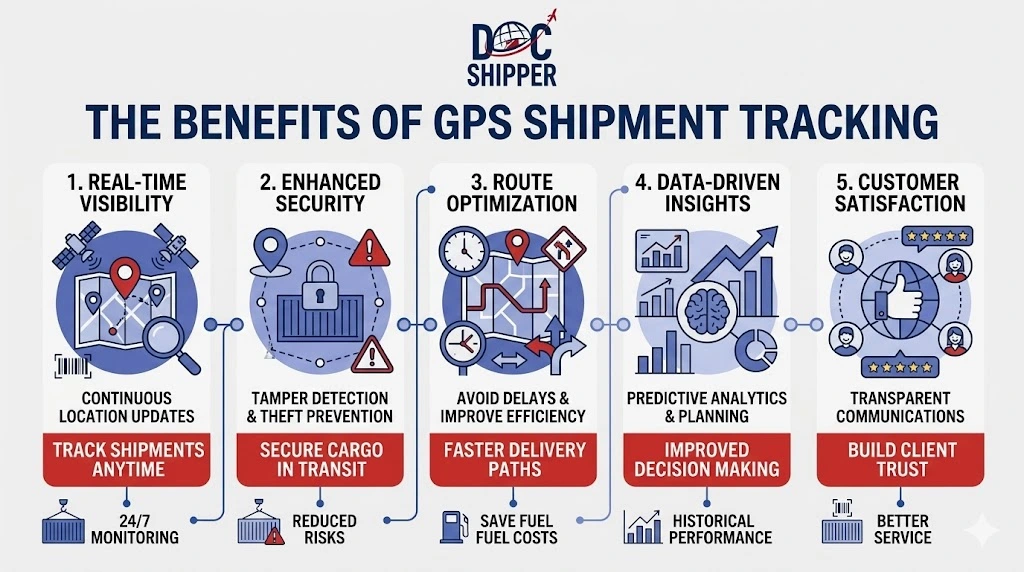
GPS shipment tracking pays off when you connect it to cost drivers, labor, detention, re-delivery, inventory buffers, and avoidable premium freight.
You don’t need a massive transformation program, you need a few measurable wins and the discipline to act on alerts.
Once the basics are in place, GPS data becomes a lever for supply chain management and carrier performance.
DocShipper Info
Reduce detention, demurrage, and premium freight by turning tracking events into carrier scorecards and operational fixes. Let’s quantify your savings potential.
Cutting operating costs across your fleet and network
We’ve seen teams accept “standard accessorials” for months, then realize GPS history could have challenged them with facts.
GPS shipment tracking helps you reduce detention, demurrage, re-delivery attempts, and unnecessary expediting across your cargo transportation plan.
This table links common costs to the GPS signal that can help you fight them.
| Cost driver | GPS signal you use | Typical operational fix |
| Detention at warehouse | Arrival and departure timestamps | Dock scheduling, labor planning, tighter appointment windows |
| Demurrage at port | Pickup delays and dwell near terminal | Earlier drayage dispatching, priority pickups |
| Premium freight | Late departure trends | Carrier scorecards, renegotiated freight rate |
| Failed delivery | Geofence missed at consignee | Better customer coordination and slot booking |
Real-time data for safety, compliance, and accountability
Bold statement: if you can’t prove what happened, you can’t manage performance.
GPS shipment tracking creates an audit trail that supports safety reviews, trade compliance investigations, and internal accountability.
When disputes pop up around damaged cargo handling or missed custody steps, time-stamped tracking events keep conversations factual.
This checklist is a strong baseline for governance without slowing operations.
- Event definitions agreed across teams, arrived, departed, delayed, exception cleared.
- Data ownership across shipper, carrier, and 3PL provider roles.
- Retention rules aligned with claims, audits, and contract windows.
- Exception playbooks so teams respond consistently, not emotionally.
- Access logs to monitor who viewed or exported sensitive shipment data.
Guidance from the World Customs Organization (WCO) often pushes toward stronger traceability in cross-border trade, and location data can support that direction when managed properly.
Fuel, route, and asset utilization optimization
We once saw a carrier run “efficient routes” on paper, but GPS proved repeated backtracking caused by poor sequencing and late pickups.
GPS shipment tracking helps you optimize routing, reduce fuel burn, and improve asset utilization across trailers, containers, and reusable pallets.
You can also identify underused lanes and rebalance capacity before you sign the next carrier contract.
This workflow shows a simple way to turn movement data into utilization gains.
Step-by-step workflow:
- 1) Baseline route distance, stops, and idle time by lane.
- 2) Flag recurring detours, long idle, and late pickups.
- 3) Adjust routing and dispatching rules in your TMS platform.
- 4) Reallocate assets to reduce empty miles and improve turn time.
- 5) Measure fuel, on-time performance, and utilization weekly.
Looking for a Reliable Shipping & Sourcing Partner?


DocShipper Platform
One platform. Your entire supply chain
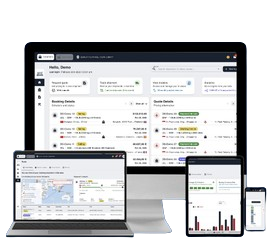
Sourcing, freight, customs & documents — all centralised, all visible, 24/7.
Advanced shipment tracking: sensors, conditions, and special use cases
GPS shipment tracking has evolved far beyond simple location pings. Today, you can combine positioning with environmental sensors, impact detection, and even satellite connectivity to protect sensitive cargo and manage complex supply chains with precision.
If you’ve ever received goods that arrived “on time” but unusable, you already know that location alone isn’t enough. Let’s break down how advanced tracking systems give you full operational control.
Environmental and condition monitoring for perishable and fragile cargo
We once supported a client shipping specialty chocolate from Europe to Southeast Asia, using GPS shipment tracking with temperature sensors. The truck arrived on time, but the internal temperature spiked above 28°C for three hours during a border delay.
Without condition monitoring, you would have blamed the warehouse. With sensor data, you could pinpoint the exact moment and location of the issue.
For perishable and fragile cargo, you can integrate:
- Temperature sensors for food, pharmaceuticals, cosmetics
- Humidity monitoring for paper, textiles, and electronics
- Light exposure alerts for sensitive chemical products
- Door-open detection to prevent theft or contamination
The World Health Organization sets strict temperature control standards for pharmaceutical transport, and you’ll need auditable records to comply. A smart gps shipment tracking system generates exportable logs you can use during audits.
Before you deploy condition monitoring, run through this quick operational checklist:
- Define acceptable temperature and humidity ranges per SKU
- Set real-time alerts for threshold breaches
- Assign clear escalation contacts for each alert
- Store historical data for at least one audit cycle
- Test sensors under real transport conditions
When you treat sensors as part of your quality management process, not just gadgets, you reduce claims and strengthen supplier accountability.
Impact, tilt, and handling alerts for high-value equipment
Here’s a direct tip from the field. If you ship industrial machinery, medical devices, or high-end electronics, you should never rely on packaging alone.
Modern GPS shipment tracking devices can detect:
- Shock events above predefined G-force levels
- Tilt angles beyond safe handling thresholds
- Excessive vibration patterns
Imagine receiving a CNC machine worth 250,000 USD. Externally, the crate looks intact. Inside, a 45-degree tilt during unloading misaligned critical components. With tilt alerts, you’ll know exactly where and when that happened.
Here’s a simplified comparison to help you decide:
| Feature | Standard GPS Tracking | Advanced Sensor-Enabled Tracking |
| Location visibility | Yes | Yes |
| Shock detection | No | Yes |
| Tilt monitoring | No | Yes |
| Claims support evidence | Limited | Strong, timestamped proof |
When disputes arise, timestamped shock data becomes powerful evidence in insurance negotiations. You shift from assumptions to documented facts.
Long-distance, cross-border, and satellite-enabled shipment tracking
What happens when your cargo moves through remote areas with no cellular coverage?
This is where gps shipment tracking with satellite connectivity becomes essential. Instead of relying solely on GSM networks, devices switch to satellite transmission when signals drop.
We’ve seen this in Central Asia rail corridors where trucks cross areas with limited infrastructure. Without satellite fallback, you lose visibility for hours.
Satellite-enabled tracking is particularly useful for:
- Cross-border road transport in low-coverage regions
- Maritime containers between port calls
- Mining and energy projects in remote zones
- Humanitarian shipments in unstable environments
The International Maritime Organization emphasizes cargo transparency and safety in global transport. Satellite-based tracking supports that objective, especially for high-risk routes.
When you manage international freight, hybrid devices that combine GPS, GSM, and satellite give you continuity of data. And continuity is what protects your operations.
DocShipper Info
Add sensors and satellite connectivity to protect high-value, perishable, and remote shipments with full traceability. Build continuity into every corridor.
Practical guide: how to implement GPS shipment tracking in your operations
Implementing GPS shipment tracking is not just about buying devices. You’re redesigning part of your operational workflow, and if you rush it, you’ll end up with data you don’t use.
Let us walk you through how to do it properly, step by step.
DocShipper Advice
Integrate GPS data into your TMS, ERP, and daily workflows with a structured pilot and KPI review. DocShipper guides you from device selection to full rollout.
Choosing the right trackers and connectivity for your routes
Start with this question. Where exactly do your shipments travel?
If your routes are urban and stable, GSM-based gps shipment tracking devices may be enough. For cross-border or remote lanes, you’ll need hybrid or satellite options.
To structure your selection, follow this simple workflow:
Step 1: Map your transport corridors and risk zones. Step 2: Identify cargo types and sensitivity levels. Step 3: Define required battery life and reporting frequency. Step 4: Match connectivity type to geographic coverage. Step 5: Test devices on a pilot route before scaling.
From experience, skipping the pilot phase is where most importers get stuck. You’ll discover battery drain issues or signal gaps only after scaling.
Installing devices, configuring alerts, and integrating data
Let’s be clear. Even the best GPS shipment tracking hardware fails if you don’t integrate it into your daily operations.
Installation depends on asset type. You might attach reusable trackers inside containers, embed them in pallets, or seal them within packaging.
Here’s what you should configure from day one:
- Geofences for warehouses, ports, and client facilities
- Delay alerts when transit exceeds planned duration
- Condition alerts for temperature or shock breaches
- Automated reporting to operations teams
You’ll also want API integration with your TMS or ERP. According to the World Economic Forum, digital integration is a key driver of resilient supply chains. When tracking data flows automatically into your systems, you eliminate manual checks and reduce errors.
At DocShipper, we’ve seen clients reduce internal follow-up emails by half simply by centralizing shipment visibility on one dashboard.
KPIs to monitor and continuously improve your tracking program
Most companies install gps shipment tracking and stop there. That’s a mistake.
If you want real ROI, you need measurable indicators. Before expanding your program, use this KPI checklist:
- On-time delivery rate before and after implementation
- Number of lost or disputed shipments
- Average dwell time at key nodes
- Temperature breach incidents per route
- Claims value reduction over time
When you review these metrics quarterly, you’ll see patterns. Certain routes consistently trigger alerts, specific partners cause delays, or seasonal peaks increase risk.
This is where tracking becomes strategic, not just operational.
Unique applications of GPS tracking beyond standard freight
You might think GPS shipment tracking is only for containers and trucks. In reality, its applications go much further, especially when you manage complex assets.
Let’s explore areas where tracking creates unexpected value.
DocShipper Info
Extend GPS visibility to airport equipment, construction tools, and last-mile fleets to unlock hidden efficiency gains. Explore tailored use cases with our team.
Airport ground operations and air cargo assets
We once worked on a project where airport ground equipment kept “disappearing” between terminals. Nothing was stolen, but assets were misplaced daily.
By applying gps shipment tracking to dollies, ULDs, and service vehicles, the operator reduced search times dramatically.
In airport environments, tracking helps you:
- Locate ground support equipment instantly
- Optimize turnaround time for aircraft
- Reduce asset replacement costs
- Improve compliance with safety protocols
The International Air Transport Association promotes digital asset management to improve efficiency. Real-time tracking supports those objectives directly.
Construction tools, trailers, and movable equipment
Here’s something many logistics managers overlook. Idle equipment quietly drains your margins.
With GPS shipment tracking, you can monitor trailers, generators, compressors, and expensive tools across multiple sites.
Ask yourself. How many times have you rented equipment you already owned but couldn’t locate?
Tracking enables you to:
- Prevent unauthorized use
- Reduce theft risk
- Improve asset rotation
- Plan maintenance based on usage data
When visibility increases, unnecessary rentals and emergency purchases decrease.
E‑commerce, last-mile delivery, and returns
Last-mile logistics is where customer expectations are highest and tolerance is lowest.
Integrating gps shipment tracking into last-mile fleets allows you to provide live delivery windows, dynamic rerouting, and accurate ETA updates.
For e-commerce operations, you can leverage:
- Real-time driver tracking for customer notifications
- Proof-of-delivery with timestamp and location
- Return flow visibility
- Route optimization based on traffic data
When customers see exactly where their parcel is, support tickets drop. You gain trust without increasing headcount.
Conclusion
GPS shipment tracking is no longer optional if you want operational control, risk reduction, and data-driven decisions. From environmental monitoring to satellite-enabled visibility, you can turn raw location data into a strategic advantage.
Before you move forward, keep these key takeaways in mind:
- Location alone is not enough, combine GPS with sensors for full cargo protection
- Choose connectivity based on your real transport corridors
- Integrate tracking data into your TMS or ERP from the start
- Monitor KPIs to measure financial and operational impact
- Explore non-traditional applications to maximize ROI
If you approach implementation methodically, you won’t just track shipments. You’ll build a smarter, safer, and more resilient logistics operation.
FAQ | GPS shipment tracking: real-time visibility for smarter, safer deliveries
Think in terms of risk and handoffs, not “track everything just in case”:
- Track at **container level** when:
- Value per container is high but SKUs are homogeneous
- The main risks are port dwell, border delays, and theft of full loads
- You rarely split cargo mid-route
- Track at **pallet level** when:
- You consolidate multiple customers/SKUs on one vehicle
- Pallets are regularly **split across different routes or consignees**
- You’ve had disputes about “missing pallets” after cross-docking
- Track at **parcel level** when:
- Last‑mile delivery and customer experience are your main pain points
- You sell D2C or high-value items with frequent returns
- You need proof for *which* specific parcel was late or damaged
- Practical rule:
- Start with **containers or trailers**, then add **pallet-level** tracking only on:
- High-value SKUs
- Known high-risk lanes
- Frequent-claim customers
The biggest issues are operational, not technical:
- **Tracking the wrong things**
- Tracking every load instead of focusing on high-value or high-risk lanes
- Tracking vehicles but not linking data to shipment IDs
- **No clear ownership**
- Nobody is officially responsible for monitoring alerts
- Confusion about who calls the carrier or customer when an exception hits
- **Over-alerting**
- Too many notifications (every ping, tiny delay) → teams start ignoring them
- **No integration**
- Data stays in a vendor portal and is never pushed into your TMS/WMS/ERP
- **No SOPs**
- Alerts come in, but there is no “playbook” defining:
- Who responds
- In what delay
- With what options (reroute, reschedule, escalate)
- Fix it by:
- Defining 2–3 priority use cases (e.g., theft, dwell, missed delivery slots)
- Assigning a clear owner per use case
- Writing 1‑page response playbooks before going live
Test against your real constraints, not their marketing:
- **Ask these specific questions:**
- What is the **default ping interval** (e.g., every 1, 5, 15, 60 minutes)?
- Can I change ping rate by **route, asset, or risk level**?
- What happens to pings in **low coverage** zones (buffer, store-and-forward, satellite fallback)?
- What is the **typical delay** between device ping and dashboard/API update?
- **Run a short pilot:**
- Choose 1–2 lanes with known issues (late deliveries, theft risk, long dwell)
- Log the **planned vs. visible events**:
- Departure time
- Border crossing
- Arrival at hub/DC
- Check: did alerts arrive early enough to change the plan, or only to explain what went wrong?
- Practical benchmark:
- If your critical decisions (rerouting, rebooking docks, contacting consignees) need a **15–30 min reaction window**, then:
- Devices pinging every 4 hours are **not** “real-time” for you
- Aim for 5–15 minutes on high-priority routes and assets
Separate **cargo visibility** from **employee surveillance** as clearly as possible:
- **Track the asset, not the person**
- Put trackers on **trailers, containers, or pallets**, not hidden in the cab
- If you track trucks, clarify it’s for **route, safety, and cargo security**, not minute-by-minute productivity scoring
- **Be transparent**
- Share a **written policy** explaining:
- What is tracked (vehicle/asset, not private car)
- When (work hours only, no off-duty monitoring)
- For what purpose (safety, on-time performance, theft prevention)
- **Limit visibility**
- Give HR and managers **aggregated data** where possible (e.g., lane on-time performance), not live maps of every driver
- Restrict who can see **exact, live locations**
- **Involve representatives**
- In some countries, inform or consult **works councils/unions** before deployment
- Result:
- You keep solid cargo visibility and audit trails
- You reduce the risk of privacy complaints and morale issues
Treat it as an investigation with clear steps and documentation:
- **Verify your own data first**
- Check last pings, time stamps, battery status, and possible gaps in coverage
- Confirm the tracker was correctly **paired to the shipment ID**
- **Align events**
- Build a simple timeline with:
- GPS events (departed, stopped, arrived, geofence entries)
- Carrier documents (POD, CMR/BOL, terminal receipts, gate logs)
- **Ask targeted questions**
- Provide the carrier with **exact times and locations**:
- “Our data shows the truck stationary at X from 10:12 to 12:45. What happened there?”
- **Decide on escalation**
- For minor discrepancies, update SOPs (e.g., scanning at the right gate)
- For major issues (false ETAs, concealed delays, suspected theft), escalate:
- Internally (procurement, risk)
- To insurance or legal if required
- **Feed back into contracts**
- Use the case to refine **SLAs, penalties, and mandatory GPS usage** on specific lanes
Combine **smart scoping** with **device and data tuning**:
- **Scope wisely**
- Start with:
- High-value or theft-prone cargo
- Lanes with chronic delays, border issues, or poor performance
- Key customers where service failures are most costly
- **Use mixed hardware**
- Reusable devices on **containers/trailers** for core lanes
- Lower-cost, disposable or light devices on **seasonal or spot shipments**
- **Optimize ping strategy**
- Slow ping rate on:
- Long, predictable ocean or rail segments
- Faster ping rate on:
- Last mile, urban delivery, high-risk segments, and border crossings
- **Leverage rules instead of more pings**
- Configure **event-based** pings (departure, arrival, geofence breach) rather than constant streaming
- **Review ROI regularly**
- Track:
- Detention/demurrage reduction
- Theft/loss claims avoided
- Fewer premium/expedite shipments
- Reinvest part of these savings into expanding tracking where it clearly pays off
Turn visibility into concrete process changes at each node:
- **Diagnose by location**
- Use geofences at:
- Ports and terminals
- DCs and warehouses
- Cross-docks and border points
- Measure average **arrival-to-departure time** per site and per carrier
- **Find patterns**
- Identify:
- Sites with systematically longer dwell
- Time-of-day or day-of-week peaks
- Carriers or lanes that underperform
- **Act on causes**
- For **warehouses/DCs**:
- Tighten or stagger appointment windows
- Align staffing with actual arrival patterns
- For **ports/terminals**:
- Move pickups earlier in free time window
- Prioritize high-cost demurrage risk containers
- For **borders**:
- Pre-validate documents and coordinate with brokers based on live ETAs
- **Close the loop**
- Share dwell reports in carrier reviews and 3PL scorecards
- Update SOPs and contracts, linking them to **measured dwell targets** rather than assumptions
Need Help with
Logistics or Sourcing ?
First, we secure the right products from the right suppliers at the right price by managing the sourcing process from start to finish. Then, we simplify your shipping experience - from pickup to final delivery - ensuring any product, anywhere, is delivered at highly competitive prices.


Fill the Form
Prefer email? Send us your inquiry, and we’ll get back to you as soon as possible.
Contact us