In short ⚡
Outsourcing to China means building an end‑to‑end supply chain that links procurement, manufacturing, quality control, freight, customs, and inventory into a controlled program rather than a one‑off purchase.
It can cut unit costs and speed scaling when you lock specifications, plan compliance and QC, choose the right Incoterms, and manage logistics and suppliers systematically.
We hope you’ll find this article genuinely useful, but remember, if you ever feel lost at any step, whether it’s finding a supplier, validating quality, managing international shipping or customs, DocShipper can handle it all for you!
What outsourcing to China really means today
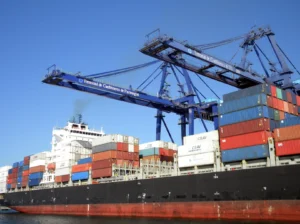
Outsourcing to China isn’t just “find a factory and place an order”.
In practice, you’re building a supply chain that ties together procurement, engineering, quality control, incoterms, customs clearance, and the real-world constraints of lead time and transit time.
Here’s the thing, the winners treat it like an operating system, not a one-off purchase.
We’ve seen importers obsess over unit price, then lose everything on freight rates, a wrong tariff classification, or missing documentation when the bill of lading is issued.
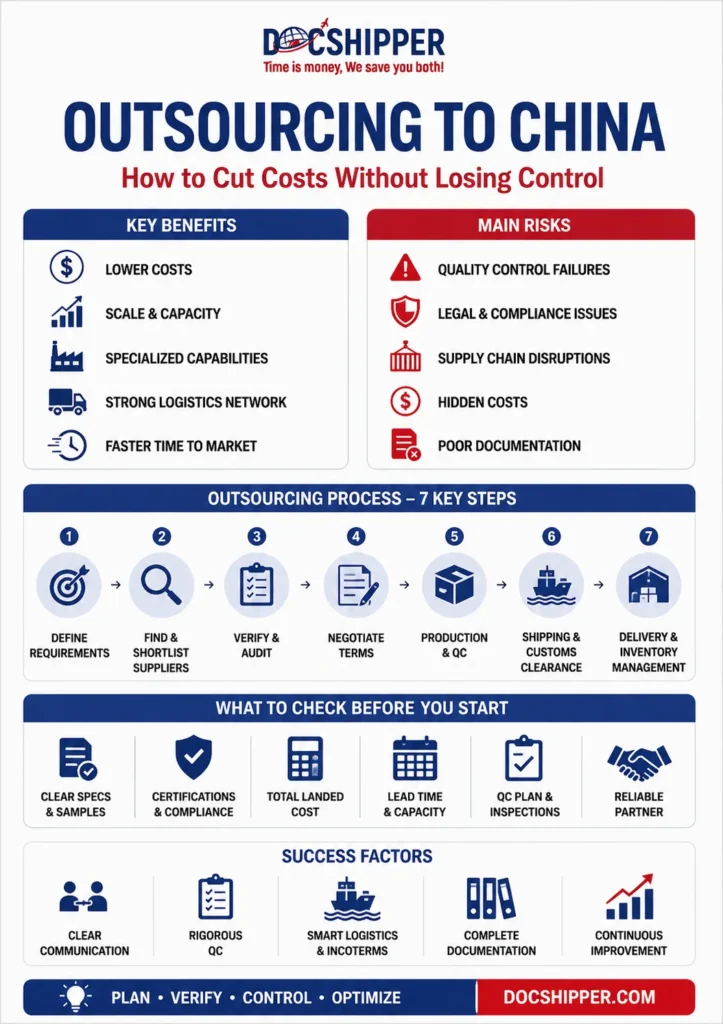
How China became the world’s manufacturing powerhouse
Back when a buyer rushed a “simple” outsourced order, we watched the first samples look perfect, then the production run quietly switch to a cheaper sub-supplier to protect the factory’s margin.
That moment explains a lot about outsourcing to China today, China isn’t one factory ecosystem, it’s a dense web of specialized clusters, subcontractors, tooling shops, and logistics lanes that can scale fast.
China’s edge grew from three forces you’ll notice fast: industrial clustering, deep supplier tiers (from raw materials to packaging), and an export machine built for containerization and high-frequency shipments.
Even global benchmarks like UNCTAD regularly highlight how manufacturing ecosystems and trade connectivity reinforce each other, China engineered both.
If you’re planning production, think beyond the factory gate.
Your outcome depends on how well you connect manufacturing to freight forwarding, consolidation, port operations, and predictable shipment tracking.
Key industries and products typically outsourced to China
Tip: start your outsourcing to China plan by mapping the category to the right industrial region, it saves weeks of dead-end sourcing.
China still dominates categories where supplier density matters, meaning you can source components, packaging, and tooling without moving your project across borders.
This matters a lot when you’re trying to control lead time, reduce rework, and avoid partial shipments that blow up your freight quote.
Use this quick reference to match typical products to what you’ll usually outsource successfully.
| Category | Common outsourced products | What to watch operationally |
| Consumer electronics | Chargers, small devices, accessories, assemblies | IEC/ISO testing needs, component traceability, battery shipping constraints |
| Home and lifestyle | Kitchenware, furniture parts, decor, textiles | Packaging specs, palletization rules, carton drop tests for long multimodal transport |
| Industrial and B2B | Machined parts, castings, fasteners, enclosures | Material certificates, tolerance control, stable subcontractors |
| Plastic and rubber | Injection molded parts, seals, consumer goods | Tooling ownership, resin grades, color matching drift in mass production |
| Packaging and printing | Boxes, labels, inserts, retail-ready kits | Ink compliance, barcodes, kitting accuracy for order fulfillment |
If your product touches regulated claims (food contact, kids, medical), don’t “assume compliance”.
Build testing and documentation into the RFQ, not after the first container is already on the water.
When outsourcing to China makes sense (and when it doesn’t)
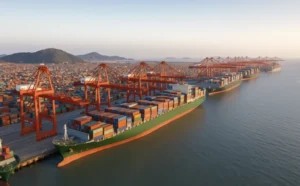
Is outsourcing to China the right move for you, or are you forcing a model that will fight you every step?
We’ve seen a brand save 18% on unit price, then lose the entire advantage because they chose EXW, underestimated local trucking, and got stuck negotiating a last-minute customs brokerage fix at destination.
So let’s make this decision practical.
Use the checklist below to sanity-check your project before you commit to tooling or deposits.
- You should outsource to China if you can order stable volumes, tolerate ocean transit time, and lock specs tightly.
- You should hesitate if you need ultra-fast design iteration, low MOQs forever, or you’re missing the capability to inspect and manage suppliers.
- You should avoid it for now if your compliance risk is high and you can’t fund testing, audits, and documented traceability.
- You’ll benefit most when you can combine production with smart inventory management, like shipping by sea and buffering stock in a warehouse or bonded warehouse.
A quick operational workflow helps you decide without emotion.
Decision workflow: define target landed cost, confirm MOQ and capacity, validate compliance needs, choose Incoterm, model freight and customs duty, plan QC gates, then approve the supplier.
Main advantages you gain by outsourcing to China
Outsourcing to China still wins when you structure it like a controlled program, not a gamble.
You’re buying access to scale, dense supplier networks, and logistics infrastructure that supports everything from consolidation to high-volume containerization.
But the advantage only shows up when you lock specs, run inspections, and manage freight like a pro.
DocShipper Info
We align sourcing, consolidation, and containerization to turn scale into controlled profitability.
Cost savings, scale, and speed to market
On a rushed consumer goods launch, we once saw a buyer accept a “too good” quote, only to discover later the factory priced without retail packaging, export cartons, and the testing costs required for the destination market.
Outsourcing to China can absolutely reduce unit cost, but the real savings come from scale economics, supplier competition, and better tooling amortization across volume.
You also gain speed when suppliers can source components locally and ramp production without waiting on imports.
To keep your cost advantage real, you need to compare like-for-like.
| Cost element | What suppliers often quote | What you must confirm |
| Unit price | FOB or EXW product only | Packaging, rejects allowance, spare parts, over/under run policy |
| Freight | Rough estimate | Container utilization, palletization, spot rates vs contracted, cargo insurance |
| Duties and taxes | Not included | Tariff classification, origin rules, applicable import/export regulations |
| Time-to-market | Production lead time only | Total lead time including QC, customs clearance, last mile |
If you want speed to market, don’t forget the downstream.
Your last mile delivery and the receiving slot at your distribution center can become the actual bottleneck.
Access to specialized capabilities and technology
Tip: when you evaluate outsourcing to China, ask “what does this factory do in-house that others can’t?” and make them prove it.
The best Chinese manufacturers aren’t “cheap”, they’re process-driven, equipped, and plugged into specialist subcontractors for tooling, surface treatment, PCB assembly, or advanced packaging.
You’ll often get better DFM feedback, faster tooling iterations, and more robust manufacturing engineering than in fragmented markets.
This is where standards matter.
If the supplier claims quality maturity, you should see structured systems aligned with ISO expectations, like calibrated instruments, controlled work instructions, and traceable corrective actions.
To keep it operational, use a short capability check in your RFQ.
- Equipment list with model numbers and photos, not marketing slides.
- Process controls, including incoming inspection and in-process checks.
- Sub-supplier list for critical parts and treatments.
- Testing ability, what they do internally vs outsourced labs.

Flexible capacity for seasonal or project-based demand
Bold truth: capacity flexibility is only an advantage in outsourcing to China if you reserve it and manage it.
We’ve watched seasonal brands get bumped in the queue right before peak because they had no forecast, no blanket PO, and no agreed production window.
China can scale fast, but factories prioritize customers who plan and communicate.
Use this simple checklist to avoid capacity surprises when demand spikes.
- Rolling forecast shared monthly, even if it’s imperfect.
- Capacity reservation in writing, tied to deposit or framework PO.
- Raw material plan for long-lead items, with agreed safety stock.
- Logistics plan for peak season, including backup modes like air for a portion of SKUs.
When you align production with logistics, you also protect cash.
You can stage goods in a warehouse, run cross-docking, or consolidate shipments to smooth inventory management and reduce per-unit freight.
Hidden risks and common pitfalls you must manage
Outsourcing to China rewards disciplined operators, and punishes “hope-based” importing.
You’ve probably dealt with suppliers who sound confident on calls, then go quiet when you ask for test reports or corrective actions.
The good news is you can manage most risks with the right controls, clear documents, and strong escalation paths.
DocShipper Advice
Deploy third-party inspections and structured QC gates before any balance payment is released.
Quality control failures and product safety issues
On a private label project, we’ve seen cartons arrive with perfect outer labels, but inside, the product used a different resin grade than the approved sample.
That’s the classic pain of outsourcing to China, the sample can be right and the mass production can drift unless you control it.
Quality risk isn’t just aesthetics.
It’s also safety, recalls, and compliance, especially when your goods face consumer standards and retailer requirements.
Use this step-by-step QC workflow to prevent “sample trap” surprises.
QC workflow: golden sample approval, pre-production meeting, incoming material checks, in-line inspection, pre-shipment inspection, container loading supervision, then retain samples per batch.
To make inspections measurable, you need objective acceptance rules.
- Define tolerances by dimension and function, not “looks good”.
- Set AQL levels and critical/major/minor defects.
- Require traceability for key materials and components.
- Lock packaging specs to protect cargo through multimodal transport.
Legal, regulatory, and compliance exposure
Tip: treat compliance as part of outsourcing to China sourcing, not a last-minute customs problem.
One of the most expensive mistakes we see is shipping first, then discovering missing declarations, wrong labeling, or incomplete test documentation at destination.
That’s when you start paying storage, demurrage, and emergency fixes while your customer waits.
You reduce exposure by structuring documentation and product compliance early.
This includes aligning on import/export regulations, required markings, and the exact documents needed for customs clearance in your destination country.
We recommend you align your paperwork to internationally recognized practices referenced by the WCO, especially around classification and border procedures.
Here’s a short checklist you can use before any first shipment.
- Commercial invoice and packing list match the PO and actual cargo.
- Correct HS code for tariff classification, validated with your broker.
- Incoterms defined clearly, with responsibilities for export clearance and transport.
- Test reports and declarations ready, with product labeling confirmed.
Political, economic, and supply chain disruption
Question: what happens to your outsourcing to China plan when freight spikes, ports congest, or a supplier’s region faces restrictions?
We’ve seen importers budget ocean shipping based on last quarter’s rates, then get hit by spot rates that doubled during peak season, forcing them into air shipments and margin panic.
Disruption rarely breaks you because of one event.
It breaks you because you didn’t build options into transportation, inventory, and supplier strategy.
Use this table to pressure-test resilience before you commit to a single-lane plan.
| Risk | What it looks like | How you mitigate |
| Freight volatility | Rate spikes, rolled bookings, longer transit time | Split shipments, early bookings, compare freight quote options, partial air buffer |
| Port and carrier disruption | Congestion, blank sailings, delays | Alternative ports, multimodal transport plans, track milestones with shipment tracking |
| Trade policy shifts | Tariff changes, enforcement spikes | Classify correctly, model duties, keep documentation audit-ready |
If you want stability, don’t rely on a single shipment rhythm.
Blend inventory buffers, supplier communication, and logistics optionality so one delay doesn’t stall your whole pipeline.
How to choose the right Chinese manufacturer or outsourcing partner
Outsourcing to China doesn’t fail because “China is risky”.
It fails because you picked the wrong partner, asked the wrong questions, or skipped verification when the supplier sounded convincing.
This is the moment most importers get stuck, too many options, too little signal.
DocShipper Info
We audit, shortlist, and verify factories so you avoid costly misalignment from day one.
Where to search and how to shortlist reliable factories
We once saw a buyer fall in love with a factory website, then learn the “manufacturer” was a trading office with no control over the actual production line.
That mistake is common in outsourcing to China, and it’s avoidable if you shortlist using evidence, not branding.
Start with multiple channels so you can cross-check what you’re being told.
Here’s a practical shortlisting workflow you can run in a week.
Shortlist workflow: define spec and target price, build a longlist, request RFQs, collect documents and factory info, score suppliers, then select 2 to 3 for sampling and audits.
Use these criteria to filter fast before you waste time on calls.
- Factory address and business scope, consistent across documents.
- Product focus that matches your exact materials and processes.
- Export experience to your market, including labeling and packaging norms.
- Logistics readiness, ability to pack for pallets, cartons, and container loading.
Verifying capabilities, certifications, and past projects
Tip: in outsourcing to China, don’t ask “are you certified?”, ask “show us the scope, the site, and the last audit date”.
Certifications only matter if they match the site producing your goods, and the scope covers your process.
You should also verify past projects that resemble your complexity, same materials, same tolerances, similar packaging and shipping constraints.
We’ve seen suppliers present a beautiful certificate for a sister factory, then produce at a different site with different controls.
This checklist keeps your verification grounded.
- Business license and export registration details match the contracting entity.
- Certification scope includes the process you’re buying.
- Production evidence, line photos, equipment serials, calibration records.
- Reference samples you can physically inspect, not just photos.
If you’re unsure, a third-party audit is cheaper than a failed first container.
That’s also where we often help, coordinating audits, inspections, and the handoff to logistics without turning it into a mess.
Comparing quotes, MOQs, and payment terms wisely
Bold statement: the cheapest quote in outsourcing to China is often the most expensive shipment you’ll ever import.
We’ve seen quotes that looked unbeatable, until the supplier added “optional” tooling, packaging, and a 3% fee for certain payment methods.
You want quotes that are comparable and operationally complete.
Use this table to normalize supplier offers before you negotiate.
| Quote item | What you ask for | Why it matters |
| Incoterm and port | FOB named port or DAP named location | Defines who pays export fees, main carriage, and risk transfer |
| MOQ and price breaks | Tiered pricing by quantity | Lets you plan inventory management and cash flow |
| Payment terms | Deposit, balance trigger, acceptable methods | Controls risk, leverage, and production priority |
| Packaging and labeling | Retail pack, master carton specs, pallet rules | Prevents cargo damage, supports distribution center receiving |
Negotiate with structure, not pressure.
If you tighten specs and QC gates, you can often improve price without pushing the supplier into corner-cutting.
Factory selection: materials, processes, and production standards
Outsourcing to China works best when your factory selection matches the physical reality of your product.
Materials, process control, and documentation discipline decide whether you get consistent shipments or constant firefighting.
This is where you stop “sourcing” and start engineering your supply chain.
DocShipper Advice
Validate materials, lead times, and documentation before committing to mass production.
Matching your product materials with factory expertise
We once saw a buyer choose a factory based on a great sample, then discover the factory didn’t actually control the raw material supply, their sub-supplier did.
In outsourcing to China, material control is where quality either stabilizes or collapses over time.
You should match the factory to your material reality, not just the finished product.
Use this checklist before you approve any supplier for production.
- Material grade defined in writing, with acceptable substitutes listed.
- Approved material suppliers or at least a disclosed supplier list.
- Incoming inspection method for material verification.
- Traceability by batch or lot for critical components.
If your product needs certifications, make material certificates and test reports part of the deliverable set.
That saves you pain later with trade compliance and destination market checks.
Evaluating manufacturing processes, lead times, and capacity
Tip: ask the factory to walk you through a real production plan, day-by-day, then compare it to your required ship date.
With outsourcing to China, the quoted lead time often excludes tooling, sampling, rework loops, and inspection windows.
Capacity also isn’t a number, it’s a priority decision the factory makes when multiple customers compete for the same line.
Use this short workflow to validate what “lead time” really means.
Lead time workflow: tooling, first article, sample approval, material purchasing, pilot run, mass production, QC, packing, export booking, port cut-off.
To keep comparisons fair between factories, ask these questions consistently.
- What % of processes are in-house vs subcontracted?
- What’s the true capacity per week on the specific line you’ll use?
- What happens in peak season, and how do they allocate production?
Aligning technical specifications and documentation
Question: if your supplier team changed tomorrow, would your outsourcing to China project still produce the same product?
If the answer is “maybe”, your documentation isn’t strong enough.
Clear specs reduce disputes, prevent “interpretation manufacturing”, and make inspections objective.
They also protect your logistics flow because packaging, labeling, and carton counts drive container loading, consolidation, and clean customs clearance.
Use this bullet list as your baseline technical pack.
- Drawings with tolerances, critical-to-quality dimensions, and revision control.
- BOM with material grades, approved alternates, and finish requirements.
- Packaging specs including carton markings, pallet pattern, and drop-test requirement.
- Inspection plan with AQL, defect definitions, and sampling method.
When you document properly, you stop negotiating every shipment from scratch.
You also make it easier for your 3PL provider to receive, store, and ship accurately downstream, including returns and reverse logistics.
Building robust quality control for manufacturing in China
When you think about outsourcing to China, cost savings probably come first. From experience, quality control is what determines whether those savings are real or wiped out by returns, recalls, or lost customers.
Manufacturing in China can be extremely reliable, but only if you build a structured QC system from day one. The ISO standards framework published by the International Organization for Standardization gives you a reference point, but you still need hands-on control tailored to your product.
DocShipper Alert
Implement sampling plans, audits, and release gates to protect every shipment.
Sampling, inspections, and third-party testing strategies
We once handled a sourcing project where the first production batch looked perfect in photos, but 18 percent of units failed functional testing once landed. That happened because no statistically valid sampling plan had been defined during outsourcing to China.
You should always define your inspection strategy before mass production starts. Waiting until goods are finished is already too late.
Here is a simple inspection workflow you can apply:
- Step 1: Approve a golden sample, signed and dated by both you and the factory.
- Step 2: Conduct a pre-production inspection to verify materials and components.
- Step 3: Perform a mid-production inspection at 20 to 50 percent completion.
- Step 4: Run a pre-shipment inspection based on AQL sampling levels.
- Step 5: If required, send samples to a certified third-party lab for compliance testing.
You’ll benefit from using third-party testing for regulated markets, especially for electronics, toys, cosmetics, or food-contact products. Think CE, RoHS, REACH, FDA, or other mandatory standards depending on your destination market.
This is where most importers get stuck, they rely only on factory internal QC reports. Independent verification protects you from bias and blind spots.
On-site audits, pre-shipment checks, and ongoing monitoring
Here’s a practical tip: never rely on a factory you haven’t audited, especially during your first outsourcing to China project.
An on-site audit tells you more in four hours than dozens of emails. You can verify machinery, workforce size, process flow, and real production capacity.
We recommend structuring your audit in three layers:
- Factory audit: legal registration, certifications, export license.
- Process audit: production line organization, traceability, calibration records.
- Social and ethical audit: working conditions, subcontracting practices.
You should also implement pre-shipment inspections as a release gate. No balance payment before a passed report, this rule alone saves you from many painful surprises.
Ongoing monitoring matters just as much. After two or three successful orders, you might feel confident and reduce controls. That’s usually when standards start drifting.
Setting up clear tolerances, defect levels, and escalation paths
Have you ever received a shipment where the supplier said, “This is within acceptable variation”? During outsourcing to China, ambiguity about tolerances creates constant friction.
You need written, measurable standards. Not “good quality”, but exact dimensions, color codes, performance metrics, and allowed deviation ranges.
Before production begins, align on these critical points:
- Critical defects: zero tolerance, safety or regulatory risk.
- Major defects: functional issues or visible flaws.
- Minor defects: small cosmetic deviations.
- AQL level: define acceptable quality limits clearly in contract.
To help you stay consistent, use this quick internal checklist before approving any shipment:
- Golden sample approved and archived.
- Signed technical specification sheet.
- AQL level agreed in writing.
- Inspection report reviewed by your team.
- Corrective action plan defined for any non-conformity.
Escalation paths should also be contractual. If defect rate exceeds threshold, you define rework, discount, or replacement procedures in advance. You’ll sleep better knowing disputes are pre-framed.
Looking for a Reliable Shipping & Sourcing Partner?
Understanding costs when outsourcing to China
Outsourcing to China is attractive because of pricing, but you only win if you understand your total landed cost. Focusing on unit price alone is a classic beginner mistake.
The World Bank consistently highlights how logistics and trade costs impact competitiveness. You should think the same way, cost is multi-layered and dynamic.
DocShipper Info
Model total landed cost with freight, duties, and storage before approving any supplier.
Breaking down unit price, tooling, and hidden expenses
Let’s be honest, the first quotation you receive during outsourcing to China is rarely the final reality.
Your unit price usually includes raw materials, labor, overhead, and factory margin. But you also need to clarify what is not included.
Here is a structured breakdown to analyze every quote:
| Cost Element | What to Verify |
| Unit price | Material grade, packaging, Incoterm used |
| Tooling or mold cost | Ownership, lifespan, maintenance responsibility |
| Sampling fees | Refundable after mass order or not |
| Packaging | Export cartons, labeling, palletization |
| Bank charges | TT fees, currency conversion spread |
Tooling is critical. You should clearly state in writing that molds belong to you, and define storage conditions.
Shipping, duties, and landed cost calculations
What’s the point of a cheap factory price if freight doubles your budget?
When outsourcing to China, you need to calculate landed cost, meaning product cost plus transport, insurance, duties, and local handling.
Your landed cost formula usually includes:
- EXW or FOB factory price.
- International freight, sea or air.
- Insurance.
- Customs duties and taxes in destination country.
- Port charges, customs broker fees, last-mile delivery.
You should confirm HS codes carefully, because classification errors directly impact duty rates. Customs authorities follow frameworks from the World Customs Organization, so accuracy matters.
At DocShipper, we often see importers underestimate storage and demurrage costs. A two-week delay at port can erase your margin.
DocShipper Platform
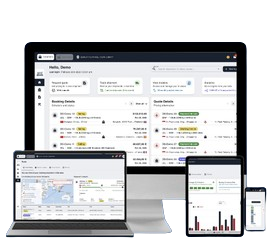
One platform. Your entire supply chain
Sourcing, freight, customs & documents — all centralised, all visible, 24/7.
Negotiation tactics that reduce cost without hurting quality
Never negotiate blindly on price.
If you push too hard during outsourcing to China, the supplier will protect their margin somewhere else, often on materials or process control.
Instead, use a structured negotiation approach:
- Increase order volume gradually in exchange for tiered pricing.
- Adjust specifications where over-engineering adds no value.
- Optimize packaging to reduce freight cost.
- Offer stable forecasts to gain better payment terms.
Here is a quick checklist before finalizing a deal:
- Have you benchmarked at least three suppliers?
- Did you review raw material index trends?
- Are payment terms aligned with inspection milestones?
- Did you simulate total landed cost scenarios?
Smart negotiation is about transparency and long-term leverage, not squeezing every cent.
Legal protection, IP security, and contracts in China
Outsourcing to China exposes you to legal and intellectual property risks if you operate casually. Contracts and registrations are not optional, they are strategic tools.
The ICC provides guidance on international commercial contracts, and you should align your agreements with recognized global standards while adapting them to Chinese law.
DocShipper Alert
Secure enforceable agreements and protect your brand in China before production starts.
Essential contract clauses to reduce your outsourcing risk
We once reviewed a supplier agreement that mentioned price and quantity, but nothing about quality criteria or jurisdiction. When a dispute arose, the buyer had no leverage.
Your manufacturing contract in outsourcing to China should cover at least:
- Detailed product specifications attached as annex.
- Quality standards and AQL levels.
- Delivery terms and Incoterm version.
- Penalty clauses for delays or non-compliance.
- Dispute resolution mechanism and governing law.
Use bilingual contracts when possible, and ensure the Chinese version is enforceable locally.
Safeguarding designs, trademarks, and confidential information
Do you assume your brand is protected just because you registered it at home?
During outsourcing to China, you should register your trademark in China under the first-to-file principle. Without local registration, you risk losing control of your own brand.
Protect your IP through:
- Chinese trademark registration before production.
- Design patents where applicable.
- Separate non-disclosure and non-use agreements.
- Controlled access to technical drawings.
You should also split production steps between suppliers for highly sensitive products when feasible.
Structuring relationships: direct hiring, dispatch, or service outsourcing
Your legal structure determines your operational risk.
When outsourcing to China, you can work directly with a manufacturer, use a sourcing agent, or establish a local entity.
| Structure | Pros | Cons |
| Direct factory contract | Lower cost, direct control | Higher management burden |
| Sourcing agent | Local expertise, easier communication | Commission cost |
| Local subsidiary | Full control, stronger IP protection | High setup and compliance cost |
You should align structure with volume, complexity, and long-term strategy.
How to manage communication, culture, and on-the-ground operations
Outsourcing to China is not just technical, it is human. Most failures happen because of miscommunication, not machinery.
You’ll notice fast that clarity beats speed in cross-border collaboration.
DocShipper Advice
Standardize documentation and meeting rhythms to keep timelines and quality aligned.
Time zones, language barriers, and documentation best practices
On one project, a simple misunderstanding about “matte finish” led to 5,000 glossy units. The word seemed clear, but the written specification was not detailed enough.
During outsourcing to China, you should rely on written documentation, annotated drawings, and visual references rather than verbal explanations.
Adopt these best practices:
- Use structured specification sheets with visuals.
- Confirm every change in writing.
- Schedule fixed weekly update calls.
- Summarize meeting minutes systematically.
You should also appoint a single decision-maker on both sides to avoid conflicting instructions.
Aligning expectations on timelines, changes, and problem-solving
Are your timelines realistic, or based on optimistic assumptions?
When outsourcing to China, you need buffer time for sampling, corrections, and shipping variability.
Define a simple operational rhythm:
- Clear production milestones.
- Agreed lead times with buffer.
- Formal change request process.
- Escalation contacts for urgent issues.
Most importantly, treat your supplier as a partner. Firm on standards, respectful in communication.
Alternatives and complements to outsourcing to China
Outsourcing to China remains powerful, but diversification is now part of serious supply chain strategy. You’ve probably felt how geopolitical shifts or freight volatility can disrupt even well-planned operations.
The World Economic Forum regularly emphasizes supply chain resilience, and you should think in the same direction.
DocShipper Info
Build a China plus one strategy to balance cost, resilience, and long-term growth.
When to diversify into India, Southeast Asia, or nearshoring
We supported a client who relied 100 percent on one Chinese factory. When lockdowns hit, production stopped overnight.
You might consider alternatives when:
- Labor-intensive products require lower wage environments.
- Trade tariffs penalize Chinese origin goods.
- Lead times must be reduced through nearshoring.
- Political exposure becomes a strategic concern.
Countries like Vietnam, India, and Mexico offer complementary strengths, but infrastructure and supplier maturity vary.
Dual-sourcing and China-plus-one strategies
Resilience is built before a crisis, not during it.
With a China-plus-one approach, you keep core production in China while developing a secondary source elsewhere.
Before implementing, review this checklist:
- Have you mapped critical components and single points of failure?
- Did you validate technical capability of the second supplier?
- Are tooling and documentation transferable?
- Did you compare total landed cost across scenarios?
Dual-sourcing increases complexity, but it also increases leverage and stability.
Conclusion
Outsourcing to China can transform your cost structure and scalability, but only if you manage quality, cost, legal protection, and communication with discipline.
You cannot delegate control entirely. You must design it.
- Build structured quality control with sampling, audits, and clear defect standards.
- Calculate total landed cost, not just factory price.
- Secure contracts and register your IP in China early.
- Formalize communication and documentation processes.
- Diversify strategically with China-plus-one when relevant.
If you approach outsourcing to China with method, transparency, and long-term thinking, you won’t just cut costs. You’ll build a resilient and competitive supply chain.
FAQ | Outsourcing to China: how to cut costs without losing control
Earlier than you think—ideally before you even place the first purchase order.
- During RFQ: share your draft QC plan (inspection stages, AQL, key tests) so suppliers quote with real quality costs in mind.
- Before tooling: have a QC partner review drawings, specs, and golden samples to spot ambiguity.
- Before first mass production: book pre-production and mid‑production inspections, not just pre‑shipment.
- Ongoing: schedule periodic audits (e.g., annually or after any major issue) to make sure standards don’t quietly slip.
The most frequent silent changes are:
To detect them in practice:
- Material downgrades (cheaper resin, thinner metal, lower‑grade fabric).
- Component substitution (different supplier for chips, bearings, zippers, etc.).
- Process shortcuts (reduced curing time, fewer inspection points, weaker packaging).
- Lock material specs (grade, brand, supplier, certificates) in your contract.
- Run incoming material checks and retain samples from each batch.
- Compare production samples to your golden sample every order (weight, hardness, color, dimensions).
- Use random lab tests on critical properties (flammability, tensile strength, chemical content).
You can still maintain strong oversight remotely by:
- Using third‑party auditors for factory audits, process audits, and pre‑shipment inspections.
- Requesting unedited factory videos: walk‑through of the line, packaging area, and storage, plus close‑ups of labels and test equipment.
- Setting up live video during key inspections so you can approve or reject on the spot.
- Requiring regular reports: production status, defect statistics, CAPA (corrective and preventive actions).
- Appointing a local representative or sourcing/QA agent to perform surprise visits when needed.
You need a decision tree ready before it happens. In practice:
- Classify the issues: are they critical (safety/compliance), major (function/fit), or minor (cosmetic)?
- If critical: do not ship. Require immediate containment, rework, or reproduction—delay is safer than recalls or seizures at customs.
- If major but fixable:
- Negotiate targeted rework and a re‑inspection of the affected lots.
- Ship only the passed portion if partial shipment is possible.
- If mostly minor:
- Decide a discount, rework on future orders, or field rework at destination.
- Document it in a corrective action plan with deadlines and responsibility.
- Always update your contract and QC checklist so the same failure carries clear penalties next time.
You can’t eliminate the risk, but you can make it much harder and less attractive:
- Register your trademark, and when possible design patents, in China before production.
- Sign a Chinese‑language NNN agreement (Non‑Disclosure, Non‑Use, Non‑Circumvention) with the actual producing entity.
- Avoid giving full product “know‑how” to a single supplier when the design is very sensitive (split sub‑assemblies if feasible).
- Use neutral or generic packaging for goods shipped to distributors or marketplaces where copycats are active.
- Monitor online platforms and trade fairs for copies, and be ready to use your Chinese IP registrations to take them down.
Pay attention less to what they say, and more to how they say it and how fast:
When you see 2–3 of these at once, pause, escalate: increase inspection frequency, request an audit, and consider lining up a backup supplier.
- Vague replies like “no problem”, “we will try our best” when you ask precise technical questions.
- Sudden changes in contact person, company name, or bank details without clear explanation and documentation.
- Repeated last‑minute requests to “skip inspection to catch the vessel” or to pay balance before QC.
- Inconsistent production timelines: dates keep slipping, but no concrete root cause or corrective plan is provided.
- Refusal or long delays in sharing test reports, material certificates, or photos/videos of ongoing production.
Need Help with
Logistics or Sourcing ?
First, we secure the right products from the right suppliers at the right price by managing the sourcing process from start to finish. Then, we simplify your shipping experience - from pickup to final delivery - ensuring any product, anywhere, is delivered at highly competitive prices.
Fill the Form
Prefer email? Send us your inquiry, and we’ll get back to you as soon as possible.
Contact us