In short ⚡
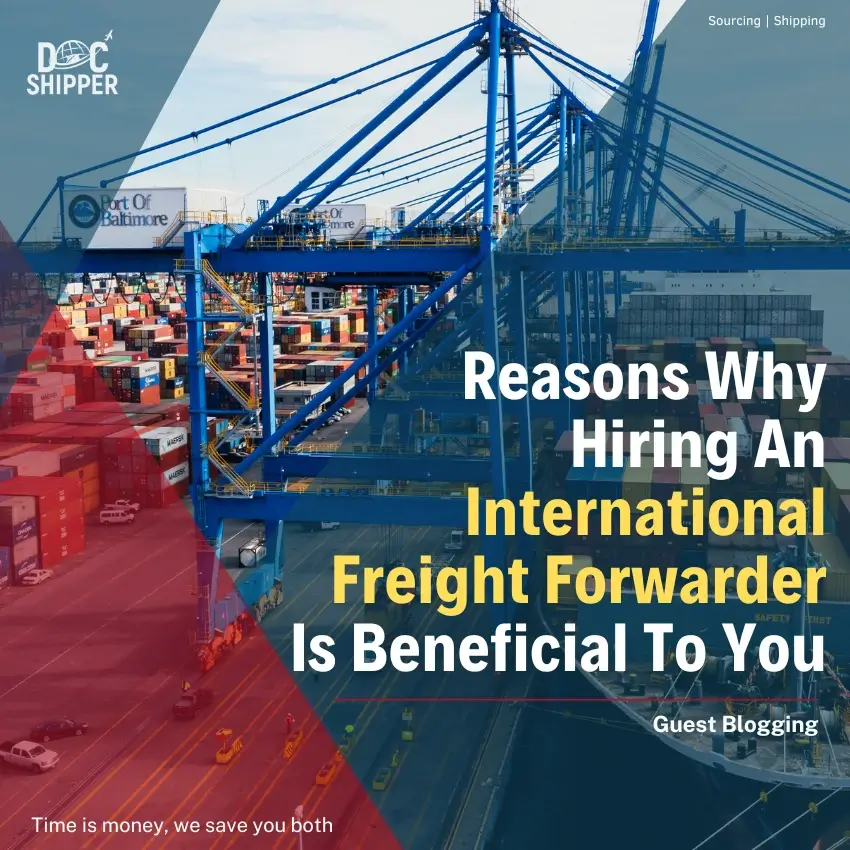
Hiring a freight forwarder gives you professional control over the “messy middle” between supplier and warehouse, reducing cost leaks, delays, and compliance risks.
They coordinate transport, documentation, customs clearance, and cargo handling so your lead times, margins, and international shipments stay stable instead of being exposed to errors and penalties.
We hope you’ll find this article genuinely useful, but remember, if you ever feel lost at any step, whether it’s finding a supplier, validating quality, managing international shipping or customs, DocShipper can handle it all for you!
What a freight forwarder actually does for your shipments
If you’re searching why hire freight forwarder, you’re probably feeling the pain already, too many moving parts, too many emails, and one missed detail can blow up your lead time.
Here’s the thing, freight forwarding isn’t “just booking transport”. It’s end-to-end logistics orchestration across carriers, ports, customs clearance, and transport documentation, with real supply chain management consequences.
We’ve seen import export projects that looked simple on paper, 1 container, 1 supplier, 1 destination, and still turned into a week of port operations drama because the bill of lading didn’t match the cargo manifest.
Quick checklist, what your freight forwarding partner should cover:
- Transport planning, multimodal transport, routing, transshipment decisions
- Freight negotiation and freight tendering, carrier contract alignment, freight rates validation
- Export and import documentation, bill of lading control, packing list, commercial invoice, certificates when needed
- Customs clearance support with a customs broker, tariff classification, trade compliance checks
- Cargo handling, containerization, palletization, cross-docking, distribution center handoff
- Shipment tracking and exception management, last-mile delivery coordination
- Risk controls, freight insurance options, claims support, security routing
- Warehousing options, bonded warehouse use, inventory management links when timing slips
Workflow, how freight forwarding works step by step:
1) You share your procurement details and delivery terms, product, HS hints, incoterms, pickup window.
2) We validate feasibility, choose the right mode, air, ocean, rail, road, or multimodal transport.
3) We run freight brokerage style comparisons, negotiate freight rates, then confirm the carrier contract.
4) We organize origin cargo handling, pickup, consolidation, palletization, and export documentation.
5) We manage port operations, sailing or flight milestones, shipment tracking, and transshipment risk points.
6) We prep customs clearance, tariff classification, compliance checks, duties and taxes workflow.
7) We coordinate delivery, cross-docking if needed, last-mile delivery, and proof of delivery for order fulfillment.
DocShipper Info
Talk to our logistics team to map your next shipment end to end with zero blind spots.
 Core responsibilities of a freight forwarder in plain language
When you ask why hire freight forwarder, the cleanest answer is this, you’re paying for control over the messy middle between “supplier ready” and “goods in your warehouse”.
You’ll notice fast that freight forwarding sits at the intersection of logistics outsourcing, compliance, and execution, not just transport.
From experience, a classic scenario goes like this: your supplier says “cargo ready Friday”, then quietly pushes to Monday, and your vessel cut-off stays Friday.
Without a freight forwarding agent pushing, you miss the cut-off, lose the booking, and your lead time jumps two weeks.
- Booking and coordination across carriers and terminals, including freight consolidation
- Document accuracy so your bill of lading, cargo manifest, and invoices match
- Incoterms clarity so delivery terms match who pays what, and when risk transfers
- Operational fixes when reality hits, rolled containers, port congestion, inspections
- Visibility for your supply chain management team, shipment tracking, milestone updates
At DocShipper, we bundle this into one operational thread so you don’t end up playing telephone between your supplier, the trucker, the warehouse, and the carrier.
DocShipper Advice
Centralize your operations with one forwarder to avoid missed cut offs and costly rebookings.
How freight forwarders fit between you, carriers, and customs
The real reason behind why hire freight forwarder shows up when three parties speak three different languages, you talk procurement and cost, carriers talk cut-offs and equipment, customs talks tariff classification and compliance.
A good forwarder translates, aligns, and documents everything so customs clearance doesn’t become a surprise bill and a shipment failure.
One time, a buyer thought “FOB” meant the supplier would handle export customs.
Then export docs weren’t filed, the container sat at the port, and demurrage started clocking before anyone even noticed.
Industry note: forwarders that follow FIATA-aligned practices typically take documentation discipline seriously, and that’s exactly what protects you when something goes sideways.
| Player | What they optimize | Where you get stuck without a forwarder |
| You | Procurement cost, lead time, delivery terms, order fulfillment | Too many handoffs, unclear incoterms, weak exception handling |
| Carrier / trucking | Equipment, schedules, port cut-offs, carrier contract terms | Rolled bookings, missed cut-offs, accessorial charges |
| Customs broker / customs | Trade compliance, tariff classification, duties, admissibility | Holds, penalties, rework on documents, delayed release |
| Freight forwarder | End-to-end coordination, documentation, risk, routing, visibility | Without this layer, you manage exceptions alone, usually too late |
With us, you get one operations team that can coordinate carriers, a customs broker, a bonded warehouse if required, and the last-mile delivery so your distribution center receives on time.
Looking for a Reliable Shipping & Sourcing Partner?


Key reasons to hire a freight forwarder instead of doing it yourself
If your question is why hire freight forwarder instead of managing logistics internally, the honest answer is that international shipping punishes “almost right”.
In freight forwarding, small errors create big invoices, storage, rebooking, inspections, reverse logistics, you name it.
We’ve watched teams try to DIY their first containerization move, only to discover too late that their delivery terms didn’t match their carrier contract, and the port billed them for delays they didn’t budget.
Quick checklist, you’re a strong candidate to outsource logistics when:
- You’re juggling multiple suppliers and you need freight consolidation to control cost
- You’re seeing volatile freight rates and you want predictable freight negotiation
- You’re getting customs questions on tariff classification or product compliance
- You can’t afford longer lead time because inventory management is already tight
- Your team is spending hours chasing shipment tracking updates and exceptions
DocShipper Alert
Outsource before errors turn into penalties, storage fees, and damaged margins.
Cost advantages: better freight rates, fewer penalties, less waste
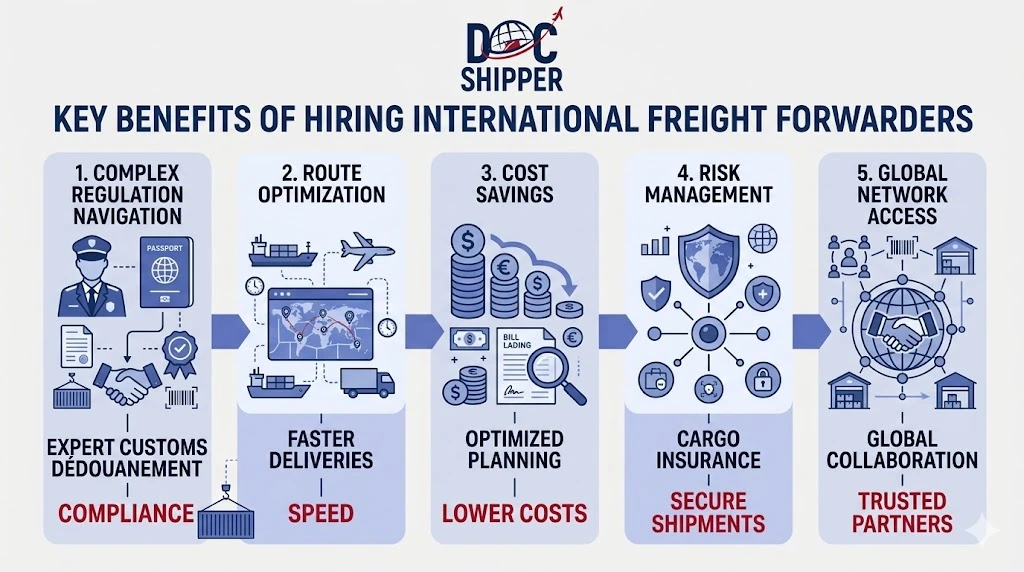
The most practical why hire freight forwarder argument is cost control, not only on freight rates, but on all the hidden leakages around cargo handling and documentation.
You don’t just want a cheap quote, you want a quote that survives reality, cut-offs, equipment shortages, and port congestion.
Here’s a scenario we see a lot: you book based on a low ocean rate, then the carrier adds local charges, storage, and a “documentation correction” fee because the bill of lading had a mismatch.
By the time the container reaches your warehouse, you’ve paid more than the “expensive” option you rejected.
- Freight negotiation leverage, better carrier contracts through volume and routing options
- Fewer accessorial surprises, clearer charges on detention, demurrage, terminal handling
- Smarter mode selection, air vs ocean vs multimodal transport based on lead time and value
- Less waste, optimized palletization, fewer damages, less rework, fewer split shipments
- Warehousing strategy, using cross-docking or a bonded warehouse to manage cash flow and duties timing
| DIY shipping cost leak | What it looks like | How we reduce it |
| Bad routing choice | Extra transshipment, missed connections, longer lead time | Route design and milestone buffers based on lane behavior |
| Documentation errors | Bill of lading amendments, customs holds, storage fees | Pre-checks on transport documentation before cutoff |
| Unplanned warehousing | Paid storage at port or terminal | Planned warehousing or cross-docking to a distribution center |
DocShipper Info
Request a full landed cost review and secure freight terms that survive real world conditions.
Risk reduction: compliance, cargo security, and fewer shipment failures
The other half of why hire freight forwarder is risk, and risk in global trade shows up as delays, penalties, and cargo that simply doesn’t get released.
Trade compliance isn’t optional, and customs clearance doesn’t care that your supplier “always shipped it this way”.
A painful real-world example: a buyer reused an old HS code from a previous product, customs reclassified it, then issued duties and a review.
The shipment sat, inventory management took a hit, and the team had to explain stockouts to sales.
Industry note: when you align your process with WCO-style thinking around classification and compliance discipline, you avoid most of the “surprise” holds that kill your schedule.
- Compliance controls, tariff classification review, document consistency, restricted goods checks
- Cargo security, safer routing, vetted carriers, freight insurance planning
- Fewer shipment failures, proactive exception management, faster rebooking decisions
- Stronger chain of custody, cargo handling standards, palletization checks, seal control
- Cleaner claims process, evidence, photos, packing verification, carrier follow-up
With DocShipper, you’re not left alone when customs asks questions or a container gets rolled, we step in, escalate, and keep your supply chain moving.
DocShipper Alert
Protect your shipments with compliance checks before customs does it for you.
When your business should bring in a freight forwarder
You should hire a freight forwarder the moment your shipments become too complex, too risky, or too time consuming to manage internally. If you are asking yourself why hire freight forwarder, it is usually because your supply chain is already showing signs of strain.
International logistics is not just about booking a container. It is about compliance, timing, documentation accuracy, and cost control across multiple countries.
- You import from China, Southeast Asia, or multiple sourcing countries and need coordinated consolidation.
- You ship under different Incoterms such as FOB, EXW, CIF and are unsure where your responsibility starts and ends.
- You face customs delays or inspections that disrupt your delivery deadlines.
- You lack in house logistics expertise to negotiate freight rates and manage carriers.
- You are scaling fast and cannot afford shipment failures.
In sourcing operations, especially in China, supplier management and logistics must be aligned. We often see importers focus on unit price and ignore freight strategy, which erodes margins.
| Business Situation | Risk Without Freight Forwarder | Impact on Your Company |
| First time importing | Incorrect documentation | Customs fines, cargo holds |
| Multiple suppliers | No consolidation plan | Higher freight cost per unit |
| EXW purchases | No origin coordination | Pickup delays, demurrage |
| Regulated products | Compliance gaps | Shipment rejection |
If your margins are tight, even a small logistics mistake can wipe out your profit on an entire order. That is when bringing in a professional forwarder shifts from optional to strategic.
At DocShipper, we integrate sourcing, quality inspection, and freight forwarding so you control the process end to end. You do not just move goods, you protect your cash flow.
DocShipper Advice
Bring in a forwarder early to align sourcing, compliance, and freight before profits erode.
How to choose the right freight forwarder for your company
Not all freight forwarders operate at the same level. If you truly want to understand why hire freight forwarder, you must also understand how to select the right one.
You are not buying transportation. You are choosing a risk management partner for your international trade operations.
- Industry expertise, do they understand your product category and compliance requirements.
- Origin presence, especially in China if you source there.
- Customs knowledge, including HS codes, duties, and documentation.
- Transparent pricing structure, no hidden destination charges.
- Operational control, do they manage shipments directly or subcontract everything.
- Communication speed, can you reach a decision maker quickly.
You should also assess their workflow. A professional freight forwarder follows a structured process, not improvised coordination.
- Step 1, shipment analysis and Incoterm verification.
- Step 2, freight quotation with detailed cost breakdown.
- Step 3, booking and carrier selection based on transit time and risk profile.
- Step 4, export documentation validation and customs filing.
- Step 5, cargo tracking and proactive issue management.
- Step 6, arrival coordination and duty optimization.
| Average Forwarder | Strategic Forwarder |
| Books cargo space | Optimizes full supply chain cost |
| Reacts to problems | Prevents problems upstream |
| Limited sourcing knowledge | Understands supplier risks in China |
| Basic tracking | Proactive milestone reporting |
We position ourselves as a strategic forwarder. We connect factory, inspection, consolidation, export clearance, freight, and destination handling into one controlled workflow.
This is how you transform logistics from a cost center into a competitive advantage.
DocShipper Info
Choose a strategic logistics partner who connects sourcing, clearance, and delivery into one workflow.
Conclusion
You started with one simple question, why hire freight forwarder. The real answer lies in cost control, compliance security, and operational stability.
- You hire a freight forwarder to reduce financial risk in international trade.
- You hire one to navigate customs and regulatory complexity without costly errors.
- You hire one to optimize freight rates and total landed cost, not just shipping price.
- You hire one to protect timelines and customer satisfaction.
- You hire one to focus on growing your business while experts manage global logistics.
If your supply chain matters to your bottom line, professional freight forwarding is not an expense. It is a strategic investment.
At DocShipper, we combine sourcing expertise in China with end to end freight forwarding so you move products with confidence. Your cargo moves, your margins stay protected, and your growth stays on track.
FAQ | Why hire a freight forwarder to protect your supply chain and your bottom line
A professional freight forwarder orchestrates the entire journey between “cargo ready” and “in your warehouse”. Concretely, that means:
- Planning the optimal route and mode (air, ocean, rail, road, or multimodal) based on cost, lead time, and risk.
- Negotiating freight rates and aligning carrier contracts with your Incoterms and delivery terms.
- Preparing and checking export/import documentation (bill of lading, commercial invoice, packing list, certificates).
- Coordinating with carriers, truckers, warehouses, and customs brokers so milestones line up.
- Monitoring shipments, handling rolled containers, delays, or inspections, and keeping you informed.
- Organizing warehousing and cross-docking when timing slips, so orders still ship on time.
Cost savings show up in several invisible places, not just the freight rate line:
- **Fewer penalties and storage fees**: proper documentation and better planning reduce demurrage, detention, and port storage.
- **Smarter routing**: choosing the right lane and mode avoids unnecessary transshipments and delays that inflate cost.
- **Consolidation opportunities**: combining shipments from multiple suppliers lowers freight cost per unit.
- **Predictable pricing**: clear visibility on local charges and accessorials, instead of surprise invoices at destination.
- **Less product damage and rework**: better packing, palletization, and cargo handling standards cut claims and waste.
It’s time to hire a forwarder when complexity, risk, or time pressure starts to overwhelm your internal team, for example:
- You import from multiple countries (e.g. China + Southeast Asia) and need synchronized pickups and consolidation.
- You use different Incoterms (FOB, EXW, CIF) and are unsure who handles which leg and which customs formalities.
- You face recurring customs holds, inspections, or documentation queries.
- Your staff spends hours chasing ETAs, trucking slots, and carrier updates.
- Your margins are tight enough that a single logistics error can erase profit on a shipment.
Forwarders sit at the crossroads between your commercial team, your suppliers, and customs authorities. They reduce risk by:
- Reviewing HS classifications and product descriptions before filing, to align with customs expectations.
- Ensuring documents are consistent (invoice, packing list, bill of lading, certificates) so nothing triggers a red flag.
- Identifying licensing, certification, or restricted-goods requirements ahead of time.
- Coordinating with experienced customs brokers who know local practices and pitfalls.
- Preparing for inspections (photos, packing details, seals) so cargo can be cleared and released faster.
Treat the selection like choosing a risk‑management partner, not just a transport vendor. Key criteria:
- **Product & industry expertise**: do they know your category and its compliance specifics?
- **Presence at origin**: especially if you source in China or Asia, local teams are crucial.
- **Customs competence**: proven experience with HS codes, duties, and special regimes.
- **Transparent quoting**: clear breakdown of origin, freight, and destination charges.
- **Operational control**: they manage core operations themselves, not through long subcontract chains.
- **Communication quality**: fast, clear answers and a single point of contact for your shipments.
Forwarders earn their value in disruption scenarios. In practice, they:
- Rebook quickly when a container is rolled or a flight is cancelled.
- Reroute shipments around congested ports or high‑risk hubs.
- Adjust trucking and warehousing plans when suppliers miss “cargo ready” dates.
- Escalate with carriers and terminals when there are unexplained holds or delays.
- Coordinate claims and insurance if goods are damaged or lost, gathering evidence and dealing with carriers.
Yes, especially if you source from China or multiple low‑cost countries. A strategic forwarder will:
- Integrate supplier lead times, MOQs, and quality checks into the logistics plan.
- Propose consolidation hubs and schedules so multiple factories feed one optimized shipment.
- Compare Incoterm options (EXW vs FOB vs CIF) based on your real landed cost, not just unit price.
- Design transport and warehousing flows that support your inventory strategy (just‑in‑time, safety stock, seasonal peaks).
- Highlight logistics risks in supplier choices before you sign contracts, so price negotiations reflect total landed cost.
Need Help with
Logistics or Sourcing ?
First, we secure the right products from the right suppliers at the right price by managing the sourcing process from start to finish. Then, we simplify your shipping experience - from pickup to final delivery - ensuring any product, anywhere, is delivered at highly competitive prices.


Fill the Form
Prefer email? Send us your inquiry, and we’ll get back to you as soon as possible.
Contact us