


In short ⚡
Acquisition Cost represents the total expense incurred to obtain goods or services, including purchase price, transportation, customs duties, insurance, and handling fees. In international logistics, understanding this comprehensive cost structure is essential for accurate pricing, profitability analysis, and competitive positioning in global markets.
Introduction
Many importers mistakenly calculate product costs using only the supplier invoice price. This fundamental error leads to underestimated budgets, reduced margins, and unprofitable operations. The true acquisition cost encompasses every expense from factory gate to warehouse arrival.
In international trade, this comprehensive cost perspective determines competitive viability. Companies that master acquisition cost analysis make informed sourcing decisions, negotiate effectively with suppliers, and maintain healthy profit margins despite market fluctuations.
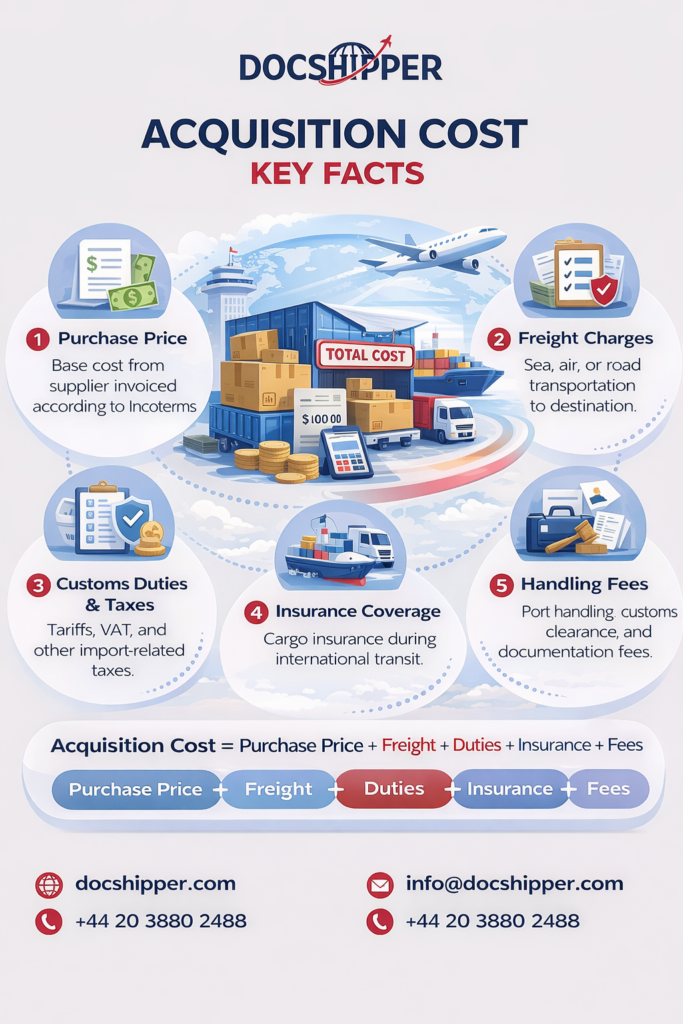
Key components of acquisition cost include:
- Purchase price – Base cost from supplier (FOB, EXW, or other Incoterms)
- International freight – Sea, air, or multimodal transportation expenses
- Customs duties and taxes – Import tariffs, VAT, excise taxes
- Insurance coverage – Cargo insurance during international transit
- Handling and clearance fees – Port charges, customs brokerage, documentation
Understanding Acquisition Cost Components
The landed cost formula provides the most accurate acquisition cost calculation. This methodology aggregates all expenses required to deliver goods to their final destination, creating a complete financial picture for procurement decisions.
Product cost forms the foundation but represents only 40-60% of total acquisition cost in international transactions. The Incoterm selected dramatically impacts this calculation. Under EXW (Ex Works), buyers assume all transportation and risk costs. Under DDP (Delivered Duty Paid), suppliers absorb these expenses, typically reflected in higher unit prices.
Freight charges vary significantly based on mode, volume, and route. Ocean freight operates on container rates (FCL) or volume/weight metrics (LCL). Air freight calculates by chargeable weight (actual or volumetric, whichever is greater). Seasonal demand fluctuations can increase freight costs by 200-300% during peak periods.
Customs duties depend on HS code classification, country of origin, and applicable trade agreements. The European Union applies MFN (Most Favored Nation) rates ranging from 0% to 17% for most goods, with preferential rates under FTAs. Misclassification risks penalties and delayed clearance. According to EU Customs regulations, importers bear responsibility for accurate declarations.
Insurance premiums typically cost 0.3-1.5% of cargo value, depending on goods type, route risk, and coverage scope. Marine cargo insurance protects against physical loss or damage during transit. High-value or fragile items require specialized coverage at premium rates.
At DocShipper, we calculate comprehensive acquisition costs for clients before shipment initiation, eliminating financial surprises and enabling accurate budget forecasting throughout the supply chain.
Practical Calculations & Data Examples
Understanding theoretical components means little without practical application. Real-world scenarios demonstrate how acquisition cost calculations influence business decisions and profitability outcomes.
Comparative Acquisition Cost Analysis
| Cost Component | China to EU (Sea) | Vietnam to US (Air) | Turkey to UK (Road) |
|---|---|---|---|
| Product Cost (FOB) | $10,000 | $8,000 | $12,000 |
| Freight | $2,500 | $4,800 | $1,200 |
| Insurance | $125 | $128 | $132 |
| Customs Duties (10%) | $1,000 | $800 | $1,200 |
| Clearance & Handling | $450 | $380 | $280 |
| Total Acquisition Cost | $14,075 | $14,108 | $14,812 |
| Cost Increase vs FOB | +40.75% | +76.35% | +23.43% |
This comparison reveals critical insights. Air freight from Vietnam increases total acquisition cost by 76% despite lower product prices. Ocean freight from China offers balanced economics for non-urgent shipments. Road transport from Turkey provides the lowest markup for European destinations.
Use Case: Electronics Importer Decision
A UK electronics retailer sources 500 laptops. Supplier A (China) quotes $400 FOB. Supplier B (Poland) quotes $480 DDP. Which offers better acquisition cost?
Supplier A calculation:
- Product cost: $400 × 500 = $200,000
- Sea freight (40ft container): $3,800
- Insurance (0.5%): $1,000
- UK import duty (0%): $0
- VAT (20% on $204,800): $40,960
- Customs clearance: $350
- Total: $246,110 ($492.22 per unit)
Supplier B calculation:
- Product cost DDP: $480 × 500 = $240,000
- All costs included in DDP price
- Total: $240,000 ($480 per unit)
Despite higher unit price, Supplier B delivers lower total acquisition cost and eliminates logistics complexity. This scenario demonstrates why total cost analysis outweighs unit price comparison.
DocShipper provides detailed acquisition cost breakdowns for all shipping scenarios, enabling data-driven supplier selection and route optimization that maximize your competitive advantage.
DocShipper Platform
Optimize Your Global Logistics with Cutting-Edge Solutions
Enhance efficiency, cut costs, and gain 24/7 visibility 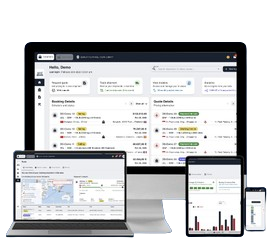 over your entire supply chain.
- Cut your shipping costs and maximize your margins
- Manage sourcing, freight, & customs on one platform
- Get real-time tracking and analytics
Conclusion
Mastering acquisition cost calculation transforms import operations from reactive cost management to strategic procurement planning. Companies that implement comprehensive cost analysis achieve superior margins, competitive pricing, and sustainable growth in international markets.
Need expert guidance on optimizing your acquisition costs? Contact DocShipper for a detailed analysis tailored to your supply chain requirements.
📚 Quiz
Test Your Knowledge: Acquisition Cost
1. What does "acquisition cost" represent in international logistics?
2. A supplier in Poland quotes $480 DDP per laptop, while a Chinese supplier quotes $400 FOB. After calculating all logistics costs, the Chinese supplier's total comes to $492 per unit. Which statement is correct?
3. On which value are customs duties typically calculated?
🎯 Your Result
📞 Free Quote in 24hFAQ | Acquisition Cost: Definition, Calculation & Practical Examples
Purchase price represents only the supplier's invoice amount. Acquisition cost includes all expenses to deliver goods to destination: freight, insurance, duties, taxes, and handling fees. Acquisition cost provides the true total investment per unit.
Incoterms define cost and risk transfer points. Under EXW, buyers pay all logistics costs separately. Under DDP, suppliers include these in the unit price. The Incoterm selected determines which party bears each cost component and impacts total acquisition cost structure.
Multiple factors cause variation: freight rate fluctuations, fuel surcharges, seasonal demand, route congestion, customs duty changes, insurance premiums, exchange rate movements, and handling fee differences. Each shipment encounters unique market conditions affecting total cost.
Optimize through: consolidating shipments for better freight rates, negotiating longer payment terms, selecting cost-effective Incoterms, utilizing trade agreements for duty reduction, comparing multiple carriers, implementing efficient customs clearance processes, and partnering with experienced freight forwarders.
Freight constitutes 15-35% of total acquisition cost for ocean shipments and 40-60% for air freight. The percentage varies based on product value density, shipping distance, mode selection, and current market rates. High-value, low-weight goods show lower freight percentages.
Customs duties calculate on CIF value (Cost, Insurance, Freight) – the product cost plus international freight and insurance to the destination port. Duties do not include domestic transportation, clearance fees, or destination handling charges incurred after customs clearance.
Chargeable weight is the greater of actual weight or volumetric weight. Volumetric weight formula: (Length × Width × Height in cm) ÷ 6000. Airlines charge based on whichever weight is higher, significantly impacting acquisition cost for bulky, lightweight items.
Common hidden costs include: demurrage and detention fees for delayed container returns, terminal handling charges, customs examination fees, documentation charges, quarantine inspections, certificate of origin costs, and currency conversion fees. These can add 5-15% to projected acquisition costs.
Review acquisition costs quarterly for stable routes and monthly for volatile markets. Freight rates fluctuate seasonally, customs duties change with trade policy updates, and exchange rates vary daily. Regular analysis ensures pricing accuracy and maintains profit margins.
No. Acquisition cost always equals or exceeds supplier price because it includes additional logistics expenses. If a quote appears lower, it likely reflects a different Incoterm (like DDP vs. EXW) where the supplier has internalized costs into their unit price.
Cargo insurance typically adds 0.3-1.5% of shipment value to acquisition cost. While seemingly minor, insurance protects against total loss scenarios. For a $100,000 shipment, insurance costs $300-$1,500 but provides coverage against potentially catastrophic financial losses.
HS code classification determines applicable customs duty rates. Incorrect classification can result in overpayment (higher duty rates) or underpayment (leading to penalties and interest). Accurate classification by experienced customs brokers optimizes acquisition cost and ensures regulatory compliance.
Need Help with
Logistics or Sourcing ?
First, we secure the right products from the right suppliers at the right price by managing the sourcing process from start to finish. Then, we simplify your shipping experience - from pickup to final delivery - ensuring any product, anywhere, is delivered at highly competitive prices.


Fill the Form
Prefer email? Send us your inquiry, and we’ll get back to you as soon as possible.
Contact us




