


In short ⚡
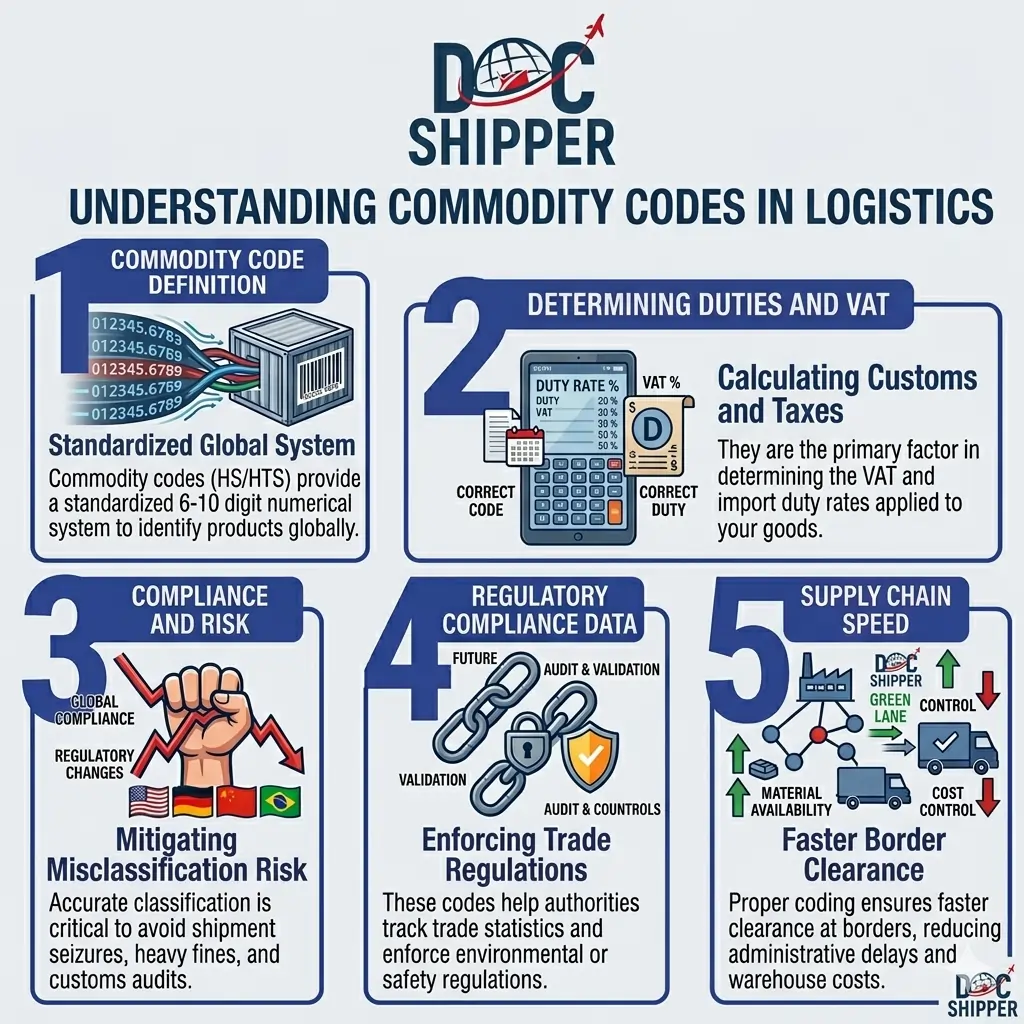
A Commodity Code is a standardized numerical classification used to identify goods in international trade. Based on the Harmonized System (HS), it enables customs authorities worldwide to categorize products, determine applicable duties, and ensure regulatory compliance. This code is essential for accurate customs declarations and smooth cross-border transactions.
Introduction
Misclassifying a product can result in shipment delays, financial penalties, or customs seizures. The commodity code eliminates ambiguity by providing a universal language for trade.
This classification system impacts every stage of the supply chain. From calculating import duties to verifying compliance with trade agreements, the commodity code serves as the foundation of international logistics.
Key characteristics of commodity codes include:
- Harmonized System (HS) foundation: A six-digit code recognized by 200+ countries
- National extensions: Countries add digits for domestic tariff schedules (e.g., 10-digit codes in the US)
- Hierarchical structure: Codes progress from general categories to specific products
- Regular updates: The World Customs Organization revises codes every five years
- Legal binding: Incorrect codes can void preferential trade agreements or trigger audits
Technical Framework & Regulatory Impact
The commodity code structure follows a precise hierarchy. The first two digits identify the chapter (product category), digits 3-4 specify the heading, and digits 5-6 define the subheading.
Tariff determination relies entirely on accurate classification. Each code corresponds to specific duty rates, which vary by country and product origin. Preferential rates under free trade agreements depend on correct commodity coding.
Regulatory compliance extends beyond tariffs. Certain codes trigger import licenses, health certificates, or environmental inspections. For example, food products require sanitary documentation, while electronics may need safety certifications.
Trade statistics depend on commodity codes for tracking import/export volumes. Governments use this data to negotiate trade agreements and monitor market trends. Businesses analyze code-level statistics to identify opportunities.
Binding Tariff Information (BTI) allows importers to request official classification rulings from customs authorities. This legal certainty protects against reclassification disputes. At DocShipper, we systematically verify commodity codes against BTI databases to prevent customs delays.
For authoritative guidance, consult the World Customs Organization Harmonized System, which maintains the global classification standard.
Practical Application & Classification Examples
Understanding commodity codes requires examining real-world scenarios. Classification errors often occur when products have multiple potential uses or combine materials.
| Product | HS Code (First 6 Digits) | Classification Logic |
|---|---|---|
| Cotton T-shirts | 6109.10 | Chapter 61 (knitted apparel), cotton material, T-shirt category |
| Laptop computers | 8471.30 | Chapter 84 (machinery), portable automatic data processing machines |
| Frozen salmon fillets | 0304.42 | Chapter 03 (fish), frozen fillets, Pacific salmon species |
| Wooden furniture (oak) | 9403.50 | Chapter 94 (furniture), wooden bedroom furniture |
| Lithium-ion batteries | 8506.50 | Chapter 85 (electrical equipment), lithium primary cells/batteries |
Case Study: A company importing “smart watches” initially classified them under 9102 (wristwatches). Customs reclassified them as 8517 (communication devices) due to their primary function. This increased the duty rate from 3.5% to 6.8%, costing €12,000 on a €175,000 shipment.
Multi-component products follow the General Rules for Interpretation (GRI). When a product contains multiple materials, classification depends on the component giving essential character. A leather-trimmed textile bag classifies based on the predominant material.
Country-specific extensions add complexity. The EU uses 8-digit TARIC codes, while the US employs 10-digit HTS codes. A bicycle classified as 8712.00 (HS) becomes 8712.00.15.00 in the US system, specifying wheel size and intended use.
Preferential origin requires matching commodity codes with rules of origin. A product may qualify for reduced duties under USMCA only if the correct code demonstrates substantial transformation occurred in a member country.
Prohibited/restricted codes identify goods requiring special permits. Code 9305 (weapons parts) triggers defense export controls, while 2710 (petroleum oils) may face environmental regulations. DocShipper’s compliance team cross-references codes against sanctioned goods lists before shipment.
Conclusion
Commodity codes form the backbone of international trade compliance. Accurate classification protects against costly delays, penalties, and regulatory violations while enabling preferential duty treatment.
Need expert assistance with product classification or customs compliance? Contact DocShipper for professional guidance tailored to your supply chain.
📚 Quiz
Test Your Knowledge: Commodity Code
Q1. What is the primary purpose of a Commodity Code in international trade?
Q2. A company imports smart watches and classifies them under HS code 9102 (wristwatches). Customs reclassifies them as 8517 (communication devices). Who bears the legal responsibility for the incorrect classification?
Q3. A textile bag features leather trim but is predominantly made of fabric. Under the General Rules for Interpretation (GRI), how should this product be classified?
🎯 Your Result
📞 Free Quote in 24hFAQ | Commodity Code: Definition, Classification & Practical Examples
The HS code is the international 6-digit foundation. Commodity codes extend this with additional national digits for tariff schedules and statistical tracking.
The World Customs Organization updates the Harmonized System every five years. The most recent revision occurred in 2022, with the next scheduled for 2027.
The importer is legally responsible for classification. Customs brokers or freight forwarders can assist, but final liability rests with the importer of record.
No. Each product receives a single code based on its essential character, composition, and function. Mixed shipments list separate codes for each distinct item.
Consequences include duty reassessment, penalties, shipment delays, or seizure. Intentional misclassification may result in criminal charges for customs fraud.
Consult your country's customs tariff database, use online classification tools, or request a Binding Tariff Information ruling from customs authorities.
Yes. Certain codes trigger dual-use export licenses or sanctions screening. Always verify codes against export control lists before shipping sensitive goods.
The first six digits (HS code) are standardized globally. Countries add national digits, creating variations like the 10-digit US HTS or 8-digit EU TARIC codes.
FTAs specify eligible products by commodity code. Incorrect classification may disqualify goods from preferential duty rates, even with valid certificates of origin.
Yes. Most customs authorities offer Binding Tariff Information (BTI) or similar programs. Rulings provide legal certainty and protection against reclassification for 3-5 years.
Software on physical media uses codes like 8523 (optical media). Electronically transmitted software typically falls outside tariff classification but may face VAT or digital service taxes.
Descriptions must enable customs to verify classification accuracy. Include material composition, intended use, and technical specifications matching the declared code.
Need Help with
Logistics or Sourcing ?
First, we secure the right products from the right suppliers at the right price by managing the sourcing process from start to finish. Then, we simplify your shipping experience - from pickup to final delivery - ensuring any product, anywhere, is delivered at highly competitive prices.


Fill the Form
Prefer email? Send us your inquiry, and we’ll get back to you as soon as possible.
Contact us




