


In short ⚡
Commodity Procurement Strategy is a structured approach to sourcing raw materials, goods, or standardized products that optimizes cost, quality, and supply chain reliability. It encompasses supplier selection, contract negotiation, risk management, and demand forecasting to secure competitive advantages in global trade operations.
Introduction
Many businesses struggle with volatile commodity prices, unreliable suppliers, and unpredictable delivery schedules. Without a robust procurement strategy, companies expose themselves to supply chain disruptions that can halt production and erode profit margins.
A Commodity Procurement Strategy addresses these challenges by establishing systematic processes for sourcing essential materials. In international logistics, this approach determines not only what you buy but how, when, and from whom—directly impacting competitiveness.
- Cost optimization through volume leveraging and market timing
- Risk mitigation via supplier diversification and hedging mechanisms
- Quality assurance through rigorous supplier qualification processes
- Supply continuity enabled by long-term contracts and strategic partnerships
- Compliance management ensuring adherence to trade regulations and sustainability standards
Strategic Mechanisms & Implementation
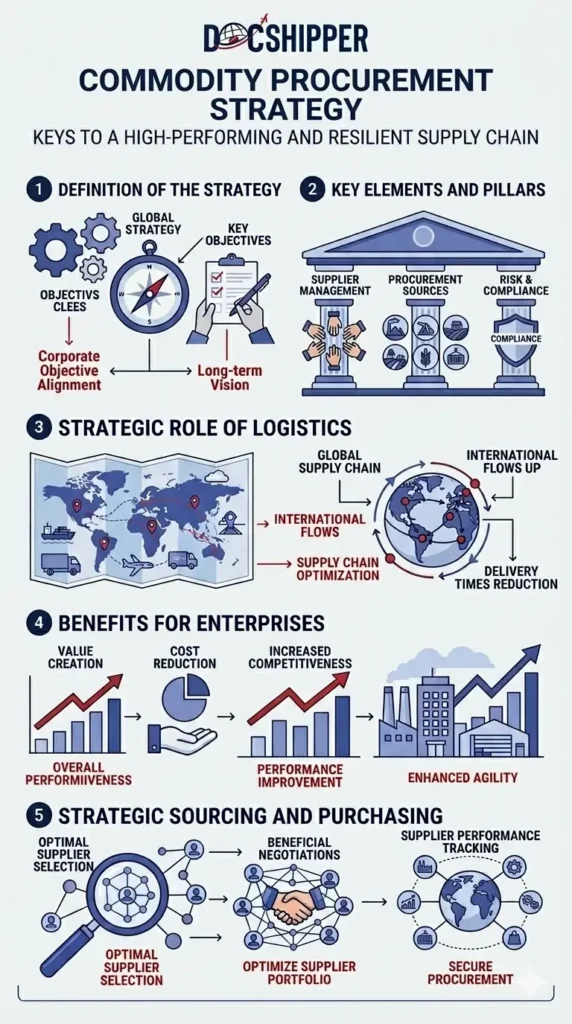
Effective commodity procurement operates on several interconnected principles. The foundation begins with category management, where commodities are grouped by characteristics, market dynamics, and strategic importance. This segmentation allows procurement teams to apply tailored approaches rather than one-size-fits-all methods.
Supplier relationship management forms the second pillar. This involves evaluating vendors not just on price but on reliability, financial stability, ethical standards, and innovation capacity. Leading organizations maintain tiered supplier portfolios with primary, secondary, and contingency sources to ensure continuity.
The third critical element is market intelligence. Procurement professionals monitor commodity indexes, geopolitical developments, currency fluctuations, and seasonal patterns. This data informs timing decisions—purchasing when markets favor buyers and securing contracts before anticipated price increases.
Contract structuring represents the tactical execution layer. Options include spot purchases for immediate needs, forward contracts locking in future prices, and framework agreements establishing terms while maintaining volume flexibility. Each instrument serves different risk-reward profiles.
At DocShipper, we integrate procurement strategy with logistics execution, ensuring that sourcing decisions align with shipping schedules, customs requirements, and destination market conditions. This holistic approach prevents the common disconnect between what’s purchased and what can actually be delivered profitably.
According to the World Trade Organization, strategic procurement practices can reduce total acquisition costs by 12-18% while improving supply chain resilience. The methodology requires continuous refinement as market conditions evolve.
Concrete Examples & Data Analysis
Consider a European electronics manufacturer sourcing lithium batteries from Asia. Without a structured strategy, they face spot market volatility averaging 23% quarterly price fluctuations. By implementing a commodity procurement strategy, they achieve measurable improvements across key metrics.
| Procurement Approach | Average Cost per Unit | Supply Reliability | Lead Time Variance |
|---|---|---|---|
| Spot Market Purchases | $47.30 | 68% | ±14 days |
| Strategic Procurement (Mixed) | $41.85 | 94% | ±4 days |
| Long-term Contracts + Hedging | $39.60 | 97% | ±2 days |
The data demonstrates a 16.3% cost reduction and dramatically improved predictability. The manufacturer allocated 60% of volume to annual contracts, 25% to quarterly agreements, and retained 15% spot market flexibility for opportunistic buying.
Use Case: Agricultural Commodity Sourcing
A food processing company in North America sources organic soybeans. Their strategy incorporated:
- Dual sourcing: 70% from US Midwest farms, 30% from Canadian suppliers
- Forward contracts: Locked 80% of annual needs at harvest time when prices dip 12-15%
- Quality protocols: Third-party certification requirements reducing defect rates from 8% to 1.2%
- Logistics integration: Coordinated procurement with rail capacity reservations, cutting transportation costs by $0.18/bushel
- Sustainability tracking: Blockchain-verified sourcing meeting EU organic import standards
This comprehensive approach yielded $2.4 million annual savings on a $18 million procurement budget while ensuring uninterrupted production across three facilities. The strategy also positioned them favorably for emerging carbon-neutral supply chain requirements.
Conclusion
A well-executed Commodity Procurement Strategy transforms purchasing from a transactional function into a competitive advantage. It balances cost efficiency with supply security, enabling businesses to navigate volatile global markets confidently.
Need expert guidance on developing your procurement strategy or integrating it with international logistics? Contact DocShipper for tailored solutions that align sourcing, shipping, and customs clearance into one seamless operation.
📚 Quiz
Commodity Procurement Strategy
Q1 — What best defines a Commodity Procurement Strategy?
Q2 — A company locks 100% of its annual commodity volume into long-term fixed contracts. What is the primary risk of this approach?
Q3 — A food manufacturer sources 100% of its organic soybeans from a single US supplier. Which action best aligns with a sound Commodity Procurement Strategy?
🎯 Your Result
📞 Free Quote in 24hFAQ | Commodity Procurement Strategy: Definition, Implementation & Concrete Examples
Any material representing significant spend, supply risk, or quality criticality benefits from strategic procurement. This includes metals, chemicals, agricultural products, energy, electronics components, and textiles.
Commodity procurement focuses on standardized, market-traded goods with price volatility. It emphasizes market timing, hedging, and supplier diversification rather than just vendor negotiation.
Accurate forecasting enables optimal contract timing, volume commitments, and inventory positioning. It prevents both shortage crises and excess stock costs while improving negotiating leverage.
Multi-sourcing typically reduces risk but may sacrifice volume discounts. Best practice involves a primary supplier for 60-70% of volume with qualified alternatives for continuity and competitive pressure.
Trade policies, tariffs, sanctions, and political instability directly affect availability and cost. Effective strategies incorporate geopolitical risk assessment and contingency sourcing from multiple regions.
Key indicators include total cost of ownership, supply continuity rate, contract compliance percentage, supplier quality scores, and savings versus market baseline pricing.
Annual comprehensive reviews are standard, with quarterly adjustments for volatile commodities. Major market shifts or supply chain disruptions trigger immediate reassessment.
Absolutely. Even modest volumes benefit from structured supplier evaluation, contract planning, and market monitoring. Cooperative purchasing groups extend small buyers' leverage.
Modern solutions include e-procurement platforms, spend analytics software, supplier relationship management systems, and AI-driven market intelligence tools that automate data collection and scenario modeling.
Responsible sourcing now includes environmental impact assessment, ethical labor verification, and carbon footprint tracking. Many buyers require supplier certification to recognized sustainability standards.
Fixed contracts can lock buyers into above-market prices if commodity values decline. Balanced strategies maintain flexibility through shorter-term agreements and spot market participation.
Exchange rate volatility can eliminate procurement savings. Strategies address this through currency hedging instruments, multi-currency contracting, or natural hedges matching revenue and cost currencies.
Need Help with
Logistics or Sourcing ?
First, we secure the right products from the right suppliers at the right price by managing the sourcing process from start to finish. Then, we simplify your shipping experience - from pickup to final delivery - ensuring any product, anywhere, is delivered at highly competitive prices.


Fill the Form
Prefer email? Send us your inquiry, and we’ll get back to you as soon as possible.
Contact us




