


In short ⚡
Contract Logistics refers to the outsourcing of resource management activities to a third-party logistics provider (3PL) through long-term agreements. This encompasses warehousing, inventory management, order fulfillment, distribution, and value-added services. Companies leverage contract logistics to optimize supply chain efficiency, reduce capital expenditure, and focus on core business activities while benefiting from specialized expertise and scalable infrastructure.Mechanisms & Strategic Expertise
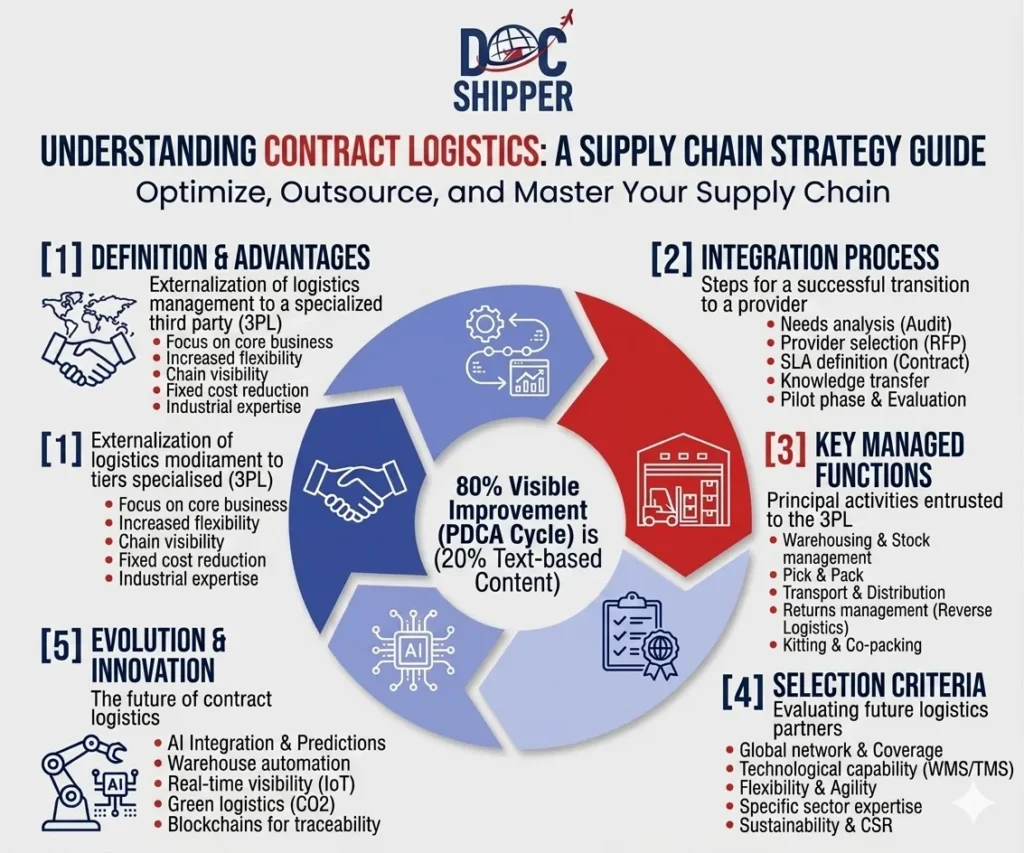
Contract logistics operates through a structured framework where the logistics provider assumes operational responsibility for defined supply chain functions. The relationship begins with a comprehensive assessment of the client’s requirements, followed by solution design, implementation, and continuous optimization.
The contractual framework typically includes service level agreements (SLAs) that define performance metrics such as order accuracy rates, on-time delivery percentages, and inventory accuracy. These agreements create accountability and establish clear expectations for both parties. Penalties for underperformance and bonuses for exceeding targets are common elements.
From a legal perspective, contract logistics agreements must address liability allocation, insurance requirements, data protection compliance (particularly GDPR in Europe), and termination conditions. The International Chamber of Commerce provides standardized frameworks for international logistics contracts that help mitigate cross-border legal risks.
Technology integration forms the operational core of modern contract logistics. Warehouse Management Systems (WMS) coordinate inventory movements, order picking, and stock replenishment. Transportation Management Systems (TMS) optimize routing and carrier selection. Integration with client ERP systems ensures real-time visibility and seamless information flow across the supply chain.
The operational model can take several forms: dedicated facilities serving a single client, multi-client shared warehousing for cost efficiency, or hybrid solutions combining both approaches. Each model offers different trade-offs between customization, cost, and flexibility. At DocShipper, we analyze your specific volume patterns and service requirements to recommend the optimal contract logistics structure for your business.
Risk management represents a critical component. Contract logistics providers implement business continuity plans, maintain appropriate insurance coverage, and establish redundancy in critical operations. This protects clients from disruptions caused by natural disasters, labor disputes, or system failures.
Concrete Examples & Operational Data
Understanding contract logistics becomes clearer through practical applications and quantifiable outcomes. The following examples demonstrate how businesses leverage these partnerships to achieve measurable results.
Use Case: E-commerce Fulfillment
A mid-sized online retailer selling consumer electronics across Europe faced challenges with order fulfillment during peak seasons. By partnering with a contract logistics provider, they achieved:
- 67% reduction in order processing time (from 48 hours to 16 hours)
- 99.2% order accuracy compared to their previous 94% internal rate
- 40% cost savings during off-peak months through shared warehousing
- Same-day dispatch capability for orders received before 2 PM
- Scalability to handle 300% volume increase during Black Friday without additional infrastructure investment
Comparative Analysis: In-House vs. Contract Logistics
| Factor | In-House Operations | Contract Logistics |
|---|---|---|
| Initial Investment | $2-5M for warehouse facility | $50-100K setup fees |
| Monthly Operating Cost | Fixed: $150K+ regardless of volume | Variable: $80-200K based on activity |
| Technology Systems | $500K-1M WMS implementation | Included in service fees |
| Scalability Timeline | 6-12 months for expansion | 2-4 weeks for capacity increase |
| Expertise Access | Limited to hired staff | Industry best practices & specialists |
Industry-Specific Applications
Automotive sector: Just-in-time delivery coordination with 99.8% on-time performance, sequenced parts delivery directly to assembly lines, and reverse logistics for defective components.
Pharmaceutical industry: Temperature-controlled storage (2-8°C) with continuous monitoring, GDP-compliant handling procedures, serialization services for regulatory compliance, and expiry date management reducing waste by 35%.
Fashion retail: Cross-docking operations reducing handling time by 60%, garment-on-hanger systems maintaining product quality, seasonal inventory management with 45-day storage flexibility, and omnichannel fulfillment supporting both B2B and B2C channels.
DocShipper provides contract logistics solutions tailored to your industry requirements, ensuring compliance with sector-specific regulations while optimizing operational efficiency across your supply chain.
Conclusion
Contract logistics transforms supply chain operations from a cost center into a strategic advantage. By partnering with specialized providers, businesses gain flexibility, reduce capital requirements, and access expertise that would be prohibitively expensive to develop internally.
Need guidance on implementing contract logistics for your business? Contact DocShipper for a customized assessment of your logistics requirements.
📚 Quiz
Test Your Knowledge: Contract Logistics
1. What best defines Contract Logistics?
2. A company signs a contract logistics agreement. How quickly can the provider typically scale up warehouse capacity compared to building in-house infrastructure?
3. An e-commerce retailer wants to handle a 300% volume spike during Black Friday without investing in new infrastructure. Which approach best describes contract logistics in this scenario?
🎯 Your Result
📞 Free Quote in 24hFAQ | Contract Logistics: Definition, Operations & Concrete Examples
Contract logistics agreements typically span 3 to 5 years, allowing sufficient time for return on initial setup investments and process optimization. Shorter contracts (1-2 years) exist for project-based needs, while some strategic partnerships extend 7-10 years with renewal options.
Contract logistics involves deeper integration, longer-term commitments, and customized solutions compared to transactional 3PL services. It includes strategic planning, dedicated resources, technology integration with client systems, and collaborative process improvement rather than simply executing predefined tasks.
Pricing typically includes storage fees (per pallet or square meter), handling charges (inbound/outbound), order processing fees, value-added service costs, technology access fees, and transportation when included. Most providers offer hybrid models combining fixed monthly minimums with variable activity-based charges.
Yes, comprehensive contract logistics providers manage international freight forwarding, customs brokerage, documentation preparation, duty payment, and compliance with import/export regulations. This end-to-end capability simplifies cross-border operations and reduces the number of vendor relationships you must manage.
Standard technology includes Warehouse Management Systems (WMS), Transportation Management Systems (TMS), order management platforms, inventory tracking with barcode/RFID scanning, client portal access for real-time visibility, and integration capabilities with ERP systems like SAP, Oracle, or Microsoft Dynamics.
Implementation timelines vary based on complexity. Simple warehousing operations can launch in 4-6 weeks, while comprehensive solutions involving custom technology integration, specialized equipment, or regulatory approvals may require 3-6 months. Phased implementations allow partial operations to begin while completing full deployment.
Termination clauses specify transition procedures, typically including 60-90 days notice, inventory transfer protocols, data handover requirements, and final billing procedures. Providers maintain your inventory security during transition and coordinate seamlessly with your new logistics partner or in-house operations.
Liability is defined in the service agreement and typically limited to specific amounts per kilogram or item unless higher-value insurance is purchased. Providers maintain cargo liability insurance, but clients often carry their own inventory insurance for comprehensive protection. Clear documentation of condition at receipt is essential.
Yes, scalability is a core advantage. Providers allocate flexible warehouse space, adjust labor resources, and modify processing capacity based on forecasted demand. Pricing structures typically include base fees for minimum capacity with variable charges for peak volumes, allowing cost alignment with business cycles.
Essential KPIs include order accuracy rate (target: 99.5%+), on-time shipment percentage (95%+), inventory accuracy (99%+), order cycle time, damage rates, returns processing time, and system uptime. Advanced agreements add customer satisfaction scores, cost-per-order metrics, and continuous improvement targets.
Reputable providers implement ISO 27001 information security standards, encrypted data transmission, role-based access controls, regular security audits, GDPR compliance for European operations, and non-disclosure agreements. Physical security includes surveillance systems, access restrictions, and inventory segregation for multi-client facilities.
Common value-added services include kitting and assembly, quality inspection, labeling and repackaging, product customization, returns processing and refurbishment, cross-docking operations, postponement strategies for market-specific configuration, and specialized handling for hazardous materials or temperature-sensitive products.
Need Help with
Logistics or Sourcing ?
First, we secure the right products from the right suppliers at the right price by managing the sourcing process from start to finish. Then, we simplify your shipping experience - from pickup to final delivery - ensuring any product, anywhere, is delivered at highly competitive prices.


Fill the Form
Prefer email? Send us your inquiry, and we’ll get back to you as soon as possible.
Contact us




