


In short ⚡
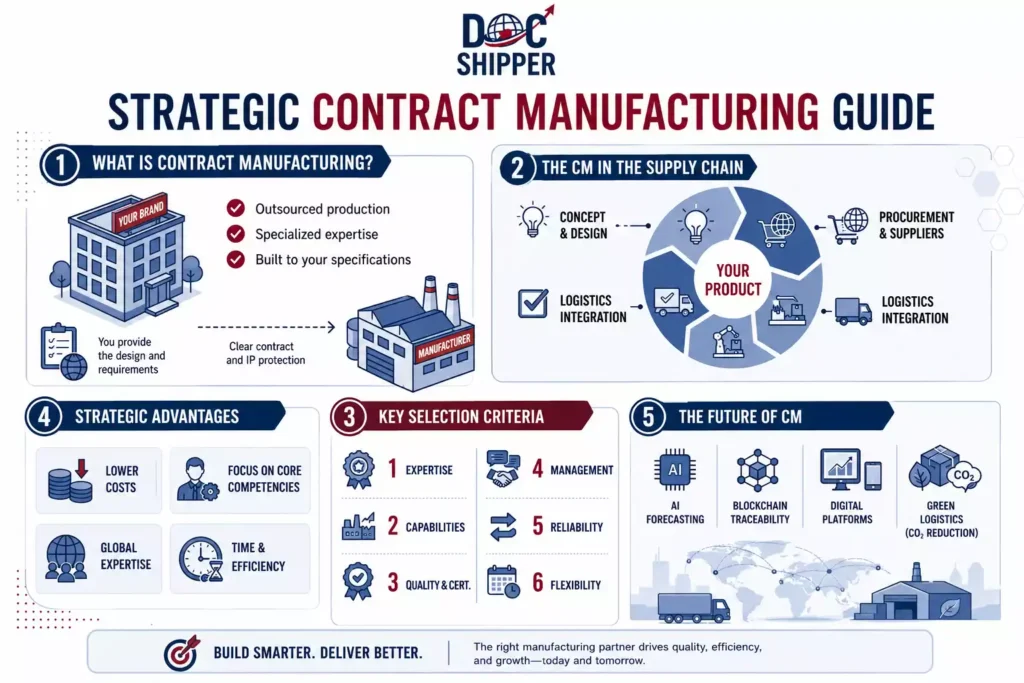
A contract manufacturer is a third-party company that produces goods on behalf of another business under a contractual agreement. This outsourcing model allows brands to focus on design, marketing, and distribution while delegating production to specialized facilities, reducing capital investment and operational complexity in global supply chains.
Introduction
Many businesses struggle with a critical question: should we manufacture in-house or outsource production? This decision impacts capital allocation, quality control, and market responsiveness. Contract manufacturing has become essential in international trade, enabling companies to scale rapidly without owning production facilities.
In global logistics, contract manufacturers serve as strategic partners in the supply chain. They bridge the gap between product development and market delivery, particularly crucial for import/export operations where regulatory compliance and production efficiency directly affect competitiveness.
Key characteristics of contract manufacturing include:
- Production outsourcing: External facilities handle manufacturing based on client specifications
- Intellectual property protection: Contractual agreements safeguard designs and formulas
- Scalability: Flexible production volumes without fixed infrastructure costs
- Specialized expertise: Access to advanced equipment and technical know-how
- Quality assurance: Certified processes meeting international standards (ISO, GMP, FDA)
In-Depth Analysis & Manufacturing Expertise
Contract manufacturing operates through several distinct models. Original Equipment Manufacturing (OEM) involves producing goods exactly to client specifications, where the contractor has no design input. Original Design Manufacturing (ODM) allows manufacturers to offer pre-designed products that clients rebrand. Private labeling represents a simpler arrangement where existing products receive custom branding.
The contractual framework governs critical elements. Minimum Order Quantities (MOQ) determine production viability, typically ranging from 500 to 10,000 units depending on product complexity. Lead times encompass sampling (2-4 weeks), tooling (4-8 weeks), and bulk production (6-12 weeks). Payment structures commonly follow 30% deposit, 70% before shipment arrangements.
Quality control mechanisms are paramount. Third-party inspections verify production standards at pre-production, during production, and pre-shipment stages. Compliance certifications ensure adherence to destination market regulations—CE marking for Europe, FCC for electronics in the United States, CCC for China market access.
Intellectual property protection requires robust Non-Disclosure Agreements (NDA) and manufacturing agreements detailing ownership rights. According to the WTO TRIPS Agreement, international IP protection varies significantly by jurisdiction, making legal safeguards essential.
At DocShipper, we systematically verify manufacturer certifications and conduct factory audits before establishing partnerships. Our procurement specialists negotiate contracts that protect client interests while ensuring production feasibility, particularly for complex import/export operations requiring regulatory compliance across multiple jurisdictions.
Concrete Examples & Industry Data
Contract manufacturing dominates several industries with measurable impact. The global contract manufacturing market reached $382 billion in 2023, with projected growth to $548 billion by 2030 at 5.3% CAGR, according to industry research.
| Industry Sector | Typical MOQ | Lead Time | Cost Savings vs In-House |
|---|---|---|---|
| Electronics | 1,000-5,000 units | 10-16 weeks | 30-40% |
| Cosmetics | 500-3,000 units | 8-12 weeks | 25-35% |
| Textiles/Apparel | 300-1,000 units | 6-10 weeks | 40-50% |
| Pharmaceuticals | 10,000+ units | 12-20 weeks | 20-30% |
| Food & Beverage | 5,000-15,000 units | 8-14 weeks | 35-45% |
Use Case: European Startup Launching Skincare Line
A French beauty brand partnered with a Korean contract manufacturer for a natural skincare range. Initial investment: €45,000 (tooling, formulation, first production run of 3,000 units). Per-unit cost: €8.50 including packaging. Comparable in-house production would require €280,000 facility investment plus €12.20 per-unit cost. The contract manufacturing approach saved €156,000 in year one while accessing specialized Korean formulation expertise and achieving K-Beauty certification.
Critical Success Factors:
- Transparent communication: Weekly production updates prevent delays
- Quality benchmarks: Pre-agreed AQL standards (typically 2.5-4.0 for consumer goods)
- Payment security: Escrow services or Letters of Credit for initial orders
- Logistics coordination: Incoterms clarity (FOB, CIF, DDP) prevents cost surprises
- Regulatory alignment: Manufacturer familiarity with destination market requirements
Conclusion
Contract manufacturing represents a strategic approach to production that reduces capital risk while accessing specialized capabilities. Success depends on rigorous partner selection, clear contractual frameworks, and proactive quality management throughout the supply chain.
Need expert guidance on contract manufacturing partnerships or international sourcing? Contact DocShipper for comprehensive procurement and logistics support tailored to your import/export requirements.
📚 Quiz
Test Your Knowledge: Contract Manufacturer
1. What best defines a contract manufacturer?
2. A brand wants a manufacturer to produce a product using the brand's own proprietary design, with no design input from the manufacturer. Which contract manufacturing model applies?
3. A European startup places its first order with an overseas contract manufacturer. To protect both parties financially, which payment and security arrangement is most appropriate?
🎯 Your Result
📞 Free Quote in 24hFAQ | Contract Manufacturer: Definition, Benefits & Concrete Examples
Contract manufacturing involves custom production to your specifications, while private labeling uses existing products with your branding. Contract manufacturing offers greater customization but requires higher MOQs and longer lead times.
Execute comprehensive NDAs before sharing specifications, register intellectual property in manufacturing jurisdictions, use trusted intermediaries for initial contacts, and conduct factory audits to assess IP protection practices.
Standard terms include 30% deposit upon order confirmation, 70% before shipment. First-time partnerships may require Letters of Credit or escrow arrangements to protect both parties.
Expect 2-4 weeks for sampling, 4-8 weeks for tooling/mold creation, then 6-12 weeks for bulk production. Total timeline from initial contact to delivery typically ranges 12-24 weeks for new products.
Essential certifications include ISO 9001 (quality management), industry-specific standards (GMP for pharmaceuticals, FDA registration for food/cosmetics), and destination market compliance (CE, FCC, RoHS as applicable).
Some manufacturers accept low MOQs (100-500 units), but per-unit costs increase significantly. Prototype specialists and local manufacturers typically offer more flexibility than large Asian facilities.
Key risks include intellectual property theft, quality inconsistencies, communication barriers, delayed deliveries, and regulatory non-compliance. Mitigation requires thorough vetting, clear contracts, and ongoing quality control.
Use verified platforms (Alibaba Gold Suppliers, ThomasNet), attend trade shows, request client references, conduct factory audits, verify certifications independently, and consider third-party sourcing agents for initial partnerships.
Essential clauses cover product specifications, quality standards, MOQs, pricing, payment terms, lead times, IP ownership, confidentiality, liability limitations, dispute resolution, and termination conditions.
You remain the importer of record responsible for duties and compliance. Ensure manufacturers provide accurate HS codes, commercial invoices, and certificates of origin. Incoterms determine when ownership and liability transfer.
Conduct pre-production inspections (confirm samples match specifications), during-production checks (verify processes at 20-30% completion), and pre-shipment inspections (AQL sampling before shipping). Third-party inspection services provide independent verification.
Switching is contractually complex and costly. Agreements typically include minimum order commitments and tooling ownership clauses. Plan transitions between production runs, secure tooling rights, and allow 3-6 months for new manufacturer onboarding.
Need Help with
Logistics or Sourcing ?
First, we secure the right products from the right suppliers at the right price by managing the sourcing process from start to finish. Then, we simplify your shipping experience - from pickup to final delivery - ensuring any product, anywhere, is delivered at highly competitive prices.


Fill the Form
Prefer email? Send us your inquiry, and we’ll get back to you as soon as possible.
Contact us




