In short ⚡
| Aspect | Fulfillment center | Distribution center |
|---|---|---|
| Main role | Picks, packs and ships individual ecommerce orders (parcels, D2C). | Replenishes stores, wholesalers or other DCs with cases and pallets. |
| Single-unit or small orders, high SKU mix. | Bulk shipments, full cases, truckload-style flows. | |
| Cost focus | Pick-pack labor, packaging, returns, last mile delivery. | Space utilization, pallet handling, linehaul and dock scheduling. |
| Best when | You compete on delivery speed and customer experience. | Your margin depends on freight efficiency and bulk flow management. |
We hope you’ll find this article genuinely useful, but remember, if you ever feel lost at any step, whether it’s finding a supplier, validating quality, managing international shipping or customs, DocShipper can handle it all for you!
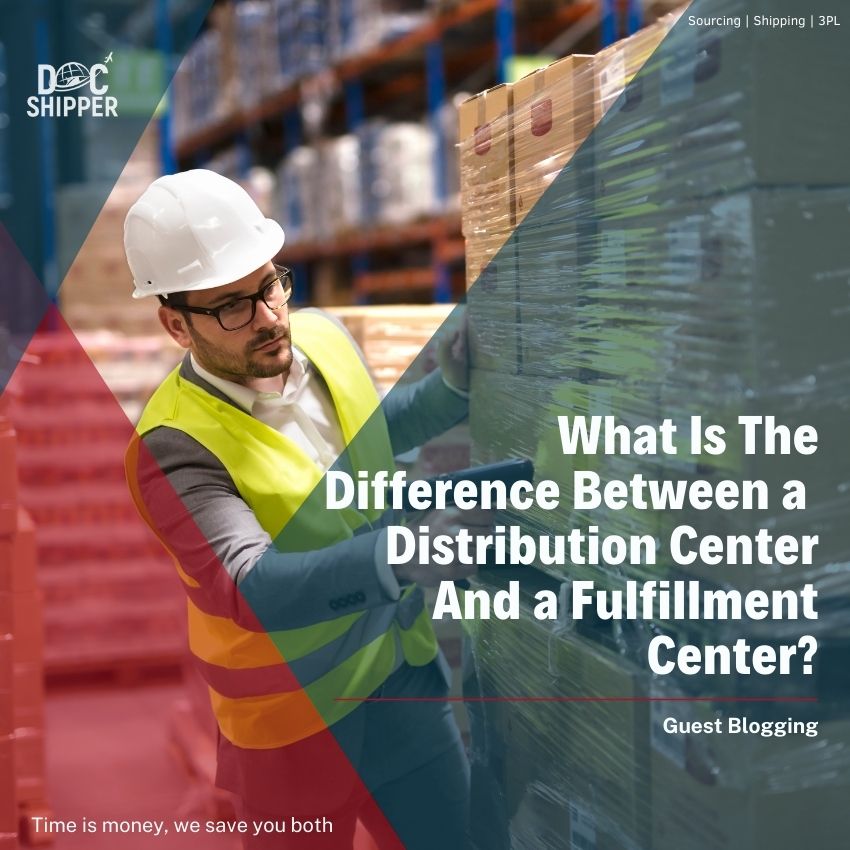
Fulfillment center vs distribution center: what each one actually does
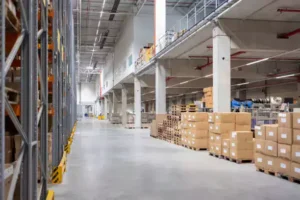
The fulfillment center vs distribution center debate gets messy because people throw in “warehouse” like it’s the same thing.
Here’s the thing, all three store goods, but they don’t serve the same moment in your supply chain management, or the same customer promise.
From experience at DocShipper, you’ll notice fast that the wrong choice doesn’t just raise warehousing fees, it ripples into lead time, transit time, returns handling, and even how you plan freight forwarding and freight consolidation from the port of loading.
- Warehouse: primarily warehousing and storage, often slower-moving inventory and simpler flows.
- Fulfillment center: built for each-order picking, packing, labeling, and last mile delivery handoff.
- Distribution center: built for bulk replenishment, store feeds, B2B networks, and often cross docking.
Think of it like this, a warehouse holds, a fulfillment center ships to shoppers, a distribution center feeds other nodes in your network.
Mini workflow to picture the difference:
Import to consumer flow: Supplier pickup, export docs, ocean freight or air freight, customs clearance, inbound receiving, pick and pack, carrier label, shipment tracking, last mile delivery.
Import to network flow: Supplier pickup, multimodal transport, inbound receiving, pallet storage, allocate to wholesalers or stores, outbound linehaul by road freight or rail freight, cross dock or store backroom receiving.
Checklist, so you don’t mislabel your operation:
- If you ship single-unit orders daily, you’re in fulfillment territory.
- If you ship pallets and cases to stores, marketplaces, or distributors, you’re in distribution territory.
- If you mostly hold inventory while waiting for sales or production, you’re closer to classic warehousing.
- If your goods sit under duty suspension, ask about a bonded warehouse setup and the impact on cash flow.
DocShipper Info
We map your supply chain from inbound freight to final delivery, so you choose the right structure, not just the closest warehouse.
How a fulfillment center works in direct-to-consumer and omnichannel logistics
In the fulfillment center vs distribution center question, a fulfillment center is the one obsessed with your shopper’s unboxing moment.
You’re not just storing cartons, you’re running inventory management at SKU level, with fast picking, tight cut-off times, and daily carrier pickups.
We’ve seen a common scenario, you negotiate EXW with a supplier, then your cartons arrive with mixed SKUs and vague labels.
Suddenly your pickers can’t batch-pick, mis-picks spike, and your “2-day delivery” promise turns into a customer support fire.
A modern fulfillment operation typically includes:
- Inbound cargo handling: appointment booking, pallet/carton receiving, damage checks, put-away.
- Order processing: wave planning, pick paths, kitting, bundles, gift notes.
- Packing compliance: right-size packaging, inserts, barcodes, marketplace requirements.
- Carrier handoff: label generation, manifesting, daily linehaul to parcel hubs.
- Reverse logistics: returns triage, refurbish, restock, or quarantine.
And yes, the paperwork still matters even if you “just sell online”.
If you import, you’ll live with documents like the bill of lading, packing list, and commercial invoice, because one mismatch can delay inbound and blow up your launch date.
Step-by-step workflow for D2C fulfillment:
1) Book international shipping, ocean freight for cost or air freight for speed.
2) Prepare import export documents, verify HS code, tariff classification, and estimate customs duties.
3) Run customs clearance with a customs brokerage partner, then deliver inbound to the fulfillment site.
4) Receive, count, and slot SKUs, then activate them in the WMS for shipment tracking.
5) Pick, pack, label, and dispatch to last mile carriers based on your SLA.
At DocShipper, we plug in as your 3PL provider and logistics provider across the upstream and downstream, from freight forwarding agent coordination to fulfillment-ready labeling, so your inbound flow doesn’t sabotage your outbound promise.
How a distribution center supports bulk replenishment and B2B networks
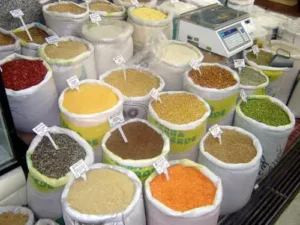
In the fulfillment center vs distribution center comparison, a distribution center is the engine room for replenishment.
You’re moving pallets and cases, optimizing dock-to-stock, and feeding stores, wholesalers, or regional nodes with predictable, high-volume outbound.
We had a client shipping to multiple retailers who assumed a fulfillment setup would be “close enough”.
Then they got hit with chargebacks because the outbound wasn’t built for retailer routing guides, pallet labels, and appointment windows at the DC doors.
A distribution center typically focuses on:
- Bulk receiving and put-away: fast unloading, pallet racking, lot control.
- Replenishment planning: safety stock, reorder points, store allocation.
- Cross docking: inbound pallets get staged and shipped out quickly with minimal storage.
- Linehaul optimization: road freight, rail freight, or multimodal transport for cost per unit.
- B2B compliance: ASN, pallet configuration, labeling, booking dock appointments.
This is also where your freight rates and contracts start to look different.
You’ll negotiate a freight contract for recurring lanes, use a freight broker or freight forwarding agent for capacity, and rely on tight cargo manifest accuracy to avoid claims.
Step-by-step workflow for distribution replenishment:
1) Consolidate supplier cargo, then book international shipping to your region.
2) Clear customs, validate HS code and tariff classification, and manage duty payment timing.
3) Receive in bulk, store pallets, and plan replenishment waves.
4) Build outbound loads by route and delivery windows, then dispatch via road or rail.
5) Track shipments, manage PODs, and handle exceptions and freight insurance claims if needed.
Authority note you can trust, the Council of Supply Chain Management Professionals often frames DCs as network nodes designed to optimize flow and service levels, not just storage.
Checklist to confirm you need a distribution center:
- You ship cases/pallets, not individual parcels.
- You serve stores, wholesalers, or other DCs with scheduled deliveries.
- You benefit from cross docking and full-truckload style dispatch.
- You need predictable allocation rules and replenishment cycles, not per-order personalization.
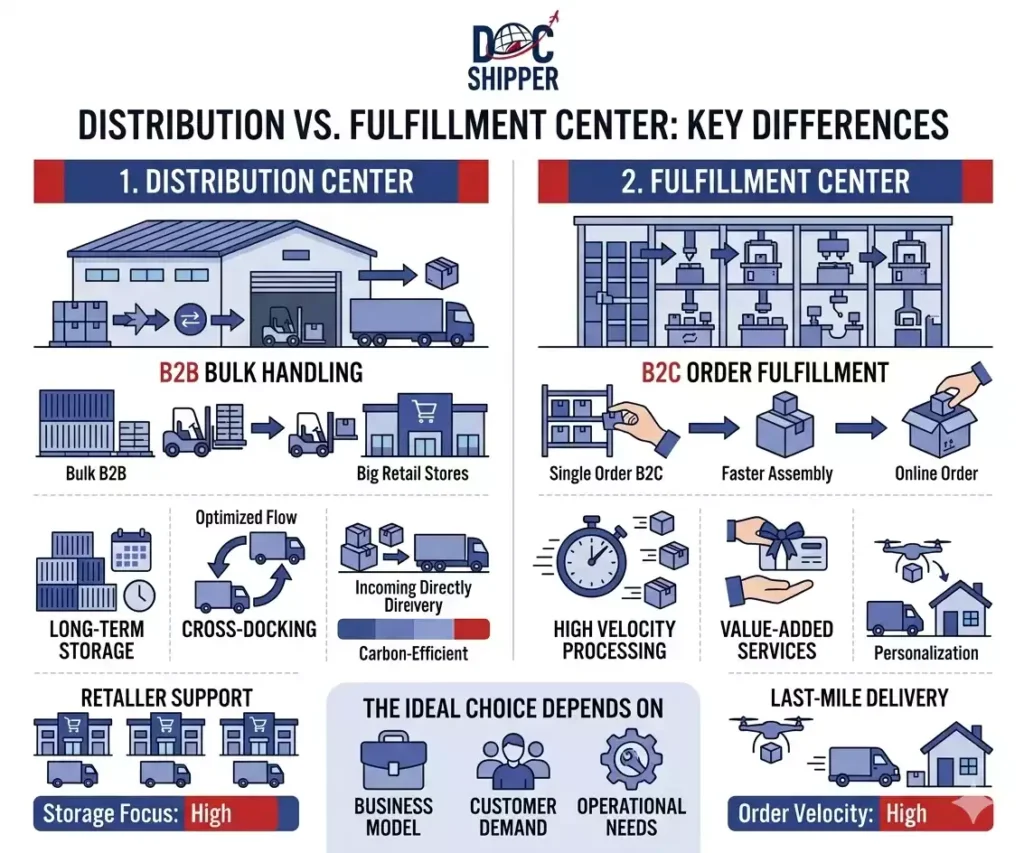
Key differences between fulfillment and distribution centers that impact your costs and delivery times
Once you understand the basics, the fulfillment center vs distribution center choice becomes a math problem, cost per order, service level, and how fast your inventory turns.
But it’s also an operations problem, because the same inbound container can behave very differently depending on where you send it.
| Dimension | Fulfillment center | Distribution center |
| Typical outbound | Single orders, parcels, D2C | Cases/pallets, B2B, store replenishment |
| Cost drivers | Pick-pack labor, packaging, returns, last mile | Space, pallets handling, linehaul, dock scheduling |
| Speed focus | Cut-off times, same-day dispatch | Planned waves, route efficiency |
| Inventory profile | High SKU count, fast turnover | Bulk stock, steadier flows |
| International impact | Inbound delays hit customer SLAs immediately | Inbound delays hit store availability and replenishment cycles |
Quick workflow to estimate total time-to-customer:
Supplier ready date, export handling, main transport (ocean freight or air freight), port dwell, customs clearance, inbound drayage, receiving time, order processing time, last mile delivery.
Checklist to keep your cost model honest:
- Count handling touches, each touch is labor and error risk.
- Separate inbound costs from outbound costs, don’t mix them in one “logistics” bucket.
- Model stockouts, not just average lead time, variability is where margins disappear.
- Include customs duties and clearance fees, especially if Incoterms shift who pays what.
DocShipper Advice
We simulate lead times, handling touches, and duties to reveal the true cost per order or per pallet.
Storage, inventory turnover, and order profiles: short-term vs long-term use
In the fulfillment center vs distribution center decision, inventory turnover is the silent deal-breaker.
If your SKUs move fast, a fulfillment center thrives, if your pallets sit longer, a distribution center or warehouse layout usually wins.
We’ve watched brands over-order to “save” on freight quotation price per unit, then pay for it in storage.
The ocean freight looked cheap, but the long dwell time in racks turned into slow cash conversion and messy cycle counts.
- Fulfillment storage: optimized for fast access, forward pick locations, frequent replenishment from reserve.
- Distribution storage: optimized for pallet density, stable locations, and wave-based movements.
- Order profile: parcels and mixed carts vs full cases and route-based pallets.
Don’t skip the import side details.
Incoterms define who controls pickup and risk, and your choice affects not only the freight rate but also whether you can enforce labeling and carton packing rules at origin.
Step-by-step way to decide based on turnover:
1) Segment SKUs by velocity, fast, medium, slow.
2) Map outbound type, parcels vs pallets.
3) Assign storage mode, forward pick for fast movers, reserve/bulk for slow movers.
4) Recalculate total landed and stored cost, including duties, handling, and shrink.
Looking for a Reliable Shipping & Sourcing Partner?
Technology, automation, and location strategy in fulfillment vs distribution
The fulfillment center vs distribution center gap widens when you look at technology and network placement.
Fulfillment leans on WMS rules for pick accuracy and shipping speed, distribution leans on throughput, dock scheduling, and transport optimization.
We’ve seen what happens when you pick a site just because rent is cheap.
Your linehaul gets longer, last mile zones get pricier, and suddenly you’re paying extra on every parcel, every day, for the same product.
- Fulfillment tech: slotting algorithms, batch picking, carrier rate shopping, automated label printing, returns portals.
- Distribution tech: yard management, appointment systems, wave planning, load building, EDI for B2B customers.
- Location strategy: fulfillment wants proximity to demand for last mile delivery, distribution wants efficient access to highways, ports, and regional hubs.
If you import at scale, tech also means document discipline.
Accurate HS code, clean commercial invoice values, and a consistent customs brokerage process keep your cargo from sitting while fees stack up.
Step-by-step network sanity check:
1) List your demand zones and required delivery times.
2) Choose mode mixes, ocean freight for base stock, air freight for spikes, road freight for regional moves.
3) Compare sites by total cost, not rent, include carrier zones, drayage, and labor.
4) Confirm the facility can handle your packaging, labeling, and cargo handling requirements.
5) Lock SOPs for shipment tracking, exception handling, and freight insurance claims.
Authority note, the World Customs Organization’s guidance on tariff classification reminds you why clean data and consistent HS code use matters, a small error can create delays that no automation can “fix” downstream.
When a fulfillment center is the better choice for your ecommerce or retail brand

If you sell directly to consumers, speed and flexibility drive your revenue. In a fulfillment center vs distribution center comparison, fulfillment wins when your business depends on fast, accurate, small-parcel shipping.
You should prioritize a fulfillment center when your order profile is fragmented and volatile. This is typical in DTC ecommerce, marketplaces, crowdfunding campaigns, and omnichannel retail.
- High volume of individual orders, low average units per order
- Need for same-day or next-day shipping
- Frequent returns and exchanges management
- Custom packaging, kitting, or promotional inserts
- Strong integration with Shopify, Amazon, WooCommerce, or ERP systems
A fulfillment center is built around picking efficiency and real-time inventory visibility. You gain scalability without investing in your own warehouse labor and WMS infrastructure.
However, you must monitor cost per order carefully. Storage fees, pick and pack fees, and last-mile shipping charges can erode your margin if your average order value is too low.
| Criteria | Why fulfillment fits |
| Order frequency | Daily, continuous flow of small orders |
| Inventory turnover | Fast moving SKUs, short storage duration |
| Customer promise | 2-day or faster delivery expectations |
| Operational complexity | Returns, exchanges, personalization |
At DocShipper, we often recommend fulfillment solutions when you are scaling internationally but want to stay asset-light. We manage supplier coordination, freight, customs clearance, and last-mile setup so your products flow seamlessly into your fulfillment network.
If your competitive advantage is speed and customer experience, fulfillment is usually the right operational backbone.

DocShipper Info
We integrate freight, customs, and fulfillment into one coordinated flow, so your parcels ship fast without losing control of upstream logistics.
When a distribution center delivers more value than a fulfillment center
A distribution center becomes more relevant when your logistics model is bulk-oriented. In the fulfillment center vs distribution center debate, distribution wins when you replenish stores, wholesalers, or regional hubs.
You benefit from a distribution center when shipments move in pallets or full truckloads rather than parcels. Your objective is cost efficiency per unit, not per order.
- B2B shipments to retailers or franchise networks
- Large batch replenishment to regional warehouses
- Longer storage periods with predictable demand
- Lower SKU customization requirements
- Focus on transport optimization and freight consolidation
A distribution center is designed for cross-docking, pallet handling, and transport routing. You reduce handling touches and improve freight economies of scale.
This model is especially powerful if you import containers from Asia and redistribute domestically. We frequently structure this flow for clients sourcing in China who ship full containers to a central DC before nationwide allocation.
| Criteria | Why distribution fits |
| Shipment size | Pallets, cartons, full truckloads |
| Customer type | Retail chains, wholesalers, distributors |
| Cost driver | Transport optimization and bulk storage |
| Operational focus | Inventory positioning and regional allocation |
If your margin depends on freight efficiency and bulk flow management, a distribution center will outperform a fulfillment center.
DocShipper Advice
We design central DC strategies with freight consolidation and routing optimization to cut unit transport costs and protect margins.
Conclusion
You should not choose between a fulfillment center and a distribution center based on trends. You should decide based on your order structure, customer promise, sourcing geography, and margin constraints.
- Choose a fulfillment center if you ship high volumes of individual ecommerce orders and compete on delivery speed
- Choose a distribution center if you move pallets and replenish stores or regional hubs
- Analyze your inventory turnover before committing to long-term storage models
- Calculate total landed cost, including pick and pack, storage, and transport
- Align your logistics model with your sourcing strategy and Incoterms
At DocShipper, we design your supply chain end-to-end, from supplier negotiation in Asia to warehousing strategy and last-mile delivery. You gain a structure that matches your growth stage, not just a warehouse solution.
FAQ | Fulfillment center vs distribution center: how to choose the right model for your supply chain
- A warehouse mainly stores goods, often for longer periods, with limited added services.
- A fulfillment center is designed for ecommerce and D2C: it stores inventory at SKU level, then picks, packs, labels, and ships individual orders to end customers, often with fast cut-off times and returns handling.
- A distribution center focuses on bulk flows: it receives pallets or cases and redistributes them to stores, wholesalers, or other DCs, often using cross-docking and full-truckload moves.
Ask yourself these questions:
- What do you ship most often?
- Mostly parcels / single orders → fulfillment center.
- Mostly pallets / cases in bulk → distribution center.
- Who are your main customers?
- Shoppers (D2C, marketplaces, subscriptions) → fulfillment.
- Retailers, wholesalers, regional hubs → distribution.
- What’s your customer promise?
- Same-day / next-day delivery and personalized orders → fulfillment.
- Scheduled, high-volume replenishment at lowest cost per unit → distribution.
In many growing brands, the answer is a mix: fulfillment for ecommerce orders, distribution for B2B flows.
A fulfillment center helps you:
- Scale without owning a warehouse or hiring your own ops team.
- Meet fast delivery promises thanks to:
- Optimized picking and packing
- Daily parcel carrier pickups
- Smart inventory placement close to demand
- Improve customer experience with:
- Custom packaging, kitting, inserts, gift notes
- Accurate order tracking and proactive updates
- Structured returns and exchanges flows
The key is to monitor unit economics: storage, pick & pack, and last-mile costs vs your average order value and margin.
A distribution center is usually the better choice when you:
- Ship in pallets or full truckloads to:
- Retail chains
- Franchise networks
- Wholesalers or other DCs
- Need to:
- Cross-dock containers into outbound trucks quickly
- Hold bulk stock and release it in planned waves
- Optimize transport cost per unit rather than speed per order
If your profitability is driven by freight efficiency and smooth replenishment, a DC will typically outperform a fulfillment-focused setup.
They affect different parts of your cost and lead-time equation:
- Fulfillment center impact:
- Shorter order processing time and cut-offs
- Higher labor and packaging cost per order
- Lower parcel transit time if close to demand zones
- Distribution center impact:
- Lower cost per unit through full-truckload and route optimization
- Longer average delivery time to the final shopper (more nodes in between)
- Better control of store availability and replenishment cycles
To compare models, break down:
- Inbound: freight, customs, drayage, receiving.
- Storage: space, handling, dwell time.
- Outbound: labor per order or per pallet, transport mode, last-mile or linehaul.
For any new site, evaluate:
- Demand and service level:
- Where your customers or stores are located
- Required delivery times (D+1, D+2, weekly, etc.)
- Transport and access:
- Distance to ports, airports, and major highways
- Parcel carrier zones and road/rail connectivity
- Operating conditions:
- Labor availability and cost
- Real estate cost vs extra transport cost
- Facility capability (automation, WMS/TMS integration, labeling and packing compliance)
Run scenarios on total landed cost and time-to-customer, not just warehouse rent, before committing.
Need Help with
Logistics or Sourcing ?
First, we secure the right products from the right suppliers at the right price by managing the sourcing process from start to finish. Then, we simplify your shipping experience - from pickup to final delivery - ensuring any product, anywhere, is delivered at highly competitive prices.
Fill the Form
Prefer email? Send us your inquiry, and we’ll get back to you as soon as possible.
Contact us