The future of the trucking industry: how technology, policy, and people will reshape freight

  • admin 27 Min
  • Published on December 19, 2022 Updated on April 13, 2026
img

In short ⚡

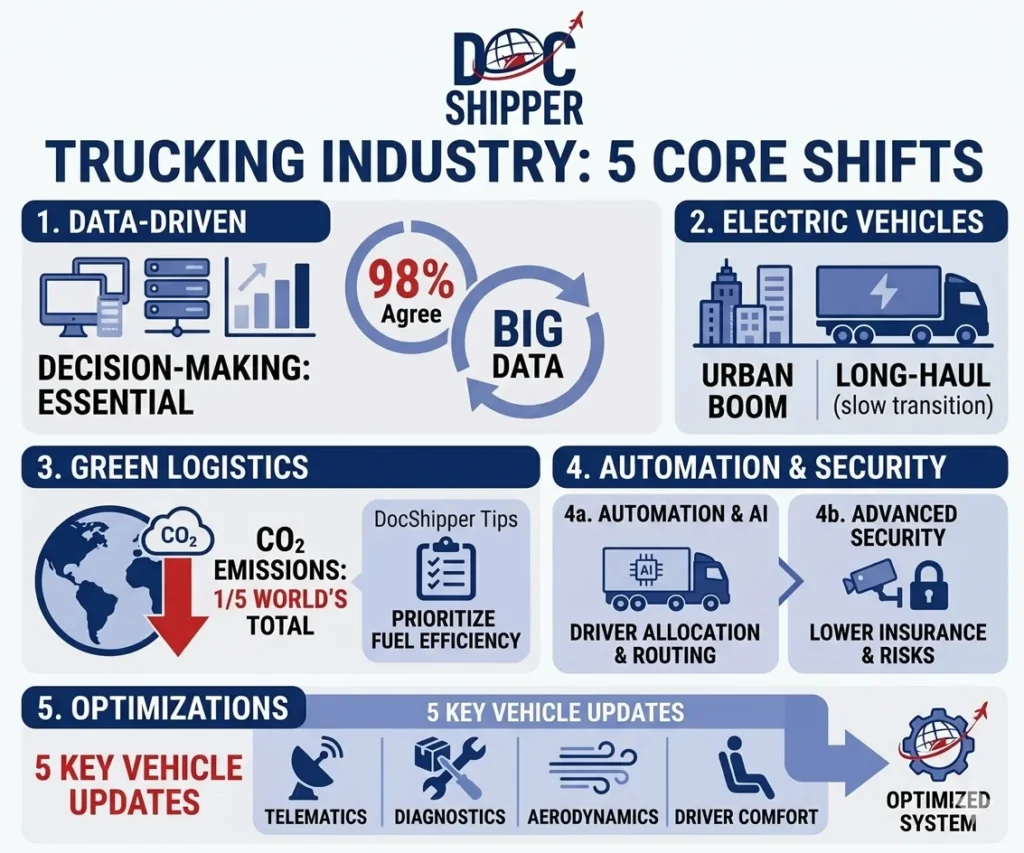
The future of the trucking industry will be shaped by rising costs, energy transition, digitization, tighter regulation, and shifting labor markets.

Fleets and shippers will rely on mixed low-emission powertrains, automation and AI in dispatch, connected telematics, stronger compliance, and improved driver retention to build resilient, data-driven, and sustainable freight networks.

We hope you’ll find this article genuinely useful, but remember, if you ever feel lost at any step, whether it’s finding a supplier, validating quality, managing international shipping or customs,  DocShipper can handle it all for you!

Free shipping quote 24h      I want to talk to a sourcing expert

Why the future of trucking matters for the economy and your business
The future of trucking industry isn’t a “carrier problem”, it’s a supply chain reality that hits your lead time, your landed cost, and your customer promises.

If you’re a consignor trying to keep just-in-time delivery working, or a consignee juggling dock appointments, you’ll notice fast that even small road haulage disruptions ripple into warehousing, cross-docking, and last-mile delivery.

Here’s the thing, trucking sits between everything, ocean freight arrivals, rail freight ramps, air freight cutoffs, and final delivery windows.

One missed pickup can force a rushed freight consolidation plan, a premium spot rate, or a painful conversation about proof of delivery that never got captured cleanly.

To make this practical, here’s a quick view of how trucking changes show up in real logistics decisions.

What changes in trucking What you feel in your shipments What you can do about it
Higher fuel and labor costs More volatile rate negotiation, tighter transport contract terms Lock lanes, index fuel, review accessorials, redesign pickup windows
More compliance and safety tech Stricter appointment discipline, more documented tracking and tracing Standardize POD workflow, align shipper instructions with carrier SOPs
Electrification and new powertrains New constraints on route length, payload, and depot charging Shift to regional networks, optimize load planning, plan charging dwell time
Automation and better dispatch Fewer empty miles, faster exception handling, better ETA accuracy Integrate TMS data, enforce barcode scan events, share dock schedules

You’ve probably dealt with carriers who “confirmed” a pickup, then disappeared when the market tightened.

We’ve seen that exact moment turn an easy domestic leg into a cascading mess, missed customs clearance slot at the border, storage fees, and a domino effect on a multimodal plan.

According to UNCTAD discussions on transport and trade resilience, inland capacity and reliability are a core piece of keeping trade moving, and trucking is often the weakest link when volatility spikes.

To keep control as the industry shifts, you’ll want a simple decision checklist you can apply lane by lane.

  • Service criticality: does this lane feed a production line or a retail launch with zero slack?
  • Network fit: can you redesign pickup and delivery windows to reduce detention and re-deliveries?
  • Data readiness: can you capture milestones like pickup, in-transit, and proof of delivery without manual chasing?
  • Risk posture: do you need cargo insurance upgrades for theft hotspots and high-value loads?

DocShipper Alert

Inland volatility can derail your entire supply chain.
Secure capacity and stabilize your lanes with DocShipper, before one missed pickup disrupts everything.

Key forces reshaping the trucking industry in the next decade

The future of trucking industry over the next 5 to 10 years will be shaped less by one “big invention” and more by a handful of forces hitting at the same time, cost pressure, energy transition, digitization, and tighter compliance.

You’ll feel it in daily operations, tender acceptance, appointment discipline, and how reliably you can connect containerization at the port to inland road haulage.

We once watched a shipper win a great linehaul rate and still lose money.

The catch was hidden accessorials, detention at a cross-dock, and poor pallet quality that slowed unloading, which then wrecked the rest of the weekly schedule.

To keep your planning grounded, here are the forces you should track and how they typically translate into action.

  • Cost inflation and capacity cycles: you’ll need sharper rate negotiation and clearer transport contract terms.
  • Energy transition: you’ll redesign routes, payload targets, and depot strategy as EV and alternative fuels scale.
  • Digitization: you’ll move from “where’s my truck?” calls to structured tracking and tracing events.
  • Security and cargo theft: you’ll invest more in geofencing, secure yards, and stricter chain-of-custody.
  • Intermodal growth: you’ll blend rail freight with regional dray and rethink freight consolidation.
  • Regulation and compliance: you’ll see more documentation discipline that also affects brokers and forwarders upstream.

If you’re moving cross-border freight, those forces connect directly to tariff classification, HS code accuracy, and how fast your customs broker can clear the load.

A late truck can mean a missed exam slot, a missed cutoff, or a storage bill you didn’t budget for, even when the bill of lading paperwork is perfect.

Use this workflow when you’re deciding where to invest first, tech, network changes, or procurement discipline.

  • Step 1: Map your lanes by service risk, cost per mile, theft exposure, and detention frequency.
  • Step 2: Identify which legs are truly flexible, time windows, mode shift options, and buffer stock.
  • Step 3: Set data standards for milestones, pickup, arrival, departure, POD, exceptions.
  • Step 4: Re-bid with clearer scope, accessorial definitions, and performance KPIs.
  • Step 5: Pilot, measure, then scale, don’t roll new tech across the whole fleet at once.

For context, the World Bank regularly highlights how logistics performance depends on infrastructure and service quality, and trucking reliability is a big piece of that puzzle.

DocShipper Info

Cost, compliance, and digitization are converging fast.
Align your contracts and data standards with our logistics experts to stay ahead of market shifts.

Electric, alternative-fuel, and sustainable trucks: where green trucking is headed

The future of trucking industry is going greener, but not in a clean, linear way.

You’ll see mixed fleets for years, electric for certain lanes, alternative fuels for others, and diesel sticking around where the math still wins.

We’ve seen shippers treat “green trucking” like a marketing box to tick, then get stuck when payload drops and dwell time rises.

The smart move is to treat sustainability like a network design problem, not a slogan.

Short-haul electrification, hydrogen, and low-emission powertrains

Last peak season, we saw a regional operation trial an electric drayage loop, port to yard to cross-dock.

It worked, until a charger queue formed and the team lost a full turn per day, which quietly wrecked capacity.

In the future of trucking industry, electrification usually wins first in short-haul and repeatable routes where you control dwell time and charging access.

Hydrogen and other low-emission powertrains may fit heavier loads or longer ranges, but you’ll plan around fueling infrastructure and maintenance maturity.

Before you commit a lane to a new powertrain, run this quick checklist to avoid the common operational traps.

  • Route reality: actual miles, elevation, temperature, and traffic, not the optimistic map distance.
  • Payload impact: how battery or tank weight affects palletization density and max gross weight.
  • Charging or fueling access: depot availability, queue risk, and downtime cost.
  • Service recovery: what happens when the vehicle is down, do you have a diesel backup plan?

The International Energy Agency frequently frames electrification as a system challenge, and trucking is a perfect example, the vehicle is only half the story.

DocShipper Advice

Green fleets require network redesign, not marketing slogans.
Model your routes, dwell time, and charging strategy with DocShipper before committing high-value lanes.

Aerodynamics, lightweight design, and fuel-efficient powertrain innovation
Tip: If you want immediate wins while the industry transitions, chase what reduces energy per mile, not what looks exciting in a press release.

In the future of trucking industry, aerodynamics, low-rolling-resistance tires, idle reduction, and lightweighting often beat big-bang changes because you can deploy them faster.

You can also tighten how you build loads, bad load planning creates drag, wasted cube, and extra trips you didn’t need.

To choose improvements without getting lost in vendor claims, compare them by payback and operational impact.

Lever Best for Watch-outs
Aero kits and fairings Highway miles, steady speeds Damage risk at docks, maintenance discipline
Lightweight trailers Payload-sensitive lanes, dense cargo Upfront capex, repair network availability
Idle reduction and APUs Long dwell times, temperature-controlled operations Driver adoption, service intervals
Powertrain calibration Mixed fleets, faster deployment Warranty and compliance constraints

When you connect those savings to your broader logistics outsourcing strategy, you can stabilize rates without squeezing carriers into unsafe behavior.

DocShipper Info

Incremental efficiency upgrades can unlock fast ROI.
Audit your load planning and energy usage with our team to reduce costs without operational disruption.

Regulations, ESG pressure, and the business case for sustainable fleets

What’s going to force your hand, regulation, customers, or pure cost?

In the future of trucking industry, the answer is often “all three”, and you’ll need to translate ESG targets into lane-level actions and contracts.

Even if your core business isn’t transportation, your tenders, scorecards, and reporting requirements influence what carriers buy and how they operate.

To keep ESG from turning into vague promises, use this simple workflow when you structure a green freight program.

  • Step 1: Define emissions boundary, well-to-wheel vs tank-to-wheel, and lane coverage.
  • Step 2: Set measurable KPIs, gCO2e/ton-mile, empty-mile ratio, on-time performance.
  • Step 3: Update procurement terms, data sharing, audit rights, and improvement cadence.
  • Step 4: Pilot lanes where you control dwell time, then scale to harder routes.

The ICC has long emphasized clear contractual frameworks in global trade, and the same mindset helps here, define responsibilities, data, and liabilities clearly.

This also ties into international moves, where incoterms choices shape who controls inland legs and who benefits from sustainability investments.

DocShipper Alert

ESG targets without clear contracts create risk exposure.
Define responsibilities, data flows, and liabilities with DocShipper before scaling your green freight program.

Automation, AI, and self-driving trucks: what’s realistic and when

The future of trucking industry will absolutely use more automation, but you shouldn’t expect a sudden switch to driverless freight everywhere.

You’ll see incremental autonomy, smarter planning, and tighter exception handling long before you see fully autonomous trucks doing complex urban delivery.

We’ve seen teams buy shiny “AI dispatch” tools and still fail because appointment data was messy and drivers weren’t supported.

Tech doesn’t replace basics, it amplifies them.

The road to autonomous trucks: from driver assistance to full automation

One carrier we worked alongside rolled out advanced driver assistance and expected instant safety gains.

Instead, false alerts annoyed drivers, and adoption dropped until the fleet tuned settings and retrained properly.

In the future of trucking industry, the realistic path is driver assistance first, then supervised automation on limited corridors, and only later broader autonomy where rules and infrastructure allow it.

You’ll also need to rethink liability, incident reporting, and how you document shipments when something goes wrong mid-route.

To keep expectations grounded, here’s a simple maturity ladder you can use in planning discussions.

  • Level 1: Driver assistance, lane keeping, braking support, safety alerts.
  • Level 2: Highway automation in constrained scenarios, driver monitors and intervenes.
  • Level 3: Hub-to-hub concepts, controlled lanes, structured handoff processes.
  • Level 4: Wider autonomy, still limited by weather, edge cases, and regulation.

The OECD has repeatedly highlighted that automation adoption depends on regulation, safety evidence, and labor transitions, not just technical capability.

DocShipper Info

Automation succeeds only with clean data and clear processes.
Prepare your lanes and compliance framework with DocShipper before investing in autonomous solutions.

AI in dispatch, routing, and predictive maintenance

Tip: Start with AI where it saves you money today, routing discipline, dwell-time reduction, and maintenance planning.

In the future of trucking industry, AI will shine in dispatch because it can react faster to real-world constraints, traffic, HOS rules, dock schedules, and weather.

Predictive maintenance also reduces breakdowns that blow up delivery windows and trigger expensive recovery moves.

To operationalize AI without chaos, use this checklist before you roll out a tool across lanes.

  • Data inputs: do you have clean timestamps for pickup, arrival, unload, and POD?
  • Exception rules: who approves reroutes, and what are the thresholds?
  • Integration: can the tool connect to your TMS, WMS, and customer visibility portal?
  • Human override: can dispatchers and drivers flag wrong suggestions fast?

This connects directly to freight execution, better routing reduces missed airway bill cutoffs at the airport, prevents demurrage from late container pickup, and keeps LCL and FCL flows predictable.

How driver roles, skills, and safety practices will evolve

Bold reality: even with automation, you’ll still rely on skilled drivers, the job will change, not disappear.

In the future of trucking industry, drivers become more like mobile operators managing tech, compliance, security, and customer interface at docks.

You’ll also see more structured safety practices, digital coaching, and tighter documentation because insurers and regulators will demand it.

To prepare your operation, follow this step-by-step workflow for evolving the driver role without breaking service.

  • Step 1: Update SOPs for tech use, ADAS alerts, device handling, and escalation paths.
  • Step 2: Train on dock processes, seal checks, photo evidence, and proof of delivery capture.
  • Step 3: Implement safety feedback loops, near-miss reporting, coaching cadence, measurable goals.
  • Step 4: Align incentives with safety and service, not just miles driven.

The ISO approach to management systems is a useful mental model here, standardize, measure, improve, and make performance repeatable.
DocShipper Advice

Evolving driver roles require structured SOPs and training.
Standardize safety, documentation, and performance metrics with DocShipper to keep service levels stable.

Connected trucks, telematics, and next‑generation GPS

The future of trucking industry is connected, and you’ll stop thinking of GPS as a dot on a map.

You’ll treat visibility like a data product that feeds customer updates, inventory planning, billing accuracy, and dispute resolution.

We’ve watched a consignee chargebacks dispute drag on for weeks because nobody could prove when the truck arrived at the gate.

Once telematics milestones were in place, the argument disappeared, and so did the admin time.

From GPS to telematics platforms: real-time tracking and diagnostics

When a shipper first upgrades from GPS pings to telematics, the “wow” moment is usually diagnostics.

In the future of trucking industry, engine health, tire pressure, door events, and harsh braking data will support fewer failures and better ETAs.

That matters for freight forwarders too, because late arrivals trigger missed connections in multimodal transport and expensive rework in freight brokerage.

To make telematics useful instead of noisy, you’ll want to standardize the few events that actually matter to customers.

  • Pickup confirmed: timestamp plus location, linked to shipment reference.
  • In-transit updates: exception-only alerts, not constant pings.
  • Arrival at delivery: geofence event, gate timestamp, dock assignment if available.
  • POD captured: signature or photo, seal status, damage notes.

The WCO encourages stronger data quality and visibility for cross-border flows, and telematics helps when you’re coordinating inland legs with inspections and release times.

DocShipper Info

Visibility should eliminate disputes, not create noise.
Deploy milestone-based telematics with DocShipper to strengthen billing accuracy and cross-border coordination.

IoT, 5G, and data analytics for smarter, safer fleet operations

Tip: Treat IoT and 5G as enablers for better decisions, not gadgets to install because “everyone’s doing it.”

In the future of trucking industry, higher bandwidth and more sensors will sharpen route risk scoring, theft prevention, and temperature compliance for sensitive cargo.

Data analytics will also improve freight forwarding planning, especially when you’re syncing inbound containers, outbound distribution, and cross-docking capacity.

Before you scale connected tech, use this checklist to avoid expensive data projects that never get adopted.

  • Define the decision: what action will change when the data changes?
  • Set owners: who watches alerts at 2 a.m., and who can authorize intervention?
  • Secure the flow: device security, access control, and audit trails for incident review.
  • Measure outcomes: fewer claims, lower detention, better on-time, reduced empty miles.

The World Economic Forum often frames connected logistics as a resilience lever, and you’ll feel that most when disruption hits and you need fast, evidence-based decisions.

DocShipper Advice

Connected tech must drive measurable decisions.
Design actionable dashboards with DocShipper to reduce claims, detention, and empty miles during disruptions.

Digital fleet management and operations in a high-cost environment

The future of trucking industry profitability will be decided in your back office as much as on the road. Fuel volatility, insurance premiums, driver wages, and equipment costs are squeezing margins, and you’re probably feeling that pressure already.

In this environment, digital fleet management is no longer optional. It’s the difference between reacting to cost spikes and controlling them with data-driven decisions.

Fleet management software, integrations, and control over costs

We once audited a fleet that was using five disconnected systems for dispatch, fuel cards, maintenance, payroll, and GPS tracking. No one had a full view of cost per mile. After integrating everything into a single fleet management software stack, they uncovered idle time losses worth six figures per year.

Here’s the thing, in the future of trucking industry, disconnected tools will quietly drain your margins.

When you implement a modern fleet management platform, you’re not just buying software. You’re building a control tower for:

  • Real-time cost per mile tracking
  • Fuel consumption and route optimization
  • Preventive maintenance scheduling
  • Driver performance analytics
  • Digital document management and proof of delivery

Before you invest, run through this checklist to avoid expensive integration mistakes.

  • Does the system integrate with your TMS and ERP?
  • Can you connect fuel cards and telematics natively?
  • Is the reporting customizable for financial audits?
  • Does it support API connections for future expansion?
  • Is cybersecurity aligned with recognized standards such as ISO guidance?

The International Transport Forum regularly highlights how digitalization improves cost transparency across freight networks. You’ll see that companies who centralize data consistently outperform those who don’t.

From experience, the biggest savings often come from small adjustments. Reducing average idle time by just 10 minutes per truck per day can transform your annual P&L.

DocShipper Alert

Disconnected systems silently erode your margins.
Centralize fleet, fuel, and financial data with DocShipper to regain control over cost per mile.

Using data to improve asset utilization, insurance, and risk management

Data is your most underused asset in the future of trucking industry. Most fleets collect telematics data but never fully exploit it.

Ask yourself, do you know your true asset utilization rate per tractor and trailer?

With structured analytics, you can improve:

  • Trailer-to-tractor ratios
  • Empty mile reduction
  • Turnaround time at docks
  • Maintenance forecasting accuracy
  • Driver risk scoring for insurance negotiations

We worked with a mid-size carrier whose insurance premiums kept rising despite a stable accident record. By presenting telematics-based safety scores and predictive maintenance logs to insurers, they renegotiated a double-digit reduction.

The workflow you should follow is simple but powerful:

Step 1: Centralize operational and financial data. Step 2: Define KPIs such as cost per mile, utilization rate, and incident frequency. Step 3: Automate monthly performance dashboards. Step 4: Use data in negotiations with insurers and financiers.

The future belongs to fleets that treat analytics as a strategic lever, not a reporting afterthought.


DocShipper Info

Insurers reward fleets that prove performance with data.
Leverage telematics analytics with DocShipper to renegotiate premiums and optimize asset utilization.

Driver experience, labor market shifts, and the future of trucking jobs

You can deploy all the technology in the world, but the future of trucking industry still depends on people. Driver shortages, aging workforce trends, and rising expectations are reshaping the labor market faster than many anticipated.

You’ve probably struggled with retention. So has almost everyone else.

Looking for a Reliable Shipping & Sourcing Partner?

We handle the entire sourcing process, supplier research, negotiation, production, and inspections, so you can focus on what matters most: growing your business.

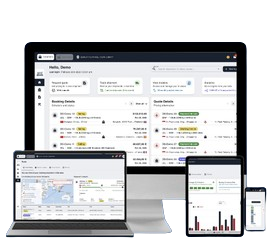
DocShipper Platform

One platform. Your entire supply chain

Sourcing, freight, customs & documents — all centralised, all visible, 24/7.

Solving driver shortages with retention, training, and better working conditions

One fleet we supported had a 70 percent annual turnover rate. Exit interviews revealed the real issue wasn’t pay, it was unpredictable schedules and poor communication.

If you want to stay competitive in the future of trucking industry, focus on retention before recruitment.

Here’s what consistently works:

  • Predictable routing and home-time planning
  • Transparent performance-based incentives
  • Continuous training on digital tools and safety
  • Clear career paths into dispatch or supervisory roles
  • Open communication channels with management

According to the International Labour Organization, improving working conditions is one of the most sustainable ways to stabilize transport labor markets globally.

Before launching new hiring campaigns, assess your internal situation using this quick checklist.

  • Do drivers have clear KPIs and bonus structures?
  • Is onboarding fully digital and standardized?
  • Do you provide ongoing skills training for new technologies?
  • Are schedules predictable at least two weeks in advance?

Retention is cheaper than constant recruitment. You already know that, but execution makes the difference.

DocShipper Advice

Retention outperforms constant recruitment.
Redesign schedules, incentives, and training with DocShipper to stabilize your workforce before scaling hiring.

Safety technology, comfort, and support systems for professional drivers

What if safety technology becomes your main competitive advantage?

Advanced Driver Assistance Systems, fatigue monitoring, and collision avoidance are no longer luxury features. In the future of trucking industry, they will be standard expectations.

You should prioritize:

  • Lane departure and automatic emergency braking
  • Driver fatigue detection systems
  • Ergonomic cabin design and climate optimization
  • Digital support apps for documentation and routing

We’ve seen fleets reduce accident frequency significantly after installing forward-collision warning systems combined with structured driver coaching. The technology alone wasn’t enough. Training made it effective.

Safer fleets mean lower insurance costs, higher driver satisfaction, and stronger brand reputation. It’s a triple win if you implement it correctly.

DocShipper Info

Safety tech becomes a competitive differentiator.
Combine ADAS, coaching, and compliance systems with DocShipper to lower risk and insurance costs sustainably.

Regulation, compliance, and market structure in tomorrow’s trucking landscape

Regulation will shape the future of trucking industry as much as innovation. Safety standards, environmental rules, and trade policies are tightening, and ignoring them will cost you.

Compliance is no longer a defensive move. It’s a strategic position.

Safety, identity verification, and compliance as competitive advantages

We once encountered a carrier who lost a major contract because they couldn’t prove real-time compliance with safety and identity verification standards. Documentation gaps killed the deal.

In the future of trucking industry, digital compliance records will become a selling point.

You should systematize:

  • Electronic logging devices and HOS compliance
  • Driver identity verification protocols
  • Digital maintenance records
  • Automated audit trails

The World Customs Organization emphasizes traceability and transparency across logistics chains. You’ll notice that shippers increasingly demand this level of visibility from carriers.

Here is a simple compliance readiness checklist you can use internally.

  • Are all driver records digitized and centralized?
  • Can you produce maintenance logs within minutes?
  • Do you run quarterly internal compliance audits?
  • Is cybersecurity included in compliance planning?

Compliance done right protects you. Done strategically, it wins contracts.

DocShipper Alert

Compliance gaps can cost you major contracts.
Digitize logs, audits, and identity controls with DocShipper to turn regulation into a sales advantage.

How tariffs, infrastructure investment, and policy shape freight demand

Policy decisions ripple directly into your freight volumes.

Have you considered how new tariffs or infrastructure bills might shift your lane profitability in the future of trucking industry?

When governments invest in highways, ports, or industrial zones, freight corridors change. When tariffs increase, sourcing patterns shift.

Policy Factor Impact on Trucking
Tariffs and trade restrictions Lane shifts, new cross-border demand
Infrastructure investment Reduced transit time, expanded corridors
Environmental regulation Fleet upgrade requirements
Labor laws Cost structure adjustments

Monitoring policy trends should be part of your strategic planning cycle, not an afterthought.

DocShipper Info

Policy shifts can reshape your most profitable lanes.
Anticipate tariff and infrastructure impacts with DocShipper to protect margins and adapt sourcing strategies early.

How shippers, carriers, and logistics partners can prepare today

The future of trucking industry won’t wait for perfect conditions. You need a practical roadmap starting now.

This is where we often see decision paralysis. Too many technologies, too many promises.

Strategic technology adoption and phased implementation

Start small, but start smart.

In the future of trucking industry, phased digital transformation reduces risk and preserves cash flow.

Follow this structured approach:

Phase 1: Audit current systems and cost structure. Phase 2: Implement high-ROI tools such as telematics and route optimization. Phase 3: Integrate analytics and predictive maintenance. Phase 4: Expand into automation and AI-assisted decision tools.

At DocShipper, we’ve seen that pilots on a limited fleet segment help you test ROI before scaling.

Before moving forward, use this decision checklist.

  • Does this technology reduce cost per mile?
  • Can it scale with fleet growth?
  • Is training included in deployment?
  • Do you have internal champions to lead adoption?

Disciplined implementation beats hype every time.

DocShipper Advice

Phased deployment reduces risk and protects cash flow.
Pilot high-ROI tools with DocShipper before scaling automation across your fleet.

Building resilient, data-driven, and sustainable supply chains

Resilience is not a buzzword anymore.

In the future of trucking industry, you’ll need diversified lanes, digital visibility, and sustainable operations to stay competitive.

You can strengthen resilience by:

  • Diversifying carrier and route options
  • Investing in real-time visibility platforms
  • Aligning sustainability targets with fleet strategy
  • Creating contingency capacity plans

The World Economic Forum consistently highlights resilience and sustainability as core pillars of next-generation supply chains. You’ll see this reflected in shipper requirements.

At DocShipper, we help partners align technology, compliance, and sustainability into one coherent logistics strategy.

DocShipper Info

Resilience requires aligned partners and clear data flows.
Build diversified, sustainable logistics strategies with DocShipper to meet rising shipper expectations confidently.

Conclusion

The future of trucking industry will be defined by technology adoption, regulatory adaptation, and human-centered leadership.

You’re not just managing trucks. You’re managing data, risk, talent, and compliance in an increasingly complex ecosystem.

Here are the key takeaways you should remember:

  • Digital fleet management is essential to control rising operational costs.
  • Data analytics improves utilization, safety, and insurance negotiations.
  • Driver retention and safety technology are strategic priorities.
  • Compliance and transparency can become competitive advantages.
  • Phased, disciplined technology adoption reduces risk and maximizes ROI.
  • Resilient and sustainable supply chains will define long-term success.

If you prepare now with a structured roadmap, you won’t just adapt to the next decade of freight. You’ll shape it.

FAQ | The future of the trucking industry: how technology, policy, and people will reshape freight

Treat it as a lane-by-lane experiment, not a fleet-wide revolution. For example:

  • Start with 1–2 short, predictable routes where you control yards and schedules.
  • Test “no-regret” measures first (aero kits, low‑rolling‑resistance tires, idle‑reduction policies) before buying new powertrains.
  • Run a side‑by‑side P&L for those lanes (fuel, maintenance, utilization, on‑time) versus your diesel baseline.
  • Keep a diesel “fallback” truck available for that lane for the first months so customers never feel the trial.
  • Only scale when you can prove cost per mile and on‑time performance are at least as good as before.

Ask us anything!

Need Help with
Logistics or Sourcing ?

First, we secure the right products from the right suppliers at the right price by managing the sourcing process from start to finish. Then, we simplify your shipping experience - from pickup to final delivery - ensuring any product, anywhere, is delivered at highly competitive prices.

Live Chat

Get instant assistance from our team—just click and start chatting!

Live Chat Now
image

Fill the Form

Prefer email? Send us your inquiry, and we’ll get back to you as soon as possible.

Contact us
image

Call us

Reach out to us on WhatsApp for quick, convenient, and personal support.

Call us
image