In short ⚡
Current logistics industry trends focus on resilience, visibility, and customer-centric service rather than just low transport cost.
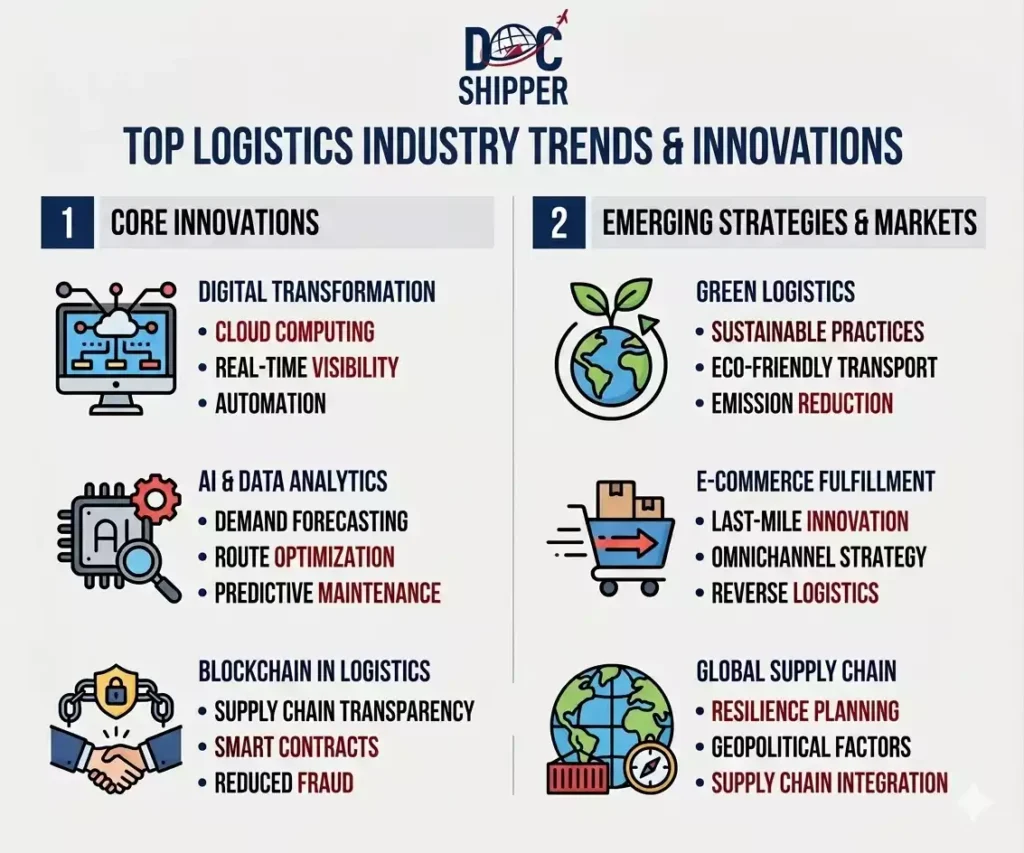
They include volatility-driven routing flexibility, tech-enabled tracking, warehouse automation, sustainability and ESG compliance, nearshoring and supplier diversification, and structured roadmaps that align procurement, logistics, and finance around shared KPIs.
We hope you’ll find this article genuinely useful, but remember, if you ever feel lost at any step, whether it’s finding a supplier, validating quality, managing international shipping or customs, DocShipper can handle it all for you!
What is changing in logistics and why these trends matter for you
If you’ve been tracking logistics industry trends, you already know the old playbook, stable lanes, predictable lead times, cheap capacity, is gone.
Here’s the thing, the winners aren’t the ones with the “best rate”, they’re the ones who can keep your supply chain moving when the plan breaks.
From experience, you’ll notice fast that every trend has a practical consequence, how you book freight, how you buffer inventory, how you manage suppliers, and how you promise delivery dates to your customers.
Quick checklist to sense-check your readiness (use this before your next peak season):
- Capacity: You’ve identified at least two routing options per key lane.
- Terms: You know which SKUs should move under FOB, EXW, or DAP, and why.
- Inventory: You’ve set reorder points based on real transit variability, not last year’s averages.
- Compliance: You can produce accurate commercial invoices and packing lists on demand, no last-minute scrambling.
- Visibility: You can answer “where is it?” in minutes, not days.
Workflow you can apply this week:
Step 1: Map your top 10 SKUs by margin and stockout risk.
Step 2: For each SKU, list primary lane, backup lane, and backup mode (ocean, air, rail, truck).
Step 3: Align Incoterms with control needs, if you need schedule control, you avoid giving it away.
Step 4: Set a “decision deadline” for expediting, for example, trigger air freight if ocean ETD slips by X days.
Step 5: Review weekly with your forwarder and warehouse, then adjust.
Market forces reshaping global logistics after COVID-19 and geopolitical shocks

The biggest logistics industry trends coming out of COVID-19 and geopolitical disruptions all point to one reality, volatility is now normal.
You’re not just buying transport anymore, you’re buying resilience across transportation, warehousing, tracking, and last-mile delivery.
A quick real-world scenario we’ve seen, you lock a “great” ocean rate for a Shenzhen to Rotterdam lane, then port congestion and blank sailings turn your 32-day plan into 55 days.
That’s the moment most importers get stuck, the supplier is ready, the booking is “confirmed”, and your customer delivery promise is already live.
What’s driving these shifts, in plain terms:
- Capacity whiplash: carriers and airlines adjust networks fast, your space can vanish overnight.
- Port and inland bottlenecks: it’s not only the ocean leg, drayage, rail, and chassis availability bite hard.
- Risk-based sourcing: you diversify suppliers, then suddenly you’re managing more lanes, more documents, more variability.
- Inventory repositioning: you move stock closer to demand, which changes your warehousing footprint and cost base.
When you plan around these logistics industry trends, you stop treating delays as exceptions and start designing buffers, routing options, and escalation rules.
Authorities like the World Trade Organization (WTO) have been highlighting how shocks ripple through trade flows, you feel that directly in lead times and landed costs.
Mini comparison table, what “volatility” changes for you:
| What you manage | Before | Now |
| Transit time planning | Single average lead time | Range-based lead time + decision triggers |
| Supplier coordination | Book after goods are ready | Pre-book windows + earlier production milestones |
| Cost control | Negotiate price once | Negotiate flexibility, access, and alternatives |
| Customer promises | Static ETA dates | Dynamic ETAs with proactive updates |
DocShipper Info
Build resilience into freight, customs, and delivery with coordinated planning.
We help you design buffers and escalation rules that actually work
How logistics trends impact shippers, 3PLs, and ecommerce brands differently
You’ll hear the same logistics industry trends headlines everywhere, but they hit you differently depending on whether you ship containers, run a 3PL operation, or sell DTC online.
And yes, that’s why two businesses can face the same disruption and get totally different outcomes.
Here’s a situation that comes up all the time, an ecommerce brand runs a promo, demand spikes, and the factory ships late.
The brand then switches to air freight, but the cartons arrive with missing labels, the warehouse rejects them, and last-mile delivery dates explode.
What changes depending on your role:
- If you’re a shipper/importer: you feel the pain in landed cost, Incoterms control, and supplier discipline.
- If you’re a 3PL: your margin lives or dies on labor planning, slotting, WMS accuracy, and dock scheduling.
- If you’re an ecommerce brand: you get judged on checkout promises, tracking transparency, and return handling speed.
In practice, adapting to logistics industry trends means you align three things, freight strategy, warehouse execution, and customer communication.
That’s exactly where we help at DocShipper, you get one coordinated plan across international shipping, customs, and delivery handoff, instead of three vendors blaming each other.
Workflow to decide “who owns what” in your chain:
Step 1: List every handoff, factory to forwarder, forwarder to carrier, port to truck, truck to warehouse, warehouse to parcel network.
Step 2: Assign an owner per handoff, and define the proof needed, POD, scan event, photo, ASN.
Step 3: Set escalation rules, who gets called after 6 hours, 24 hours, 48 hours.
Step 4: Link this to your Incoterms, if you pay for it, you should control it.
Technology trends redefining logistics operations end to end
The most practical logistics industry trends in 2021 weren’t just “cool tech”, they were tools you could apply immediately to reduce errors, speed up fulfillment, and improve tracking.
You don’t need a science project, you need measurable wins in transportation, warehousing, visibility, and last-mile delivery.
We’ve watched teams buy software, then realize too late that the process wasn’t ready, no clean SKUs, no scanning discipline, no master data.
So let’s keep it operational and realistic.
Tech adoption checklist (before you spend a dollar):
- You’ve defined the one KPI the tool must move, pick accuracy, dock-to-stock time, OTIF, or claims rate.
- You can export clean data, SKUs, dimensions, weights, HS codes, supplier IDs.
- You’ve mapped exceptions, damages, short shipments, relabeling, split shipments.
- You’ve assigned an internal owner, not “the vendor”.
- You’ve planned change management on the floor, scanners, SOPs, training.
Workflow to roll out tech without breaking operations:
Step 1: Pilot on one lane or one warehouse zone.
Step 2: Track baseline metrics for 2 to 4 weeks.
Step 3: Deploy, then audit daily exceptions.
Step 4: Scale only after you hit target accuracy and cycle time.
DocShipper Info
Start with clean data, clear KPIs, and controlled pilots before scaling.
We deploy practical tools that deliver measurable gains fast
Automation, robotics, and warehouse digitization across the value chain
Among the logistics industry trends that actually change daily work, warehouse automation and digitization sit at the top.
You’ll feel it in picking speed, inventory accuracy, and the ability to handle ecommerce-like order profiles without chaos.
A quick story from the field, a warehouse starts batching orders manually during peak, then one small labeling mistake snowballs.
Two pallets get swapped, the carrier picks up the wrong freight, and suddenly you’re paying expedited shipping plus credit notes.
What “automation” really means across the value chain:
- Receiving: barcode scanning, ASN matching, photo proof for damages.
- Storage: better slotting, dynamic locations, cycle counting discipline.
- Picking: pick-to-light, voice picking, carts optimized by route.
- Packing: dimensioning, automated label printing, cartonization rules.
- Shipping: dock scheduling, load checks, scan-based dispatch confirmation.
The kicker, you don’t automate to replace people, you automate to remove the repeatable errors that drain your margin.
Groups like MHI track material handling innovation closely, and the pattern is consistent, digitization starts with data discipline, not robots.
| Warehouse capability | Manual baseline | Digitized outcome |
| Inventory accuracy | Periodic stocktakes | Cycle counts + scan compliance |
| Order fulfillment speed | Walk-and-pick | Wave picking + optimized routes |
| Error rate | Human checks only | System validation + exception flags |
Looking for a Reliable Shipping & Sourcing Partner?
Data, AI, IoT, and digital twins for real-time visibility and smarter decisions
If you’re serious about logistics industry trends, visibility tech is where you turn “guessing” into decisions you can defend.
You’re aiming for one thing, real-time tracking across modes so you can react early, not after your customer complains.
We’ve seen a classic case, a container clears customs, but no one notices it sits at the terminal because the truck appointment wasn’t booked.
Three days later you pay storage, your warehouse labor plan collapses, and your last-mile deliveries slip.
Here’s how these technologies apply in plain operations terms:
- IoT: temperature and shock monitoring for sensitive cargo, plus location pings to reduce “lost time”.
- AI: ETA prediction using carrier performance, port congestion, and inland dwell time patterns.
- Control towers: one dashboard to manage exceptions, holds, rollovers, and delivery appointments.
- Digital twins: a simulation model to test scenarios, what happens if you shift 20% volume to another port.
When you connect these logistics industry trends to your SOPs, you stop treating visibility as “nice to have” and start using it to trigger actions, expedite, re-route, or reallocate inventory.
Standards and guidance from bodies like GS1 matter here, because clean identifiers and event data are what make tracking reliable end to end.
Workflow to turn visibility into action (not just dashboards):
Step 1: Define your critical milestones, cargo ready, pickup, gate-in, departure, arrival, customs release, out-gate, delivery.
Step 2: Set threshold alerts, for example, “no update in 24 hours” or “ETA slip of 3+ days”.
Step 3: Attach an action to each alert, book truck slot, switch carrier, split shipment, notify customer.
Step 4: Review exceptions weekly and fix root causes with your forwarder, carrier, and warehouse.
Customer, market, and regulatory trends you can’t ignore in logistics

You are no longer competing on price alone. You are competing on speed, transparency, sustainability, and resilience, all at once.
These logistics industry trends are driven by your customers, by regulators, and by market volatility. If you ignore them, your supply chain becomes a liability instead of a growth engine.
- Same-day and next-day delivery expectations across B2C and increasingly B2B channels
- End-to-end shipment visibility with real-time tracking and proactive alerts
- ESG and carbon reporting requirements from governments and enterprise buyers
- Nearshoring and supplier diversification to reduce geopolitical exposure
- Omnichannel fulfillment integrating ecommerce, retail, and marketplace logistics
Customer-centric logistics is no longer optional. You must design your transportation, warehousing, and last-mile strategy around service levels, not just cost per unit.
At the same time, regulatory pressure is accelerating. Carbon taxes, customs digitization, and stricter compliance rules are reshaping cross-border trade flows.
| Trend | Operational Impact | How You Should Respond |
| Faster delivery expectations | Pressure on inventory positioning and last-mile networks | Use distributed warehousing and predictive demand planning |
| Sustainability requirements | Carbon reporting, greener transport modes | Shift to multimodal transport and optimize load factors |
| Customs digitalization | Mandatory electronic documentation and data accuracy | Integrate digital customs workflows and compliance audits |
| Supply chain resilience | Higher safety stocks and supplier redundancy | Diversify sourcing beyond single-country dependency |
If you source from Asia, especially China, you must align procurement, freight, and compliance from day one. We help you integrate sourcing, quality control, and international shipping under one operational framework so you reduce risk before goods even leave the factory.

DocShipper Alert
Integrate sourcing, freight, and customs early to avoid costly surprises.
We align procurement and shipping before your goods leave the factory
How logistics companies can prioritize and implement new trends
You cannot implement every innovation at once. You need a structured roadmap aligned with your margins, customer profile, and operational maturity.
Start with impact versus feasibility. Focus first on projects that increase visibility and reduce operational risk.
- Map your current supply chain from supplier to final customer
- Identify bottlenecks in transportation, warehousing, and customs
- Quantify cost of delays, stockouts, and compliance errors
- Prioritize digital visibility and automation initiatives
- Run pilot projects before scaling globally
Execution discipline matters more than trend awareness. You need clear KPIs such as OTIF, lead time variability, inventory turnover, and carbon intensity per shipment.
Then you move to cross-functional integration. Procurement, logistics, finance, and sales must share the same data backbone.
| Implementation Phase | Key Actions | Expected Result |
| Assessment | Supply chain audit, risk mapping, supplier review | Clear visibility on weaknesses |
| Pilot | Test automation, tracking tools, or new transport modes | Measured ROI before scaling |
| Scale | Standardize processes across regions and partners | Operational consistency |
| Optimize | Continuous data analysis and cost benchmarking | Long-term competitive advantage |
If you import from China or Southeast Asia, implementation also means aligning Incoterms, freight contracts, and quality inspections. We support you from supplier sourcing to final delivery, ensuring that innovation translates into measurable performance gains.
DocShipper Advice
Prioritize high impact pilots, track ROI, then scale with discipline.
We support you from sourcing to delivery to turn strategy into performance
Conclusion
The most important logistics industry trends are not theoretical. They directly affect your costs, your service level, and your competitive positioning.
- You must design logistics around customer speed and transparency expectations
- You need real-time visibility across transportation and warehousing
- You should integrate sustainability into mode selection and supplier strategy
- You must diversify sourcing to reduce geopolitical and operational risk
- You need a structured implementation roadmap with measurable KPIs
If you want to future-proof your supply chain, you cannot treat logistics as a back-office function. With the right sourcing strategy, digital tools, and international freight expertise, we help you transform logistics into a scalable growth driver.
FAQ | Logistics industry trends: how to future-proof your supply chain strategy
A 3PL (third-party logistics) provider manages part or all of your logistics operations for you. Typically, they can handle:
- International freight (air, sea, road, rail)
- Warehousing and inventory management
- Order fulfillment and last‑mile delivery
- Returns (reverse logistics) and value‑added services like kitting or labeling
You should consider a 3PL when:
- Your internal team spends too much time firefighting shipments and stock issues
- You’re scaling into new markets and don’t want to build your own warehouses
- You need better visibility, KPIs, and process discipline than your current setup allows
A good 3PL doesn’t just move boxes, it aligns capacity, inventory, and service levels with your commercial strategy.
Global sourcing services support you in buying products or components internationally while controlling risk and total landed cost. They usually include:
- Supplier identification and vetting in key regions (e.g., China, Southeast Asia)
- Price and terms negotiation, including Incoterms (FOB, EXW, DAP, etc.)
- Quality control and pre‑shipment inspections
- Coordination with freight, customs, and warehousing partners
Impact on your supply chain strategy:
- Better cost base by accessing competitive suppliers
- Reduced disruption risk through supplier diversification and nearshoring options
- Smoother handoff between procurement and logistics, fewer last‑minute surprises
- More accurate lead times to plan inventory and customer delivery promises
A solid fleet management app does more than show dots on a map. It helps you:
- Cut operating costs
- Monitor fuel usage, idling, and empty miles
- Optimize routes based on traffic, time windows, and priorities
- Improve service and reliability
- Real‑time ETAs and status updates
- Faster response to delays, breakdowns, or route changes
- Strengthen compliance and safety
- Driver hours and maintenance schedules tracked automatically
- Digital PODs, checklists, and incident reports
- Use data to make better decisions
- Analyze on‑time performance by lane, driver, or customer
- Identify where to add or remove vehicles, or switch modes
In a volatile market, this level of control supports the broader trend toward real‑time visibility and dynamic planning.
Fleet management is shifting from static planning to continuous optimization. Key evolutions include:
- Data‑driven dispatching
- AI‑assisted routing using live traffic, port congestion, and historical performance
- Integrated visibility
- Trucks connected with warehouse and TMS/WMS systems so loading, unloading, and dock slots are synchronized
- Multimodal coordination
- Road legs planned in sync with ocean, air, or rail schedules instead of in isolation
- Predictive maintenance
- Vehicle health monitored via telematics to prevent breakdowns during critical runs
Combined with volatility in capacity and lead times, modern fleet management becomes a core lever to protect your service levels and margins.
With volatility, nearshoring, and stricter customer expectations, your relationship with a 3PL should move from “outsourced warehouse” to “strategic operations partner”:
- Share more upstream data
- Forecasts, promotions, and product launches so they can plan labor and space
- Align on KPIs, not just rates
- OTIF, lead time variability, inventory accuracy, claim rates, carbon intensity
- Co‑design contingency plans
- Alternate routes and modes, overflow storage, and expedited playbooks
- Integrate systems
- EDI/API connections for orders, stock, tracking events, and customs data
Used this way, a 3PL helps you implement many logistics industry trends (visibility, automation, customer‑centric SLAs) without you having to build all the infrastructure.
You don’t need a full “control tower” project to benefit. Start with:
- Shipment tracking upgrades
- Use your 3PL/forwarder’s portal or low‑cost tools for milestone‑based tracking and alerts
- Simple IoT for sensitive cargo
- Deploy basic temperature or shock loggers for high‑value or fragile goods
- AI‑driven ETAs via partners
- Many forwarders now offer predictive ETAs powered by AI; plug those into your customer communication
- “Lite” digital twins via what‑if analysis
- Work with your logistics partner to simulate scenarios (e.g., shifting volume to another port) using existing data
Focus on one measurable improvement at a time, for example:
- Fewer demurrage/storage days
- Lower stockouts during peak
- Higher on‑time delivery for key SKUs
This way, you ride the same trends as large players, but in a scoped, ROI‑positive way.
Need Help with
Logistics or Sourcing ?
First, we secure the right products from the right suppliers at the right price by managing the sourcing process from start to finish. Then, we simplify your shipping experience - from pickup to final delivery - ensuring any product, anywhere, is delivered at highly competitive prices.
Fill the Form
Prefer email? Send us your inquiry, and we’ll get back to you as soon as possible.
Contact us