In short ⚡
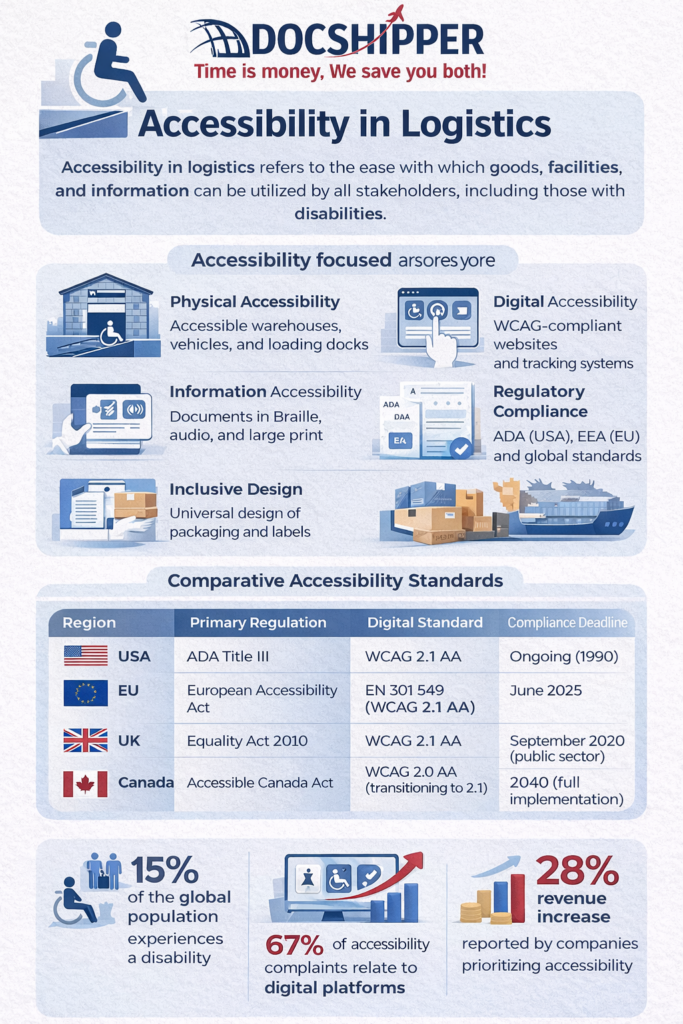
Accessibility in logistics refers to the ease with which goods, facilities, and information can be reached, utilized, or understood by all stakeholders, including those with disabilities. It encompasses physical infrastructure design, digital platform usability, regulatory compliance with international standards, and inclusive communication practices throughout the supply chain.
Introduction
Many logistics operators overlook accessibility requirements until facing penalties or operational disruptions. This oversight creates barriers for customers with disabilities and limits market reach.
In international trade, accessibility impacts warehouse design, transportation modes, customs documentation, and digital platforms. Companies that prioritize accessibility gain competitive advantages through broader customer bases and regulatory compliance.
- Physical accessibility: Ramps, elevators, and adapted loading docks in warehouses and distribution centers
- Digital accessibility: WCAG-compliant websites and tracking systems for visually or hearing-impaired users
- Information accessibility: Clear, multilingual documentation in accessible formats (Braille, audio, large print)
- Regulatory compliance: ADA (USA), European Accessibility Act, UN Convention on Rights of Persons with Disabilities
- Inclusive design: Universal design principles applied to packaging, labeling, and customer service interfaces
Deepening & Expertise
Accessibility in logistics operates across multiple regulatory frameworks. The Americans with Disabilities Act (ADA) mandates physical and digital accessibility for U.S. operations, while the European Accessibility Act requires member states to ensure accessible services by 2025.
The Web Content Accessibility Guidelines (WCAG 2.1) establish technical standards for digital platforms. Level AA compliance is the international benchmark for logistics tracking systems, booking platforms, and customer portals. This includes keyboard navigation, screen reader compatibility, and sufficient color contrast ratios.
Physical infrastructure requirements vary by jurisdiction but commonly include wheelchair-accessible entrances, tactile paving, visual and auditory alerts in facilities, and ergonomic workstations. The ISO 21542 standard provides comprehensive guidance for accessible building design in commercial environments.
For documentation, the UN Convention on the Rights of Persons with Disabilities requires accessible formats for critical information. This impacts bills of lading, customs declarations, and safety documentation. At DocShipper, we systematically verify that all client-facing documents meet accessibility standards to prevent communication barriers during customs clearance.
Transportation accessibility extends to vehicle design, boarding assistance, and real-time communication systems. The Air Carrier Access Act and EU Regulation 1107/2006 mandate specific accommodations for passengers with disabilities, which logistics providers must coordinate when handling personal effects or accompanied shipments.
Reference: UN Convention on the Rights of Persons with Disabilities
Concrete Examples & Data
Research shows that 15% of the global population experiences some form of disability, representing a significant market segment. Companies with strong accessibility practices report 28% higher revenue and 2x higher net income compared to industry peers, according to Accenture’s 2018 disability inclusion study.
Comparative Accessibility Standards
| Region | Primary Regulation | Digital Standard | Compliance Deadline |
|---|---|---|---|
| United States | ADA Title III | WCAG 2.1 AA (recommended) | Ongoing (1990) |
| European Union | European Accessibility Act | EN 301 549 (WCAG 2.1 AA) | June 2025 |
| United Kingdom | Equality Act 2010 | WCAG 2.1 AA | September 2020 (public sector) |
| Canada | Accessible Canada Act | WCAG 2.0 AA (transitioning to 2.1) | 2040 (full implementation) |
Use Case: E-commerce Fulfillment Center
A major European logistics provider invested €2.3 million in accessibility upgrades across three fulfillment centers. Modifications included:
- Physical adaptations: Adjustable-height workstations (€450,000), wheelchair-accessible pathways (€680,000)
- Digital systems: WCAG 2.1 AA-compliant warehouse management system (€720,000)
- Training programs: Staff accessibility awareness and assistive technology training (€180,000)
- Assistive technology: Screen readers, voice-activated picking systems, tactile signage (€270,000)
Results after 18 months: 34% increase in workforce diversity, 19% reduction in workplace accidents, and €4.1 million additional revenue from previously underserved customer segments.
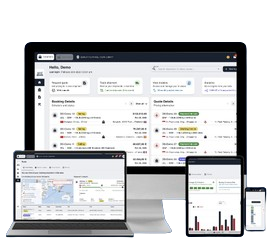
DocShipper Platform
One platform. Your entire supply chain
Sourcing, freight, customs & documents — all centralised, all visible, 24/7.
Key Implementation Points
- Audit first: Conduct comprehensive accessibility audits before modifications (typical cost: €8,000-€25,000)
- Prioritize digital: 67% of accessibility complaints relate to digital platforms; start with WCAG compliance
- Employee involvement: Include employees with disabilities in design and testing phases
- Phased approach: Implement critical path improvements first, then expand systematically
- Documentation: Maintain accessibility conformance reports for regulatory compliance and customer transparency
Conclusion
Accessibility represents both a legal obligation and a strategic opportunity in international logistics. Companies that integrate accessibility into their operations enhance market reach, reduce legal risks, and improve overall service quality.
Need guidance on implementing accessibility standards in your supply chain? Contact DocShipper for expert support tailored to your operational requirements.
📚 Quizz
Test Your Knowledge: Accessibility in Logistics
Q1 — What does "accessibility" mean in a logistics context?
Q2 — A logistics company decides to add ramps and adjustable workstations only after an employee files a formal complaint. Which concept does this illustrate?
Q3 — A European e-commerce fulfillment center wants to prioritize its accessibility investments. Based on industry data, where should it focus first?
🎯 Your Result
📞 Free Quote in 24hFAQ | Accessibility in Logistics: Definition, Standards & Practical Examples
Accessibility refers to proactive design that removes barriers for all users, while accommodation involves reactive adjustments for specific individuals. Accessible design benefits everyone; accommodations address individual needs as they arise.
Requirements vary by jurisdiction and company size. In the U.S., ADA applies to businesses with 15+ employees. The EU Accessibility Act affects companies providing services to the public, regardless of size. Consult local regulations for specific thresholds.
Costs range from €15,000 to €80,000 depending on platform complexity, existing code quality, and feature scope. Ongoing maintenance adds 10-15% annually. Early-stage integration is significantly cheaper than retroactive fixes.
Inadequate door widths (less than 32 inches), missing ramps or uneven surfaces, insufficient lighting, inaccessible restrooms, and lack of tactile wayfinding systems. These account for approximately 73% of physical accessibility complaints in logistics facilities.
Yes. Many insurers offer 5-12% premium reductions for facilities meeting enhanced accessibility standards, as these correlate with lower accident rates and reduced liability exposure. Document compliance for maximum benefit.
Accessible documentation ensures all parties can understand critical information, reducing errors and delays. Customs authorities increasingly require digital submissions that meet accessibility standards, particularly for electronic declarations and supporting documents.
Universal design creates systems usable by the widest range of people without adaptation. In logistics, this includes packaging that's easy to open regardless of dexterity, intuitive tracking interfaces, and facilities navigable without specialized knowledge.
Many jurisdictions offer tax credits. The U.S. provides the Disabled Access Credit (up to $5,000) and Barrier Removal Deduction (up to $15,000). EU member states have varying incentive programs. Consult tax advisors for specific benefits.
Use automated tools (WAVE, axe, Lighthouse) for initial screening, then conduct manual testing with assistive technologies. Engage users with disabilities for authentic feedback. Professional audits cost €3,000-€12,000 and provide detailed conformance reports.
Accessible design often aligns with sustainable practices: durable materials, efficient layouts, reduced waste, and inclusive employment. Companies integrating both report stronger stakeholder engagement and improved ESG ratings.
Absolutely. Clear signage benefits all workers, adjustable equipment reduces injury, and intuitive digital systems decrease training time. Studies show accessible workplaces have 22% higher productivity and 30% lower turnover rates.
Conduct comprehensive audits every 2-3 years or when making significant operational changes. Annual reviews of high-traffic areas and customer-facing systems are recommended. Continuous monitoring of digital platforms ensures ongoing compliance as standards evolve.
Need Help with
Logistics or Sourcing ?
First, we secure the right products from the right suppliers at the right price by managing the sourcing process from start to finish. Then, we simplify your shipping experience - from pickup to final delivery - ensuring any product, anywhere, is delivered at highly competitive prices.


Fill the Form
Prefer email? Send us your inquiry, and we’ll get back to you as soon as possible.
Contact us