


In short ⚡
Agreed valuation is a predetermined customs value established between an importer and customs authorities before goods cross borders. This fixed valuation method eliminates disputes, accelerates clearance, and provides cost certainty for recurring shipments of identical products.
Introduction
One of the most common challenges importers face is customs valuation uncertainty. Price fluctuations, complex transfer pricing, and inconsistent documentation create delays and unexpected duty assessments.
Agreed valuation offers a strategic solution for businesses with regular import flows. By establishing a fixed customs value upfront, companies gain predictability in their international supply chain operations.
This mechanism is particularly relevant for:
- Recurring shipments of identical goods with stable characteristics
- Related-party transactions where transfer pricing may raise questions
- Complex products requiring technical valuation expertise
- Time-sensitive imports where clearance speed is critical
- Duty optimization strategies within legal compliance frameworks
Understanding the Mechanism & Legal Framework
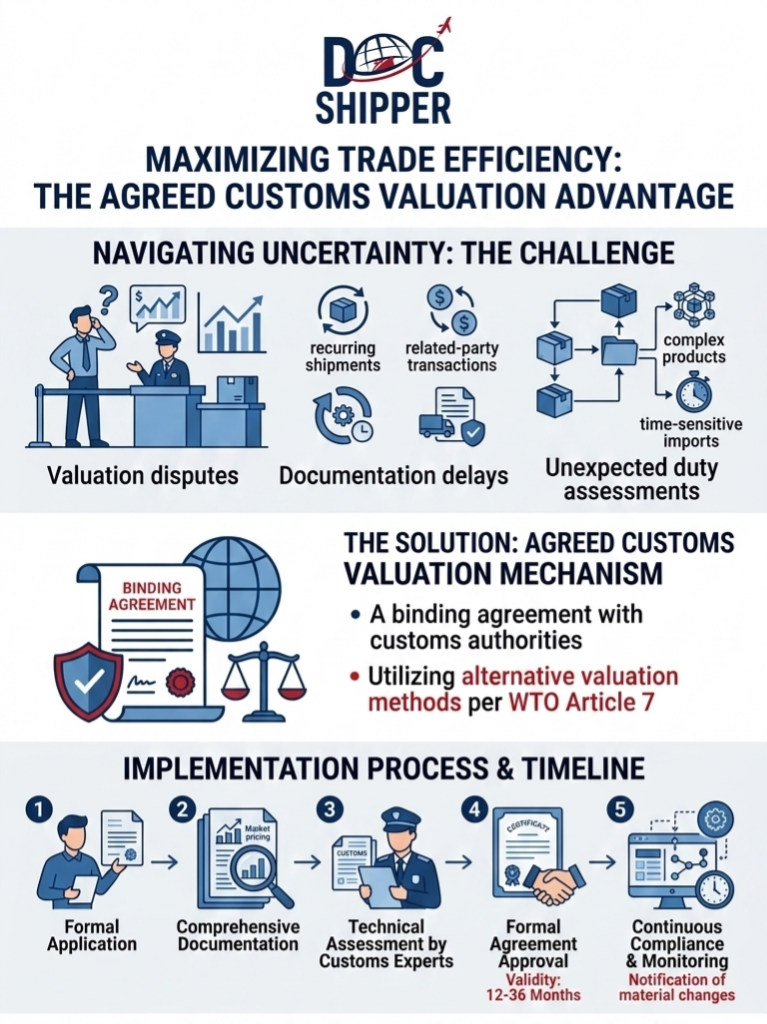
Agreed valuation operates through a binding agreement between the importer and customs authorities. This arrangement is governed by the WTO Valuation Agreement, specifically addressing situations where transaction value cannot be readily determined.
The process begins with a formal application submitted to the competent customs office. The importer must provide comprehensive documentation demonstrating why standard valuation methods are impractical or inappropriate for their specific goods.
Technical assessment follows, where customs experts examine the product specifications, market conditions, and proposed valuation methodology. This review ensures the agreed value reflects genuine commercial reality while protecting revenue interests.
Once approved, the validity period typically ranges from 12 to 36 months, depending on jurisdiction and product stability. During this time, all qualifying shipments benefit from the predetermined value, eliminating case-by-case assessments.
Compliance obligations remain critical throughout the agreement duration. Importers must notify customs of any material changes affecting product characteristics, manufacturing processes, or market conditions. At DocShipper, we systematically monitor these parameters to ensure our clients maintain full compliance with their agreed valuation arrangements.
The legal foundation varies by country but generally references Article 7 of the WTO Customs Valuation Agreement, which permits alternative valuation methods when transaction value cannot be determined under Articles 1 through 6.
Practical Examples & Data Analysis
Understanding agreed valuation becomes clearer through real-world scenarios. Consider a pharmaceutical manufacturer importing active ingredients from a related entity in Switzerland.
Case Study: Pharmaceutical Import Optimization
A French laboratory imports 500kg of specialized chemical compounds monthly. Standard transaction value raises questions due to related-party pricing. Without agreed valuation, each shipment faces 5-7 day delays for valuation review.
| Scenario | Clearance Time | Cost Predictability | Administrative Burden |
|---|---|---|---|
| Standard Valuation | 5-7 days per shipment | Variable (±15%) | High (documentation per shipment) |
| Agreed Valuation | 24-48 hours | Fixed (100%) | Low (annual review only) |
| Annual Savings | 60+ days logistics time | €45,000 budgeting accuracy | 180 hours staff time |
Quantitative Benefits Analysis:
- Clearance acceleration: 70-80% reduction in processing time for routine shipments
- Duty predictability: Eliminates valuation disputes that can increase costs by 12-18%
- Cash flow optimization: Fixed duty calculations enable precise working capital planning
- Compliance security: Pre-approved methodology reduces audit risk by approximately 65%
- Administrative efficiency: Staff resources redirect from repetitive documentation to strategic tasks
Another common application involves automotive components. A German manufacturer importing electronic modules from Japan established an agreed valuation based on comparable uncontrolled price methodology, referencing independent market transactions for similar technology. This approach provided a defensible value while accommodating rapid technological evolution in the sector.
Conclusion
Agreed valuation transforms customs compliance from a reactive challenge into a strategic advantage. For businesses with consistent import patterns, this mechanism delivers measurable benefits in speed, cost control, and operational predictability.
Need guidance on implementing agreed valuation for your supply chain? Contact DocShipper for expert customs advisory services tailored to your specific import requirements.
DocShipper Platform
One platform. Your entire supply chain
Sourcing, freight, customs & documents — all centralised, all visible, 24/7.
📚 Quiz
Test Your Knowledge: Agreed Valuation
Q1 — What is agreed valuation in the context of international trade?
Q2 — A common misconception about agreed valuation is that its primary purpose is to reduce customs duties. What is its actual primary goal?
Q3 — A French pharmaceutical company imports the same chemical compound monthly from a related Swiss entity. Customs regularly delays shipments 5–7 days for valuation review. Which approach best resolves this situation?
🎯 Your Result
📞 Free Quote in 24hFAQ | Agreed Valuation: Definition, Calculation & Practical Examples
Products with consistent specifications, recurring shipments, and clear commercial justification qualify. Common categories include pharmaceuticals, industrial components, and technology products where standard valuation methods prove impractical.
Typical processing ranges from 60 to 120 days, depending on product complexity and documentation completeness. Customs authorities require thorough technical review before granting approval.
The primary goal is predictability, not duty reduction. However, accurate valuation based on proper methodology may optimize duty calculations within legal frameworks, potentially lowering costs compared to inflated safety margins.
Material changes require immediate notification to customs. Depending on the variation magnitude, authorities may adjust the agreed value, maintain it with conditions, or require a new application.
Most WTO member states recognize this mechanism under Article 7 provisions. However, implementation procedures and acceptance criteria vary significantly by jurisdiction. EU customs union members follow harmonized guidelines.
Essential documents include product specifications, commercial invoices, transfer pricing studies (for related parties), market analysis, manufacturing cost breakdowns, and justification for alternative valuation methodology.
Generally, agreed valuation applies to specific products from designated origins. Multiple suppliers require separate agreements unless goods are genuinely identical and sourced under comparable commercial terms.
Agreed valuation determines customs value for duty calculation purposes. Preferential tariff rates from FTAs still apply to this value, provided origin requirements are met independently.
Renewal applications require updated documentation demonstrating continued validity of the valuation basis. Customs may request additional information if market conditions, product specifications, or regulatory frameworks have evolved.
Yes. Customs retain audit rights throughout and after the agreement period. Maintaining comprehensive supporting documentation is essential to defend the valuation methodology if questioned.
Violations may result in agreement termination, duty reassessments with interest, and potential penalties for misrepresentation. Serious breaches can trigger criminal investigations in some jurisdictions.
Agreed valuation complements but doesn't replace transfer pricing compliance. Companies must maintain consistent positions across customs and tax authorities, though methodologies may differ due to distinct regulatory objectives.
Need Help with
Logistics or Sourcing ?
First, we secure the right products from the right suppliers at the right price by managing the sourcing process from start to finish. Then, we simplify your shipping experience - from pickup to final delivery - ensuring any product, anywhere, is delivered at highly competitive prices.


Fill the Form
Prefer email? Send us your inquiry, and we’ll get back to you as soon as possible.
Contact us


