


In short ⚡
Automated Identification System (AIS) is a maritime tracking technology that enables vessels to broadcast and receive real-time position, speed, course, and identification data via VHF radio frequencies. Mandated by IMO for vessels over 300 GT, AIS enhances navigation safety, collision avoidance, and supply chain visibility in international shipping operations.
Introduction
Imagine coordinating a container shipment from Shanghai to Rotterdam without knowing your vessel’s exact location for days. This visibility gap creates delays, increases costs, and complicates customs clearance planning. The Automated Identification System solves this fundamental challenge in maritime logistics.
In modern international trade, AIS has become the backbone of maritime transparency. Whether you’re managing import/export operations or coordinating port arrivals, understanding AIS capabilities directly impacts your supply chain efficiency.
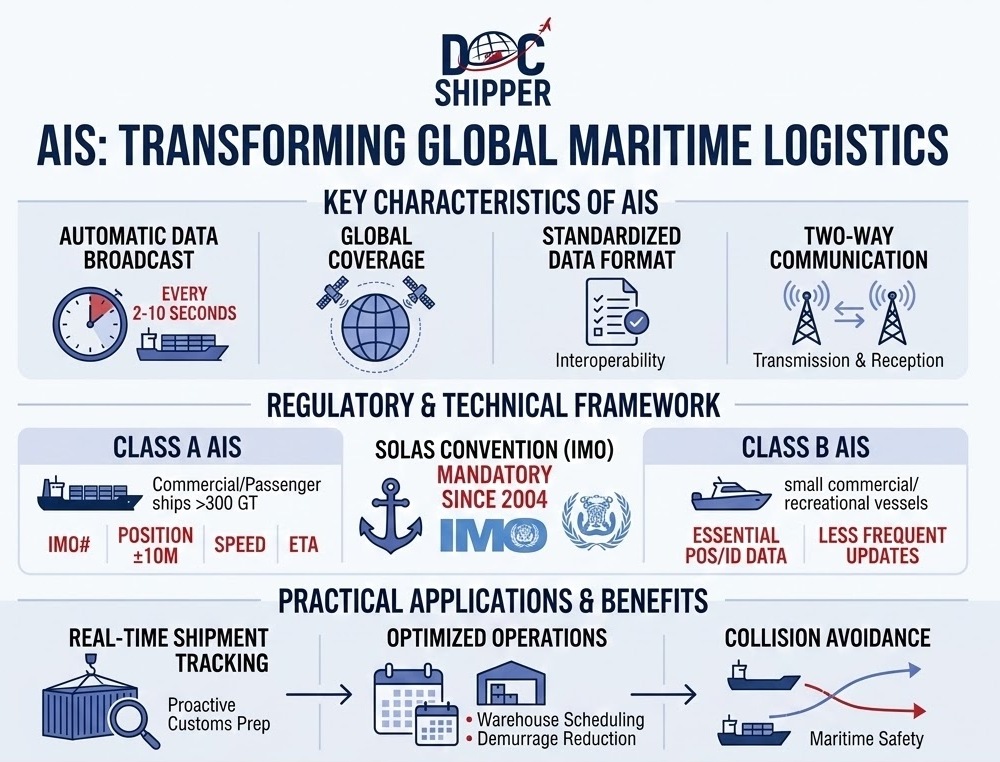
Key characteristics of AIS technology include:
- Automatic broadcasting of vessel data every 2-10 seconds (depending on speed and maneuver status)
- Global coverage through satellite and terrestrial receiver networks
- Standardized data format ensuring interoperability across platforms
- Two-way communication enabling both transmission and reception of information
- Integration capability with Electronic Chart Display and Information Systems (ECDIS)
Technical Framework & Regulatory Requirements
The International Maritime Organization (IMO) established AIS requirements through the SOLAS Convention Chapter V, making it mandatory for specific vessel categories since 2004. This regulation fundamentally transformed maritime traffic management and cargo tracking capabilities.
AIS operates on two dedicated VHF maritime frequencies (161.975 MHz and 162.025 MHz) using Self-Organizing Time Division Multiple Access (SOTDMA) technology. This protocol allows hundreds of vessels to share the same frequency without interference, with each transmission occupying a unique time slot.
There are two primary AIS classes with distinct capabilities:
Class A AIS is mandatory for commercial vessels over 300 GT on international voyages, passenger ships, and all vessels over 500 GT. These units transmit comprehensive data including static information (IMO number, call sign, vessel dimensions), dynamic information (position accuracy to 10 meters, speed over ground, rate of turn), and voyage-related data (destination, ETA, cargo type, draught).
Class B AIS serves smaller commercial vessels and recreational craft. While less powerful, Class B units provide essential position and identification data, transmitting less frequently to avoid congesting the network.
At DocShipper, we leverage AIS data to provide clients with real-time shipment tracking, enabling proactive customs documentation preparation and optimized warehouse scheduling. This visibility reduces demurrage risks and improves overall supply chain coordination.
The system’s collision avoidance functionality represents perhaps its most critical safety application. By displaying surrounding vessel traffic with predicted courses, AIS enables navigators to make informed decisions in congested waters, significantly reducing maritime accidents in major shipping lanes.
Practical Applications & Data Examples
Understanding AIS through practical scenarios reveals its transformative impact on logistics operations. The following examples demonstrate how this technology creates measurable value across the supply chain.
Comparative Analysis: Vessel Tracking Accuracy
| Tracking Method | Position Accuracy | Update Frequency | Coverage | Cost |
|---|---|---|---|---|
| AIS (Satellite) | ±10 meters | 2-10 seconds | Global | Mandatory/Included |
| Manual Reporting | ±50 nautical miles | 12-24 hours | Limited | Labor-intensive |
| Container GPS Trackers | ±5 meters | 15-60 minutes | Global | $50-150/unit |
| LRIT (Long Range) | ±1 nautical mile | 6 hours | Beyond 1000nm | Subscription-based |
Use Case: Port Congestion Management
A European importer awaiting 450 TEU of electronics from Asia faced potential demurrage charges due to uncertain vessel arrival. By monitoring AIS data, the logistics team identified a 36-hour delay caused by port congestion in Singapore.
This advance notice enabled three critical actions: rescheduling the customs broker appointment, reallocating warehouse resources, and negotiating extended free time with the terminal operator. The result was €8,400 in avoided demurrage fees and optimized labor deployment.
The AIS data revealed the vessel’s actual speed dropped from 18 knots to 4 knots when entering the Singapore Strait, with position updates showing a 12-hour anchorage wait. This granular visibility transformed reactive crisis management into proactive planning.
DocShipper Platform
Optimize Your Global Logistics with Cutting-Edge Solutions
Enhance efficiency, cut costs, and gain 24/7 visibility 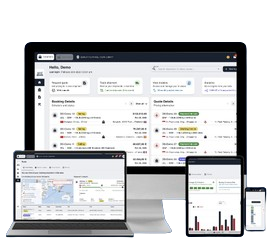 over your entire supply chain.
- Cut your shipping costs and maximize your margins
- Manage sourcing, freight, & customs on one platform
- Get real-time tracking and analytics
Key Operational Benefits
- ETA accuracy improvement: AIS-based calculations reduce arrival time variance from ±24 hours to ±2 hours for final approach
- Customs preparation: Advance vessel tracking enables earlier ISF filing and customs documentation submission
- Transshipment coordination: Real-time data synchronizes feeder vessel schedules with mother ship arrivals
- Insurance verification: AIS tracks provide auditable proof of vessel route compliance for cargo insurance claims
- Environmental monitoring: Emission Control Area (ECA) compliance verification through speed and route analysis
At DocShipper, our freight forwarding platform integrates AIS feeds directly into client dashboards, providing automated notifications when vessels pass critical waypoints. This integration eliminates manual tracking while ensuring stakeholders receive timely updates throughout the shipping process.
Conclusion
The Automated Identification System has evolved from a collision avoidance tool into an essential supply chain visibility platform. Its real-time data capabilities enable proactive logistics management, cost reduction, and enhanced operational efficiency across international shipping operations.
Need expert guidance on optimizing your maritime shipment tracking or customs clearance coordination? Contact DocShipper for comprehensive freight forwarding solutions that leverage advanced tracking technologies.
📚 Quiz
Test Your Knowledge: Automated Identification System (AIS)
1. What is the primary purpose of the Automated Identification System (AIS) in maritime operations?
2. A vessel suddenly disappears from AIS tracking mid-voyage. What is the most likely explanation?
3. A European importer is awaiting a container shipment and wants to avoid costly demurrage fees. How does AIS data best help in this scenario?
🎯 Your Result
📞 Free Quote in 24hFAQ | Automated Identification System (AIS): Definition, Applications & Concrete Examples
Radar detects physical objects using radio waves but cannot identify vessels or their intentions. AIS provides vessel identification, course, speed, and destination data automatically. Modern navigation uses both systems complementarily for comprehensive situational awareness.
Yes, customs authorities increasingly reference AIS records to verify declared vessel arrival times, route compliance, and transshipment activities. This data supports ISF accuracy validation and can be requested during audits or dispute resolution processes.
AIS gaps occur due to satellite coverage limitations, intentional transponder deactivation (sometimes for security reasons), equipment malfunction, or signal interference in congested areas. Terrestrial receiver coverage also varies significantly by coastal proximity and infrastructure investment.
GPS-based AIS position accuracy reaches ±10 meters under normal conditions. However, ETA calculations depend on weather, port congestion, and operational factors. Professional logistics platforms combine AIS data with predictive algorithms to improve arrival time forecasting accuracy.
SOLAS requires Class A AIS for vessels ≥300 GT on international voyages, all passenger ships, and vessels ≥500 GT on domestic routes. Smaller commercial vessels may use voluntary Class B systems. Regulations vary by flag state and operational area.
AIS provides route monitoring capabilities that identify deviations from planned courses, potentially indicating hijacking or unauthorized diversions. However, sophisticated criminals may disable transponders. AIS works best as part of comprehensive security protocols including satellite surveillance and naval coordination.
AIS broadcasts general cargo type categories (e.g., "container ship," "tanker," "bulk carrier") and hazardous cargo indicators, but not specific commodity details or shipper information. Detailed cargo data remains in commercial shipping documents and customs declarations.
Professional forwarders integrate AIS feeds into tracking platforms, providing automated milestone notifications (departure, waypoint passage, port approach). This eliminates manual status update requests and enables proactive exception management when delays occur.
Basic AIS data is available through free platforms like MarineTraffic and VesselFinder, though with limitations on historical data and update frequency. Commercial subscriptions provide enhanced features including API access, predictive analytics, and comprehensive vessel databases for professional logistics applications.
Vessels must report AIS malfunctions to coastal authorities and arrange repairs at the next port. Navigation continues using traditional methods (radar, visual observation, radio communication). For cargo tracking, alternative methods like container GPS devices or carrier updates become necessary.
AIS data verifies vessel speed reductions in Emission Control Areas (ECAs), validates routing through Marine Protected Areas, and supports carbon emission calculations based on distance traveled and vessel characteristics. Port state control authorities use this data for environmental regulation enforcement.
Advanced AIS analytics platforms often outperform carrier ETAs by incorporating real-time speed changes, weather impacts, and historical port congestion patterns. Accuracy improvements of 40-60% are common when using algorithmic predictions versus static carrier schedules for final approach timing.
Need Help with
Logistics or Sourcing ?
First, we secure the right products from the right suppliers at the right price by managing the sourcing process from start to finish. Then, we simplify your shipping experience - from pickup to final delivery - ensuring any product, anywhere, is delivered at highly competitive prices.


Fill the Form
Prefer email? Send us your inquiry, and we’ll get back to you as soon as possible.
Contact us


