


In short ⚡
Alternative rates are backup pricing mechanisms used in international shipping when standard freight rates cannot be applied due to cargo characteristics, route changes, or market volatility. These rates provide flexible pricing solutions that adapt to exceptional circumstances, ensuring cargo movement continues despite deviations from conventional shipping parameters.
Introduction
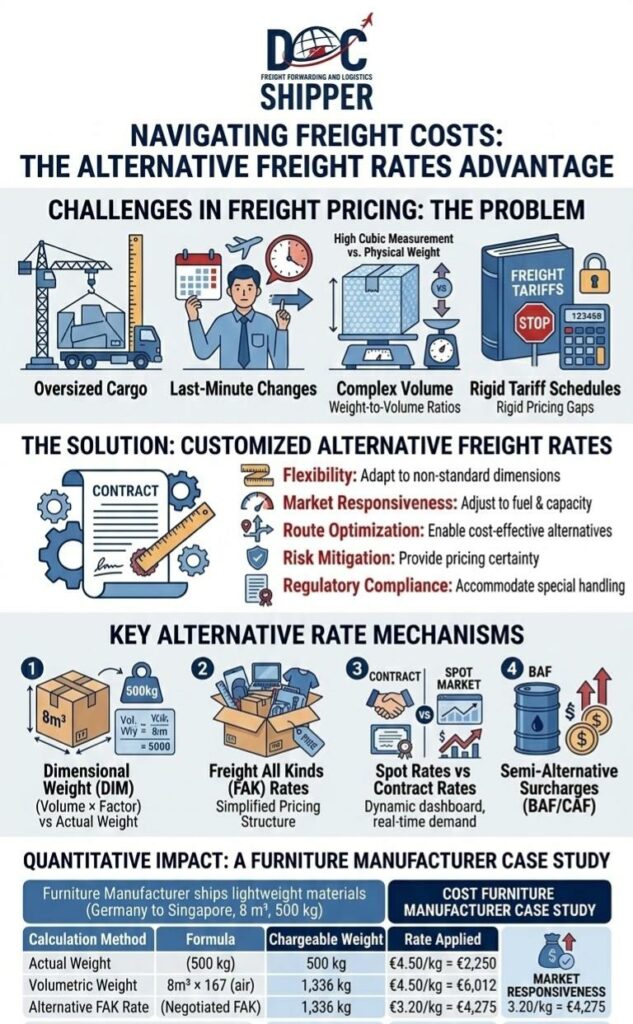
Shippers frequently encounter situations where standard freight rates simply don’t fit. Oversized cargo, last-minute route changes, or extreme weight-to-volume ratios create pricing gaps that can delay shipments or inflate costs unexpectedly.
Alternative rates address these challenges by offering customized pricing structures that reflect actual shipping conditions rather than rigid tariff schedules. In international logistics, understanding these mechanisms separates efficient operations from costly delays.
- Flexibility: Adapt to non-standard cargo dimensions or weights
- Market responsiveness: Adjust to fuel surcharges and capacity fluctuations
- Route optimization: Enable cost-effective alternatives when primary lanes are unavailable
- Risk mitigation: Provide pricing certainty during volatile market periods
- Regulatory compliance: Accommodate special handling requirements without service disruption
In-Depth Analysis & Expertise
Alternative rates emerge when conventional freight class systems or weight-based tariffs fail to accurately represent shipping costs. Carriers deploy these mechanisms to maintain profitability while offering shippers viable transport solutions.
The most common trigger is dimensional weight pricing (DIM weight), where cargo volume exceeds its actual weight proportionally. When a shipment’s cubic measurement suggests higher space consumption than its physical weight justifies, carriers apply volumetric rates instead of standard per-kilogram charges.
Freight All Kinds (FAK) rates represent another alternative mechanism. These simplified pricing structures eliminate freight class distinctions, offering uniform rates across multiple commodity types. FAK agreements benefit high-volume shippers who move diverse products and seek administrative simplification.
Regulatory frameworks influence alternative rate application significantly. The European Union’s transport regulations require transparent pricing disclosure, ensuring shippers understand when and why alternative rates apply. Carriers must justify rate changes with documented cost factors.
Spot rates versus contract rates create another alternative pricing dimension. When contract volumes fall short or exceed projections, carriers may invoke spot market pricing—a dynamic alternative reflecting real-time supply-demand conditions. At DocShipper, we monitor these fluctuations daily to secure optimal pricing for our clients, whether through contracted alternatives or strategic spot market engagement.
The bunker adjustment factor (BAF) and currency adjustment factor (CAF) function as semi-alternative rates—surcharges that modify base freight rates according to fuel costs and exchange rate volatility. These mechanisms protect carriers from market instability while providing shippers with transparent cost breakdowns.
Concrete Examples & Data
Understanding alternative rates requires examining real-world scenarios where standard pricing fails to capture actual logistics costs.
Case Study: Dimensional Weight Impact
A furniture manufacturer ships 500kg of lightweight packaging materials from Germany to Singapore. The cargo measures 8 cubic meters.
| Calculation Method | Formula | Chargeable Weight | Rate Applied |
|---|---|---|---|
| Actual Weight | 500 kg | 500 kg | €4.50/kg = €2,250 |
| Volumetric Weight | 8m³ × 167 (air) = 1,336 kg | 1,336 kg | €4.50/kg = €6,012 |
| Alternative Rate | Negotiated FAK | 1,336 kg | €3.20/kg = €4,275 |
The alternative FAK rate saves €1,737 compared to standard volumetric pricing while still covering the carrier’s space costs—a 29% reduction achieved through negotiated pricing structures.
Spot Rate Scenario
During peak season (October-November), a shipper needs urgent container space from Shanghai to Rotterdam. Contract rates are fully allocated.
- Contract rate (unavailable): $2,800 per 40ft container
- Spot market alternative: $4,200 per 40ft container
- Premium paid: 50% above contract, but shipment departs within 72 hours
- Delay cost avoidance: $8,000 in potential retail stockout penalties
- Net benefit: $3,800 savings versus waiting for contract allocation
This demonstrates how alternative spot rates, despite higher unit costs, deliver superior total landed cost outcomes when time-sensitivity factors are quantified.
Bunker Adjustment Factor Example
A carrier’s base ocean freight rate is $1,500 per TEU. Fuel costs increase 30% over a quarter.
| Component | Q1 Rate | Q2 Rate (BAF Applied) | Variance |
|---|---|---|---|
| Base Freight | $1,500 | $1,500 | — |
| BAF Surcharge | $200 | $380 | +$180 |
| Total Cost | $1,700 | $1,880 | +10.6% |
The BAF functions as a dynamic alternative rate component, adjusting total freight costs without renegotiating base contracts. This mechanism provides carriers with cost recovery while maintaining pricing structure stability.
Conclusion
Alternative rates provide essential flexibility in international shipping, transforming potential logistics obstacles into manageable cost variables. Mastering these mechanisms enables shippers to navigate market volatility and cargo complexity with confidence.
Need expert guidance on optimizing your freight rates? Contact DocShipper for customized logistics solutions that leverage alternative pricing strategies to your advantage.
📚 Quiz
Test Your Knowledge: Alternative Rates
Q1 — What is the primary purpose of alternative rates in international shipping?
Q2 — A shipper moves 500 kg of lightweight cargo that occupies 8 cubic meters by air. Which weight will the carrier use to calculate the freight charge?
Q3 — During peak season, a shipper's contract capacity is fully allocated. They pay a spot rate 50% above contract price to ship within 72 hours, avoiding $8,000 in stockout penalties. What does this scenario best illustrate?
🎯 Your Result
📞 Free Quote in 24hFAQ | Alternative Rates: Definition, Calculation & Concrete Examples
Carriers invoke alternative rates when cargo dimensions, weight ratios, or market conditions deviate significantly from tariff assumptions. Non-standard shipments, capacity shortages, or fuel volatility trigger these pricing adjustments to reflect actual transportation costs accurately.
Dimensional weight equals (Length × Width × Height in cm) ÷ 5000 for most air carriers. Some use 6000 as the divisor. The result is compared to actual weight, and the higher figure determines chargeable weight and applicable rates.
FAK (Freight All Kinds) rates apply uniform pricing across multiple commodity types, eliminating freight class distinctions. This simplifies billing for shippers with diverse product portfolios, while class-based systems assign rates according to density, handling, and liability factors.
Yes. Volume commitments, long-term contracts, and predictable shipping patterns enable shippers to pre-negotiate alternative rate structures. These agreements often include FAK arrangements, capped surcharges, or volumetric weight thresholds that provide cost certainty.
Spot rates reflect immediate market conditions and change daily based on supply-demand dynamics. Contract rates lock in pricing for specified periods (typically 6-12 months) with volume commitments. Spot rates serve as alternatives when contract capacity is exhausted or unavailable.
BAF adjustments activate when fuel costs fluctuate beyond predetermined thresholds—typically 5-10% variance from baseline prices. Carriers publish BAF schedules quarterly or monthly, linking surcharge rates directly to published fuel indices like Platts or Bunkerworld.
Yes. Maritime and aviation authorities require transparent disclosure of alternative rate mechanisms. The Federal Maritime Commission (USA) and European Commission mandate that carriers justify surcharges and alternative pricing with documented cost factors, protecting shippers from arbitrary charges.
CAF surcharges compensate carriers for exchange rate volatility between contract currency and operational expense currencies. When the dollar weakens against the euro, for example, a carrier may apply CAF to maintain revenue parity despite unfavorable conversion rates.
Carriers must provide rate confirmation sheets, tariff references, or contract addendums that specify alternative rate triggers and calculation methods. Commercial invoices should itemize base rates, surcharges, and alternative rate components separately for audit transparency.
Absolutely. Less-than-container-load (LCL) and consolidated shipments frequently use alternative rates based on cubic meter pricing or weight breaks. These mechanisms allocate shared container costs proportionally, often resulting in more favorable rates than small parcel services.
Peak season surcharges (PSS) function as temporary alternative rates applied during high-demand periods. These premiums—typically $500-$1,500 per container—supplement base rates to manage capacity constraints and incentivize off-peak shipping when possible.
High-value or hazardous cargo may trigger alternative rates that incorporate elevated insurance premiums and special handling costs. Carriers adjust pricing to reflect increased liability exposure, often requiring separate insurance documentation to validate alternative rate application.
Need Help with Logistics or Sourcing ?
First, we secure the right products from the right suppliers at the right price by managing the sourcing process from start to finish. Then, we simplify your shipping experience - from pickup to final delivery - ensuring any product, anywhere, is delivered at highly competitive prices.


Fill the Form
Prefer email? Send us your inquiry, and we’ll get back to you as soon as possible.
Contact us


