


In short ⚡
The ATA Carnet is an international customs document that allows temporary duty-free and tax-free admission of goods across borders for up to one year. Issued under the Istanbul Convention, this "passport for goods" eliminates customs duties and VAT for professional equipment, commercial samples, and exhibition materials in over 80 countries worldwide.
Introduction
Many businesses lose thousands in unnecessary customs duties when transporting equipment internationally for temporary purposes. The confusion between permanent imports and temporary admissions creates costly delays and compliance issues.
The ATA Carnet solves this by providing a standardized customs procedure recognized across major trading nations. For companies involved in trade shows, professional events, or temporary projects abroad, understanding this document is essential.
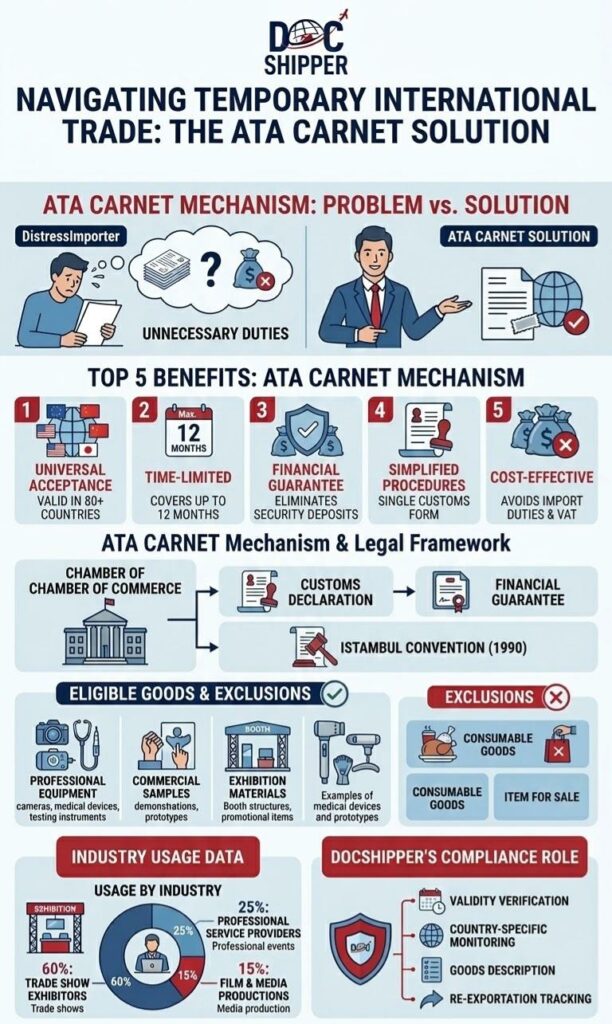
- Universal acceptance: Valid in 80+ countries including EU, USA, China, and Japan
- Time-limited: Covers temporary admission periods up to 12 months
- Financial guarantee: Eliminates need for individual security deposits at each border
- Simplified procedures: Single document replaces multiple national customs forms
- Cost-effective: Avoids payment and reclaim of import duties and VAT
ATA Carnet Mechanism & Legal Framework
The ATA system operates under the Istanbul Convention (1990), which replaced earlier agreements and established a unified framework for temporary admission. The acronym “ATA” combines French and English: “Admission Temporaire/Temporary Admission.”
Issuing authority: National chambers of commerce issue carnets through their affiliation with the World Chambers Federation (WCF). In the United States, the U.S. Council for International Business administers the program. European countries typically operate through their national chamber networks.
The carnet functions as both a customs declaration and a financial guarantee. When you present it at the border, customs officials detach vouchers rather than collecting duties. This guarantee, backed by an international chain of chambers, ensures that duties will be paid if goods don’t re-export as declared.
Eligible goods categories include professional equipment (cameras, medical devices, testing instruments), commercial samples (product demonstrations, prototypes), and exhibition materials (booth structures, promotional items). Consumable goods and items intended for sale are explicitly excluded.
The validity period runs maximum one year from issuance date. Some countries impose shorter limits—China restricts certain categories to six months. Extensions require applying for a new carnet before expiration. At DocShipper, we systematically verify carnet validity dates and country-specific restrictions to prevent customs rejections during international exhibitions.
Legal obligations include accurate goods description, complete re-exportation within the authorized period, and proper voucher management at each border crossing. Failure to re-export triggers liability for full duties plus penalties, which the issuing chamber will claim from the carnet holder. Official guidance is available through the World Customs Organization.
Practical Use Cases & Industry Data
Understanding how carnets function in real scenarios clarifies their value. Industry data shows that trade show exhibitors represent 60% of carnet usage, followed by professional service providers at 25%, and film/media productions at 15%.
Use Case: Technology Trade Show Circuit
A German robotics manufacturer exhibits at CES Las Vegas (January), Mobile World Congress Barcelona (February), and Canton Fair Guangzhou (April). Without an ATA Carnet:
| Scenario | Without ATA Carnet | With ATA Carnet |
|---|---|---|
| USA Entry (€50K equipment) | Customs bond $12,500 + broker fees $800 | Carnet presentation only |
| Spain Entry (EU member) | T1 transit document €200 | Carnet voucher detached |
| China Entry | Deposit 30% of value (€15K) + VAT guarantee | Carnet voucher detached |
| Total Cost | ~€28,500 tied up capital | €450 carnet fee |
The carnet eliminates cash flow blockage and reduces administrative burden by 75%. Processing time at borders drops from 2-4 hours to 15-30 minutes per crossing.
Industry-Specific Applications
Film production: Camera equipment valued at $500K+ moving between shooting locations across multiple countries. A single carnet covers the entire production schedule, avoiding repeated customs clearances.
Medical services: Diagnostic equipment for temporary medical missions or training programs. Carnets enable hospitals to loan specialized devices internationally without permanent export procedures.
Engineering projects: Testing instruments and tools for short-term infrastructure assessments. Construction firms use carnets for site surveys requiring specialized equipment unavailable locally.
Sports events: Professional equipment for international competitions. Olympic teams routinely use carnets for training gear, broadcasting equipment, and specialized sports apparatus.
At DocShipper, we process carnet applications and manage voucher reconciliation for clients operating multi-country exhibition circuits, ensuring compliance across all jurisdictions.
DocShipper Platform
Optimize Your Global Logistics with Cutting-Edge Solutions
Enhance efficiency, cut costs, and gain 24/7 visibility  over your entire supply chain.
- Cut your shipping costs and maximize your margins
- Manage sourcing, freight, & customs on one platform
- Get real-time tracking and analytics
Conclusion
The ATA Carnet remains the most efficient customs solution for temporary international goods movement, saving businesses significant capital and administrative resources. Proper implementation requires understanding validity constraints, country-specific rules, and meticulous documentation.
Need assistance with ATA Carnet procedures or international logistics compliance? Contact DocShipper for expert guidance tailored to your specific trade requirements.
📚 Quiz
Test Your Knowledge: ATA Carnet
Q1 — What is the primary purpose of an ATA Carnet?
Q2 — A company wants to use an ATA Carnet to ship a batch of products abroad for sale at a trade show. Is this a valid use of the carnet?
Q3 — A German robotics firm is planning to exhibit at trade shows in the USA, Spain, and China within the same year. Which approach best describes the correct use of an ATA Carnet in this scenario?
🎯 Your Result
📞 Free Quote in 24hFAQ | ATA Carnet: Definition, Usage & Practical Examples
Standard processing takes 5-10 business days through national chambers of commerce. Expedited service (24-48 hours) is available for urgent needs at additional cost, typically 50-100% premium over standard fees.
No. Carnets cover only temporary admission. Goods intended for sale, consumption, or permanent import require standard commercial customs procedures and duty payment. Misuse triggers penalties and carnet revocation.
You must report the incident to local authorities and customs immediately. Provide police reports and insurance documentation to your issuing chamber. Duties may still apply unless you prove the goods cannot re-export due to circumstances beyond your control.
No. Only 80+ countries participate in the ATA Convention. Major non-participants include most African nations, several South American countries, and some Middle Eastern states. Always verify acceptance before travel.
Fees vary by country and goods value. In the US, expect $270-$500 base fee plus 0.035% of total value as security. EU chambers charge €150-€400 plus similar percentage-based guarantees. High-value shipments may require additional insurance.
No direct extensions exist. You must apply for a new carnet before the original expires. Some countries allow "replacement" carnets if goods remain abroad, but this requires re-export and re-import under the new document.
Always travel with the original carnet, detailed goods list (packing list), commercial invoices, and proof of ownership. Customs may request additional technical specifications, especially for controlled or high-value items like electronics.
No. All goods must be listed when the carnet is issued. If you need to add items later, you must obtain a separate carnet or use alternative customs procedures for the additional goods.
Report the loss immediately to your issuing chamber and local customs. You'll need a replacement carnet to continue operations or re-export goods. The original carnet must be formally cancelled to prevent fraudulent use. Replacement fees typically equal new carnet costs.
Not always required, but highly recommended for complex shipments or unfamiliar countries. Brokers ensure proper voucher completion, navigate local customs variations, and resolve discrepancies. Self-handling works for simple, low-value shipments with experienced staff.
Physical media (laptops, servers, demo units) qualify if temporarily imported. Pure software licenses or cloud-based services don't require carnets. Hardware containing proprietary software should be declared with full technical specifications to avoid classification disputes.
Expired validity dates, incomplete goods descriptions, missing vouchers from previous crossings, goods not matching the declared list, or attempting to use carnets in non-participating countries. Always verify all details before departure and maintain complete records of all border crossings.
Need Help with
Logistics or Sourcing ?
First, we secure the right products from the right suppliers at the right price by managing the sourcing process from start to finish. Then, we simplify your shipping experience - from pickup to final delivery - ensuring any product, anywhere, is delivered at highly competitive prices.


Fill the Form
Prefer email? Send us your inquiry, and we’ll get back to you as soon as possible.
Contact us


