
In short ⚡
ATDNSHINC (All Time Day Night Sundays Holidays Included) is a charter party term indicating that laytime calculation includes all calendar days without exception, including weekends and holidays. This clause ensures continuous counting of loading/unloading time, preventing disputes over allowable delays and protecting charterers from unexpected demurrage charges in international shipping operations.Introduction
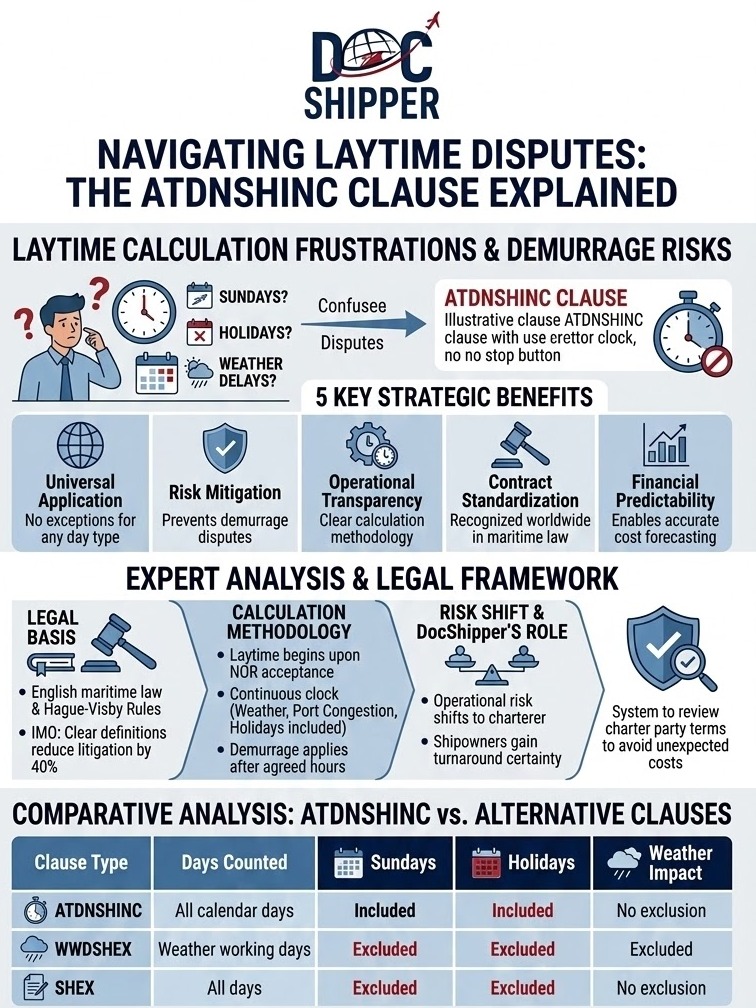
Confusion over laytime calculation causes thousands of shipping disputes annually. When does the clock stop? Do Sundays count? What about national holidays?
The ATDNSHINC clause eliminates ambiguity by establishing absolute clarity: every single day counts. This term is critical in charter parties, particularly for bulk cargo operations where loading/unloading efficiency directly impacts profitability.
- Universal application: No exceptions for any day type
- Risk mitigation: Prevents demurrage disputes
- Operational transparency: Clear calculation methodology
- Contract standardization: Recognized worldwide in maritime law
- Financial predictability: Enables accurate cost forecasting
Expert Analysis & Legal Framework
ATDNSHINC belongs to the family of laytime clauses that govern the permitted duration for cargo operations. Unlike “WWDSHEX” (Weather Working Days Sundays Holidays Excluded), this clause runs continuously from commencement to completion.
The legal foundation derives from English maritime law and international conventions like the Hague-Visby Rules. According to the International Maritime Organization, clear laytime definitions reduce litigation by 40% in bulk shipping contracts.
Calculation methodology: Laytime begins upon Notice of Readiness (NOR) acceptance. Every subsequent hour counts, regardless of weather, port congestion, or local holidays. If 72 hours are agreed and operations take 80 hours, 8 hours of demurrage apply.
Contractual implications: Charterers must ensure efficient stevedoring operations. Port delays, equipment failures, or labor strikes do not pause the clock. This creates pressure for optimal logistics planning.
Risk allocation: The clause shifts operational risk to the charterer. Ship owners gain certainty about vessel turnaround time, while charterers must negotiate adequate laytime allowances during contract formation.
At DocShipper, we systematically review charter party terms including ATDNSHINC clauses to ensure our clients understand their obligations and avoid unexpected demurrage costs during international shipments.
Practical Examples & Data
Understanding ATDNSHINC requires examining real-world scenarios where this clause directly impacts costs and operations.
Comparative Analysis: ATDNSHINC vs. Alternative Clauses
| Clause Type | Days Counted | Sundays | Holidays | Weather Impact |
|---|---|---|---|---|
| ATDNSHINC | All calendar days | Included | Included | No exclusion |
| WWDSHEX | Weather working days | Excluded | Excluded | Excluded |
| SHEX | All days | Excluded | Excluded | No exclusion |
Use Case: Grain Shipment from Argentina to China
Scenario parameters:
- Cargo: 50,000 MT soybeans
- Agreed laytime: 5 days (120 hours) ATDNSHINC
- Loading rate: 10,000 MT per day
- NOR tendered: Monday 08:00
- Loading completed: Saturday 14:00 (134 hours elapsed)
Financial impact: With demurrage at $15,000/day, the 14-hour overage costs $8,750. Had the contract specified SHEX (Sundays/Holidays Excluded), Sunday would not count, potentially saving the charterer significant expense.
Key Operational Insights
- Port selection matters: Ports with 24/7 operations minimize risk under ATDNSHINC
- Buffer planning: Charterers typically negotiate 15-20% laytime buffer
- Weather monitoring: Unlike WWDSHEX, weather delays cost money under ATDNSHINC
- Documentation precision: NOR timing disputes can invalidate laytime calculations
- Stevedore coordination: Pre-arranged labor ensures continuous operations
Conclusion
ATDNSHINC represents the most stringent laytime calculation method in maritime commerce, demanding operational excellence and precise contract negotiation. Understanding this clause is essential for anyone involved in charter party agreements.
Need expert guidance on charter party terms or logistics optimization? Contact DocShipper for professional support tailored to your shipping requirements.
📚 Quiz
Test Your Knowledge: ATDNSHINC
Q1 — What does the acronym ATDNSHINC stand for in maritime shipping?
Q2 — A charterer's vessel is loading grain over a long weekend that includes a national holiday. Under ATDNSHINC terms, what happens to the laytime clock?
Q3 — A shipper is negotiating a charter party for a bulk soybean cargo. They are concerned about potential weather delays at the discharge port. Which clause better protects them from paying demurrage due to bad weather?
🎯 Your Result
📞 Free Quote in 24hFAQ | ATDNSHINC: Definition, Meaning & Practical Use in Logistics
ATDNSHINC means "All Time Day Night Sundays Holidays Included," indicating that laytime runs continuously without any exclusions for weekends, holidays, or nighttime hours.
SHEX (Sundays Holidays Excluded) stops the laytime clock on Sundays and holidays, while ATDNSHINC counts every single day including weekends and all holidays without exception.
Laytime commences when the vessel tenders Notice of Readiness (NOR) and the port authority or charterer accepts it, confirming the ship is ready to load or discharge cargo.
No. Unlike WWDSHEX clauses, ATDNSHINC does not exclude weather delays. The clock runs continuously regardless of meteorological conditions preventing cargo operations.
Shipowners benefit as it guarantees faster vessel turnaround certainty. Charterers face higher risk but gain predictable scheduling if operations are efficient.
Demurrage equals the agreed daily rate divided by 24, multiplied by hours exceeding allowed laytime. For example, 10 hours over at $12,000/day equals $5,000 demurrage.
Yes. All charter party terms are negotiable. Charterers can propose alternative clauses like SHEX or request additional laytime allowances to mitigate ATDNSHINC risks.
If NOR is rejected (vessel not ready, documents incomplete, etc.), laytime does not commence. The clock starts only after valid NOR acceptance by the receiving party.
ATDNSHINC primarily applies to bulk cargo charter parties. Container shipping typically uses different frameworks like liner terms or free in/out clauses rather than laytime calculations.
Force majeure clauses (war, strikes, natural disasters) may suspend laytime if explicitly stated in the charter party. Standard ATDNSHINC alone does not automatically grant such exceptions.
Port congestion does not stop ATDNSHINC laytime unless the charter party includes specific "waiting time" provisions. Delays before berth availability may not count as laytime.
Statement of Facts (SOF), NOR timestamps, port logs, and time sheets signed by ship's master and port agents provide legal evidence for laytime and demurrage calculations.
Need Help with Logistics or Sourcing ?
First, we secure the right products from the right suppliers at the right price by managing the sourcing process from start to finish. Then, we simplify your shipping experience - from pickup to final delivery - ensuring any product, anywhere, is delivered at highly competitive prices.
Fill the Form
Prefer email? Send us your inquiry, and we’ll get back to you as soon as possible.
Contact us