


In short ⚡
The Benefit-Cost Ratio (BCR) is a financial metric that compares the total expected benefits of a project to its total costs. A BCR greater than 1.0 indicates that benefits exceed costs, making the investment economically viable. This ratio is essential in logistics and international trade for evaluating shipping routes, warehouse investments, and supply chain optimization projects.
Introduction
Many importers struggle to justify logistics investments without quantifiable proof of return. Should you invest in air freight despite higher costs? Is warehouse automation worth the capital expenditure? The Benefit-Cost Ratio provides the answer.
In international logistics, every decision impacts profitability. BCR transforms subjective choices into data-driven strategies by measuring economic efficiency across procurement, transportation, and distribution operations.
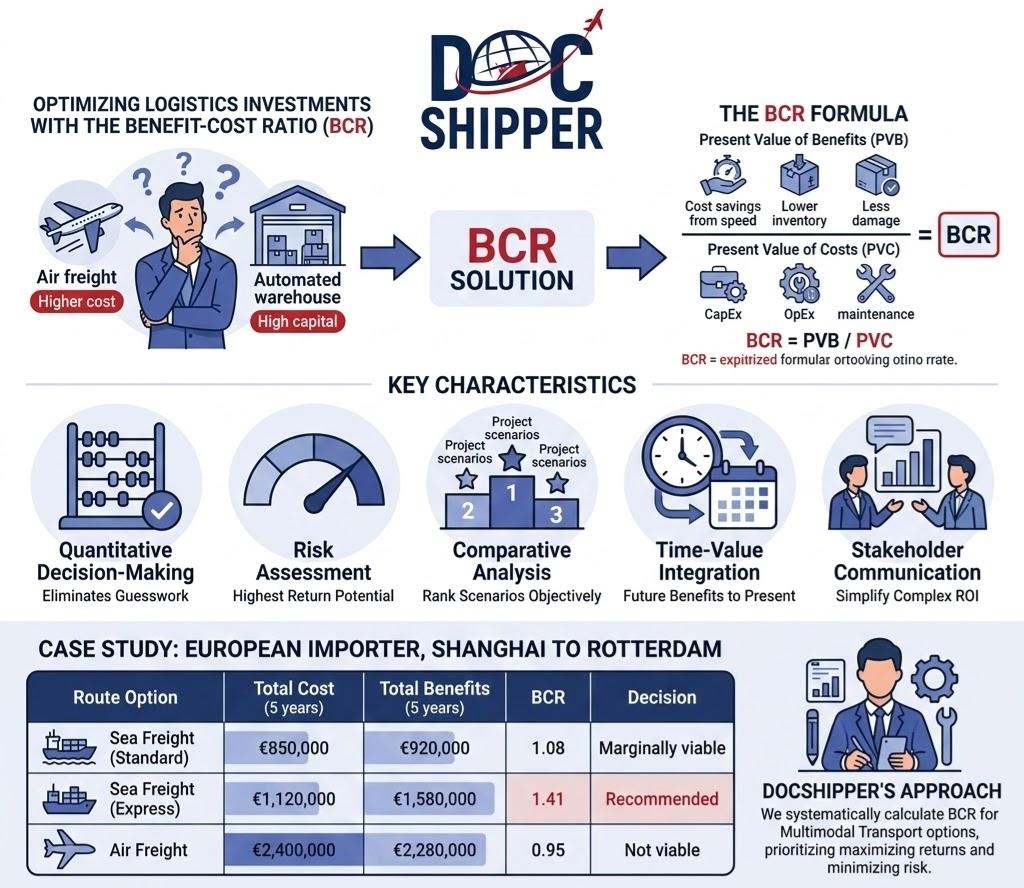
Key characteristics of BCR in logistics:
- Quantitative decision-making: Eliminates guesswork from capital allocation
- Risk assessment: Identifies projects with highest return potential
- Comparative analysis: Ranks multiple logistics scenarios objectively
- Time-value integration: Accounts for present value of future benefits
- Stakeholder communication: Simplifies complex ROI discussions
In-Depth Analysis & Strategic Applications
The standard BCR formula divides the present value of benefits by the present value of costs. Both numerator and denominator must account for the time value of money using appropriate discount rates, typically reflecting the weighted average cost of capital (WACC).
In logistics, benefits include cost savings from reduced transit times, lower inventory holding costs, decreased damage rates, and improved customer satisfaction metrics. Costs encompass initial capital expenditure, operational expenses, maintenance, training, and opportunity costs of alternative investments.
The discount rate selection critically impacts BCR accuracy. International logistics projects often use rates between 8-12%, adjusted for currency risk and country-specific factors. The European Investment Bank recommends sector-specific rates aligned with EU cohesion policy guidelines for transport infrastructure.
Sensitivity analysis strengthens BCR reliability by testing how variations in key assumptions affect outcomes. For example, fluctuating fuel prices, exchange rate volatility, or demand forecast errors can shift a BCR from 1.3 to 0.9, transforming a viable project into a liability.
Advanced applications incorporate non-monetary benefits such as carbon emission reductions, regulatory compliance improvements, and supply chain resilience. The International Maritime Organization (IMO) increasingly requires environmental impact quantification in shipping route evaluations.
At DocShipper, we systematically calculate BCR for clients evaluating multimodal transport options, ensuring every logistics decision maximizes financial and operational returns while minimizing risk exposure.
Concrete Examples & Comparative Data
Consider a European importer evaluating two shipping routes from Shanghai to Rotterdam:
| Route Option | Total Cost (5 years) | Total Benefits (5 years) | BCR | Decision |
|---|---|---|---|---|
| Sea Freight (Standard) | €850,000 | €920,000 | 1.08 | Marginally viable |
| Sea Freight (Express) | €1,120,000 | €1,580,000 | 1.41 | Recommended |
| Air Freight | €2,400,000 | €2,280,000 | 0.95 | Not viable |
The express sea freight option delivers the highest BCR despite higher upfront costs. Benefits include reduced inventory carrying costs (€320,000 savings), faster market response generating additional revenue (€480,000), and lower stockout penalties (€150,000 avoided losses).
Warehouse automation case study: A U.S. distributor invested $2.8M in automated picking systems. Five-year benefits totaled $4.3M through labor cost reduction ($2.1M), accuracy improvements reducing returns ($1.4M), and throughput increases enabling new contracts ($800K). The resulting BCR of 1.54 justified the investment, with payback achieved in 3.2 years.
Key BCR interpretation guidelines:
- BCR > 1.5: Highly attractive investment with comfortable margin of safety
- BCR 1.2-1.5: Viable project requiring moderate risk tolerance
- BCR 1.0-1.2: Marginal viability; conduct thorough sensitivity analysis
- BCR < 1.0: Costs exceed benefits; reject unless strategic imperatives exist
- Negative BCR: Fundamental project redesign required
Industry benchmarks vary significantly. Manufacturing supply chains typically target BCR ≥ 1.3, while perishable goods logistics may accept 1.15 due to urgency premiums. Infrastructure projects often require BCR > 2.0 for public funding approval.
Conclusion
The Benefit-Cost Ratio transforms logistics decision-making from intuition to evidence-based strategy. By quantifying the relationship between investment and return, BCR enables importers and exporters to allocate capital efficiently across competing priorities.
Need expert guidance on optimizing your logistics investments? Contact DocShipper for comprehensive BCR analysis tailored to your supply chain requirements.
DocShipper Platform
One platform. Your entire supply chain
Sourcing, freight, customs & documents — all centralised, all visible, 24/7.
📚 Quiz
Test Your Knowledge: Benefit-Cost Ratio (BCR)
Q1 — What does a Benefit-Cost Ratio (BCR) greater than 1.0 indicate?
Q2 — A logistics manager is reviewing a past investment that already consumed €200,000 in planning fees. Should these fees be included in the BCR calculation for the upcoming project phase?
Q3 — A European importer is comparing three shipping routes from Shanghai to Rotterdam. Sea Freight Express has a BCR of 1.41, Standard Sea Freight has a BCR of 1.08, and Air Freight has a BCR of 0.95. Which route should the importer choose?
🎯 Your Result
📞 Free Quote in 24hFAQ | Benefit-Cost Ratio (BCR): Definition, Calculation & Concrete Examples
BCR expresses benefits as a ratio to costs (benefits/costs), while ROI shows percentage return ((benefits-costs)/costs × 100). BCR of 1.5 equals 50% ROI. BCR is preferred for comparing projects of different scales.
Use discounted cash flow analysis. Calculate present value of each year's benefits and costs using the formula: PV = FV / (1+r)^n, where r is discount rate and n is year number. Sum all PVs and divide total benefits by total costs.
Typically 8-12% for developed markets, 12-18% for emerging markets. Adjust for currency risk, political stability, and project-specific factors. Use your company's weighted average cost of capital (WACC) as baseline.
Yes, through monetization techniques. Assign dollar values to carbon reduction using market prices for emissions credits, or quantify brand reputation improvements through customer retention metrics. Include these in total benefits calculation.
Minimum 1.0 for break-even, but most companies require 1.2-1.5 for acceptable risk-adjusted returns. Public sector projects often mandate BCR > 2.0. Higher thresholds apply for uncertain or long-term investments.
Use real discount rates (adjusted for inflation) rather than nominal rates, or inflate all future cash flows consistently. Inconsistent treatment of inflation distorts BCR, typically understating true project value.
No. BCR evaluates future benefits versus future costs. Sunk costs are irrelevant to forward-looking decisions. Only include costs incurred from the decision point forward, plus opportunity costs of alternative investments.
Vary key assumptions (fuel prices, demand volumes, exchange rates) by ±10-20%. Recalculate BCR for each scenario. If BCR remains >1.0 across pessimistic scenarios, the project demonstrates robust viability.
NPV shows absolute dollar value (benefits minus costs), while BCR shows relative efficiency (benefits divided by costs). A $10M project with $12M benefits has NPV of $2M and BCR of 1.2. Use both metrics together.
Technically yes, if benefits are negative (project creates net harm). In practice, this indicates fundamental flaws. More commonly, BCR < 1.0 signals costs exceed benefits. Negative values suggest calculation errors or extreme scenarios.
Quarterly for projects >$1M or >2 years duration. Major market changes (fuel price spikes, regulatory shifts, demand fluctuations) warrant immediate recalculation. Continuous monitoring prevents sunk cost fallacy traps.
Yes, BCR's standardized ratio format enables direct comparison across warehouse automation, route optimization, fleet upgrades, and technology implementations. Rank all opportunities by BCR to prioritize capital allocation efficiently.
Need Help with
Logistics or Sourcing ?
First, we secure the right products from the right suppliers at the right price by managing the sourcing process from start to finish. Then, we simplify your shipping experience - from pickup to final delivery - ensuring any product, anywhere, is delivered at highly competitive prices.


Fill the Form
Prefer email? Send us your inquiry, and we’ll get back to you as soon as possible.
Contact us


