


In short ⚡
Best in Class refers to organizations, processes, or solutions that demonstrate superior performance compared to industry peers across key operational metrics. In logistics, Best in Class companies achieve excellence through optimized supply chain efficiency, advanced technology adoption, and exceptional customer service standards.
Introduction
Many logistics providers claim excellence, yet few truly achieve Best in Class status. The gap between average performance and industry leadership often determines competitive advantage in international trade.
In global supply chain management, Best in Class designation identifies organizations that consistently outperform competitors in operational efficiency, cost management, and service quality. This distinction matters because shipping delays, customs errors, or poor communication can cost thousands in penalties and lost business.
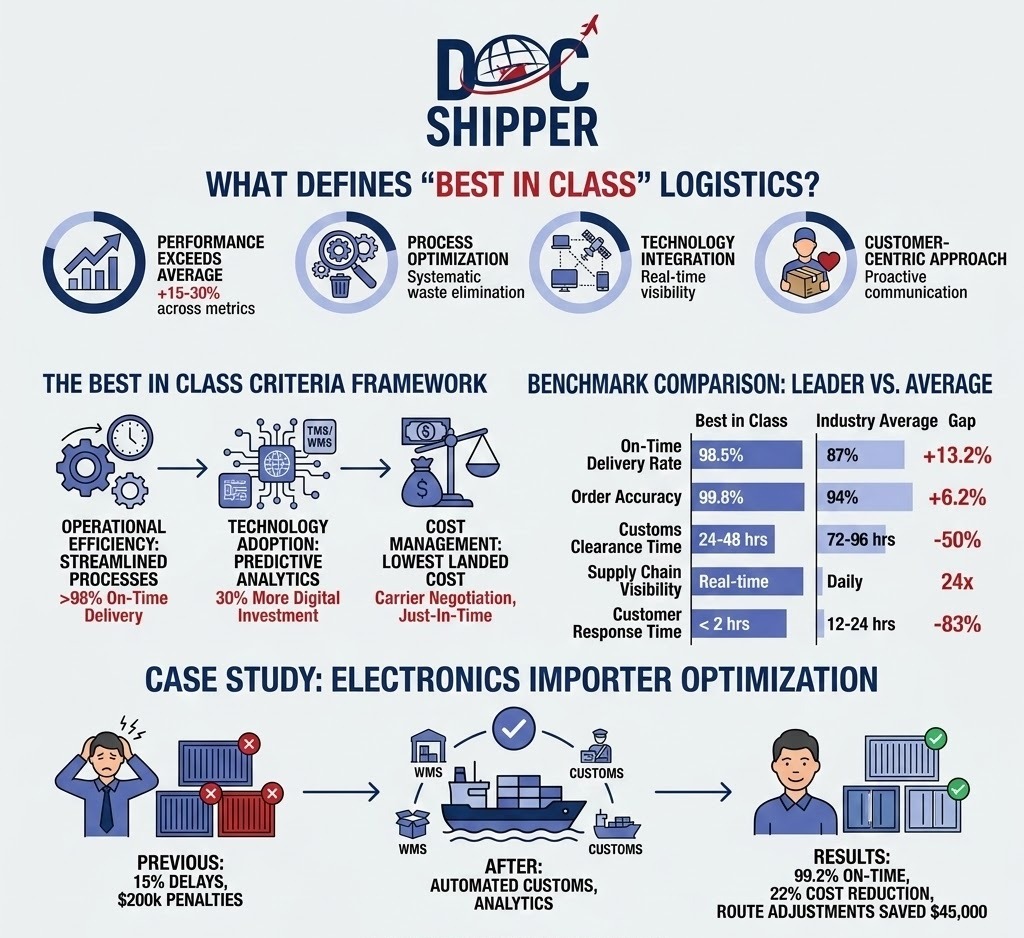
- Quantifiable superiority: Performance exceeds industry averages by 15-30% across core metrics
- Process optimization: Systematic elimination of waste and inefficiency throughout operations
- Technology integration: Advanced systems enabling real-time visibility and predictive analytics
- Customer-centric approach: Proactive communication and customized solutions
- Continuous improvement: Regular benchmarking and adaptation to evolving market demands
Best in Class Criteria & Strategic Framework
Achieving Best in Class status requires measurable excellence across multiple operational dimensions. Organizations must demonstrate sustained performance superiority, not temporary improvements.
The foundation rests on operational efficiency metrics. Best in Class logistics providers maintain on-time delivery rates exceeding 98%, compared to industry averages of 85-90%. They reduce order cycle times by 20-40% through streamlined processes and eliminate redundant handling steps.
Technology adoption separates leaders from followers. Advanced warehouse management systems (WMS), transportation management systems (TMS), and AI-powered forecasting tools enable predictive decision-making. According to the APICS Supply Chain Council, Best in Class companies invest 30% more in digital transformation than competitors.
Cost management excellence involves optimizing total landed costs without compromising service quality. Leaders negotiate better carrier rates through volume consolidation, minimize inventory holding costs via just-in-time strategies, and reduce customs delays through proactive compliance management.
Risk mitigation capabilities define resilience. Best in Class organizations maintain diversified supplier networks, implement robust contingency planning, and leverage insurance solutions to protect against disruptions. At DocShipper, we systematically verify documentation accuracy and customs compliance to prevent costly delays for our clients.
Customer experience optimization completes the framework. Real-time shipment tracking, dedicated account management, and 24/7 support accessibility create competitive differentiation. Transparency in pricing and proactive problem resolution build long-term partnerships rather than transactional relationships.
Performance Benchmarks & Real-World Cases
Understanding Best in Class requires examining concrete performance data and comparative analysis. The following benchmarks illustrate the measurable gap between industry leaders and average performers.
| Performance Metric | Best in Class | Industry Average | Performance Gap |
|---|---|---|---|
| On-Time Delivery Rate | 98.5% | 87% | +13.2% |
| Order Accuracy | 99.8% | 94% | +6.2% |
| Customs Clearance Time | 24-48 hours | 72-96 hours | -50% |
| Supply Chain Visibility | Real-time tracking | Daily updates | 24x improvement |
| Customer Response Time | < 2 hours | 12-24 hours | -83% |
Case Study: Electronics Importer Optimization
A European electronics distributor partnered with a Best in Class logistics provider to import components from Asia. Previous arrangements resulted in 15% delivery delays and $200,000 annual customs penalties.
After implementing Best in Class practices—including automated customs documentation, consolidated shipping schedules, and predictive analytics—the company achieved 99.2% on-time delivery, eliminated customs fines entirely, and reduced total logistics costs by 22%. The provider’s proactive communication system alerted the client to potential port congestion three weeks in advance, enabling route adjustments that saved $45,000 in expedited shipping fees.
Key Performance Indicators for Best in Class Status:
- Perfect order rate: Minimum 95% (delivered complete, on-time, damage-free, with correct documentation)
- Cash-to-cash cycle time: 30-40% faster than industry median through optimized inventory turnover
- Supply chain cost as percentage of revenue: 4-6%, compared to industry average of 8-10%
- Forecast accuracy: Within 5% variance for demand planning and capacity allocation
- Claims ratio: Less than 0.5% of total shipments require damage or loss claims
Conclusion
Best in Class designation represents measurable operational excellence that directly impacts profitability and competitive positioning in international logistics. Organizations achieving this status demonstrate consistent superiority across efficiency, technology, cost management, and customer service metrics.
Need assistance optimizing your supply chain to Best in Class standards? Contact DocShipper for expert guidance on international shipping, customs compliance, and logistics optimization.
DocShipper Platform
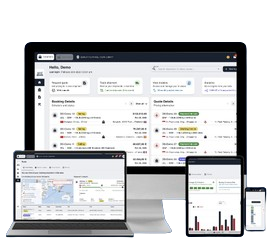
One platform. Your entire supply chain
Sourcing, freight, customs & documents — all centralised, all visible, 24/7.
📚 Quiz
Test Your Knowledge: Best in Class
Q1 — What does "Best in Class" mean in a logistics context?
Q2 — A company claims it is "Best in Class" because it matched the industry average on-time delivery rate of 87% last quarter. Is this claim accurate?
Q3 — A European electronics importer is suffering from frequent customs delays (72–96 hours) and $200,000 in annual penalties. Which approach reflects a Best in Class solution to this problem?
🎯 Your Result
📞 Free Quote in 24hFAQ | Best in Class: Definition, Criteria & Concrete Examples in Logistics
Best in Class refers to organizations demonstrating top-quartile performance across key metrics including on-time delivery (>98%), order accuracy (>99%), and supply chain cost efficiency (4-6% of revenue). These companies leverage advanced technology and optimized processes to consistently outperform competitors.
They implement automated documentation systems, maintain pre-approved customs broker relationships, utilize harmonized tariff classification databases, and conduct proactive compliance audits. This reduces clearance times from industry average 72-96 hours to 24-48 hours.
Leaders deploy integrated WMS/TMS platforms, IoT sensors for real-time tracking, AI-powered demand forecasting, blockchain for documentation transparency, and cloud-based collaboration tools. Investment typically exceeds industry average by 30%.
Yes, through strategic partnerships with specialized providers, cloud-based technology adoption, and focus on niche excellence. Small companies often outperform larger competitors in customer responsiveness and flexibility when leveraging expert third-party logistics support.
Benchmarking compares performance against average standards, while Best in Class identifies top 10-20% performers. Best in Class represents aspirational targets exceeding median performance by 15-30%, not just meeting industry norms.
Leading companies integrate carbon footprint reduction, optimized routing for fuel efficiency, and sustainable packaging. Best in Class providers reduce emissions 20-35% below industry average while maintaining service quality.
Through diversified carrier networks, real-time monitoring systems, pre-established contingency protocols, and proactive client communication. They maintain alternative routing options and buffer inventory strategies to minimize disruption impact.
Response times under 2 hours, dedicated account management, 24/7 support availability, proactive shipment updates, and transparent pricing. Customer satisfaction scores typically exceed 90% compared to industry average of 75-80%.
Quarterly reviews ensure alignment with evolving industry standards. Annual comprehensive audits compare performance against top competitors. Technology and market changes require continuous monitoring rather than static benchmarking.
Companies typically reduce total logistics costs 15-25% through optimized routing, consolidated shipments, reduced errors, and faster customs clearance. Additional savings come from minimized inventory holding costs and eliminated penalty fees.
Core principles remain consistent, but specific metrics adapt to sector requirements. Electronics logistics prioritizes speed and security, while bulk commodities emphasize cost efficiency. Best in Class providers customize solutions while maintaining excellence across fundamental performance indicators.
Begin with comprehensive performance audits, identify gap areas, invest in critical technology upgrades, establish strategic partnerships with expert providers, and implement continuous improvement programs. Most organizations achieve measurable improvement within 6-12 months of systematic optimization.
Need Help with
Logistics or Sourcing ?
First, we secure the right products from the right suppliers at the right price by managing the sourcing process from start to finish. Then, we simplify your shipping experience - from pickup to final delivery - ensuring any product, anywhere, is delivered at highly competitive prices.


Fill the Form
Prefer email? Send us your inquiry, and we’ll get back to you as soon as possible.
Contact us


