


In short ⚡
A Blanket Order is a long-term purchase agreement between a buyer and supplier for recurring deliveries of goods at predetermined prices over a specified period, eliminating the need for individual purchase orders for each transaction.
Introduction
Many importers struggle with repetitive ordering processes, fluctuating prices, and administrative overhead when sourcing materials regularly. Each individual purchase order consumes time, creates documentation burdens, and exposes businesses to price volatility.
The Blanket Order solves this challenge by establishing a framework agreement that streamlines procurement for recurring needs. This instrument is particularly valuable in international trade where predictability and cost control determine competitive advantage.
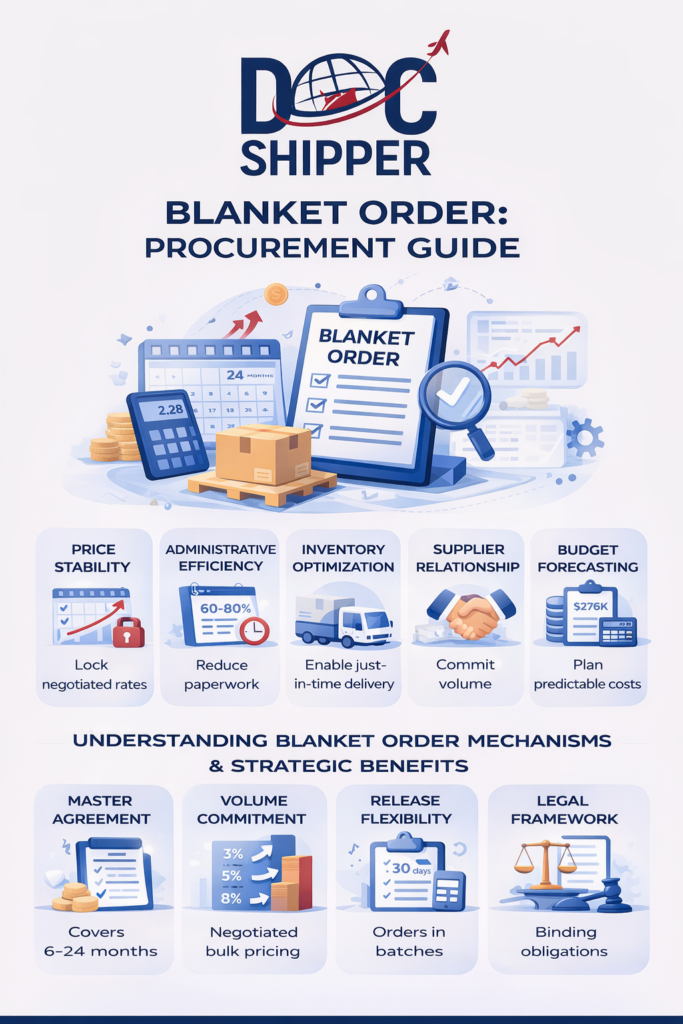
- Price stability: Lock in negotiated rates for extended periods regardless of market fluctuations
- Administrative efficiency: Reduce paperwork by 60-80% compared to individual POs
- Inventory optimization: Enable just-in-time delivery without renegotiating terms
- Supplier relationship: Strengthen partnerships through committed volume guarantees
- Budget forecasting: Improve financial planning with predictable procurement costs
Understanding Blanket Order Mechanisms & Strategic Benefits
A Blanket Order functions as a master agreement covering multiple shipments over 6 to 24 months. Unlike spot purchases, it establishes quantity commitments, delivery schedules, and pricing structures upfront while allowing flexibility in release timing.
The contract typically specifies minimum and maximum order quantities per release, payment terms, quality standards, and Incoterms. Each individual shipment is executed through a release order or call-off that references the master agreement without renegotiating commercial terms.
From a legal standpoint, Blanket Orders create binding obligations for both parties. The buyer commits to minimum purchase volumes while the supplier guarantees capacity allocation and price protection. This framework is governed by the ICC Incoterms and applicable trade law depending on jurisdiction.
Volume-based pricing tiers represent a critical component. Suppliers offer graduated discounts as cumulative quantities increase throughout the contract period. A typical structure might provide 3% discount at 10,000 units, 5% at 25,000 units, and 8% at 50,000 units.
The release mechanism operates through simplified procedures. Instead of full commercial negotiations, buyers issue release notices specifying quantity and delivery date. At DocShipper, we automate these release processes through integrated procurement platforms, ensuring compliance with master agreement terms while reducing processing time from days to hours.
Risk allocation differs significantly from traditional contracts. Demand forecasting risk shifts partially to the buyer through minimum commitments, while price volatility risk transfers to the supplier who must honor locked-in rates. Currency fluctuation clauses and force majeure provisions become essential safeguards.
Practical Examples & Cost Analysis
Consider a European electronics manufacturer importing 120,000 plastic components annually from a Chinese supplier. Traditional procurement involves 24 separate purchase orders with individual price negotiations and administrative processing.
| Procurement Model | Unit Price | Admin Cost/Year | Total Annual Cost | Savings |
|---|---|---|---|---|
| Individual POs (24/year) | $2.40 | $9,600 | $297,600 | Baseline |
| Blanket Order (12 releases) | $2.28 | $3,200 | $276,800 | $20,800 (7.0%) |
The 5% unit price reduction comes from volume commitment guarantees, while administrative savings result from consolidated documentation and reduced negotiation cycles. This scenario demonstrates typical cost improvements across manufacturing sectors.
Use Case: Automotive Parts Import
A North American automotive supplier established a 18-month Blanket Order for brake components with a Vietnamese manufacturer. The agreement covered 200,000 units with quarterly releases based on production schedules.
- Volume commitment: Minimum 150,000 units guaranteed, maximum 250,000 units allowed
- Pricing structure: Base price $45/unit with 6% discount at 175,000 units, 10% at 200,000 units
- Release flexibility: 30-day notice for quantities between 10,000-20,000 per shipment
- Payment terms: Net 60 days from delivery, consolidated monthly invoicing
- Quality assurance: Third-party inspection protocol embedded in master agreement
The actual procurement reached 215,000 units over the contract period, generating $96,750 in savings compared to spot market pricing. At DocShipper, we structure similar agreements for clients across industries, incorporating quality control checkpoints and customs compliance verification at each release stage.
Industry data shows Blanket Orders reduce procurement cycle time by an average of 42% while improving supplier on-time delivery rates from 78% to 94%. The commitment visibility allows suppliers to optimize production scheduling and raw material procurement.
Conclusion
Blanket Orders transform procurement from transactional to strategic, delivering cost predictability and operational efficiency crucial for competitive international sourcing. The framework balances commitment with flexibility, creating mutual value for buyers and suppliers.
Need expert guidance on structuring Blanket Orders for your import operations? Contact DocShipper for tailored procurement solutions that optimize your supply chain performance.
DocShipper Platform
Cut logistics costs. Not corners.
See exactly where your logistics costs are bleeding — and how to fix it. Book your expert demo.

📚 Quiz
Test Your Knowledge: Blanket Order
Q1 — What best defines a Blanket Order in international procurement?
Q2 — Under a Blanket Order, who bears the price volatility risk once the contract is signed?
Q3 — A manufacturer needs to import 120,000 standardized components per year with predictable demand. Which procurement approach is most appropriate?
🎯 Your Result
📞 Free Quote in 24hFAQ | Blanket Order: Definition, Calculation & Concrete Examples
Most Blanket Orders span 12 to 24 months, balancing price stability with market flexibility. Shorter periods (6 months) suit volatile markets, while longer terms (36 months) work for stable commodities.
A Blanket Order specifies firm pricing and minimum quantities, while framework agreements establish general terms without binding volume commitments. Blanket Orders create stronger contractual obligations for both parties.
Standard Blanket Orders lock prices, but contracts may include escalation clauses tied to raw material indices or currency fluctuations exceeding defined thresholds (typically 10-15%).
Contracts typically include shortfall penalties, often 50-75% of the profit margin on uncommitted volumes. Some agreements allow rollover of obligations to subsequent periods with mutual consent.
Release mechanisms vary from email notifications to EDI systems or procurement platforms. Modern practice uses automated systems that validate releases against master agreement parameters before transmission.
They work best for standardized goods with predictable demand. Custom or rapidly evolving products require more flexible procurement approaches due to specification uncertainty.
Essential elements include inspection protocols, acceptance criteria, rejection procedures, and remedy mechanisms. Third-party verification at origin often provides cost-effective quality assurance for international shipments.
They simplify documentation through consistent HS codes, valuations, and origin declarations. Customs authorities often approve standing instructions for repetitive shipments under master agreements.
Termination clauses typically require 60-90 days notice and settlement of minimum commitments. Force majeure provisions allow exit under extraordinary circumstances like regulatory changes or supply chain disruptions.
FOB and CIF dominate international Blanket Orders, providing clear cost allocation. DDP suits buyers seeking total landed cost predictability, though it transfers more risk to suppliers.
Contracts denominated in supplier currency expose buyers to exchange risk, while buyer currency shifts risk to suppliers. Hedging mechanisms or adjustment clauses mitigate extreme volatility impacts.
Release documentation includes the release notice referencing the master agreement, delivery instructions, and any release-specific requirements. Full commercial documentation (invoice, packing list) accompanies each shipment but references the master terms.
Need Help with
Logistics or Sourcing ?
First, we secure the right products from the right suppliers at the right price by managing the sourcing process from start to finish. Then, we simplify your shipping experience - from pickup to final delivery - ensuring any product, anywhere, is delivered at highly competitive prices.


Fill the Form
Prefer email? Send us your inquiry, and we’ll get back to you as soon as possible.
Contact us


