


In short ⚡
A Blanket Purchase Order (BPO) is a long-term procurement agreement between a buyer and supplier establishing pre-negotiated terms for recurring purchases over a defined period. It streamlines ordering by eliminating repetitive negotiations while securing volume discounts and consistent pricing for standardized goods or services.
Introduction
Many procurement teams struggle with repetitive purchase orders that consume administrative resources while failing to leverage volume discounts. This inefficiency becomes particularly costly in international logistics where standardized materials—packaging supplies, spare parts, or consumables—are needed regularly.
The Blanket Purchase Order addresses this challenge by creating a master agreement that governs multiple transactions. Instead of issuing individual POs for each shipment, companies establish overarching terms that apply to all releases within a specified timeframe.
Key characteristics include:
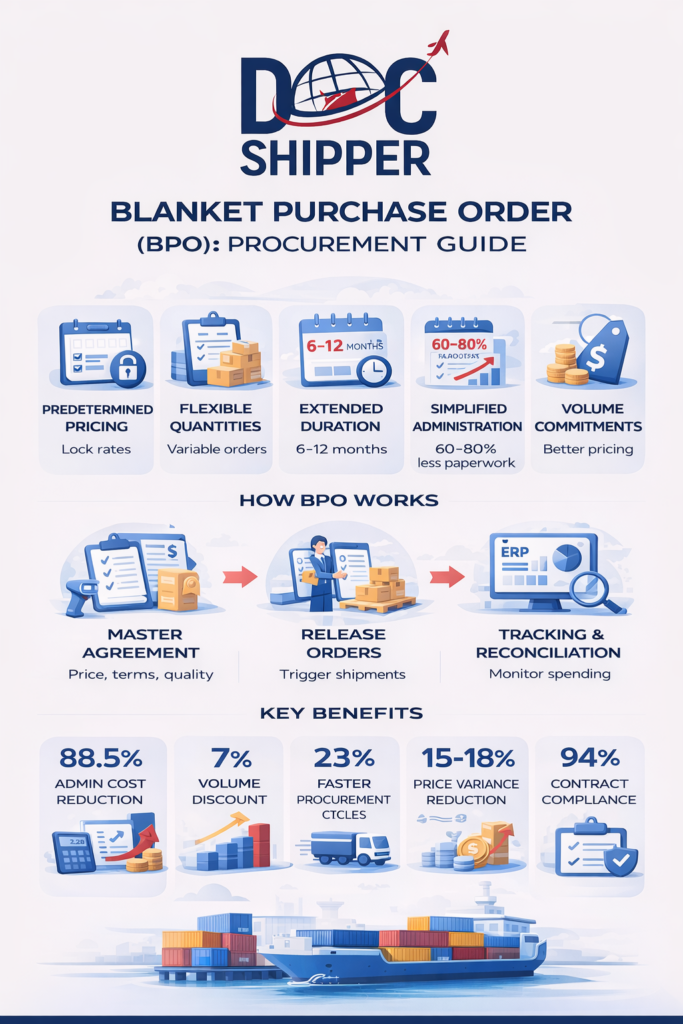
- Predetermined pricing: Locks in rates regardless of market fluctuations during the contract period
- Flexible quantities: Allows release orders for varying volumes within agreed maximums
- Extended duration: Typically covers 6-12 months, sometimes extending to multi-year agreements
- Simplified administration: Reduces paperwork by 60-80% compared to individual POs
- Volume commitments: Establishes minimum/maximum purchase thresholds to secure favorable terms
In global supply chains, BPOs prove essential for managing relationships with freight forwarders, customs brokers, and packaging suppliers where predictable needs meet variable timing.
Mechanisms & Strategic Implementation
A Blanket Purchase Order functions as a framework contract with three operational layers. The master agreement establishes commercial terms including unit prices, payment schedules, quality standards, and delivery protocols. The release mechanism allows authorized personnel to trigger individual shipments against the BPO without renegotiating terms. The reconciliation process tracks cumulative spending against agreed limits.
Legal structures vary by jurisdiction. Under Incoterms 2020 and CISG (UN Convention on Contracts for the International Sale of Goods), BPOs must clearly specify whether they constitute binding commitments or frameworks for future orders. European Union procurement directives require transparent documentation when BPO values exceed €139,000 for public sector entities.
The calculation methodology for BPO limits typically combines historical consumption data with forecasted growth. For example: Annual consumption × 1.15 (growth factor) ÷ 12 months = monthly ceiling. Companies often set total agreement values at 110-125% of expected needs to accommodate demand spikes without contract amendments.
Risk allocation clauses determine liability for price fluctuations, currency variations, and force majeure events. Well-structured BPOs include escalation formulas tied to commodity indices or currency baskets. At DocShipper, we systematically review these clauses to ensure our clients’ international agreements protect against volatile shipping markets and customs regulation changes.
The performance monitoring framework should track supplier compliance rates, delivery punctuality, and quality metrics. Leading procurement systems integrate BPO data with ERP platforms to automate three-way matching (PO-receipt-invoice) and flag deviations exceeding 5% of agreed terms.
For authoritative guidance on international commercial contracts, consult the ICC Model Contracts which provide standardized frameworks compatible with BPO structures across 170+ jurisdictions.
Concrete Examples & Comparative Data
Consider an electronics manufacturer importing components from Southeast Asia. Without a BPO, each shipment requires a new purchase order with individual price negotiations. Analysis shows this company processes 48 orders annually for the same supplier, each taking 4 hours of procurement time at $65/hour—totaling $12,480 in administrative costs alone.
By implementing a 12-month BPO, they reduce this to:
- Initial setup: 12 hours ($780)
- Monthly releases: 0.5 hours × 12 ($390)
- Annual review: 4 hours ($260)
- Total: $1,430 (88.5% reduction)
The same manufacturer negotiated a 7% volume discount by committing to $850,000 annual spending, saving an additional $59,500. Combined administrative and pricing benefits yielded $70,550 in first-year value.
| Procurement Method | Annual Orders | Admin Cost | Unit Price | Total Spend |
|---|---|---|---|---|
| Individual POs | 48 | $12,480 | $100 | $862,480 |
| Blanket PO | 1 (12 releases) | $1,430 | $93 | $791,930 |
| Savings: | $70,550 (8.2%) |
Use Case: Freight Forwarding Services
A fashion retailer shipping 120 containers annually from Bangladesh established a BPO with DocShipper covering ocean freight, customs clearance, and last-mile delivery. The agreement specified:
- Rate lock: $2,850 per 40ft container (vs. spot market fluctuations of $2,400-$3,600)
- Minimum commitment: 100 containers/year
- Priority allocation: Guaranteed space during peak seasons
- Payment terms: Net 45 days (improved from net 15)
When spot rates spiked to $4,200 during Q4 congestion, the BPO saved $162,000 on 120 shipments while ensuring delivery reliability that competitors lacked. The cash flow improvement from extended payment terms freed up $427,500 in working capital.
Data-Driven Insights:
- Companies using BPOs report 23% faster procurement cycles (Source: Procurement Leaders Network 2023)
- Average price variance reduction: 15-18% compared to spot purchasing
- Supplier relationship scores improve by 31% due to predictable demand visibility
- Contract compliance rates reach 94% vs. 67% for ad-hoc purchasing
- Working capital efficiency gains average 12-15% through optimized payment terms
Conclusion
The Blanket Purchase Order transforms procurement from a transactional burden into a strategic advantage. By locking in favorable terms while maintaining operational flexibility, companies reduce costs, improve supplier relationships, and stabilize international supply chains.
Need expert guidance on structuring BPOs for your logistics operations? Contact DocShipper to optimize your procurement strategy across global markets.
DocShipper Platform
One platform. Your entire supply chain
Sourcing, freight, customs & documents — all centralised, all visible, 24/7.
📚 Quiz
Test Your Knowledge: Blanket Purchase Order
Q1 — What best defines a Blanket Purchase Order (BPO)?
Q2 — A common misconception about Blanket Purchase Orders is that they always constitute a legally binding commitment to purchase a fixed quantity. What is the correct interpretation?
Q3 — A fashion retailer ships 120 containers per year from Bangladesh. Spot market rates fluctuate between $2,400 and $4,200 per container. Which approach best leverages a Blanket Purchase Order?
🎯 Your Result
📞 Free Quote in 24hFAQ | Blanket Purchase Order: Definition, Calculation & Concrete Examples
Most BPOs span 6-12 months, though strategic agreements for critical supplies may extend to 2-3 years. Duration depends on price stability, demand predictability, and supplier capacity. Shorter terms suit volatile markets; longer terms maximize administrative savings.
A standard PO covers a single transaction with specific quantities and delivery dates. A BPO establishes terms for multiple releases over time without defining exact quantities upfront. Think of it as a master contract enabling simplified ordering.
Yes, if the agreement includes escalation clauses tied to commodity indices, currency fluctuations, or regulatory changes. Fixed-price BPOs lock rates entirely, while variable structures allow predetermined adjustments based on external factors.
Most agreements allow amendments to increase limits, though this may require renegotiation. Alternatively, supplementary POs can cover excess demand. Well-designed BPOs set limits at 115-125% of forecasted needs to minimize amendments.
This depends on contract language. Some BPOs constitute firm commitments for minimum quantities, while others serve as non-binding frameworks. Legal enforceability varies by jurisdiction—always specify commitment levels explicitly in the agreement.
Calculate administrative cost reduction (hours saved × labor rate) plus price variance savings (volume discount percentage × total spend). Include cash flow benefits from improved payment terms and risk mitigation value from price stability.
BPOs work best for standardized, repetitive purchases with predictable demand patterns—packaging materials, freight services, spare parts, office supplies, or raw materials. Avoid using them for custom-engineered items or one-time projects.
Technically yes, but this complicates administration and dilutes volume leverage. Multi-supplier BPOs (called "master agreements") typically apply when sourcing identical commodities from regional providers to ensure supply continuity.
Implement automated tracking in your ERP or procurement system to monitor cumulative spending against limits, delivery performance, quality metrics, and pricing accuracy. Monthly reconciliation reports should flag variances exceeding 5%.
The most frequent issues include: setting unrealistic volume commitments, inadequate escalation clauses, poor release authorization controls, insufficient performance monitoring, and failure to review agreements quarterly. Clear governance prevents these problems.
Absolutely. BPOs are particularly effective for freight forwarding, customs brokerage, and warehousing where service needs are recurring but volumes fluctuate. They provide rate stability while accommodating seasonal demand variations.
Include currency clauses that either fix exchange rates at contract inception or establish adjustment mechanisms tied to central bank rates. For multi-currency agreements, specify which party bears exchange risk and set variance thresholds (typically ±3-5%).
Need Help with Logistics or Sourcing ?
First, we secure the right products from the right suppliers at the right price by managing the sourcing process from start to finish. Then, we simplify your shipping experience - from pickup to final delivery - ensuring any product, anywhere, is delivered at highly competitive prices.


Fill the Form
Prefer email? Send us your inquiry, and we’ll get back to you as soon as possible.
Contact us


