


In short ⚡
Blanket Release is a logistics authorization allowing multiple shipments under a single purchase order or contract. Instead of issuing separate release orders, buyers schedule deliveries incrementally while maintaining centralized control over quantities, dates, and specifications. This method streamlines procurement, reduces administrative overhead, and optimizes inventory management in international trade operations.
Introduction
Companies frequently struggle with managing multiple small shipments from the same supplier. Issuing separate purchase orders for each delivery creates paperwork bottlenecks, increases processing costs, and complicates supplier coordination. The blanket release solves this challenge by establishing a framework agreement that governs multiple deliveries over time.
In international logistics, this mechanism proves particularly valuable for businesses requiring regular replenishment of components, raw materials, or finished goods. It bridges procurement strategy with operational flexibility, enabling just-in-time inventory practices while maintaining contractual clarity.
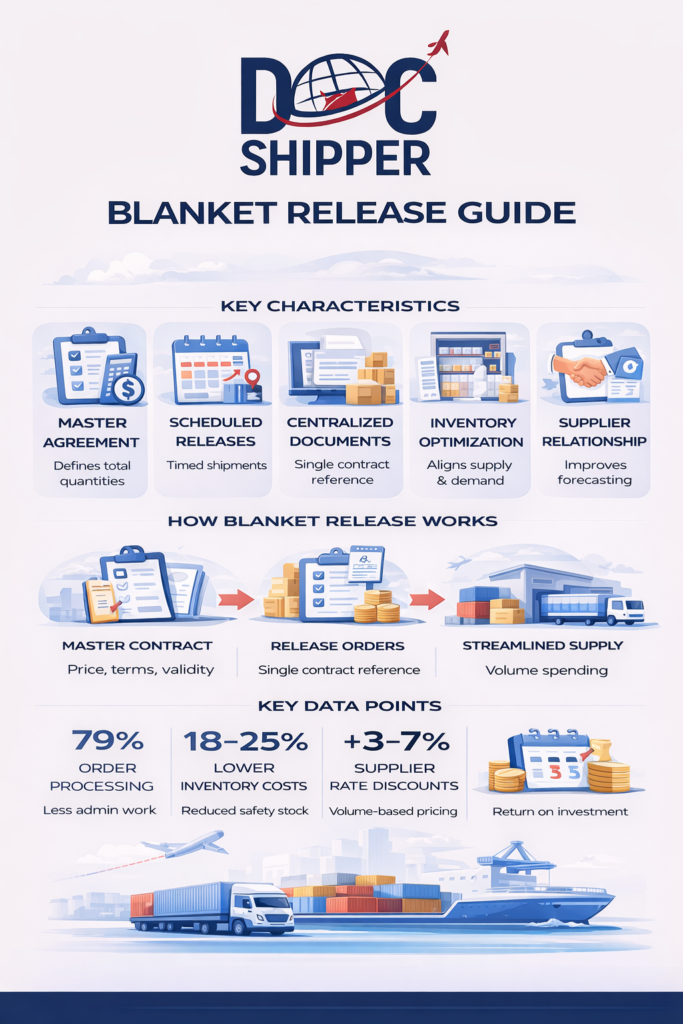
Key characteristics of blanket release systems include:
- Master agreement defining total quantities, pricing, and validity period
- Scheduled releases specifying delivery dates and quantities per shipment
- Centralized documentation reducing customs and administrative complexity
- Inventory optimization aligning deliveries with production or sales cycles
- Supplier relationship management providing predictable demand visibility
Mechanisms & Strategic Implications
The blanket release operates through a two-tier contractual structure. The master purchase order establishes total volume, unit pricing, quality specifications, and contract duration. Individual release orders then draw against this master agreement, specifying exact quantities and delivery windows without renegotiating terms.
From a customs perspective, blanket releases simplify documentation when structured correctly. Importers can reference the master agreement in multiple customs declarations, reducing repetitive data entry. However, authorities require clear traceability between release orders and the overarching contract. According to World Customs Organization guidelines, proper documentation must demonstrate that each shipment falls within pre-approved parameters.
The financial control mechanism represents another critical dimension. Accounts payable teams process invoices against the master agreement rather than individual orders, consolidating payment cycles. This approach improves cash flow forecasting and often unlocks volume-based discounts negotiated in the original contract.
Regarding inventory management integration, modern ERP systems synchronize blanket releases with material requirements planning (MRP) modules. When production schedules change, the system automatically adjusts release quantities and dates within contract parameters. This dynamic adjustment capability reduces stockouts and excess inventory simultaneously.
At DocShipper, we configure blanket release frameworks with clients’ procurement systems, ensuring that release schedules align with shipping lead times and customs clearance windows. This coordination prevents delivery mismatches that could disrupt production or incur demurrage charges.
The risk mitigation aspect deserves emphasis. By locking in pricing and terms upfront, buyers hedge against market volatility. Conversely, suppliers gain demand visibility that enables better production planning. This mutual benefit explains why blanket releases dominate automotive, electronics, and pharmaceutical supply chains where component consistency and delivery reliability are non-negotiable.
Practical Examples & Data Analysis
Consider a European electronics manufacturer sourcing semiconductors from Taiwan. Without a blanket release, each production cycle would require separate purchase orders, customs entries, and payment processing. The administrative cost per order averages €75-€120 according to procurement benchmarks.
Scenario comparison:
| Parameter | Traditional Orders | Blanket Release |
|---|---|---|
| Annual shipments | 24 separate POs | 1 master + 24 releases |
| Processing cost | €2,160 (24 × €90) | €450 (setup + releases) |
| Lead time variability | ±5 days per order | ±2 days (pre-scheduled) |
| Inventory holding cost | Higher (safety stock) | Reduced by 18-25% |
| Supplier pricing | Standard rate | 3-7% volume discount |
This manufacturer reduced administrative overhead by 79% while improving delivery predictability. The locked-in pricing protected them during a 12% semiconductor price surge in Q2, yielding €340,000 in cost avoidance on their annual €4.8M contract.
Pharmaceutical industry case: A US-based API importer established a six-month blanket release with an Indian manufacturer for 12 bi-weekly shipments. Each release specified temperature-controlled container requirements and expedited customs clearance protocols. The pre-negotiated framework reduced customs dwell time from 4.2 days to 1.8 days average, critical for temperature-sensitive materials.
Key operational metrics from blanket release implementations:
- Order processing time: Reduced by 60-75% compared to individual POs
- Inventory turnover: Improved by 1.4-2.1 cycles annually
- Supplier compliance rate: Increases to 94-97% (vs. 82-88% standard)
- Cash-to-cash cycle: Shortened by 8-14 days through payment consolidation
- Customs examination rate: Decreases 30-40% with consistent documentation patterns
At DocShipper, we’ve observed that clients implementing blanket releases for high-frequency imports achieve ROI within 3-5 months through combined savings in administration, inventory holding costs, and negotiated pricing advantages.
Conclusion
The blanket release represents a strategic procurement tool that transforms repetitive purchasing into streamlined supply chain coordination. By balancing contractual stability with operational flexibility, it addresses the core challenge of managing frequent international shipments efficiently.
Need assistance structuring blanket release agreements with your suppliers or integrating them with customs procedures? Contact Docshipper for expert guidance tailored to your supply chain requirements.
DocShipper Platform
Cut logistics costs. Not corners.
See exactly where your logistics costs are bleeding — and how to fix it. Book your expert demo.

📚 Quiz
Test Your Knowledge: Blanket Release
Q1 — What is the primary purpose of a Blanket Release in logistics?
Q2 — A common misconception about Blanket Releases is that they leave quantities and timing completely open-ended. What actually distinguishes them from standing purchase orders?
Q3 — A US pharmaceutical importer needs to receive 12 bi-weekly shipments of temperature-sensitive APIs from India over six months. Which approach best fits this scenario?
🎯 Your Result
📞 Free Quote in 24hFAQ | Blanket Release: Definition, Process & Practical Examples
Most blanket releases span 6-12 months, aligning with fiscal planning cycles. Some industries like automotive use 24-36 month agreements for strategic components, while seasonal businesses prefer quarterly renewals.
Yes, through escalation clauses tied to raw material indices or currency fluctuations. These must be defined in the master agreement with clear calculation methodologies to maintain customs compliance.
Blanket releases specify total contract value and quantities upfront, with scheduled drawdowns. Standing orders establish terms but leave quantities and timing open-ended, offering less budget predictability.
Companies typically negotiate amendment protocols in the master agreement, allowing quantity increases within defined thresholds (often 10-20%) or establishing procedures for supplemental agreements.
Absolutely, especially for businesses with predictable replenishment needs. The administrative savings and improved supplier terms often provide greater relative benefit to smaller operations with limited procurement staff.
When properly structured with clear master agreement references and individual release order tracking, customs agencies generally approve this approach. The key requirement is demonstrating traceability between each shipment and the overarching contract.
Not in a single agreement. Each blanket release is supplier-specific. However, companies often implement parallel blanket releases with multiple suppliers for similar products, managed through centralized procurement systems.
Penalty structures vary by contract but typically include late delivery fees, expedited shipping cost absorption by the supplier, or quantity reduction rights for the buyer. These terms must be explicit in the master agreement.
They provide the contractual framework for JIT delivery schedules. Release orders synchronize with production sequences, often with delivery windows narrowed to specific hours rather than days, reducing work-in-progress inventory.
Yes, particularly for recurring logistics services like warehousing, transportation, or customs brokerage. The same principles apply: master agreement for terms and rates, with individual release orders for specific service activations.
Modern procurement platforms automate release generation based on inventory triggers, integrate with supplier portals for real-time acknowledgment, and provide analytics on utilization rates and delivery performance against contracted terms.
They improve working capital efficiency by spreading payments across scheduled deliveries rather than large upfront purchases. Combined with negotiated payment terms, this can reduce cash conversion cycles by 15-30 days.
Need Help with Logistics or Sourcing ?
First, we secure the right products from the right suppliers at the right price by managing the sourcing process from start to finish. Then, we simplify your shipping experience - from pickup to final delivery - ensuring any product, anywhere, is delivered at highly competitive prices.


Fill the Form
Prefer email? Send us your inquiry, and we’ll get back to you as soon as possible.
Contact us


