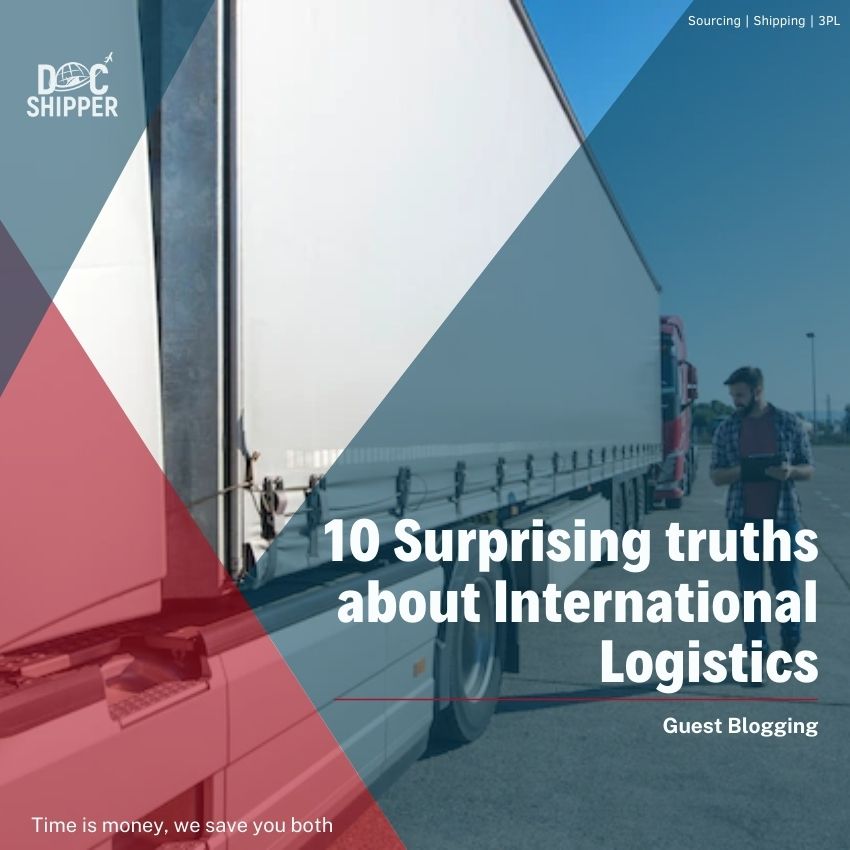


10 hidden truths about international logistics that shape your supply chain

  • admin 16 Min
  • Published on June 24, 2022 Updated on April 9, 2026
img

In short ⚡

Key truths about international logistics show it is far more than moving goods from A to B; it is a cross-border operating system where weak links quickly turn into costly surprises.

You must manage four parallel flows—goods, data, money and risk—while balancing cost, speed, reliability and sustainability across multiple actors and modes.

We hope you’ll find this article genuinely useful, but remember, if you ever feel lost at any step, whether it’s finding a supplier, validating quality, managing international shipping or customs,  DocShipper can handle it all for you!

Free shipping quote 24h      I want to talk to a sourcing expert

What “international logistics” really means beyond shipping from A to B

If you’re searching for truths international logistics, here’s the thing, it’s not “book a carrier, get a bill of lading, done.”

International logistics is the operating system behind your cross-border supply chain management, and you’ll notice fast that one weak link turns into a very expensive surprise.

At DocShipper, we see it every week, a shipment looks simple on paper, then customs clearance, inventory management, and payment terms collide at the border.

Quick workflow you can use to map the real scope:

Step 1: Define your Incoterms and who owns each cost and risk.

Step 2: Lock your documents set, commercial invoice, packing list, and transport document (bill of lading or airway bill).

Step 3: Validate HS code, customs regulations, and estimate import duties and tariffs.

Step 4: Choose multimodal transport, then plan freight consolidation, containerization, and palletization.

Step 5: Plan warehousing, bonded warehouse options, and last-mile delivery with proof of delivery.

Step 6: Add tracking and tracing, freight insurance, and reverse logistics rules before you ship.

Checklist, the “are you actually ready?” version:

  • Incoterms confirmed in the freight contract, not just in emails.
  • Commercial invoice values match payment terms and compliance expectations.
  • Packing list matches pallet count, weights, and carton labeling.
  • HS code reviewed, and you’ve sanity-checked import duties and tariffs exposure.
  • Customs brokerage assigned, with escalation contacts for inspections.
  • Tracking and tracing milestones defined, including proof of delivery.
  • Freight insurance agreed, including theft, water damage, and general average for ocean cargo.

The full picture: flows of goods, data, money and risk across borders

The first of the real truths international logistics is that your cargo is only one flow, the others are data, money, and risk.

If your documents lag behind your physical shipment, customs clearance doesn’t “slow down,” it stops.

From experience, a supplier once released goods in Shenzhen with a last-minute carton change, and the packing list wasn’t updated.

The container arrived fine, but the mismatch triggered a customs query, warehousing fees stacked up, and the buyer’s inventory management plan collapsed in two days.

So what are the four flows you manage in logistics, in plain terms?

  • Goods flow: palletization, containerization, cross-docking, and last-mile delivery.
  • Data flow: HS code, commercial invoice, packing list, bill of lading or airway bill, tracking and tracing.
  • Money flow: freight rates, accessorials, import duties, tariffs, demurrage, detention, and claims.
  • Risk flow: Incoterms handover points, compliance, damage, theft, and reverse logistics.

One insider tip, the International Chamber of Commerce (ICC) Incoterms rules don’t just define “who pays,” they define “who bleeds” when something goes sideways.

What you think you’re managing What you’re actually managing Typical failure point
Shipment movement Multimodal transport + handovers + lead time Missed cut-off, rollover, missed appointment
“Paperwork” Compliance data set for customs regulations HS code mismatch, valuation questions
Freight quote Freight contract scope + accessorial triggers Unexpected detention, storage, re-delivery
Delivery Proof of delivery + claims + reverse logistics Shortage disputes, concealed damage claims

Key players you depend on: carriers, freight forwarders, customs and 3PLs

Another of the truths international logistics is that you’re never “shipping alone,” even if you only talk to one contact.

Behind any international shipment sits a chain of carrier partners, freight forwarding teams, customs brokerage, and often a 3PL or 4PL running warehousing and inventory management.

We’ve seen the classic trap, you accept a freight quote, then discover your “forwarder” doesn’t control the carrier booking and can’t fix a missed vessel.

That’s when lead time turns into wishful thinking.

Here’s how the roles split in real life:

  • Carrier: the operator moving cargo, ocean line, airline, rail, or trucking, plus equipment control.
  • Freight forwarder: the architect of freight consolidation, routing, and multimodal transport, plus documentation support.
  • Freight broker: typically arranges capacity, common in trucking, sometimes with limited document scope.
  • Customs broker: manages customs clearance, compliance, HS code logic, and duty and tariff calculations.
  • 3PL: executes warehousing, cross-docking, order prep, and last-mile delivery.
  • 4PL: orchestrates your whole network across providers, often with KPI governance.

One practical truth, your bill of lading and airway bill aren’t “formalities,” they’re legal control documents that decide who can claim the cargo.

At DocShipper, we align freight forwarding, customs clearance, and warehousing in one operating plan so you don’t chase five parties during a delay.

Actor What you get What you must verify
Freight forwarder Routing, freight consolidation, document support Who issues documents, who controls bookings, claims process
Customs brokerage Customs clearance and compliance HS code method, power of attorney, audit trail
3PL warehouse Warehousing and inventory management Receiving SLAs, cycle count, damage handling, bonded warehouse capability

The biggest myths and hard truths about costs, speed and reliability

If you want more truths international logistics, start with this, your biggest risks hide inside “cheap,” “fast,” and “guaranteed.”

Freight rates look like the headline, but the total landed cost is the real story, and it includes time, compliance, and failure recovery.

We’ve watched importers nail the purchase price, then lose the margin in detention, storage, rework, and missed sales windows.

Workflow to control cost, speed, reliability together:

Step 1: Build a lane baseline using real freight rates, not spot-only screenshots.

Step 2: Add accessorials and risk buffers, pickup, delivery appointments, detention, demurrage.

Step 3: Tie service levels to measurable milestones, cut-off, departure, arrival, customs release, POD.

Step 4: Decide where to hold inventory, origin consolidation, in-transit, destination warehousing.

Step 5: Pre-agree exception playbooks, inspections, holds, re-routing, partial deliveries.

Checklist, your “true cost” capture list:

  • Freight quote scope matches the Incoterms responsibility split.
  • Origin and destination charges listed, not hidden behind “THC included” vagueness.
  • Customs clearance line items separated from duty and tax amounts.
  • Detention and demurrage free time confirmed in writing.
  • Freight insurance value and deductible agreed before pickup.
  • Warehousing, cross-docking, and last-mile delivery fees mapped to volumes.

Why the cheapest quote rarely reflects true logistics costs

One of the most painful truths international logistics is that the cheapest freight quote often wins the tender, then quietly loses you money.

You don’t pay for “transport,” you pay for a chain of commitments, equipment, capacity, compliance, and time.

We remember a buyer who chose a low ocean rate for containerization from Asia, then got hit with rolled bookings twice.

By the time the cargo arrived, demurrage plus urgent trucking wiped out the savings, and the retailer demanded penalties for missed launch dates.

Here’s what tends to be missing from the “cheap” number:

  • Accessorials: appointment deliveries, chassis, overweight, waiting time.
  • Port and terminal costs: handling, documentation, storage after free time.
  • Customs-related friction: exams, holds, amendment fees, compliance support.
  • Service reliability: carrier schedule integrity and space protection.
  • Downstream fixes: split shipments, air upgrades, reverse logistics.
Quote element Looks cheap because… What you should ask
Base freight rates Carrier price is low this week Is space protected by a freight contract or spot only?
Customs brokerage Bundled into “all-in” Who owns compliance and post-entry audits?
Delivery Last-mile delivery assumed simple Appointments, POD, redelivery, inside delivery included?

At DocShipper, we structure your freight forwarding offer like a landed-cost model so you can compare apples to apples, not apples to surprises.

Looking for a Reliable Shipping & Sourcing Partner?

We handle the entire sourcing process, supplier research, negotiation, production, and inspections, so you can focus on what matters most: growing your business.

The truth about transit times, delays and service levels you can actually control

Another of the core truths international logistics is that you can’t control everything about transit time, but you can control more than you think.

The trick is separating “carrier transit time” from “door-to-door lead time,” because most delays happen at handoffs and paperwork gates.

A real scenario we see, your supplier finishes production on Friday, but the commercial invoice arrives Monday with a wrong HS code.

Customs clearance gets stuck, the container sits, and suddenly everyone blames the carrier even though the delay started in your data flow.

What you can control, reliably:

  • Cut-off readiness: packing list accuracy, palletization plan, export docs on time.
  • Routing design: direct vs transshipment, multimodal transport choices, buffer days.
  • Customs readiness: HS code validation, compliance notes, import duties funding, broker instructions.
  • Exception speed: pre-approved re-routing, partial release, alternate last-mile delivery.
  • Visibility: tracking and tracing events that match your internal milestones.

And what you mostly can’t control, so you plan around it:

  • Port congestion and terminal appointment scarcity.
  • Carrier blank sailings, aircraft capacity shifts, weather disruptions.
  • Random customs inspections and intensified enforcement cycles.

You’ll hear a lot of marketing about “guaranteed timelines,” but even IATA airline standards still depend on correct paperwork and acceptance cut-offs.

When we manage your shipment, we focus on service levels you can enforce, documented milestones, escalation paths, and clean documents that keep customs brokerage moving.

DocShipper Advice

Trucking is not just execution, it is leverage.
Design your drayage, cross border and last mile as one strategy.
Control capacity before disruption controls you

Trucking’s real role in global logistics and why it still dominates the last mile

When you talk about truths international logistics, you must accept one fact: nothing moves without a truck at some point. Even air and ocean freight depend on trucking to connect ports, airports, warehouses and final customers.

Trucking is the glue of your supply chain, especially in North America where road infrastructure is deeply integrated with distribution networks. In Canada and the US, more than 70 percent of domestic freight by value moves by truck.

  • Port to warehouse drayage after ocean arrival
  • Airport pickup and bonded transport
  • Cross border US Canada FTL and LTL
  • Final mile delivery to retail, construction sites or consumers
  • Reverse logistics and returns

You rely on different types of drivers depending on your freight profile. Choosing the wrong model increases risk, cost and delay.

Driver type Scope Best for Risk level
Company driver Employed by carrier Stable long term contracts Lower operational risk
Owner operator Independent contractor Flexible capacity spikes Variable reliability
Team drivers Two drivers per truck Time sensitive freight Higher cost
Specialized drivers Hazmat, oversized, reefer Regulated cargo Compliance critical

The hard truth is that trucking is both the most flexible and the most exposed mode. It faces driver shortages, fuel volatility, weather disruption and border compliance constraints.

You cannot compare trucking to ocean or rail without context. Each mode solves a different operational equation.

Mode Speed Cost per unit Flexibility Typical use
Truck Medium to fast Medium Very high Domestic, cross border, last mile
Ocean Slow Low Low Intercontinental bulk
Air Very fast Very high Medium Urgent, high value goods
Rail Medium Low to medium Low Heavy inland volumes

At DocShipper, we integrate trucking into your global routing strategy, not as an afterthought but as a controlled cost driver. You gain visibility from factory pickup in Asia to final delivery in Toronto or Montreal.

DocShipper Info

Sustainability requires engineered decisions, not slogans.
Use consolidation, mode shift and smarter routing to cut emissions without killing margin.
Measure trade offs before committing publicly

7 uncomfortable truths about sustainability in international logistics

Everyone talks about green supply chains, but the operational reality is more complex. If you manage international flows, you must balance carbon targets with cost and service commitments.

Sustainability is a trade off equation, not a marketing slogan. Here are seven uncomfortable truths you need to face.

  • 1. Ocean freight is efficient per unit, but total emissions are massive. Scale does not mean zero impact.
  • 2. Air freight destroys your carbon footprint. One urgent shipment can offset months of optimization.
  • 3. Trucking electrification is slow. Infrastructure and battery limits restrict long haul adoption.
  • 4. Rail is cleaner, but less flexible. You sacrifice routing agility for emissions gains.
  • 5. Sustainable packaging increases unit cost. Especially for low margin consumer goods.
  • 6. Carbon reporting is complex. Scope 3 data from overseas suppliers is often unreliable.
  • 7. Customers say they want green logistics. Many still choose the cheapest option at checkout.

The operational truth is that sustainability must be engineered into network design. You reduce emissions through consolidation, better forecasting and optimized Incoterms.

Action lever Impact on CO2 Impact on cost
Shipment consolidation High reduction Cost decrease
Mode shift air to ocean Very high reduction Major cost decrease
Nearshoring Medium reduction Variable cost impact
Route optimization Moderate reduction Cost neutral to positive

We help you quantify these trade offs with measurable KPIs. You move from emotional decisions to data driven supply chain design.

Conclusion

International logistics is not just about moving goods. It is about controlling risk, cost, compliance and sustainability across borders.

  • You now understand that trucking dominates the last mile and connects every major mode.
  • You see how different driver models affect reliability and scalability.
  • You can compare trucking with ocean, air and rail based on operational criteria.
  • You recognize the real environmental trade offs behind global freight.
  • You know that optimization requires integrated control from supplier to final delivery.

At DocShipper, we design your logistics architecture end to end. You focus on growing your business, we secure the execution on the ground.

FAQ | 10 hidden truths about international logistics that shape your supply chain

It depends on what you’re optimizing for, but trucking remains the most flexible piece of the puzzle.

  • Best when you need: door-to-door reach, cross-border moves, last mile, and time-sensitive regional deliveries.
  • Less competitive when: you’re moving huge volumes over long distances (ocean/rail win on cost per unit) or ultra-urgent long-haul freight (air wins on speed).
  • In practice: almost every international shipment still needs a truck to connect ports, airports, warehouses and final customers.

Ask us anything!

Need Help with
Logistics or Sourcing ?

First, we secure the right products from the right suppliers at the right price by managing the sourcing process from start to finish. Then, we simplify your shipping experience - from pickup to final delivery - ensuring any product, anywhere, is delivered at highly competitive prices.

Live Chat

Get instant assistance from our team—just click and start chatting!

Live Chat Now
image

Fill the Form

Prefer email? Send us your inquiry, and we’ll get back to you as soon as possible.

Contact us
image

Call us

Reach out to us on WhatsApp for quick, convenient, and personal support.

Call us
image