


In short ⚡
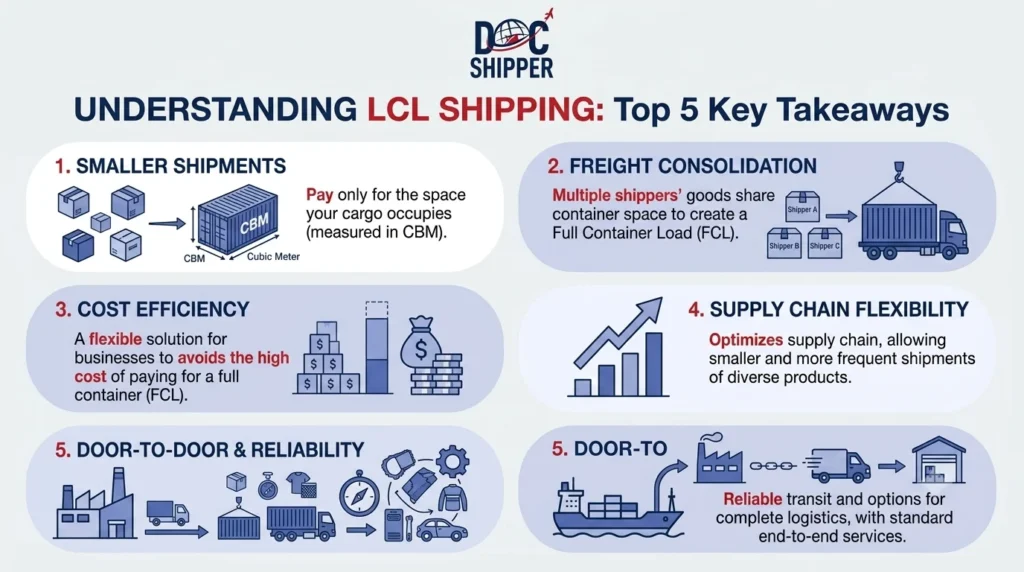
Less-Than-Container Load (LCL) is a shipping method where cargo from multiple exporters is consolidated into a single container, ideal for shipments that don't require a full container. This cost-effective solution allows businesses to pay only for the space they use, making international trade accessible for small to medium volumes while sharing container costs with other shippers.Introduction
Many importers face a common dilemma: their cargo volume doesn’t justify renting an entire 20-foot or 40-foot container, yet air freight costs are prohibitively expensive. This is precisely where Less-Than-Container Load shipping becomes essential. In global trade, approximately 40% of ocean freight shipments utilize LCL, making it a cornerstone of flexible logistics operations.
LCL shipping bridges the gap between small parcel services and full container loads (FCL), offering significant cost savings while maintaining reasonable transit times. Understanding LCL fundamentals is crucial for optimizing supply chain expenses and managing inventory efficiently.
- Volume flexibility: Ship from 1 cubic meter up to approximately 15 CBM without paying for unused space
- Cost efficiency: Pay only for the volumetric or weight space your cargo occupies within the shared container
- Consolidation process: Freight forwarders combine shipments from different clients at origin ports before ocean transit
- Deconsolidation handling: Cargo is separated at destination ports and delivered to individual consignees
- Documentation complexity: Requires meticulous coordination as multiple bills of lading share one master container
LCL Mechanisms & Logistics Expertise
The LCL shipping process involves several critical stages managed by consolidation warehouses at origin ports. These facilities receive cargo from multiple shippers, conduct quality inspections, and strategically load goods into containers based on destination and compatibility. The consolidation phase typically adds 3-5 days to transit times compared to FCL shipments.
Freight calculation methodology for LCL differs fundamentally from FCL pricing. Carriers charge based on either volumetric measurement (cubic meters) or gross weight (kilograms/tons), applying the “whichever is greater” principle. The industry standard ratio is 1 CBM = 1000 kg. Additionally, LCL shipments incur specific charges including origin handling fees, destination deconsolidation charges, and documentation processing.
Understanding cargo compatibility rules is essential for successful LCL shipping. Consolidators must ensure that goods sharing container space don’t pose contamination risks, temperature conflicts, or hazardous material incompatibilities. For instance, foodstuffs cannot share space with chemicals, and certain commodities require segregation according to IMO dangerous goods regulations.
The Bill of Lading structure in LCL operations includes both a House Bill of Lading (HBL) issued by the freight forwarder to the shipper and a Master Bill of Lading (MBL) issued by the carrier to the consolidator. This dual-documentation system requires precise coordination to prevent customs clearance delays. At DocShipper, we manage this entire documentation chain to ensure seamless processing through customs authorities.
Transit time considerations make LCL inherently slower than FCL due to consolidation/deconsolidation processes. Standard LCL shipments experience 5-10 additional days compared to FCL on identical trade routes. However, this trade-off becomes economically justified for shipments below the FCL breakeven point, typically around 15 cubic meters depending on the route.
Practical Examples & Cost Analysis
To illustrate when LCL becomes the optimal choice, consider this comparative scenario: An electronics importer in Los Angeles needs to ship 8 cubic meters of goods from Shenzhen, China. The cargo weighs 3,200 kg (well below the volumetric threshold). Let’s examine the cost differential between shipping methods.
| Shipping Method | Base Freight | Additional Fees | Total Cost | Transit Time |
|---|---|---|---|---|
| LCL (8 CBM) | $560 | $280 | $840 | 25-30 days |
| FCL 20′ Container | $1,800 | $350 | $2,150 | 18-22 days |
| Air Freight | $2,240 | $180 | $2,420 | 5-7 days |
This comparison reveals that LCL offers 61% cost savings compared to FCL and 65% savings versus air freight for this specific volume. The economic breakeven point between LCL and FCL typically occurs between 12-18 cubic meters, depending on trade lane rates and seasonal demand fluctuations.
Real-world case study: A German furniture retailer imports handcrafted Indonesian teak chairs quarterly. Each shipment contains 6 CBM with a declared value of €12,000. By utilizing LCL through Jakarta to Hamburg, they pay approximately €480 in ocean freight versus €1,650 for a 20′ container they’d only fill 20% of. Over four annual shipments, this strategy saves €4,680 in transportation costs alone.
Critical factors influencing LCL viability include:
- Cargo density: High-density goods maximize value since LCL charges favor heavy, compact shipments
- Shipment frequency: Regular small volumes benefit more than occasional large shipments
- Inventory carrying costs: LCL enables just-in-time strategies, reducing warehousing expenses
- Seasonality impact: Peak season surcharges can increase LCL rates by 30-50% during Q4
- Port infrastructure: Major consolidation hubs (Shanghai, Rotterdam, Los Angeles) offer better LCL rates than secondary ports
At DocShipper, we analyze your specific shipping patterns and cargo characteristics to determine the optimal threshold between LCL and FCL, often identifying hybrid strategies that maximize cost efficiency across your annual shipping calendar.
Conclusion
Less-Than-Container Load shipping represents a strategic logistics solution for businesses seeking cost optimization without compromising on reliability. Understanding LCL mechanics, cost structures, and optimal application scenarios empowers importers to make data-driven decisions that directly impact their bottom line. As global trade continues evolving toward smaller, more frequent shipments, LCL proficiency becomes increasingly valuable for competitive supply chain management.
Need expert guidance on whether LCL fits your shipping requirements? Contact DocShipper for a customized freight analysis tailored to your specific trade lanes and cargo profiles.
📚 Quiz
Test Your Knowledge: Less-Than-Container Load (LCL)
What defines the core principle of Less-Than-Container Load (LCL) shipping?
How are LCL freight charges calculated by carriers?
An importer has 8 CBM of electronics to ship from Shanghai to Los Angeles. Based on the article's cost analysis, which scenario is correct?
🎯 Your Result
📞 Free Quote in 24hFAQ | Less-Than-Container Load (LCL): Definition, Calculation & Practical Examples
Most freight forwarders accept LCL shipments starting from 1 cubic meter (CBM), though some carriers set minimums at 0.5 CBM. Below these thresholds, couriers or air freight typically become more cost-effective. The practical lower limit depends on your origin-destination pair and consolidation frequency at departure ports.
LCL charges are based on either volumetric measurement (cubic meters) or gross weight (tons), whichever yields the higher charge. The standard conversion ratio is 1 CBM = 1000 kg. Additionally, LCL includes origin consolidation fees ($25-75), destination deconsolidation charges ($50-150), and documentation processing. FCL, conversely, charges a flat rate per container regardless of how much space you utilize.
LCL adds 5-10 days to ocean transit due to consolidation at origin (2-4 days) and deconsolidation at destination (3-6 days). Cargo must wait until the consolidator accumulates sufficient volume to fill a container heading to your destination. FCL containers depart on fixed sailing schedules without this accumulation period, and unloading at destination is faster since the entire container belongs to one consignee.
Yes, but with strict limitations. Hazardous cargo (classified under IMO guidelines) requires specialized LCL consolidation where only compatible dangerous goods share container space. This significantly reduces available consolidation options and increases costs by 30-80%. Non-hazardous cargo cannot share containers with hazardous materials, requiring dedicated consolidation schedules that may add 7-14 days to transit times.
Liability in LCL shipments follows the Hague-Visby Rules, limiting carrier responsibility to approximately $500 per package or customary freight unit. Since your cargo shares space with others, determining liability can be complex. Cargo insurance is strongly recommended for LCL shipments, typically costing 0.3-0.5% of declared value. The consolidator, ocean carrier, and deconsolidator each hold different liability scopes, making comprehensive insurance essential.
The economic breakeven point typically occurs between 12-18 cubic meters, depending on your trade lane. Calculate your total LCL cost (base freight + consolidation + deconsolidation) and compare it to FCL rates. Additional factors include cargo value (higher-value goods justify FCL security), urgency (FCL is 5-10 days faster), and shipment frequency. If you consistently ship above 15 CBM, FCL usually becomes more economical.
LCL customs clearance occurs after deconsolidation at the destination port, whereas FCL cargo can sometimes be cleared while still containerized. Your House Bill of Lading (HBL) must precisely match customs documentation, as errors affect only your portion of a multi-shipper container. Processing may take 1-3 days longer than FCL since customs authorities handle multiple consignees from one container. Working with experienced customs brokers minimizes these delays.
Several cargo categories face restrictions: extremely fragile items requiring climate control (better suited for air freight), oversized pieces exceeding standard pallet dimensions, perishable goods with strict temperature requirements, and high-value cargo where theft risk in shared containers is unacceptable. Additionally, odor-emitting products, liquids prone to leakage, and goods requiring specialized handling equipment typically face surcharges or outright rejection by consolidators.
Tracking LCL shipments is more limited than FCL. You can monitor the master container's ocean voyage using the Master Bill of Lading number, but visibility into consolidation/deconsolidation stages varies by forwarder. Modern freight forwarders provide milestone-based tracking (cargo received, consolidated, departed, arrived, deconsolidated, out for delivery). Real-time GPS tracking typically isn't available for individual LCL consignments within shared containers, unlike FCL where the entire container is yours.
Essential LCL documentation includes: Commercial Invoice (detailed product description and value), Packing List (dimensions and weight per package), House Bill of Lading (issued by freight forwarder), Master Bill of Lading (issued by carrier), Certificate of Origin (if claiming preferential duty rates), and product-specific certificates (FDA, CE, Phytosanitary, etc.). Unlike FCL, LCL requires meticulous package-level detail since your cargo will be physically separated from its container during deconsolidation.
LCL typically costs 50-70% less than air freight for comparable shipments, though transit time increases by 15-25 days. For a 5 CBM shipment from China to Europe, air freight might cost $2,800-3,500 versus $600-900 for LCL. The savings become more pronounced for dense, heavy cargo where air freight's weight-based pricing significantly inflates costs. However, inventory carrying costs during the longer LCL transit must be factored into total landed cost calculations.
While not legally mandatory, cargo insurance is highly advisable for LCL. Carrier liability is limited to approximately $500 per package under international conventions—far below the actual value of most shipments. LCL cargo faces higher handling risk due to multiple loading/unloading cycles during consolidation and deconsolidation. Comprehensive marine cargo insurance typically costs 0.3-0.6% of declared value and covers loss, damage, and theft throughout the entire journey, including inland transportation segments.
Need Help with
Logistics or Sourcing ?
First, we secure the right products from the right suppliers at the right price by managing the sourcing process from start to finish. Then, we simplify your shipping experience - from pickup to final delivery - ensuring any product, anywhere, is delivered at highly competitive prices.


Fill the Form
Prefer email? Send us your inquiry, and we’ll get back to you as soon as possible.
Contact us




:%20Definition,%20Calculation%20&%20Practical%20Examples)