


In short ⚡
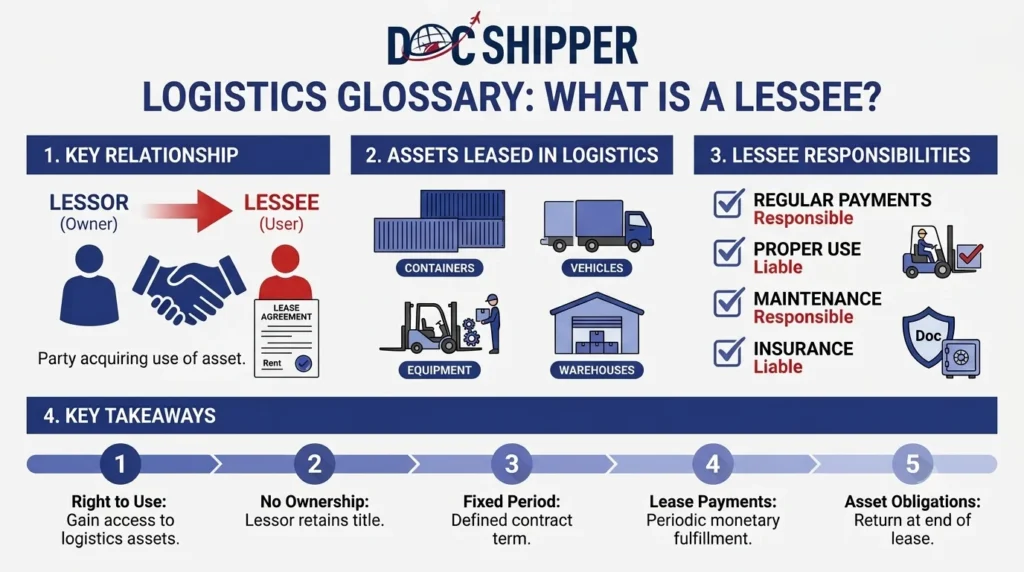
A lessee is an individual or company that leases assets from a lessor under a contractual agreement. In international logistics, lessees commonly lease containers, warehouses, transport equipment, or vehicles to optimize operational flexibility without capital expenditure. This arrangement enables businesses to scale operations while maintaining cash flow efficiency.
Introduction
Many logistics operators confuse ownership with operational control. This distinction becomes critical when managing international supply chains. A lessee gains temporary possession and usage rights without owning the asset, providing strategic advantages in volatile markets.
In global trade, leasing arrangements govern billions in equipment value annually. Container shipping alone involves millions of leased units crossing borders daily. Understanding the lessee’s role ensures compliance, cost optimization, and liability management.
Key characteristics of a lessee in logistics:
- Contractual obligation: Bound by lease terms including duration, payment, and maintenance responsibilities
- Operational control: Exercises full usage rights within contract parameters
- Financial flexibility: Avoids large capital outlays while accessing necessary equipment
- Liability exposure: Responsible for damage, loss, or misuse during lease period
- Documentation requirements: Must maintain proper lease records for customs and insurance purposes
In-Depth Analysis & Expertise
The lessee-lessor relationship in international logistics operates within complex legal frameworks. Lease agreements must specify jurisdictional authority, particularly for cross-border movements. Container leases, for instance, involve master lease agreements governed by international conventions like the UNCITRAL Model Law.
Three primary lease structures exist in logistics. Operating leases provide short-term flexibility, ideal for seasonal demand fluctuations. Finance leases function similarly to purchase agreements, transferring substantially all asset risks and rewards. Sale-and-leaseback arrangements allow companies to unlock capital from owned assets while maintaining operational access.
Tax implications vary significantly by jurisdiction. In most countries, operating lease payments qualify as deductible operating expenses, improving cash flow. Finance leases often receive different accounting treatment under IFRS 16 and ASC 842 standards, requiring balance sheet recognition.
Insurance obligations represent critical considerations. Lessees typically must maintain comprehensive coverage including liability, damage, and theft protection. Container lessees face additional requirements for depot storage and international transit coverage. At DocShipper, we systematically verify insurance compliance across all leased equipment to prevent costly disputes.
Default scenarios carry severe consequences. Lease agreements contain cross-default clauses triggering immediate termination if payment obligations aren’t met. For international lessees, this can strand critical shipments mid-transit, creating cascading supply chain failures.
Practical Examples & Data
Container leasing dominates global shipping economics. Approximately 55% of the world’s container fleet operates under lease agreements. Major lessees include shipping lines like Maersk, MSC, and CMA CGM, who balance owned and leased fleets to optimize capacity.
| Asset Type | Typical Lease Duration | Monthly Cost Range | Primary Lessee Profile |
|---|---|---|---|
| 20ft Container | 6-36 months | $40-$120 | Shipping lines, freight forwarders |
| Warehouse Space (1000m²) | 12-60 months | $3,000-$15,000 | 3PLs, importers, distributors |
| Refrigerated Trailer | 24-48 months | $1,500-$2,500 | Cold chain operators, food importers |
| Aircraft (Boeing 737F) | 72-144 months | $250,000-$350,000 | Cargo airlines, express couriers |
Use Case: A mid-sized electronics importer leases warehouse space in Rotterdam for 24 months at €8,000 monthly. Instead of investing €500,000 in facility purchase, they maintain working capital for inventory. The lease includes loading docks, security systems, and customs bonded area access. After lease expiration, they relocate closer to final distribution markets without asset disposal complications.
Key financial considerations for lessees include:
- Total cost of leasing: Monthly payments multiplied by duration versus purchase price plus financing costs
- Residual value risk: Finance lessees may face balloon payments or guaranteed buyout obligations
- Maintenance burden: Operating leases typically shift maintenance to lessor; finance leases place it on lessee
- Early termination penalties: Can reach 50-80% of remaining lease value
- Technology obsolescence: Short-term leases protect against equipment becoming outdated
Conclusion
The lessee role enables strategic flexibility in international logistics while requiring careful attention to contractual obligations, insurance requirements, and financial implications. Proper lease management directly impacts operational efficiency and cost control across global supply chains.
Need expert guidance on lease agreements or equipment optimization? Contact DocShipper for tailored logistics solutions.
📚 Quiz
Test Your Knowledge: Lessee in Logistics
What is the primary characteristic that defines a lessee in international logistics?
According to lease agreements, who typically bears liability for damage to leased logistics equipment during operations?
A shipping company needs 50 additional containers for 6 months to handle seasonal demand. What best describes the strategic advantage of being a lessee in this scenario?
🎯 Your Result
📞 Free Quote in 24hFAQ | Lessee in Logistics: Definition, Role & Practical Examples
The lessee is the party that rents or leases the asset (container, warehouse, vehicle), while the lessor is the owner who provides the asset under lease terms. Lessees gain temporary usage rights; lessors retain ownership and receive lease payments.
Subleasing requires explicit permission in the master lease agreement. Most container and warehouse leases prohibit unauthorized subleasing. Violations can trigger immediate contract termination and liability for losses. Always verify sublease clauses before transferring usage rights.
The lessee typically assumes customs responsibilities for goods transported in leased containers. However, the container itself often enters under temporary admission procedures, requiring lessor documentation. Duty liability for contents falls on the importer or lessee operating the shipment.
Lease agreements specify damage liability terms. Minor wear qualifies as normal use; significant damage requires repair at lessee expense. Most contracts mandate insurance coverage with lessors named as loss payees. Failure to repair or compensate can result in legal action and credit damage.
In most jurisdictions, operating lease payments qualify as deductible business expenses, reducing taxable income. Finance lease accounting differs—payments split between principal (capitalized) and interest (deductible). Consult tax professionals familiar with IFRS 16 or local GAAP standards for specific treatment.
Container leases range from one-way trips (a few weeks) to long-term master leases of 10+ years. Standard operating leases run 6-36 months, balancing flexibility with rate stability. Finance leases extend 5-12 years, approximating container economic life of 12-15 years.
Early termination clauses typically impose penalties calculated as remaining lease value discounted at a predetermined rate. Some agreements allow termination with 60-90 days notice but require payment of 3-6 months additional rent. Penalty-free termination usually requires force majeure events or lessor breach.
Lessees must retain copies of lease agreements, payment records, insurance certificates, maintenance logs, and customs documentation. International movements require proof of lease status to demonstrate temporary importation eligibility. Auditors verify these documents to confirm asset control and expense legitimacy.
Operating leases previously stayed off-balance sheet but now require recognition under IFRS 16 and ASC 842 as right-of-use assets with corresponding liabilities. This increases reported assets and liabilities while maintaining similar expense patterns. Finance leases always required balance sheet treatment similar to purchased assets.
Warehouse lessees typically need general liability coverage (minimum $1-5 million), property insurance covering building improvements, cargo insurance for stored goods, and workers' compensation. Lessors often require certificates of insurance naming them as additional insureds to protect against third-party claims arising from lessee operations.
Modifications require written lessor approval and typically involve higher lease rates or restoration deposits. Common modifications include refrigeration units, tank conversions, or specialized racking. Lessees must return containers to original condition unless agreed otherwise, with restoration costs potentially exceeding modification benefits.
Bankruptcy triggers automatic stay provisions protecting lessees temporarily. Lessors can file relief motions to reclaim assets if lease payments cease. In reorganization, courts may allow lease assumption (continuation) or rejection (termination). Lessors typically rank as secured creditors for equipment value but face collection delays and potential losses.
Need Help with
Logistics or Sourcing ?
First, we secure the right products from the right suppliers at the right price by managing the sourcing process from start to finish. Then, we simplify your shipping experience - from pickup to final delivery - ensuring any product, anywhere, is delivered at highly competitive prices.


Fill the Form
Prefer email? Send us your inquiry, and we’ll get back to you as soon as possible.
Contact us




