



In short ⚡
The Manufacturing Calendar is a structured time framework defining operational production days, excluding non-working periods such as weekends, public holidays, and planned shutdowns. It enables precise planning of manufacturing schedules, capacity calculations, and delivery commitments by aligning production timelines with actual available working hours.
Introduction
In international trade, the phrase “30 days lead time” often creates misunderstandings. Does it mean 30 calendar days or 30 actual production days? This confusion can derail delivery schedules, inflate costs, and damage supplier relationships.
The Manufacturing Calendar eliminates this ambiguity by providing a standardized reference for production planning. It directly impacts procurement strategies, inventory management, and logistics synchronization across the entire supply chain.
Key characteristics of an effective Manufacturing Calendar include:
- Clear distinction between working days and non-production periods
- Integration of regional holidays specific to manufacturing locations
- Planned maintenance windows and seasonal shutdown periods
- Shift patterns that may extend production beyond standard business hours
- Flexibility mechanisms for urgent orders or capacity adjustments
Technical Framework & Strategic Implications
Manufacturing Calendars operate on multiple organizational levels, from individual production lines to enterprise-wide systems. Understanding these layers is essential for accurate capacity planning and delivery forecasting.
The base configuration typically defines a standard work week, commonly Monday through Friday in Western markets, or Sunday through Thursday in Middle Eastern facilities. This foundation must then be customized for regional holidays, which vary dramatically across manufacturing hubs.
For instance, Chinese New Year typically shuts down Asian factories for 7-15 days, while European manufacturers observe extended summer closures in July-August. These predictable shutdowns require advance planning, yet many importers only discover them when production halts unexpectedly.
The shift structure component determines daily operational hours. A single-shift facility operates 8 hours daily, while three-shift operations run continuously. This distinction fundamentally changes capacity calculations—a 20-day lead time in a three-shift facility delivers far more output than the same timeframe in a single-shift plant.
Maintenance windows represent planned downtime for equipment servicing, quality audits, or facility upgrades. Leading manufacturers schedule these during low-demand periods, but the timing must be transparent to all supply chain partners.
At DocShipper, we integrate supplier Manufacturing Calendars into our procurement planning systems, ensuring our clients receive realistic delivery forecasts from the initial quotation stage. This proactive approach has reduced delivery delays by approximately 30% in our managed supply chains.
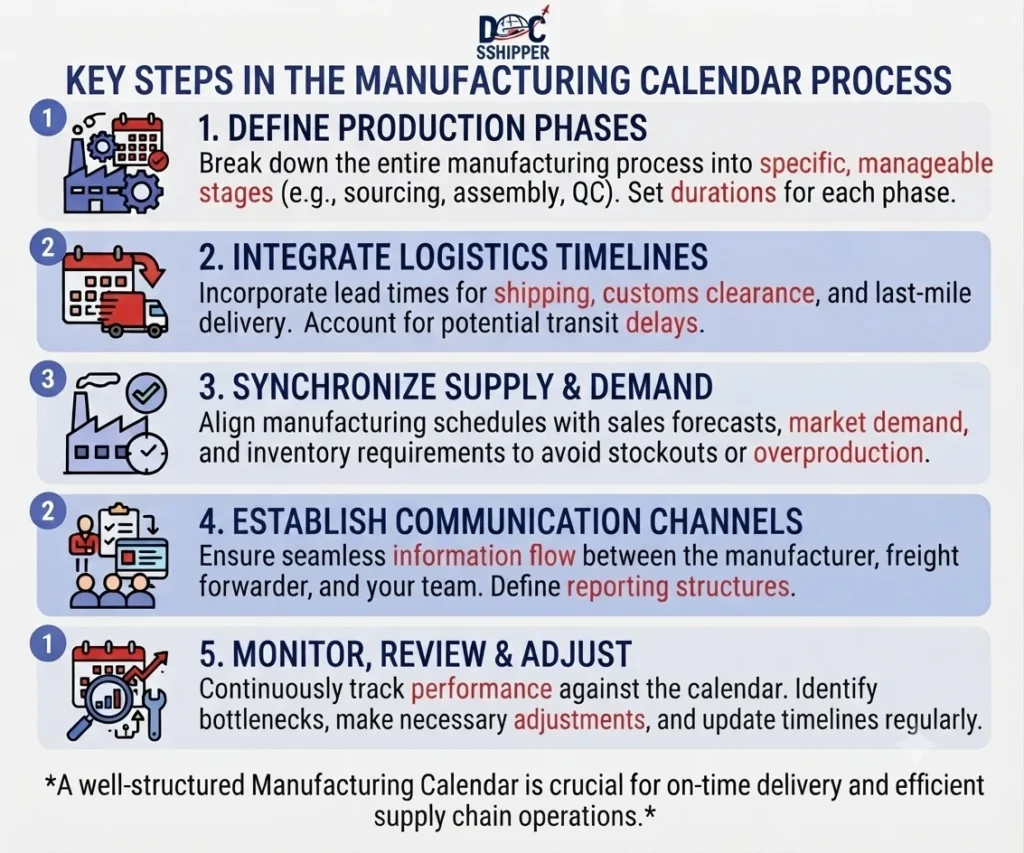
Practical Applications & Real-World Examples
To illustrate the tangible impact of Manufacturing Calendar management, consider these real-world scenarios from international sourcing operations:
Comparative Analysis: Calendar Types
| Calendar Type | Working Days/Year | Impact on Lead Time | Common Regions |
|---|---|---|---|
| Standard 5-Day Week | 250-260 days | Baseline reference | North America, Europe |
| 6-Day Production Week | 300-310 days | 20% faster throughput | China, India, Bangladesh |
| Continuous (3-Shift) | 340-350 days | Up to 40% reduction | Automotive, electronics |
| Seasonal (Adjusted) | 220-240 days | 15-20% longer | Agriculture, tourism sectors |
Use Case: Electronics Import from Shenzhen
A European electronics retailer orders 10,000 units with a quoted “45-day lead time” from a Shenzhen manufacturer in late January.
Without Manufacturing Calendar awareness: The buyer expects delivery by mid-March. However, Chinese New Year (February 10-17) completely halts production for 10 days, plus an additional 5 days for workforce ramp-up. Actual delivery occurs March 25—a 10-day delay causing stockouts during peak sales season.
With Manufacturing Calendar integration: DocShipper’s planning system flags the holiday impact during quotation review. We advise either placing the order 2 weeks earlier or adjusting inventory buffers. The client chooses early ordering, receives goods on schedule, and maintains 98% product availability throughout the quarter.
Critical Planning Points
- Holiday buffer zones: Add 3-5 days before and after major holidays for logistics congestion
- Multi-supplier coordination: Align calendars when components come from different regions
- Contract clauses: Define whether lead times reference working days or calendar days explicitly
- System integration: ERP and procurement software should auto-adjust for non-working days
- Communication protocols: Establish weekly production status updates during extended lead times
Conclusion
The Manufacturing Calendar transforms abstract lead time promises into concrete operational commitments. By aligning production planning with actual working days, businesses eliminate costly surprises and build more resilient supply chains.
Need expert guidance on manufacturing timeline management for your imports? Contact DocShipper for a customized supply chain assessment.
📚 Quiz
Test Your Knowledge: Manufacturing Calendar
What does a Manufacturing Calendar primarily define?
A supplier quotes "30 days lead time" without specifying the calendar type. What is the most common mistake importers make?
You're sourcing electronics from China with delivery expected in early March. The supplier confirms a 45-day lead time in late January. What critical factor should you verify?
🎯 Your Result
📞 Free Quote in 24hFAQ | Manufacturing Calendar: Definition, Structure & Practical Applications
A Manufacturing Calendar specifically tracks production-capable days, excluding weekends, holidays, and planned maintenance shutdowns. Standard business calendars simply mark non-working days without considering shift patterns, capacity limitations, or industry-specific closures. For accurate lead time calculations, always reference the manufacturer's specific production calendar rather than generic calendar tools.
Request the annual production calendar during supplier qualification, ideally before placing your first order. Reputable manufacturers maintain documented calendars showing public holidays, planned shutdowns, and peak production periods. If a supplier cannot provide this information, it may indicate inadequate production planning systems. DocShipper routinely collects and validates these calendars for all vetted suppliers in our network.
Yes, calendars may be adjusted for unexpected events such as government-mandated shutdowns, natural disasters, or energy restrictions. Responsible manufacturers communicate these changes immediately to affected customers. Build contractual provisions requiring 14-day advance notice for non-emergency calendar modifications. Emergency changes should trigger automatic communication protocols and revised delivery schedules.
Shift patterns dramatically alter effective production time. A single 8-hour shift provides 8 production hours per working day. Two-shift operations (16 hours) double daily capacity, while three-shift continuous production maximizes equipment utilization. When comparing lead times between suppliers, always clarify their shift structure—a 30-day lead time in a three-shift facility delivers approximately three times more output than a single-shift operation.
Chinese New Year (late January to mid-February) causes the most significant disruption, with 7-21 day factory closures across China, Vietnam, and other Asian nations. Secondary impacts include Golden Week in China (October 1-7), Diwali in India (October-November), and Songkran in Thailand (April 13-15). Plan purchases 60-90 days before these periods to avoid production gaps.
Absolutely. Include the manufacturer's official calendar as a contract appendix, with clauses defining how non-working days affect delivery commitments. Specify whether quoted lead times reference calendar days or working days, and establish protocols for calendar change notifications. This documentation provides legal clarity if delivery disputes arise and forces both parties to align on realistic timelines from the contract signing.
Many European manufacturers close for 2-4 weeks during July-August, particularly in France, Italy, and Spain. Unlike predictable annual holidays, shutdown timing varies by company. Request specific closure dates by March to adjust summer procurement strategies. Consider diversifying suppliers across different European regions or combining European sources with Asian manufacturers operating on different holiday cycles.
Modern ERP systems and specialized supply chain management platforms can integrate multiple manufacturing calendars with automated lead time calculations. These tools flag conflicts when order timing coincides with supplier holidays and suggest optimal order placement dates. Cloud-based collaboration platforms allow real-time calendar sharing between buyers and suppliers, reducing miscommunication. DocShipper's proprietary platform consolidates calendars from 200+ verified suppliers across 15 countries.
Industry best practice targets ±5% variance for standard production runs under normal conditions. For example, a 40-day lead time should deliver within 38-42 days. Variances exceeding 10% indicate inadequate production planning or unrealistic calendar assumptions. Track supplier performance against their own calendars—consistent delays suggest the calendar doesn't reflect actual operational capacity.
No, standard Manufacturing Calendars only track production facility working days. They assume raw materials arrive on schedule. Sophisticated planning requires layering supplier calendars—your manufacturer's calendar, their raw material supplier calendars, and logistics provider schedules. This multi-tier calendar mapping reveals hidden bottlenecks. For complex products with 10+ component sources, comprehensive calendar analysis can add 2-3 weeks to total procurement cycles.
Force majeure clauses typically excuse non-performance due to unforeseeable events (pandemics, wars, natural disasters). However, well-drafted contracts distinguish between predictable calendar events (scheduled holidays) and true force majeure. Manufacturers cannot claim force majeure for publicly announced holidays or routine maintenance. Establish clear definitions in contracts, and require suppliers to maintain contingency plans for high-probability disruptions like typhoon season in Southeast Asia.
Limited negotiation is possible for large-volume buyers. Some manufacturers offer "priority production windows" during normally slower periods, or guarantee skeleton crew operations during standard shutdown weeks for premium customers. More commonly, buyers negotiate earlier order cutoff dates before major holidays in exchange for volume commitments. Realistic negotiation focuses on communication protocols and calendar transparency rather than attempting to change fundamental cultural or regulatory holiday patterns.
Need Help with
Logistics or Sourcing ?
First, we secure the right products from the right suppliers at the right price by managing the sourcing process from start to finish. Then, we simplify your shipping experience - from pickup to final delivery - ensuring any product, anywhere, is delivered at highly competitive prices.


Fill the Form
Prefer email? Send us your inquiry, and we’ll get back to you as soon as possible.
Contact us




