


In short ⚡
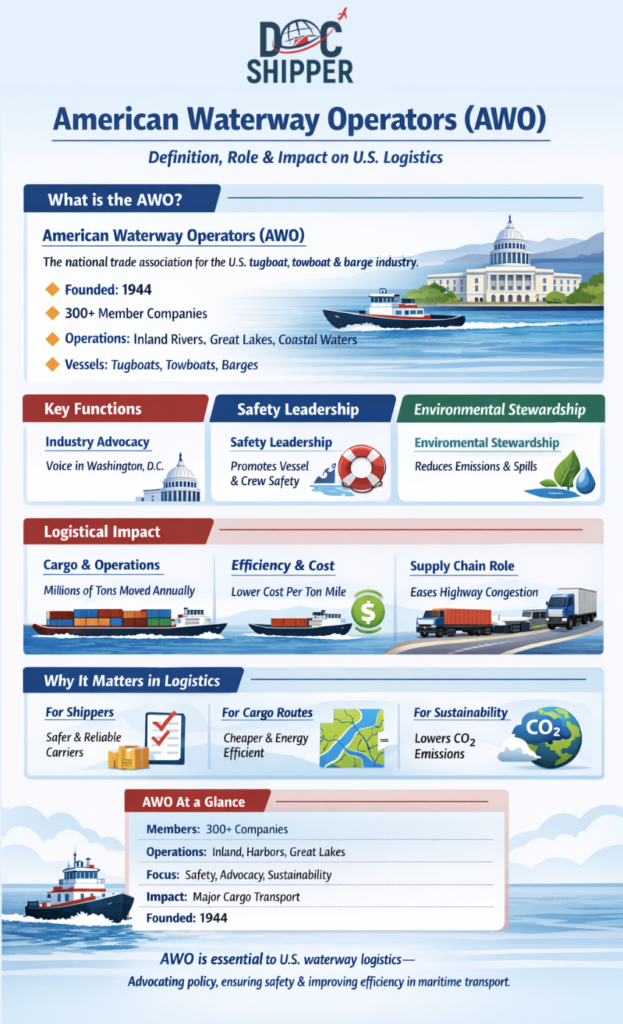
American Waterway Operators (AWO) is the national trade association representing the U.S. tugboat, towboat, and barge industry. Founded in 1944, AWO advocates for safe, sustainable, and efficient inland and coastal waterway transportation, supporting over 5,500 vessels that move critical cargo across America's 25,000 miles of navigable waterways.Introduction
Many shippers overlook inland waterways when planning freight routes, yet this mode moves 14% of all U.S. domestic freight by weight. The American Waterway Operators stands at the center of this critical infrastructure, shaping policy, safety standards, and operational best practices for an industry that handles over 600 million tons of cargo annually.
Understanding AWO’s influence matters for anyone involved in import/export logistics. This organization doesn’t just represent vessel operators—it directly impacts shipping costs, regulatory compliance, and supply chain reliability across the United States.
Key characteristics of AWO’s scope:
- Membership base: 300+ companies operating tugboats, towboats, and barges
- Geographic reach: Inland rivers, Great Lakes, coastal waters, and harbors
- Cargo types: Agricultural products, petroleum, chemicals, coal, aggregates, containers
- Safety programs: Responsible Carrier Program (RCP) with third-party audits
- Advocacy focus: Infrastructure funding, environmental regulations, workforce development
AWO’s Role & Industry Expertise
AWO functions as both a policy advocate and industry standard-setter. The association works directly with Congress, the U.S. Coast Guard, and the Army Corps of Engineers to shape regulations affecting waterway commerce. This includes lock and dam maintenance funding, vessel inspection protocols, and environmental compliance requirements.
The organization’s Responsible Carrier Program sets the benchmark for operational safety in the marine transportation sector. Companies enrolled in RCP undergo rigorous third-party audits covering vessel maintenance, crew training, drug testing, and environmental management. For shippers, working with RCP-certified carriers reduces liability risk and ensures regulatory compliance.
AWO’s environmental initiatives focus on reducing emissions and preventing spills. The industry already produces 43% fewer carbon emissions per ton-mile than rail and 800% fewer than trucks. AWO pushes for further improvements through alternative fuels, hull design optimization, and operational efficiency standards.
The association also addresses workforce challenges. With an aging mariner population, AWO partners with maritime academies and community colleges to develop training programs. This directly affects service availability—labor shortages can delay shipments and increase costs.
On the infrastructure front, AWO lobbies for the $20+ billion needed to modernize aging locks and dams. Delays at these chokepoints cost shippers millions annually. According to the U.S. Army Corps of Engineers, unscheduled lock closures cause an average 52 hours of delay per incident.
At DocShipper, we monitor AWO policy developments closely. Changes in waterway regulations or infrastructure funding directly impact transit times and costs for clients shipping bulk commodities or oversized cargo via inland routes.
Impact on Logistics: Data & Examples
The economic impact of AWO’s member companies extends far beyond vessel operations. Waterway transportation generates $230 billion in annual economic output and supports 585,000 jobs across shipbuilding, port operations, and related services.
Cost efficiency comparison: Moving cargo by barge costs significantly less than alternative modes. One 15-barge tow carries the equivalent of 1,050 trucks or 216 rail cars. This translates to substantial savings for bulk shippers.
| Transport Mode | Cost per Ton-Mile | Fuel Efficiency (ton-miles per gallon) | CO₂ Emissions (grams/ton-mile) |
|---|---|---|---|
| Inland Barge | $0.013 | 647 | 33 |
| Rail | $0.024 | 477 | 58 |
| Truck | $0.079 | 155 | 264 |
Real-world case study: A grain exporter shipping 60,000 tons of soybeans from Illinois to New Orleans faces this scenario. Using barges costs approximately $468,000 in freight charges. The same shipment by rail would cost $864,000, and by truck $2.8 million. The waterway route also avoids highway congestion and reduces carbon footprint by 85%.
Infrastructure impact: When Lock 27 on the Mississippi River underwent emergency repairs in 2020, delays cost shippers an estimated $1.2 million per day. AWO’s advocacy for proactive maintenance funding aims to prevent such disruptions.
Five critical data points about AWO’s industry:
- Volume: 600+ million tons of cargo moved annually on U.S. waterways
- Efficiency: One gallon of fuel moves one ton of cargo 647 miles by barge vs. 155 miles by truck
- Safety record: RCP participants have 40% fewer accidents than non-participants
- Employment: 35,000 mariners employed directly on tugboats and towboats
- Trade routes: 25,000 miles of commercially navigable waterways connecting 38 states
DocShipper Platform
One platform. Your entire supply chain
Sourcing, freight, customs & documents — all centralised, all visible, 24/7.
Conclusion
The American Waterway Operators shapes the operational, regulatory, and economic landscape of U.S. inland and coastal shipping. For logistics professionals, understanding AWO’s role means recognizing how policy advocacy, safety standards, and infrastructure investments directly affect freight costs, transit reliability, and compliance requirements.
Need expert guidance on waterway transportation options or multimodal logistics strategies? Contact DocShipper for tailored solutions that optimize your supply chain.
📚 Quiz
American Waterway Operators (AWO)
Q1 — What is the primary role of the American Waterway Operators (AWO)?
Q2 — A shipper wants to reduce liability risk and ensure regulatory compliance when selecting a barge carrier. Which AWO program should they look for?
Q3 — A grain exporter needs to move 60,000 tons of soybeans from Illinois to New Orleans. Based on AWO industry data, which statement best reflects the advantage of choosing inland barge transport?
🎯 Your Result
📞 Free Quote in 24hFAQ | American Waterway Operators (AWO): Definition, Role & Impact on U.S. Logistics
AWO members include tugboat and towboat operators, barge lines, shipyards, marine equipment suppliers, and service providers supporting waterway commerce. Membership spans companies operating on inland rivers, coastal waters, and the Great Lakes.
RCP certification ensures carriers meet rigorous safety, environmental, and operational standards through third-party audits. Shippers working with RCP carriers reduce liability exposure and gain assurance of regulatory compliance and professional operations.
Primary commodities include petroleum products (35% of tonnage), coal (22%), aggregates and sand (15%), agricultural products (12%), chemicals (8%), and manufactured goods including containers. Barges excel at moving bulk and oversized cargo economically.
Barges produce 33 grams of CO₂ per ton-mile versus 58 for rail and 264 for trucks. Waterway transport also reduces highway congestion and infrastructure wear. AWO promotes further emission reductions through alternative fuels and operational improvements.
AWO advocates for funding to repair and modernize aging locks, dams, and channels. Many structures exceed their 50-year design life. Unscheduled closures cause significant delays and costs. The association pushes for proactive maintenance and capital improvements.
Yes. Container-on-barge services operate on major rivers and coastal routes. This mode suits shippers seeking lower costs for non-time-sensitive freight. AWO members increasingly invest in container-capable vessels to support intermodal logistics.
AWO works directly with the U.S. Coast Guard, Congress, and regulatory agencies to shape vessel inspection standards, crew licensing requirements, environmental rules, and safety protocols. The association provides industry expertise during rulemaking processes.
An aging mariner population creates labor shortages. AWO partners with maritime schools to develop training programs and promote careers in marine transportation. Workforce availability directly impacts service capacity and costs for shippers.
Lock closures, low water levels, or weather events can halt barge traffic for days. For bulk commodities with tight delivery windows (grain exports, refinery feedstocks), delays trigger demurrage charges and contractual penalties. AWO's infrastructure advocacy aims to minimize such disruptions.
The Mississippi River system (including Ohio, Illinois, and Missouri Rivers) handles the highest tonnage. The Gulf Coast, Great Lakes, and Columbia-Snake River system also see significant activity. AWO members operate wherever navigable waterways support commercial traffic.
AWO maintains a public member directory on its website. For RCP certification, shippers can request audit documentation directly from carriers. Third-party verification confirms compliance with safety and environmental standards.
AWO coordinates with federal agencies on spill response protocols, navigation safety during natural disasters, and continuity of critical cargo movements. Members participate in joint exercises and maintain equipment for environmental incident response.
Need Help with
Logistics or Sourcing ?
First, we secure the right products from the right suppliers at the right price by managing the sourcing process from start to finish. Then, we simplify your shipping experience - from pickup to final delivery - ensuring any product, anywhere, is delivered at highly competitive prices.


Fill the Form
Prefer email? Send us your inquiry, and we’ll get back to you as soon as possible.
Contact us




