


In short ⚡
An advising bank is a financial institution that notifies an exporter of a letter of credit (LC) issued by a foreign buyer's bank. Acting as an intermediary, it authenticates the LC's validity without assuming payment responsibility, facilitating secure cross-border transactions in international trade.
Introduction
Many exporters hesitate when receiving payment guarantees from unknown foreign banks. How can you trust a letter of credit issued thousands of miles away? This uncertainty creates significant risk in international commerce.
The advising bank solves this problem by serving as a trusted local intermediary. Located in the exporter’s country, it verifies the authenticity of payment instruments and ensures compliance with international banking standards.
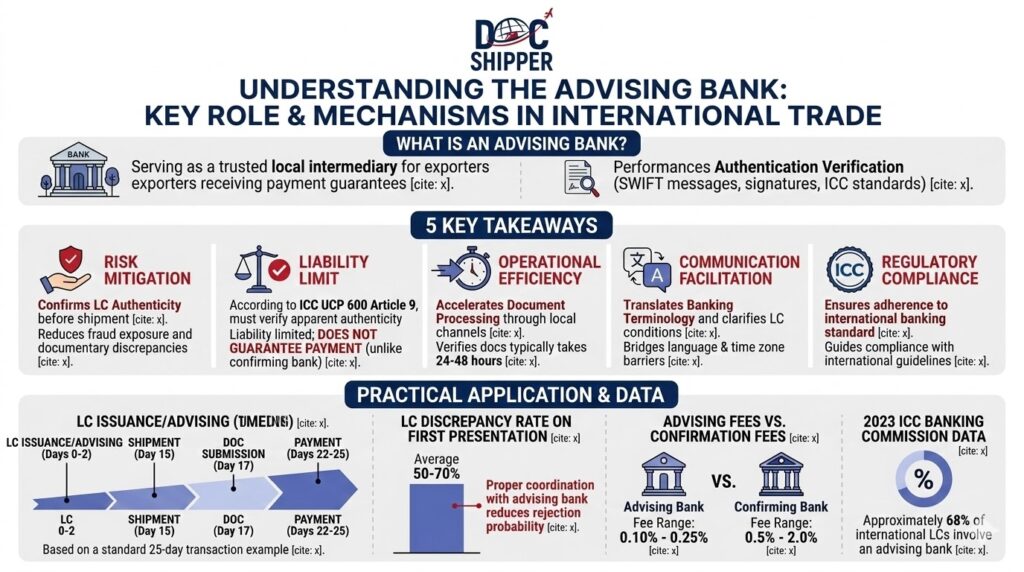
Understanding the advising bank’s function is essential for:
- Risk mitigation: Confirming LC authenticity before shipment
- Operational efficiency: Accelerating document processing through local banking channels
- Regulatory compliance: Ensuring adherence to UCP 600 guidelines
- Communication facilitation: Bridging language and time zone barriers between trading partners
- Cost optimization: Reducing fraud exposure and documentary discrepancies
Role & Mechanisms of the Advising Bank
The advising bank operates within a structured four-party documentary credit system. When an importer requests an LC from their issuing bank, that institution transmits the credit instrument to an advising bank in the exporter’s jurisdiction.
The advising bank performs authentication verification by checking SWIFT message authenticity, signature validity, and compliance with International Chamber of Commerce (ICC) standards. This process typically takes 24-48 hours upon receipt.
Unlike a confirming bank, the advising bank does not guarantee payment. Its liability is limited to ensuring the LC appears genuine on its face. According to ICC UCP 600 Article 9, the advising bank must exercise reasonable care to verify the apparent authenticity of the credit.
The advising bank handles document transmission between exporter and issuing bank. After shipment, the exporter submits commercial invoices, bills of lading, and certificates of origin to the advising bank, which forwards them for payment processing.
Communication management represents another critical function. The advising bank translates banking terminology, clarifies LC conditions, and notifies the exporter of amendments or discrepancies. At DocShipper, we coordinate directly with advising banks to resolve documentary issues before they delay payment, ensuring smooth transaction completion.
Practical Examples & Operational Data
Consider a German machinery exporter selling €500,000 worth of equipment to a Brazilian buyer. The buyer’s bank in São Paulo issues an LC, transmitted via SWIFT to Deutsche Bank in Frankfurt (advising bank).
Timeline breakdown:
| Stage | Timeframe | Action |
|---|---|---|
| LC Issuance | Day 0 | Brazilian bank issues LC |
| Advising | Day 1-2 | Deutsche Bank verifies and notifies exporter |
| Shipment | Day 15 | Exporter ships machinery |
| Document Submission | Day 17 | Exporter submits docs to advising bank |
| Payment | Day 22-25 | Issuing bank releases funds |
Fee structure comparison: Advising fees typically range from 0.10% to 0.25% of the LC value. For the €500,000 transaction, the German exporter pays approximately €500-€1,250. This contrasts with confirmation fees (0.5-2.0%), making advising more cost-effective when the issuing bank has strong creditworthiness.
Risk scenario: An Asian textile exporter received an LC allegedly from a Middle Eastern bank. The advising bank detected forged SWIFT codes within 36 hours, preventing a $200,000 fraud. This demonstrates the protective value of proper LC advising.
According to 2023 ICC Banking Commission data, approximately 68% of international LCs involve an advising bank, with discrepancy rates averaging 50-70% on first presentation. Proper coordination with your advising bank reduces rejection probability significantly.
Key operational metrics:
- Average advising timeframe: 1-3 business days
- Document examination period: 5 banking days (per UCP 600)
- Amendment notification: Within 24 hours of receipt
- Standard advising fee: 0.15% of LC value
- SWIFT transmission time: 4-8 hours internationally
Conclusion
The advising bank provides essential authentication and communication services in documentary credit transactions, protecting exporters from fraudulent instruments while streamlining international payment processes. Understanding its distinct role from confirming banks enables better financial decision-making.
Need expert guidance on letter of credit procedures or international payment security? Contact DocShipper for comprehensive support throughout your cross-border trade operations.
DocShipper Platform
Cut logistics costs. Not corners.
See exactly where your logistics costs are bleeding — and how to fix it. Book your expert demo.

📚 Quiz
Test Your Knowledge: Advising Bank
Q1 — What is the primary role of an advising bank in a letter of credit transaction?
Q2 — An exporter receives a letter of credit. The advising bank detects suspicious SWIFT codes. What is the correct interpretation of the advising bank's liability in this situation?
Q3 — A German exporter wants extra security because the issuing bank in a high-risk country has uncertain creditworthiness. Which option best addresses this concern?
🎯 Your Result
📞 Free Quote in 24hFAQ | Advising Bank: Definition, Role & Practical Examples in International Trade
An advising bank only notifies and verifies the LC without payment obligation. A confirming bank adds its own payment guarantee, assuming liability if the issuing bank defaults. Confirmation costs significantly more but provides additional security.
Yes. If the advising bank cannot authenticate the LC or suspects fraud, it may decline to advise. It will notify the issuing bank and beneficiary of its decision, protecting all parties from potential risks.
Standard advising takes 1-3 business days from SWIFT receipt. Complex LCs requiring clarification may take 5-7 days. Urgent advising services are available at premium rates for time-sensitive transactions.
No. The advising bank's responsibility is limited to verifying apparent authenticity. It bears no payment obligation unless it also confirms the LC. This distinction is critical for risk assessment.
Usually, the issuing bank selects the advising bank based on correspondent banking relationships. However, exporters can request a specific advising bank if they have an existing relationship or prefer certain service standards.
Typically: commercial invoice, packing list, bill of lading, certificate of origin, and insurance certificate. Specific requirements depend on LC terms. The advising bank checks these against LC stipulations before forwarding.
Fees are generally a percentage of the LC value (0.10-0.25%) plus fixed handling charges ($50-$200). Additional fees apply for amendments, document examination, and express services. Fee structures vary by bank and transaction complexity.
The advising bank notifies the exporter of discrepancies within 5 banking days. The exporter can correct documents, request an LC amendment, or ask the buyer to accept discrepancies. Payment is withheld until resolution.
Yes. Many advising banks offer negotiation services, purchasing documents from the exporter before receiving payment from the issuing bank. This provides faster cash flow but involves additional fees and credit evaluation.
While not legally mandatory, using an advising bank is standard practice and strongly recommended. Direct communication between exporter and foreign issuing bank increases fraud risk and complicates dispute resolution significantly.
Advising banks operate under ICC Uniform Customs and Practice for Documentary Credits (UCP 600), supplemented by local banking regulations. SWIFT messaging standards and anti-money laundering laws also apply to their operations.
Electronic advising via SWIFT or blockchain platforms reduces processing time from days to hours, minimizes errors, and provides instant authentication. However, traditional paper-based advising remains common in certain markets with limited digital infrastructure.
Need Help with
Logistics or Sourcing ?
First, we secure the right products from the right suppliers at the right price by managing the sourcing process from start to finish. Then, we simplify your shipping experience - from pickup to final delivery - ensuring any product, anywhere, is delivered at highly competitive prices.


Fill the Form
Prefer email? Send us your inquiry, and we’ll get back to you as soon as possible.
Contact us




