
In short ⚡
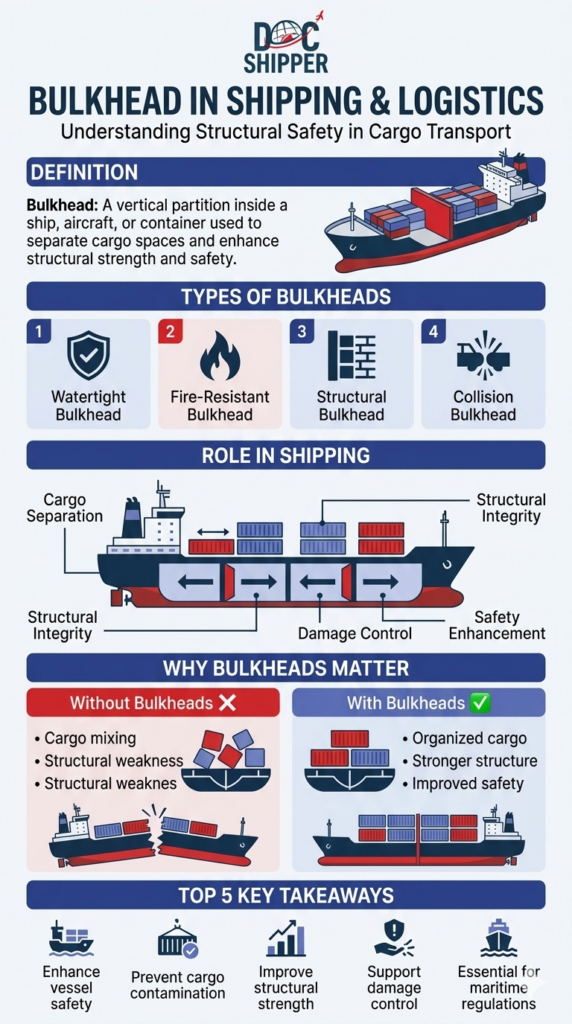
Bulkhead is a vertical partition or wall inside a ship, aircraft, or container that divides the cargo space into separate compartments. It provides structural integrity, prevents cargo shifting, and enhances safety by containing water or fire in case of damage. Bulkheads are essential for stability and security in international logistics.Introduction
Many importers and exporters overlook the critical role of bulkheads in cargo transport. Yet, understanding this structural element can prevent costly damages, delays, and safety incidents during international shipping.
Bulkheads serve as the backbone of cargo compartmentalization across maritime, air, and intermodal transport. They transform empty spaces into controlled, secure zones that protect goods from shifting, contamination, and environmental hazards.
- Structural reinforcement: Maintains vessel integrity under heavy loads and rough seas
- Safety compartmentalization: Contains flooding, fire, or hazardous material spills
- Cargo segregation: Separates incompatible goods (chemicals, food, machinery)
- Load distribution: Prevents dangerous weight imbalances during transit
- Regulatory compliance: Meets SOLAS and IMO safety standards for commercial shipping
Technical Expertise & Structural Functions
Bulkheads operate on fundamental principles of naval architecture and cargo engineering. In maritime transport, they are classified into watertight bulkheads, which prevent water ingress between compartments, and non-watertight bulkheads, used primarily for cargo organization.
The collision bulkhead stands as the most critical safety feature, positioned forward of the ship to contain water if the bow is breached. International regulations require this bulkhead to be located at 5-8% of the vessel’s length from the forward perpendicular, as specified by the International Maritime Organization (IMO) SOLAS Convention.
Container shipping employs temporary bulkheads or cargo bars to secure goods within individual containers. These removable structures prevent load shifting during handling and transport, particularly crucial for partial container loads (LCL shipments).
In air cargo, aircraft bulkheads separate pressurized passenger cabins from unpressurized cargo holds. They must withstand differential pressure loads while maintaining fire resistance ratings. At DocShipper, we coordinate with airlines to ensure proper bulkhead positioning for sensitive cargo requiring specific atmospheric conditions.
Tank bulkheads in chemical tankers feature specialized coatings and materials resistant to corrosive substances. These must comply with the International Code for the Construction and Equipment of Ships Carrying Dangerous Chemicals in Bulk (IBC Code), ensuring zero cross-contamination between different chemical grades.
Practical Examples & Data Comparison
Understanding bulkhead applications through real-world scenarios clarifies their operational importance across different transport modes.
Comparative Analysis: Bulkhead Types by Transport Mode
| Transport Mode | Bulkhead Type | Primary Function | Material | Typical Cost Impact |
|---|---|---|---|---|
| Ocean Freight (Container) | Temporary cargo bar | Load securing | Steel/Aluminum | €50-150 per container |
| Bulk Carrier | Watertight bulkhead | Compartment isolation | Structural steel | Built into vessel cost |
| Chemical Tanker | Coated tank bulkhead | Product segregation | Stainless steel + epoxy | 15-20% of tank construction |
| Air Cargo | Pressure bulkhead | Cabin pressurization | Aluminum alloy | Critical safety component |
| Intermodal Container | Removable partition | Multi-product separation | Plywood/Composite | €30-80 per installation |
Use Case: Electronics Shipment from China to Germany
A DocShipper client shipped 12 tons of consumer electronics in a 40ft container. Without proper bulkhead installation, the cargo shifted during rough seas in the Bay of Biscay, causing €45,000 in damages.
Solution implemented: Installation of three vertical bulkheads with airbags created four secure compartments. Cost: €280. Result: Zero damage on subsequent shipments, with insurance premiums reduced by 18%.
Key Data Points for Logistics Professionals
- Damage reduction: Proper bulkhead use decreases cargo damage by 67% in LCL shipments
- Regulatory requirement: SOLAS mandates minimum 8 watertight compartments for vessels over 150m
- Cost efficiency: Temporary bulkheads cost 0.3-0.8% of cargo value but prevent 15-40% damage rates
- Time savings: Pre-installed bulkheads reduce container loading time by 25-30 minutes
- Weight capacity: Standard container bulkheads support lateral loads up to 0.6g acceleration
Conclusion
Bulkheads represent fundamental infrastructure in cargo transport, directly impacting safety, compliance, and cost efficiency. Proper specification and installation protect goods, vessels, and supply chain continuity.
Need expert guidance on bulkhead requirements for your shipment? Contact DocShipper for professional logistics consultation tailored to your cargo specifications.
📚 Quiz
Test Your Knowledge: Bulkhead
Q1 — What is the primary definition of a bulkhead in shipping?
Q2 — A shipper assumes that bulkheads are mandatory in all shipping containers. Is this correct?
Q3 — A client ships 12 tons of electronics in a 40ft container. Cargo shifts in rough seas and causes €45,000 in damage. What is the most appropriate bulkhead-based solution going forward?
🎯 Your Result
📞 Free Quote in 24hFAQ | Bulkhead: Definition, Types & Practical Examples in Shipping
A bulkhead is a structural element providing strength and safety (often watertight), while a partition is typically a non-structural divider used only for space organization without load-bearing or safety functions.
No. Standard FCL (Full Container Load) shipments don't require bulkheads. They're mandatory only when regulations demand cargo segregation or when LCL shipments need load securing to prevent shifting.
Standard temporary bulkheads withstand lateral forces up to 0.6g (60% of cargo weight). Heavy-duty systems can handle 1.0g, suitable for high-density goods like metals or machinery components.
Most use mild or high-tensile steel for strength. Specialized applications employ stainless steel (chemical resistance), aluminum alloys (weight reduction in aircraft), or composite materials for specific environmental conditions.
While physically possible, professional installation is recommended. Improper placement or securing can create liability issues, void insurance coverage, and fail to prevent cargo damage during transit.
Yes, minimally. A standard bulkhead occupies 5-15cm of length, reducing capacity by approximately 0.5-1.5%. The trade-off is justified by damage prevention and regulatory compliance benefits.
The collision bulkhead is the foremost watertight barrier in a ship, designed to contain flooding if the bow is breached. It's positioned 5-8% of vessel length from the front per SOLAS regulations.
Permanent ship bulkheads undergo annual surveys as part of vessel certification. Temporary container bulkheads should be inspected before each use for structural integrity, corrosion, and proper fastening mechanisms.
Absolutely. Aircraft bulkheads must meet FAA/EASA pressure and fire resistance standards. Maritime bulkheads follow IMO SOLAS requirements focusing on watertight integrity and structural strength under wave loads.
Failure can cause cargo shifting, vessel instability, or compartment flooding. Consequences include damaged goods, insurance claims, potential vessel loss, and liability for environmental damage if hazardous materials are involved.
Yes. Custom bulkheads accommodate unique requirements: ventilated designs for perishables, insulated versions for temperature-sensitive goods, or reinforced structures for heavy machinery. DocShipper arranges specialized configurations based on cargo specifications.
Many insurers mandate proof of proper bulkhead installation for high-value or fragile cargo. Documentation includes photos, installation certificates, and compliance with carrier-specific securing standards to validate coverage.
Need Help with Logistics or Sourcing ?
First, we secure the right products from the right suppliers at the right price by managing the sourcing process from start to finish. Then, we simplify your shipping experience - from pickup to final delivery - ensuring any product, anywhere, is delivered at highly competitive prices.
Fill the Form
Prefer email? Send us your inquiry, and we’ll get back to you as soon as possible.
Contact us