


In short ⚡
Bull rings are metal rings welded or bolted to container walls, floors, or ceilings, designed to secure cargo using lashing straps, chains, or ropes. Essential in maritime and intermodal transport, they prevent load shifting during handling and transit, ensuring cargo integrity and compliance with international safety standards.
Introduction
Cargo damage during international shipping often results from inadequate securing methods. Bull rings address this critical challenge by providing fixed anchor points inside containers and trailers.
These seemingly simple components play a vital role in the global supply chain. They enable shippers to comply with IMO regulations, CTU Code requirements, and customs inspection standards.
Key characteristics of bull rings include:
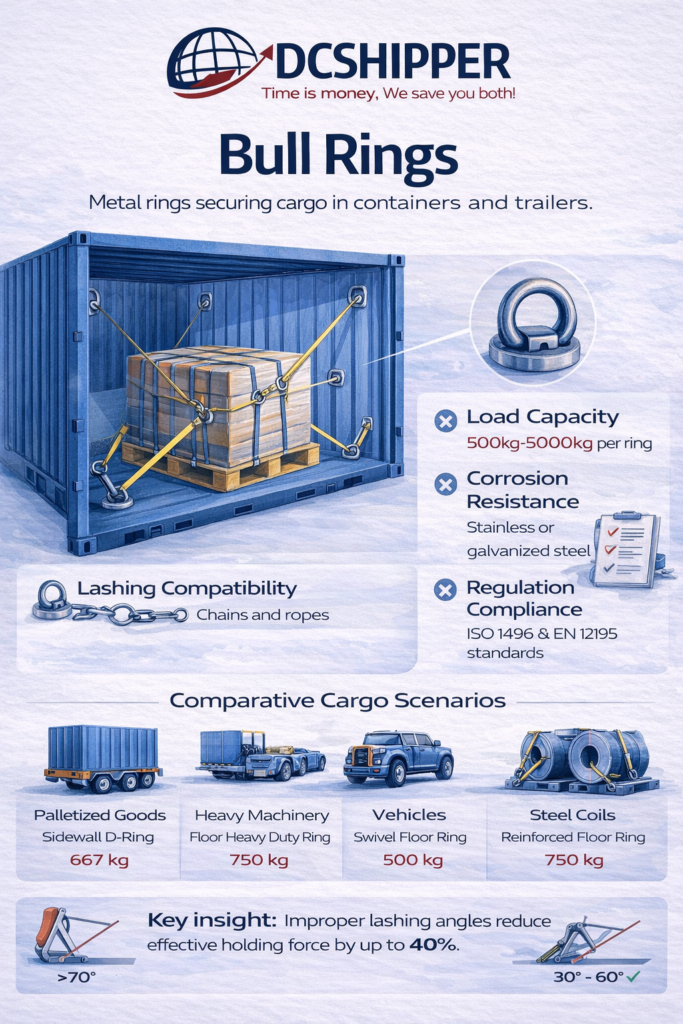
- Load capacity ranging from 500 kg to 5,000 kg per ring
- Corrosion-resistant materials (galvanized steel, stainless steel)
- Strategic placement at container corners and mid-points
- Compatibility with standard lashing equipment (ratchet straps, chains)
- Compliance with ISO 1496 and EN 12195 standards
Understanding bull ring specifications prevents common mistakes like overloading, improper lashing angles, and equipment failure that lead to cargo claims.
Technical Specifications & Safety Standards
Bull rings must withstand dynamic forces during ocean transport, including rolling, pitching, and sudden braking. The minimum breaking load (MBL) determines their suitability for specific cargo types.
Standard configurations include:
- Flush-mounted rings: Recessed into container floors to prevent tripping hazards
- D-rings: Welded to sidewalls for vertical lashing
- Swivel rings: Allow 360-degree rotation for flexible securing angles
- Heavy-duty rings: Reinforced versions for machinery and oversized cargo
The International Maritime Organization (IMO) mandates specific lashing point quantities based on container size. A 20-foot container typically requires 8 to 12 bull rings, while 40-foot containers need 16 to 24.
Load distribution is critical. Each bull ring should support no more than 25% of the total cargo weight when using four-point lashing. The lashing angle should remain between 30° and 60° from horizontal for optimal tension transfer.
Material selection impacts longevity. Hot-dip galvanized steel offers excellent corrosion resistance for standard containers. Marine-grade stainless steel (316L) is preferred for reefer containers and chemical transport where moisture and corrosive substances are present.
At DocShipper, we inspect bull ring conditions during container surveys to identify rust, deformation, or missing components that could compromise cargo security during international transit.
Practical Applications & Use Cases
Bull rings serve diverse cargo types across industries. Their proper use directly affects insurance coverage, as carriers may deny claims for improperly secured loads.
Comparative Load Scenarios
| Cargo Type | Bull Ring Configuration | Lashing Method | Typical Load/Ring |
|---|---|---|---|
| Machinery (3 tons) | 4 floor-mounted heavy-duty rings | Chain lashing with tensioners | 750 kg |
| Palletized goods (8 tons) | 12 sidewall D-rings | Ratchet straps (5,000 kg MBL) | 667 kg |
| Vehicles (2 units, 4 tons total) | 8 floor swivel rings | Wheel straps + axle chains | 500 kg |
| Steel coils (12 tons) | 16 reinforced floor rings | Wire rope lashing | 750 kg |
Real-World Case Study
A European automotive parts exporter shipping to Australia experienced cargo damage when standard bull rings failed during rough seas. Investigation revealed:
- Bull rings rated at 1,000 kg MBL were used for 1,500 kg actual loads
- Lashing angles exceeded 70°, reducing effective holding force by 40%
- Corrosion had reduced metal thickness by 15% due to saltwater exposure
Solution implemented: Upgrade to marine-grade stainless steel rings with 2,500 kg MBL, combined with proper lashing geometry training for warehouse staff. Subsequent shipments experienced zero cargo shift incidents.
DocShipper Platform
Cut logistics costs. Not corners.
See exactly where your logistics costs are bleeding — and how to fix it. Book your expert demo.

Industry-Specific Requirements
Pharmaceutical logistics: Temperature-controlled containers require non-sparking stainless bull rings to prevent ignition risks near refrigerant systems.
Hazardous materials: UN-certified containers mandate bull rings tested to 150% of rated capacity, with annual recertification.
Project cargo: Oversized equipment often requires custom-welded bull rings positioned according to engineering calculations, verified by marine surveyors.
DocShipper’s cargo securing specialists calculate optimal bull ring placement and lashing patterns for non-standard loads, ensuring compliance with both origin and destination country regulations.
Conclusion
Bull rings represent the foundation of cargo securing systems in containerized transport. Their proper selection, installation, and usage directly impact shipment safety, insurance validity, and regulatory compliance.
Need expert guidance on cargo securing solutions for your international shipments? Contact DocShipper for professional consultation on lashing equipment and container preparation.
📚 Quiz
Test Your Knowledge: Bull Rings
Q1 — What is the primary purpose of bull rings in containerized shipping?
Q2 — A shipper uses bull rings rated at 1,000 kg MBL to secure a load of 1,500 kg per ring, and sets lashing angles at 75°. What is the most likely outcome?
Q3 — You are shipping pharmaceutical goods in a temperature-controlled reefer container. Which bull ring specification is most appropriate?
🎯 Your Result
📞 Free Quote in 24hFAQ | Bull Rings: Definition, Applications & Practical Examples in Logistics
Most standard container bull rings have a minimum breaking load (MBL) of 1,000 to 2,000 kg. Heavy-duty versions for specialized cargo can reach 5,000 kg. Always verify the ring's stamped or certified capacity before use.
A standard 40-foot container features 16 to 24 bull rings strategically placed along sidewalls and floors. High-cube containers may include additional ceiling-mounted rings for vertical lashing of tall cargo.
Modifications to leased containers require written approval from the leasing company. Unauthorized welding voids container certifications and may result in penalty charges. Always consult your lease agreement before alterations.
D-rings feature a flat side welded to container walls, ideal for sidewall lashing. O-rings (bull rings) are circular and typically floor-mounted, allowing 360-degree strap routing. Both serve cargo securing but suit different lashing geometries.
Use the formula: Number of points = (Cargo weight × Safety factor) / (Ring capacity × cos(lashing angle)). A safety factor of 1.5 to 2.0 is standard. For complex loads, consult IMO CSS Code guidelines or a marine surveyor.
Yes. Pre-shipment inspections check for corrosion, deformation, missing rings, and weld integrity. Damaged or substandard bull rings must be repaired or replaced before cargo loading to maintain insurance coverage.
Common materials include hot-dip galvanized steel (standard containers), stainless steel 304/316L (marine environments), and forged alloy steel (heavy-duty applications). Material choice depends on cargo type, route, and environmental exposure.
Reuse depends on condition assessment. Rings showing rust pitting, cracks, or deformation exceeding 5% of original dimensions should be replaced. Load testing to 150% of rated capacity confirms suitability for continued service.
Reefer containers often use stainless steel bull rings to withstand condensation and temperature fluctuations. Placement avoids interference with cooling unit airflow and insulation panels. Capacity remains similar to dry containers.
Key standards include ISO 1496 (container construction), EN 12195 (load securing), IMO CSS Code (cargo securing systems), and CTU Code (container packing). National regulations like U.S. FMCSA and EU Directive 2014/47 also apply.
Optimal angles range from 30° to 60° from horizontal. Steeper angles reduce effective restraint force significantly—a 70° angle provides only 34% of strap tension as horizontal restraint compared to 87% at 30°.
Bolt-on lashing rings offer flexibility for temporary installations or containers where welding is prohibited. However, they typically have lower load ratings (500-1,000 kg) and require regular torque checks to prevent loosening during transit.
Need Help with
Logistics or Sourcing ?
First, we secure the right products from the right suppliers at the right price by managing the sourcing process from start to finish. Then, we simplify your shipping experience - from pickup to final delivery - ensuring any product, anywhere, is delivered at highly competitive prices.


Fill the Form
Prefer email? Send us your inquiry, and we’ll get back to you as soon as possible.
Contact us




