


In short ⚡
Balloon Freight refers to low-density, high-volume cargo that occupies significant space relative to its weight. In logistics, these shipments are charged based on volumetric weight rather than actual weight, impacting transportation costs. Understanding balloon freight is crucial for optimizing shipping expenses and selecting appropriate freight solutions.Introduction
Many businesses face unexpected freight charges when shipping bulky items like furniture, packaging materials, or textile products. The confusion arises from the gap between physical weight and the space consumed in transport vehicles or containers.
Balloon freight represents a critical concept in international logistics. Carriers cannot maximize revenue by transporting lightweight goods that occupy disproportionate cargo space. This reality shapes pricing structures across air, ocean, and road freight.
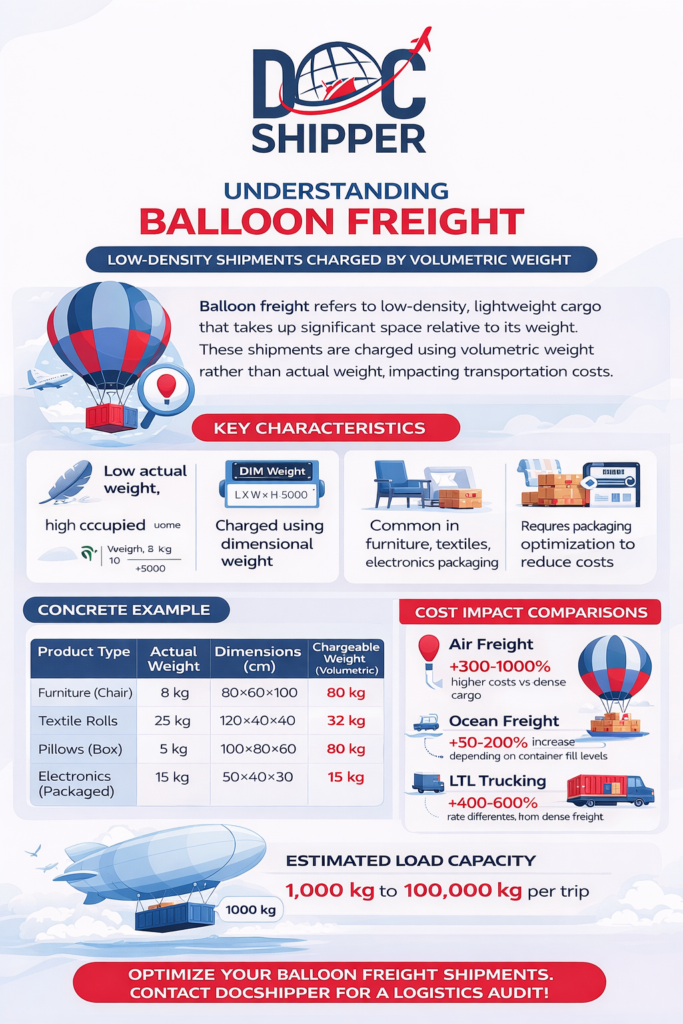
Key characteristics of balloon freight include:
- Low actual weight compared to occupied volume
- Charged using dimensional weight (DIM weight) calculations
- Common in industries like furniture, textiles, and consumer electronics packaging
- Requires strategic packaging optimization to reduce costs
- Impacts mode selection between air, sea, and ground transportation
Understanding Mechanisms & Technical Implications
The concept of volumetric weight (also called dimensional weight) governs balloon freight pricing. Carriers calculate this by multiplying length × width × height, then dividing by a dimensional factor specific to the transport mode.
For air freight, the standard IATA dimensional factor is 6000 cm³/kg (or 166 cm³/lb). Ocean freight typically uses 1000 cm³/kg or measures in cubic meters. When volumetric weight exceeds actual weight, shippers pay for the higher figure.
The density threshold determines classification. Goods with density below 166 kg/m³ (air) or 1000 kg/m³ (ocean) automatically qualify as balloon freight. This mathematical reality forces logistics managers to reconsider packaging strategies.
Regulatory frameworks acknowledge this pricing mechanism. The IATA Cargo Services Conference standardizes dimensional weight calculations globally, ensuring consistency across airlines and freight forwarders.
Packaging optimization becomes essential. Collapsible designs, vacuum compression, and nested stacking reduce cubic dimensions without compromising product integrity. At DocShipper, we conduct packaging audits to identify cost-saving opportunities before goods enter the supply chain.
The freight class system in North America (NMFC codes) directly incorporates density. Classes 50-85 represent dense goods, while classes 250-500 indicate low-density balloon freight with exponentially higher rates per pound.
Concrete Examples & Comparative Data
Understanding balloon freight requires examining real-world scenarios. The following table compares actual versus chargeable weight for common shipments:
| Product Type | Actual Weight | Dimensions (cm) | Volumetric Weight | Chargeable Weight |
|---|---|---|---|---|
| Furniture (Chair) | 8 kg | 80×60×100 | 80 kg | 80 kg |
| Textile Rolls | 25 kg | 120×40×40 | 32 kg | 32 kg |
| Pillows (Box) | 5 kg | 100×80×60 | 80 kg | 80 kg |
| Electronics (Packaged) | 15 kg | 50×40×30 | 10 kg | 15 kg |
Use Case: Furniture Importer
A European retailer imports 100 chairs from China. Each chair weighs 8 kg but measures 80×60×100 cm. Actual total weight: 800 kg. Volumetric weight: 8,000 kg. Air freight cost at $4/kg results in $32,000 instead of $3,200—a 900% increase.
The solution involved flat-pack design. Reducing dimensions to 120×60×15 cm per unit lowered volumetric weight to 1,800 kg, saving $24,800 per shipment. DocShipper’s packaging consultants identify such opportunities during sourcing phases.
Cost Impact Analysis:
- Air freight: Balloon freight can increase costs by 300-1000% compared to dense cargo
- Ocean freight: Impact ranges from 50-200% depending on container utilization
- LTL trucking: Freight class differences create 400-600% rate variations
- Express couriers: DHL/FedEx apply strict DIM weight rules, often doubling small parcel costs
- Consolidation benefits: Combining shipments can reduce per-unit balloon freight penalties by 30-40%
DocShipper Platform
One platform. Your entire supply chain
Sourcing, freight, customs & documents — all centralised, all visible, 24/7.
Conclusion
Balloon freight fundamentally alters logistics economics by prioritizing space over weight. Businesses shipping low-density goods must integrate volumetric calculations into procurement and packaging strategies from the outset.
Need expert guidance on optimizing your balloon freight shipments? Contact DocShipper for a comprehensive logistics audit tailored to your product specifications.
📚 Quiz
Test Your Knowledge: Balloon Freight
Q1 — What best defines "Balloon Freight" in logistics?
Q2 — A shipper believes that as long as their goods are lightweight, they will always pay low freight rates. Is this correct?
Q3 — A European retailer ships 100 chairs by air from China. Each chair weighs 8 kg but has a volumetric weight of 80 kg. Which strategy would most effectively reduce the chargeable weight?
🎯 Your Result
📞 Free Quote in 24hFAQ | Balloon Freight: Definition, Applications & Concrete Examples
Actual weight is the physical weight measured on a scale. Volumetric weight calculates space occupied using dimensions divided by a carrier-specific factor. Shippers pay whichever is higher.
Multiply length × width × height (in centimeters), then divide by 6000. The result is volumetric weight in kilograms. For inches, divide by 166 to get pounds.
Furniture, textiles, packaging materials, sporting goods, and consumer electronics with excessive protective packaging face balloon freight challenges regularly.
Yes. Vacuum sealing, collapsible designs, nested stacking, and eliminating air gaps can reduce dimensions by 30-60%, significantly lowering volumetric weight charges.
Ocean freight uses cubic meters or a 1000 cm³/kg ratio instead of air's 6000 cm³/kg. The impact is lower but still substantial for very low-density cargo.
Goods below 166 kg/m³ density typically incur air freight balloon charges. For ocean, the threshold is around 1000 kg/m³ depending on the carrier.
LTL freight classes (50-500) are density-based. Low-density balloon freight falls into higher classes (250-500) with exponentially higher per-pound rates.
Consolidation allows better container or pallet utilization, reducing wasted space. This can lower the effective volumetric weight per unit by 30-40% through optimized loading.
Yes. All major couriers apply dimensional weight rules. Small parcels with low density often incur double or triple the expected cost based on actual weight alone.
Standard commercial invoices, packing lists, and bills of lading apply. However, accurate dimension declarations are critical as carriers verify and adjust charges if discrepancies exist.
Experienced forwarders like DocShipper negotiate carrier contracts with favorable dimensional factors, recommend packaging improvements, and select optimal transport modes based on density profiles.
Expedited ocean services, rail freight corridors (Europe-Asia), and hybrid air-sea solutions offer cost savings of 40-70% compared to pure air freight while maintaining reasonable transit times.
Need Help with
Logistics or Sourcing ?
First, we secure the right products from the right suppliers at the right price by managing the sourcing process from start to finish. Then, we simplify your shipping experience - from pickup to final delivery - ensuring any product, anywhere, is delivered at highly competitive prices.


Fill the Form
Prefer email? Send us your inquiry, and we’ll get back to you as soon as possible.
Contact us




