


In short ⚡
Bill of Lading Terms refer to the specific conditions, clauses, and contractual stipulations printed on a Bill of Lading that define the responsibilities, liabilities, and rights of shippers, carriers, and consignees during maritime transport. These terms govern cargo handling, delivery conditions, liability limitations, and dispute resolution mechanisms in international shipping operations.Introduction
Confusion around Bill of Lading terms causes thousands of shipment delays and disputes annually. Many importers sign these documents without understanding the fine print that determines who pays for damages, demurrage, or cargo loss.
In international trade, the Bill of Lading serves three critical functions: receipt of goods, contract of carriage, and document of title. The terms embedded within this document create binding legal obligations across jurisdictions.
Key characteristics of Bill of Lading Terms include:
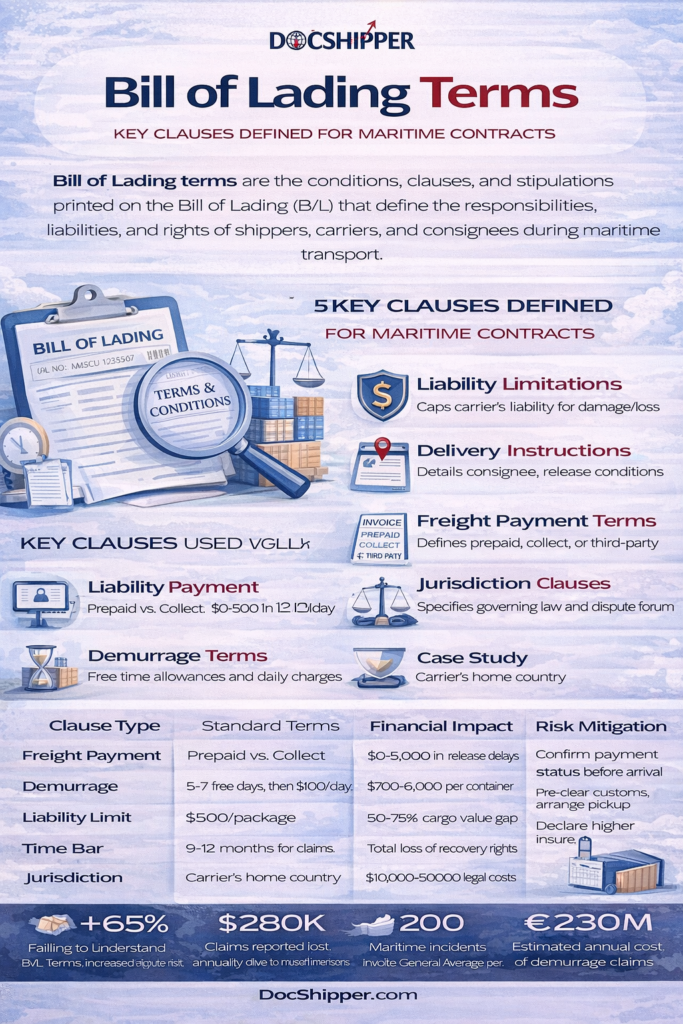
- Liability limitations – Caps on carrier responsibility for cargo damage or loss
- Freight payment conditions – Prepaid, collect, or third-party billing arrangements
- Delivery instructions – Release conditions and consignee identification requirements
- Jurisdiction clauses – Governing law and dispute resolution mechanisms
- Carrier responsibilities – Obligations regarding seaworthiness, proper stowage, and care
Understanding Bill of Lading Terms & Legal Framework
The legal foundation of Bill of Lading terms rests primarily on international conventions. The Hague-Visby Rules (1968) and Hamburg Rules (1978) establish baseline carrier liabilities and shipper rights. Most commercial Bills of Lading incorporate these conventions while adding carrier-specific conditions.
The paramount clause typically appears at the top of the B/L terms, stating which international convention governs the contract. This determines liability limits, time bars for claims, and burden of proof requirements. Under Hague-Visby, carriers limit liability to approximately $500 per package unless higher value is declared.
Modern Bills of Lading include demurrage and detention clauses that specify free time allowances and daily charges for container usage beyond agreed periods. These terms directly impact landed costs and require careful coordination with inland transport.
The both-to-blame collision clause protects carriers when accidents involve multiple vessels. Shippers may face additional charges even when their carrier wasn’t at fault. Understanding this clause prevents unexpected cost exposures during claim settlements.
General Average clauses invoke ancient maritime law principles. When a vessel faces peril, the master may sacrifice cargo to save the voyage. All cargo owners contribute proportionally to losses, regardless of whose goods were jettisoned. According to the International Chamber of Commerce, General Average declarations occur in approximately 200 maritime incidents annually.
At DocShipper, we systematically review these clauses before shipment to ensure clients understand their exposure and can secure appropriate marine cargo insurance coverage.
Practical Examples & Key Clauses Analysis
Real-world application of Bill of Lading terms reveals their financial impact. Consider a container of electronics valued at $150,000 shipped from Shanghai to Rotterdam. Without declared value, Hague-Visby limits recovery to approximately $62,500 (based on 500 packages at $125 SDR per package).
| Clause Type | Standard Terms | Financial Impact | Risk Mitigation |
|---|---|---|---|
| Freight Payment | Prepaid vs. Collect | $0-5,000 in release delays | Confirm payment status before arrival |
| Demurrage | 5-7 free days, then $75-150/day | $750-4,500 per container | Pre-clear customs, arrange pickup |
| Liability Limit | $500/package or unit | 50-90% cargo value gap | Declare higher value, insure |
| Time Bar | 9-12 months for claims | Total loss of recovery rights | Document damage immediately |
| Jurisdiction | Carrier’s home country | $10,000-50,000 legal costs | Negotiate arbitration clause |
Case Study: A German importer received damaged machinery from China. The Bill of Lading contained a one-year time bar clause. The importer waited 13 months before filing a claim, believing the standard limitation period was two years. The claim was rejected entirely based on the contractual time bar, resulting in a $280,000 unrecovered loss.
The Himalaya Clause extends carrier liability protections to subcontractors, stevedores, and terminal operators. This prevents cargo owners from circumventing carrier liability limits by suing handling agents directly. Shippers must understand this clause when structuring insurance coverage.
Freight forwarder’s B/L terms differ significantly from carrier B/Ls. Forwarders often act as carriers under their house B/L while being shippers on the master B/L. This creates dual contractual relationships with different liability exposures and payment obligations.
The on-deck cargo clause permits carriers to stow containers on deck unless explicitly prohibited. Deck cargo faces higher risk of loss overboard and may void certain insurance coverage. Shippers of sensitive electronics or temperature-controlled goods should negotiate under-deck stowage guarantees.
Conclusion
Bill of Lading terms form the contractual backbone of maritime transport, directly impacting liability, costs, and claim rights. Understanding these clauses before shipment prevents costly disputes and enables proper risk management through insurance and contractual negotiation.
Need expert guidance on Bill of Lading terms for your shipments? Contact DocShipper for comprehensive freight forwarding and customs clearance support tailored to your international trade requirements.
📚 Quizz
Test Your Knowledge: Bill of Lading Terms
Q1 — What does a Bill of Lading primarily represent in international shipping?
Q2 — Under the Hague-Visby Rules, what is the default carrier liability limit per package when no higher value is declared?
Q3 — A German importer receives damaged machinery but waits 13 months to file a claim, assuming a 2-year limitation period. What most likely happens?
🎯 Your Result
📞 Free Quote in 24hFAQ | Bill of Lading Terms: Definition, Types & Practical Examples
Freight Prepaid means the shipper has paid ocean freight charges before shipment. Freight Collect requires the consignee to pay upon delivery. This designation determines who holds financial responsibility and affects cargo release procedures at destination ports.
No. International conventions like Hague-Visby establish minimum carrier liabilities that cannot be reduced by contractual terms. However, B/L terms can add obligations beyond convention minimums, such as shorter claim periods or specific arbitration requirements.
A clean Bill of Lading confirms cargo was received in apparent good condition without damage, shortages, or packaging defects. Banks require clean B/Ls for letter of credit payments. Claused or dirty B/Ls note exceptions and may trigger payment rejections.
Demurrage charges apply when cargo remains at the terminal beyond free time. Detention charges occur when containers stay with consignees beyond allowed periods before return. Both generate daily fees but apply to different custody phases of container usage.
A surrender B/L (also called "telex release") allows cargo release without presenting original paper documents. The shipper returns all originals to the carrier, who notifies the destination agent to release cargo to the named consignee upon identity verification.
Yes, when issued through approved platforms complying with UNCITRAL Model Law on Electronic Transferable Records. Electronic B/Ls (eBLs) provide the same legal functions as paper documents while reducing fraud risk and transit time. Adoption varies by jurisdiction and carrier.
This clause indicates the carrier has not verified container contents and relies on shipper's declaration. It limits carrier liability for cargo description accuracy. Carriers only confirm seal integrity and external container condition, not internal goods specifications.
Large shippers with significant volume can negotiate certain terms like extended free time, liability limits, or jurisdiction clauses. Smaller shippers typically accept standard carrier terms but can request amendments for specific shipments, subject to carrier approval and possible surcharges.
The Notify Party receives arrival notifications and cargo documentation at destination. While not the legal consignee, this party (often a customs broker or freight forwarder) initiates clearance processes. Incorrect notify details cause delivery delays and demurrage charges.
Most maritime jurisdictions require 7-10 years retention for B/L documentation. This supports potential claims, audits, and compliance verification. Electronic archiving systems increasingly replace physical storage while maintaining legal validity and accessibility requirements.
Cargo release requires posting a Letter of Indemnity (LOI) and bank guarantee, typically 200% of cargo value. The guarantee remains active for the statute of limitations period (often 6 years) to protect carriers against fraudulent original B/L presentation claims.
Multimodal or combined transport B/Ls cover multiple transport modes under one contract. Terms apply throughout the journey but may reference different liability regimes for sea, air, road, and rail segments. The UNCTAD/ICC Multimodal Transport Rules often govern these contracts.
Need Help with
Logistics or Sourcing ?
First, we secure the right products from the right suppliers at the right price by managing the sourcing process from start to finish. Then, we simplify your shipping experience - from pickup to final delivery - ensuring any product, anywhere, is delivered at highly competitive prices.


Fill the Form
Prefer email? Send us your inquiry, and we’ll get back to you as soon as possible.
Contact us




