


In short ⚡
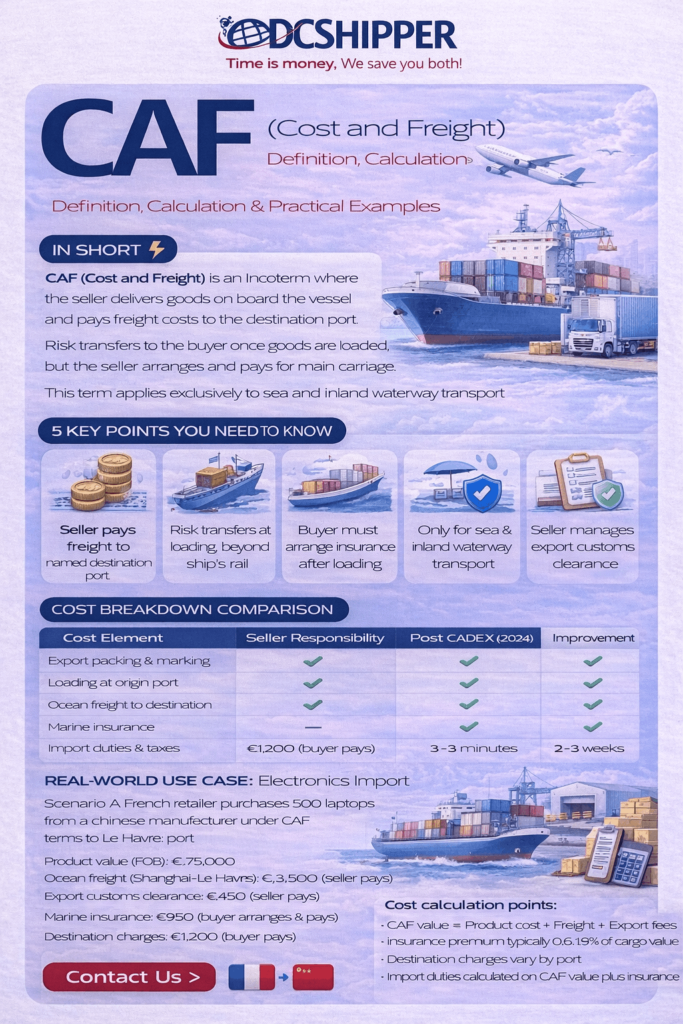
CAF (Cost and Freight) is an Incoterm where the seller delivers goods on board the vessel and pays freight costs to the destination port. Risk transfers to the buyer once goods are loaded, but the seller arranges and pays for main carriage. This term applies exclusively to sea and inland waterway transport.Introduction
Confusion between CAF and CIF remains one of the most common pitfalls in international trade negotiations. Many importers mistakenly believe freight payment equals risk coverage, leading to costly disputes when cargo damage occurs during transit.
Understanding CAF is essential because it defines the exact moment risk transfers from seller to buyer, clarifies who bears which costs, and determines insurance responsibilities. This Incoterm directly impacts pricing strategies, contract negotiations, and financial planning for both parties.
- Seller pays freight to the named destination port
- Risk transfers at loading when goods pass the ship’s rail
- Buyer arranges insurance from port of loading onwards
- Applicable only to maritime and inland waterway transport
- Export customs clearance is the seller’s responsibility
CAF Mechanism & Legal Obligations
The CAF term creates a split responsibility structure where cost obligations differ from risk allocation. The seller must contract and pay for carriage to bring goods to the destination port, but risk transfers much earlier during the loading process.
Critical risk transfer point: Once goods cross the ship’s rail at the port of shipment, all risk of loss or damage transfers to the buyer. This means the seller has fulfilled delivery obligations even if the vessel sinks during transit, provided goods were properly loaded.
Freight payment obligation: The seller must arrange transportation through a reliable carrier and pay all costs until the destination port. This includes loading charges at origin, ocean freight, and standard maritime fees, but excludes unloading costs at destination.
Documentation requirements: The seller must provide the buyer with proof of delivery (Bill of Lading or Sea Waybill), commercial invoice, and any documents needed for import clearance. According to ICC Incoterms 2020, these documents must be provided at the seller’s expense.
Insurance gap consideration: Unlike CIF, CAF does not require the seller to procure insurance. The buyer bears this responsibility from the moment goods are loaded. At DocShipper, we systematically advise clients on this insurance gap to prevent coverage lapses during the critical transit period.
Export compliance: The seller handles all export formalities, licenses, and customs clearance at origin. Import clearance, duties, and taxes at destination remain the buyer’s responsibility, creating a clear jurisdictional division between parties.
Practical Examples & Cost Calculations
Understanding CAF through concrete scenarios helps clarify cost distribution and risk management strategies. The following examples illustrate typical transactions under this Incoterm.
Cost Breakdown Comparison
| Cost Element | Seller Responsibility | Buyer Responsibility |
|---|---|---|
| Export packing & marking | ✓ | — |
| Loading at origin port | ✓ | — |
| Ocean freight to destination | ✓ | — |
| Marine insurance | — | ✓ |
| Unloading at destination | — | ✓ |
| Import duties & taxes | — | ✓ |
Real-World Use Case: Electronics Import
Scenario: A French retailer purchases 500 laptops from a Chinese manufacturer under CAF terms to Le Havre port.
- Product value (FOB): €75,000
- Ocean freight (Shanghai-Le Havre): €3,500 (seller pays)
- Export customs clearance: €450 (seller pays)
- Marine insurance: €950 (buyer arranges and pays)
- Destination charges: €1,200 (buyer pays)
Total CAF price: €78,950 (€75,000 + €3,500 + €450). The buyer’s additional costs include insurance (€950) and destination handling (€1,200), bringing total landed cost to €81,100 before duties.
Risk scenario: If cargo is damaged during the voyage, the buyer must file the insurance claim since risk transferred at loading in Shanghai. The seller has no liability for transit damage under CAF terms.
Key calculation points:
- CAF value = Product cost + Freight + Export fees
- Insurance premium typically 0.5-1.5% of cargo value
- Destination charges vary by port (terminal handling, documentation)
- Import duties calculated on CAF value plus insurance
- Total landed cost includes all expenses until goods reach final destination
Conclusion
CAF remains a practical Incoterm for buyers who prefer controlling their insurance coverage while benefiting from seller-arranged freight. Understanding the risk transfer point prevents costly disputes and ensures proper financial planning.
Need assistance navigating CAF terms or managing international shipments? Contact DocShipper for expert guidance on Incoterms selection and logistics optimization.
📚 Quiz
Test Your Knowledge: CAF (Cost and Freight)
1. Under CAF (Cost and Freight) terms, who is responsible for paying the ocean freight to the destination port?
2. A shipment of goods is damaged mid-voyage after being properly loaded onto the vessel under CAF terms. Who bears the financial loss?
3. A European importer is negotiating a contract with an Asian supplier. They want the supplier to pay freight but prefer to control their own marine insurance policy. Which Incoterm best fits this requirement?
🎯 Your Result
📞 Free Quote in 24hFAQ | CAF (Cost and Freight): Definition, Calculation & Practical Examples
CAF requires the buyer to arrange insurance, while CIF obligates the seller to provide minimum insurance coverage. Both terms involve seller-paid freight, but insurance responsibility differs fundamentally between them.
Risk transfers when goods pass the ship's rail at the port of shipment. From that moment, the buyer bears all risks of loss or damage, even though the seller still pays for freight to destination.
No, CAF applies exclusively to sea and inland waterway transport. For air shipments, use CPT (Carriage Paid To) or CIP (Carriage and Insurance Paid To) instead, which cover all transport modes.
The buyer pays unloading costs at the destination port. The seller's freight payment obligation ends when goods reach the named port, excluding discharge operations and terminal handling charges.
CAF is not an official Incoterm 2020 term. The correct equivalent is CFR (Cost and Freight). However, CAF remains commonly used in certain markets as a synonym for CFR.
Buyers should secure at least Institute Cargo Clauses (C) coverage, though Institute Cargo Clauses (A) provides comprehensive protection. Coverage should start from the port of loading until final destination.
CAF price equals product cost plus ocean freight plus export-related expenses. It excludes insurance, import duties, and destination handling charges, which remain buyer responsibilities under this term.
The seller must provide a Bill of Lading or Sea Waybill, commercial invoice, packing list, and any documents required for export clearance. These prove delivery and enable the buyer to claim goods.
Yes, parties can modify standard CAF obligations through explicit contract clauses. However, any deviation should be clearly documented to prevent disputes and ensure both parties understand their adjusted responsibilities.
The seller bears responsibility for any damage occurring before goods cross the ship's rail. Pre-loading damage remains the seller's liability, requiring replacement or compensation before risk transfer occurs.
Customs authorities typically use the CAF value plus insurance as the basis for calculating import duties. This customs value includes product cost, freight, and insurance, forming the dutiable amount.
CAF suits buyers with established insurance relationships who want cost control. Small businesses without insurance expertise might prefer CIF, where sellers arrange coverage, reducing complexity and potential coverage gaps.
Need Help with
Logistics or Sourcing ?
First, we secure the right products from the right suppliers at the right price by managing the sourcing process from start to finish. Then, we simplify your shipping experience - from pickup to final delivery - ensuring any product, anywhere, is delivered at highly competitive prices.


Fill the Form
Prefer email? Send us your inquiry, and we’ll get back to you as soon as possible.
Contact us




