



In short ⚡
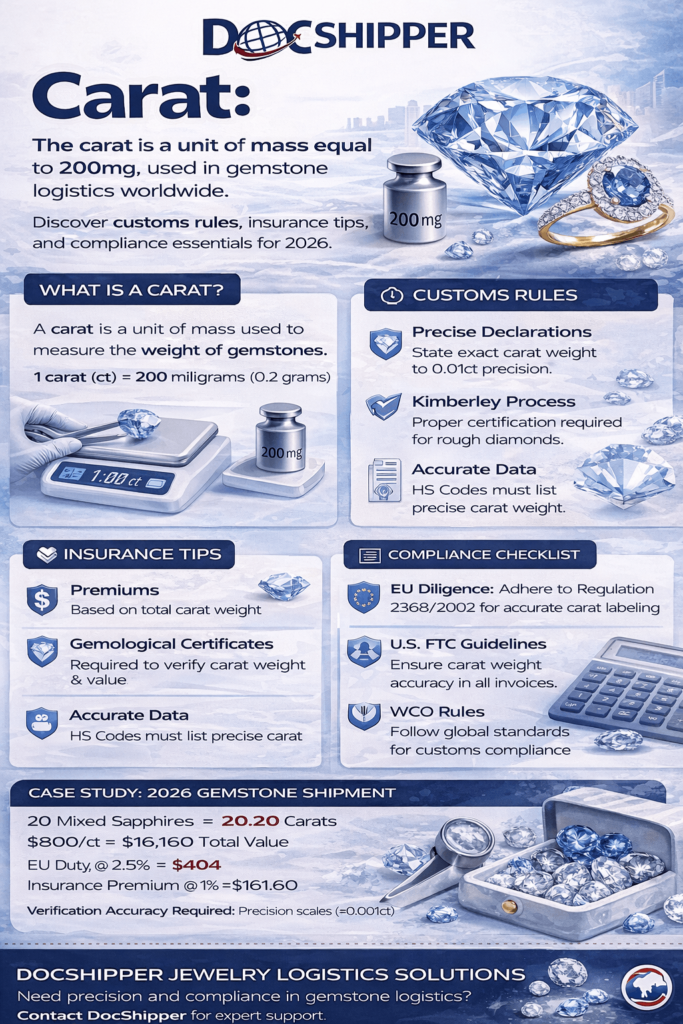
Carat is a unit of mass used in the gemstone and precious metals industry, equal to 200 milligrams (0.2 grams). In international logistics, understanding carat measurements is essential for customs valuation, insurance coverage, and regulatory compliance when shipping high-value jewelry, diamonds, and precious stones across borders.
Introduction
Confusion between carat (mass) and karat (purity) causes frequent errors in customs declarations for jewelry shipments. This distinction directly impacts duty calculations, insurance claims, and trade compliance.
In the global supply chain for precious goods, accurate carat measurement determines product classification under HS codes, affects tariff rates, and influences security protocols during international transport.
- Standardized mass unit: Exactly 200 mg, internationally recognized since 1907
- Customs valuation: Directly linked to declared value and duty assessment
- Insurance requirements: Premium calculations based on total carat weight
- Regulatory compliance: Kimberley Process certification for rough diamonds
- Documentation precision: Commercial invoices must specify exact carat weight
Technical Standards & Regulatory Framework
The metric carat was officially adopted at the Fourth General Conference on Weights and Measures in 1907, replacing various regional systems. This standardization eliminated discrepancies that previously complicated international diamond trading.
For customs purposes, carat weight must be declared with precision to two decimal places. The World Customs Organization requires separate declaration of carat weight and metal purity (karat for gold) to prevent misclassification under Harmonized System codes.
The Kimberley Process Certification Scheme mandates that rough diamond shipments include exact carat weight on all accompanying documentation. This international agreement, supported by 75 participating countries, prevents conflict diamonds from entering legitimate trade channels.
Insurance valuation for high-value shipments requires gemological certificates from recognized laboratories (GIA, IGI, HRD) specifying carat weight alongside cut, color, and clarity grades. Discrepancies between declared and certified weights trigger customs inspections.
At DocShipper, we systematically verify carat declarations against supporting gemological certificates to ensure seamless customs clearance and prevent costly delays for jewelry importers.
The European Union Regulation 2368/2002 establishes specific requirements for precious stone labeling, including mandatory carat disclosure on consumer-facing documentation. Similar regulations exist under U.S. Federal Trade Commission guidelines.
Valuation Methods & Shipping Scenarios
Customs duty calculation for gemstones follows a weight-based formula where total carat weight determines the applicable tariff bracket. A 5-carat diamond faces different duty rates than a 0.5-carat stone, even with identical per-carat valuations.
Comparative Shipping Scenario
| Shipment Type | Total Carat Weight | Declared Value (USD) | Insurance Premium | Customs Duty Rate |
|---|---|---|---|---|
| Single 2ct Diamond | 2.00 ct | $18,000 | 0.8% ($144) | 0% (most markets) |
| 100 × 0.02ct Diamonds | 2.00 ct | $4,500 | 1.2% ($54) | 2.5% (jewelry mounting) |
| Mixed Gemstone Lot | 50.00 ct (various) | $12,000 | 1.5% ($180) | 3.5% (semi-precious) |
Practical Calculation Example
An importer receives 15 sapphires with the following weights: 3 × 1.25ct, 7 × 0.85ct, 5 × 2.10ct. Total carat calculation:
- (3 × 1.25) + (7 × 0.85) + (5 × 2.10) = 3.75 + 5.95 + 10.50 = 20.20 carats total
- If declared value is $800/carat: 20.20ct × $800 = $16,160 customs value
- EU import duty (HS 7103.91): 2.5% × $16,160 = $404 duty payable
- Insurance at 1.0% coverage: $161.60 premium
Weight verification protocol: Customs authorities may re-weigh shipments using calibrated precision scales (±0.001ct accuracy). Discrepancies exceeding 0.5% trigger detailed inspections and potential penalties.
For rough diamond shipments under the Kimberley Process, each parcel requires a certificate listing individual stone weights. A 500-carat lot might contain 200+ individual stones, each documented separately to prevent smuggling through weight manipulation.
DocShipper’s quality control process includes third-party weight verification for high-value gemstone shipments, ensuring documentation accuracy before customs presentation and eliminating clearance delays.
Conclusion
Precise carat measurement and documentation form the foundation of compliant, efficient international gemstone logistics. Errors in weight declaration create cascading problems across valuation, insurance, and regulatory compliance.
Need expert guidance on precious goods shipping? Contact DocShipper for specialized support in jewelry and gemstone logistics.
📚 Quiz
Test Your Knowledge: Carat in Logistics
Q1 — What does "carat" measure in the context of international gemstone logistics?
Q2 — A customs officer re-weighs a diamond shipment declared at 10.00 carats and measures 10.08 carats. What is the likely outcome?
Q3 — An importer ships 5 rubies each weighing 1.50 carats, declared at $600 per carat. What is the correct customs value to declare?
🎯 Your Result
📞 Free Quote in 24hFAQ | Carat: Definition, Calculation & Practical Examples in Logistics
Carat measures gemstone weight (200mg per carat), while karat indicates gold purity (24 karat = pure gold). These are completely separate measurement systems despite similar pronunciation.
Yes, customs may re-weigh gemstones using precision scales. Significant discrepancies between declared and measured weights can result in penalties, shipment delays, or confiscation.
Higher total carat weight typically increases insurance costs, though premium rates also depend on gemstone type, quality, and shipping route security. Expect 0.5-2% of declared value.
Most jurisdictions require declaration regardless of weight, but shipments below 0.25 total carats may qualify for simplified procedures. Always verify country-specific regulations.
Acceptable documents include gemological laboratory certificates (GIA, IGI), commercial invoices with detailed weight breakdowns, and Kimberley Process certificates for rough diamonds.
Yes, some tariff classifications differentiate between weight ranges. For example, diamonds over 0.5 carats may fall under different HS codes than smaller stones.
Industry standard requires accuracy to two decimal places (0.01ct). Professional gemological scales measure to 0.001ct precision for high-value stones.
Yes, carat weight applies identically to natural and lab-grown gemstones. However, customs classification and duty rates may differ based on origin (natural vs. synthetic).
Underdeclaration can trigger fraud investigations and financial penalties. Overdeclaration results in excess duty payments. Both scenarios cause clearance delays and potential legal consequences.
Rough diamonds require Kimberley Process certification with exact carat weight per parcel. Polished diamonds need gemological certificates but face less stringent parcel-level documentation requirements.
Multiply carats by 0.2 to get grams (1 carat = 0.2g). For example, 50 carats = 10 grams. This conversion is essential for freight weight calculations.
Yes, high total carat shipments typically require armored transport, specialized insurance, and enhanced tracking. Thresholds vary by carrier but often start at 100 total carats or $50,000 value.
Need Help with
Logistics or Sourcing ?
First, we secure the right products from the right suppliers at the right price by managing the sourcing process from start to finish. Then, we simplify your shipping experience - from pickup to final delivery - ensuring any product, anywhere, is delivered at highly competitive prices.


Fill the Form
Prefer email? Send us your inquiry, and we’ll get back to you as soon as possible.
Contact us




