


In short ⚡
A carnet is an international customs document that allows temporary duty-free importation of goods across multiple countries without paying duties or posting bonds at each border. Issued under international conventions, carnets simplify cross-border movements for professionals transporting samples, equipment, or exhibition materials temporarily.
Introduction
International trade professionals often face a common challenge: moving goods temporarily across borders without triggering complex customs procedures or paying duties on items that will return home. This creates administrative burdens and cash flow problems for businesses attending trade shows, delivering samples, or deploying professional equipment abroad.
The carnet system solves this problem by functioning as a “passport for goods.” Recognized by customs authorities in over 80 countries, it eliminates repetitive paperwork and financial guarantees at each border crossing. This mechanism is particularly valuable in international logistics where speed and cost-efficiency determine competitive advantage.
Key characteristics of carnets include:
- Valid for up to 12 months from issuance date
- Covers temporary imports without payment of duties or taxes
- Recognized under international conventions (ATA, TIR, CPD)
- Requires goods to be re-exported within the validity period
- Issued by authorized chambers of commerce or trade associations
Understanding Carnet Mechanisms & Legal Framework
The ATA carnet (Admission Temporaire/Temporary Admission) represents the most widely used format, governed by the Istanbul Convention of 1990. This international treaty, administered by the World Customs Organization, standardizes temporary admission procedures across signatory countries. The system relies on a chain of guarantee managed by national guaranteeing associations.
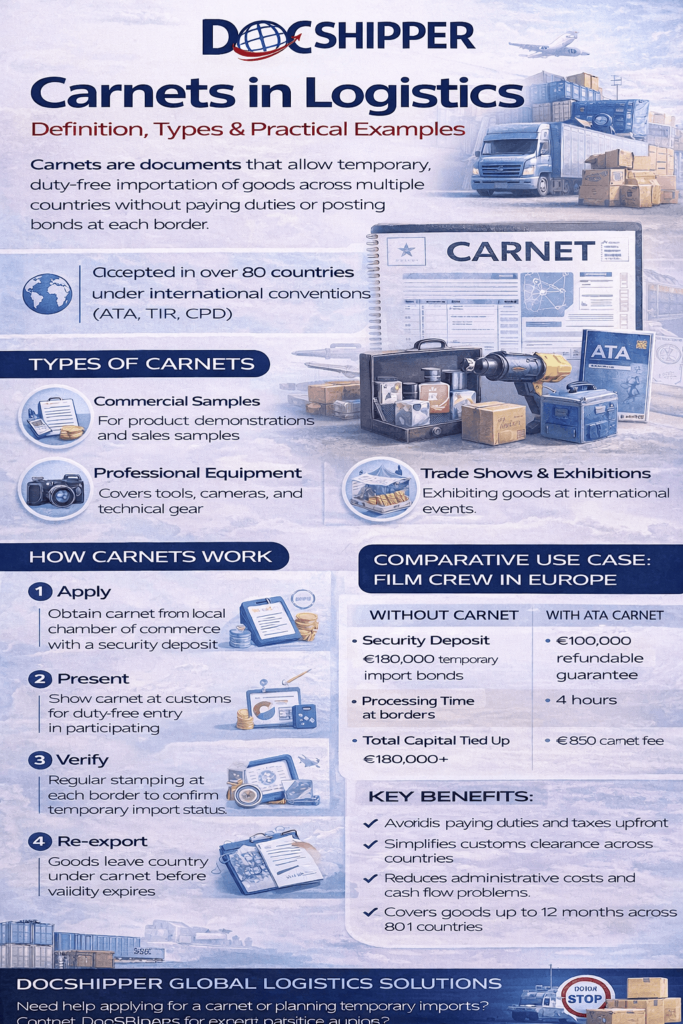
Three primary carnet types serve distinct purposes. Commercial samples carnets facilitate product demonstrations and sales negotiations without commercial transaction completion. Professional equipment carnets cover tools, cameras, medical devices, and technical instruments used by traveling professionals. Exhibition and fair carnets enable duty-free display of goods at international trade events, conferences, and promotional activities.
The operational mechanism involves a security deposit system. When applying for a carnet, the holder provides a financial guarantee (typically 40% of the goods’ value) to the issuing organization. This guarantee covers potential duties and taxes if goods are not re-exported as declared. Customs authorities stamp the carnet at each entry and exit point, creating an auditable trail of movements.
Legal compliance requires adherence to strict re-exportation deadlines. Goods must leave the importing country before the carnet expires. Failure to comply results in duty assessment, penalties, and potential forfeiture of the security deposit. Extensions are possible but must be requested before expiration and are subject to approval by both the issuing association and destination customs authorities.
At DocShipper, we systematically verify carnet validity dates and endorsement completeness before shipment departure to prevent costly customs delays and penalty assessments at destination borders.
The TIR carnet (Transports Internationaux Routiers) differs fundamentally by covering goods in transit rather than temporary admission. Managed by the International Road Transport Union (IRU), TIR carnets enable sealed trucks to cross multiple borders without intermediate customs inspections. This system is particularly valuable for road freight transiting non-EU countries where border procedures would otherwise require repeated unloading and inspection. Learn more about TIR procedures at the IRU official website.
Practical Applications & Real-World Scenarios
Understanding carnet applications through concrete examples clarifies when and how to use this customs facilitation tool effectively.
Comparative Scenario: Trade Show Participation
| Aspect | Without Carnet | With ATA Carnet |
|---|---|---|
| Customs Processing Time | 3-7 days per border | Same-day clearance |
| Duty Payment | Full duties paid upfront, reclaim later | No payment required |
| Documentation | Separate forms per country | Single document for all destinations |
| Cash Flow Impact | €15,000 tied up for 60-90 days | €500 carnet fee only |
| Administrative Burden | High (customs broker per country) | Low (single issuance process) |
Use Case: Film Production Equipment Movement
Scenario: A French production company needs to film in Switzerland (non-EU), Germany, and the UK over 6 months. Equipment value: €250,000 including cameras, lighting, and sound gear.
Carnet solution: The company obtains an ATA carnet listing all equipment with serial numbers. At each border, customs officers verify equipment against the carnet list and stamp the document. Total processing time across all borders: 4 hours. Security deposit: €100,000 (returned after final re-importation to France). Carnet issuance cost: €850.
Alternative cost without carnet: Estimated duties and VAT per country (temporary import bonds): Switzerland €50,000, Germany €47,500, UK £42,000. Administrative fees for customs brokers: €3,200. Total capital tied up: approximately €180,000 for the project duration.
Key Operational Points
- Application timeline: Allow 5-10 business days for carnet issuance before departure
- Goods valuation: Must reflect current market value, not depreciated accounting value
- Serial number tracking: High-value items require individual identification to prevent substitution
- Partial shipments: Carnets allow splitting goods across multiple shipments within validity period
- Country limitations: Verify destination country acceptance before relying on carnet (notably USA requires specific procedures)
DocShipper assists clients in preparing accurate carnet applications, including goods valuation, serial number documentation, and coordination with issuing chambers of commerce to ensure seamless border crossings.
Conclusion
Carnets represent an essential customs facilitation tool for businesses engaged in temporary cross-border goods movements. By eliminating duty payments and streamlining documentation across multiple countries, they reduce both financial burden and administrative complexity in international logistics operations.
Need assistance with carnet applications or international shipping procedures? Contact DocShipper for expert guidance tailored to your specific logistics requirements.
📚 Quiz
Test Your Knowledge: Carnet
1. What is the primary purpose of a carnet in international logistics?
2. A company uses an ATA carnet to bring product samples to a trade show abroad, then sells all the samples on-site. Is this a valid use of the carnet?
3. A road freight operator needs to move commercial goods in a sealed truck through five non-EU countries without intermediate customs inspections at each border. Which carnet type is most appropriate?
🎯 Your Result
📞 Free Quote in 24hFAQ | Carnet in Logistics: Definition, Types & Practical Examples
An ATA carnet is valid for up to 12 months from the date of issuance. Goods must be re-exported before expiration, though extensions may be requested through the issuing organization if approved by destination customs authorities.
No. Carnets cover only temporary admission of goods that will be re-exported. If you sell goods during the trip, you must complete standard import procedures, pay applicable duties, and discharge the carnet properly to avoid penalties.
Over 80 countries and territories accept ATA carnets, including the EU, UK, Switzerland, Turkey, Japan, Australia, and Canada. Notably, the USA accepts carnets but requires additional procedures. Check current lists with your national issuing authority.
Immediately contact the issuing organization to report the loss. They can issue a replacement carnet, but you must provide detailed documentation of all previous border crossings and current goods location. Lost carnets create significant compliance risks.
Costs vary by country and goods value, typically ranging from €300 to €1,500 for issuance fees. Additionally, you must provide a security deposit (usually 40% of goods value) which is refunded upon proper carnet discharge and goods re-exportation.
No. All goods must be listed on the carnet at issuance. If you need to transport additional items, you must apply for a new carnet or use alternative customs procedures for the unlisted goods.
Not typically. Carnets simplify procedures to allow self-clearance at borders. However, complex shipments or high-value goods may benefit from broker assistance to ensure proper endorsement and avoid procedural errors that could trigger duty assessments.
ATA carnets cover temporary admission of goods that will be re-exported (samples, equipment, exhibition goods). TIR carnets facilitate transit of commercial goods through multiple countries in sealed vehicles without intermediate customs inspections.
Generally no. Carnets are designed for durable goods that can be re-exported in the same condition. Consumables (food, promotional materials distributed free) require standard import procedures, though some countries allow limited quantities under specific conditions.
You need a detailed goods list with descriptions, values, quantities, and serial numbers (for high-value items), company registration documents, purpose of travel documentation, and financial guarantee. Specific requirements vary by issuing organization.
Return the completed carnet to the issuing organization within the deadline (typically 6 months after expiration). Ensure all customs stamps are present for each border crossing. The organization verifies proper re-exportation before releasing your security deposit.
Yes, though procedures differ from accompanied baggage. The carnet holder or authorized representative must present the document to customs. Coordination with your logistics provider is essential to ensure proper endorsement at each transit point.
Need Help with
Logistics or Sourcing ?
First, we secure the right products from the right suppliers at the right price by managing the sourcing process from start to finish. Then, we simplify your shipping experience - from pickup to final delivery - ensuring any product, anywhere, is delivered at highly competitive prices.


Fill the Form
Prefer email? Send us your inquiry, and we’ll get back to you as soon as possible.
Contact us




