


In short ⚡
A carrier is a transportation company responsible for moving goods from origin to destination under a contract of carriage. Carriers can operate by sea, air, road, or rail, and assume legal liability for cargo during transit according to international conventions.
Introduction
Many importers confuse carriers with freight forwarders or customs brokers. Understanding the carrier’s exact role prevents costly misunderstandings regarding liability, insurance, and documentation.
In international trade, the carrier acts as the physical link between supplier and buyer. Their responsibilities extend beyond mere transportation—they issue critical documents, manage cargo safety, and operate under strict regulatory frameworks.
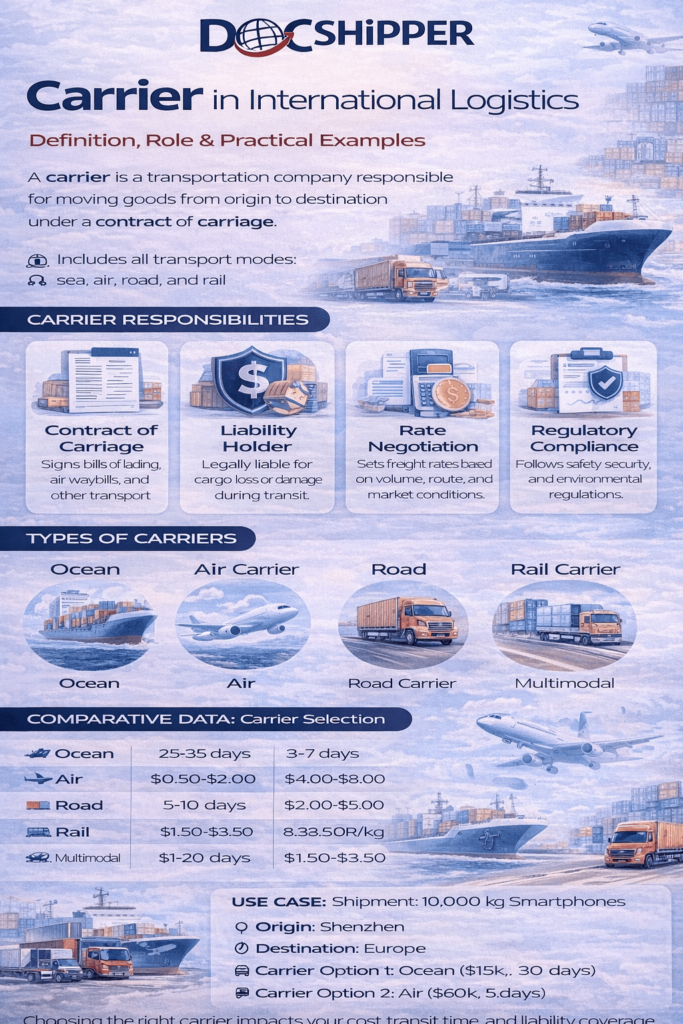
- Legal entity: Carriers sign contracts of carriage and issue transport documents (Bill of Lading, Air Waybill).
- Liability holder: They assume responsibility for cargo loss or damage during transit.
- Mode-specific: Ocean carriers, air carriers, trucking companies, and rail operators each follow distinct conventions.
- Rate negotiators: Carriers set freight rates based on volume, route, and market conditions.
- Compliance actors: They must adhere to safety, security, and environmental regulations.
Carrier Types & Legal Framework
Understanding carrier classifications is essential for selecting the right partner and managing contractual obligations. Each carrier type operates under specific international conventions that define their liability limits and operational standards.
Ocean carriers transport containerized or bulk cargo via sea routes. They operate under the Hague-Visby Rules or Rotterdam Rules, which limit liability to approximately $500 per package unless higher value is declared. Major ocean carriers include Maersk, MSC, and CMA CGM.
Air carriers provide expedited shipping for time-sensitive or high-value goods. The Montreal Convention governs air transport, capping liability at 19 Special Drawing Rights per kilogram unless additional insurance is purchased. Airlines like Lufthansa Cargo and Emirates SkyCargo dominate this sector.
Road carriers handle domestic and cross-border trucking. In Europe, the CMR Convention applies, limiting liability to 8.33 SDR per kilogram. Full truckload (FTL) and less-than-truckload (LTL) services offer flexibility for different shipment sizes.
Rail carriers move large volumes overland, particularly effective for China-Europe routes via the Trans-Siberian Railway. The CIM Convention regulates international rail transport, with liability similar to road transport conventions.
Multimodal carriers combine multiple transport modes under a single contract. They issue a Multimodal Transport Document and assume liability for the entire journey, simplifying documentation for shippers.
At DocShipper, we carefully select carriers based on your cargo specifications, budget, and timeline. Our partnerships with major carriers across all modes ensure competitive rates and reliable service.
Reference: International Maritime Organization provides comprehensive information on maritime carrier regulations.
Practical Examples & Comparative Data
Selecting the appropriate carrier requires understanding cost structures, transit times, and liability differences. The following comparisons illustrate real-world scenarios.
| Carrier Type | Transit Time (Asia-Europe) | Cost per kg | Liability Limit | Best For |
|---|---|---|---|---|
| Ocean Carrier | 25-35 days | $0.50-$2.00 | $500/package | High-volume, non-urgent |
| Air Carrier | 3-7 days | $4.00-$8.00 | 19 SDR/kg | Time-sensitive goods |
| Rail Carrier | 15-20 days | $1.50-$3.50 | 8.33 SDR/kg | China-Europe corridor |
| Road Carrier | 5-10 days (regional) | $2.00-$5.00 | 8.33 SDR/kg | Last-mile delivery |
Use Case: A European electronics retailer imports 10,000 kg of smartphones from Shenzhen. Using an ocean carrier costs approximately $15,000 with 30-day transit. Switching to air freight reduces transit to 5 days but increases cost to $60,000. The retailer chooses ocean freight for regular inventory and reserves air for launch products.
Carrier selection criteria:
- Transit time requirements: Air for perishables, ocean for bulk commodities.
- Cost constraints: Ocean freight offers 70-80% savings versus air on long routes.
- Cargo characteristics: Hazardous goods require certified carriers with ADR/IMDG compliance.
- Insurance needs: High-value shipments justify declared value coverage exceeding standard liability.
- Route availability: Some destinations lack direct ocean service, requiring multimodal solutions.
DocShipper analyzes your specific requirements to recommend the optimal carrier and mode combination. Our volume agreements with major carriers translate into preferential rates for our clients.
Conclusion
Selecting the right carrier directly impacts your supply chain efficiency, cost structure, and risk management. Understanding carrier types, legal frameworks, and liability limitations enables informed decisions that protect your cargo and bottom line.
Need expert guidance on carrier selection for your next shipment? Contact DocShipper for personalized logistics solutions tailored to your business needs.
📚 Quiz
Test Your Knowledge: Carrier
Q1 — What best defines a carrier in international logistics?
Q2 — Under the Montreal Convention, what is the standard liability limit for air carriers in case of cargo loss or damage?
Q3 — A European retailer needs to import 10,000 kg of smartphones from Shenzhen for a major product launch in 6 days. Which carrier type is the most appropriate choice?
🎯 Your Result
📞 Free Quote in 24hFAQ | Carrier: Definition, Role & Practical Examples in International Logistics
A carrier physically transports goods and assumes liability during transit. A freight forwarder arranges transportation by contracting with carriers but typically does not own transport assets or assume carrier liability.
The carrier holds liability for cargo damage during their custody period, subject to convention limits. Shippers should declare higher values or purchase cargo insurance for full protection against loss.
Large shippers with consistent volumes can negotiate contract rates. Smaller businesses typically access better rates through freight forwarders who consolidate shipments and leverage volume discounts.
Ocean carriers issue Bills of Lading, air carriers provide Air Waybills, and road carriers use CMR documents. These serve as receipts, contracts of carriage, and in some cases, documents of title.
Rates depend on weight, volume, route, fuel surcharges, seasonal demand, and cargo type. Ocean freight uses per-container pricing, while air freight charges by chargeable weight (greater of actual or volumetric weight).
International conventions cap carrier liability (e.g., $500 per package for ocean, 19 SDR/kg for air). Shippers must declare higher values and pay ad valorem charges for increased coverage.
Most carriers offer port-to-port or airport-to-airport service. Door-to-door requires multimodal arrangements combining ocean/air with trucking, often coordinated by freight forwarders.
Carriers provide tracking numbers for online monitoring. Ocean carriers offer container tracking via their websites, while air carriers use AWB numbers. Real-time updates vary by carrier and service level.
Cargo insurance protects against carrier insolvency. The carrier's assets may be liquidated to cover claims, but recovery is uncertain. Working with financially stable carriers reduces this risk.
Yes, carriers can reject dangerous goods without proper documentation, prohibited items, or cargo exceeding their equipment capabilities. Each carrier maintains a list of restricted commodities.
Common carriers serve the general public with published rates and standard terms. Contract carriers operate under private agreements with specific clients, offering customized services and negotiated rates.
Liability typically ends upon delivery to the consignee or designated agent. Claims must be filed within convention timeframes: 9 months for ocean (Hague-Visby), 2 years for air (Montreal Convention).
Need Help with
Logistics or Sourcing ?
First, we secure the right products from the right suppliers at the right price by managing the sourcing process from start to finish. Then, we simplify your shipping experience - from pickup to final delivery - ensuring any product, anywhere, is delivered at highly competitive prices.


Fill the Form
Prefer email? Send us your inquiry, and we’ll get back to you as soon as possible.
Contact us




