


In short ⚡
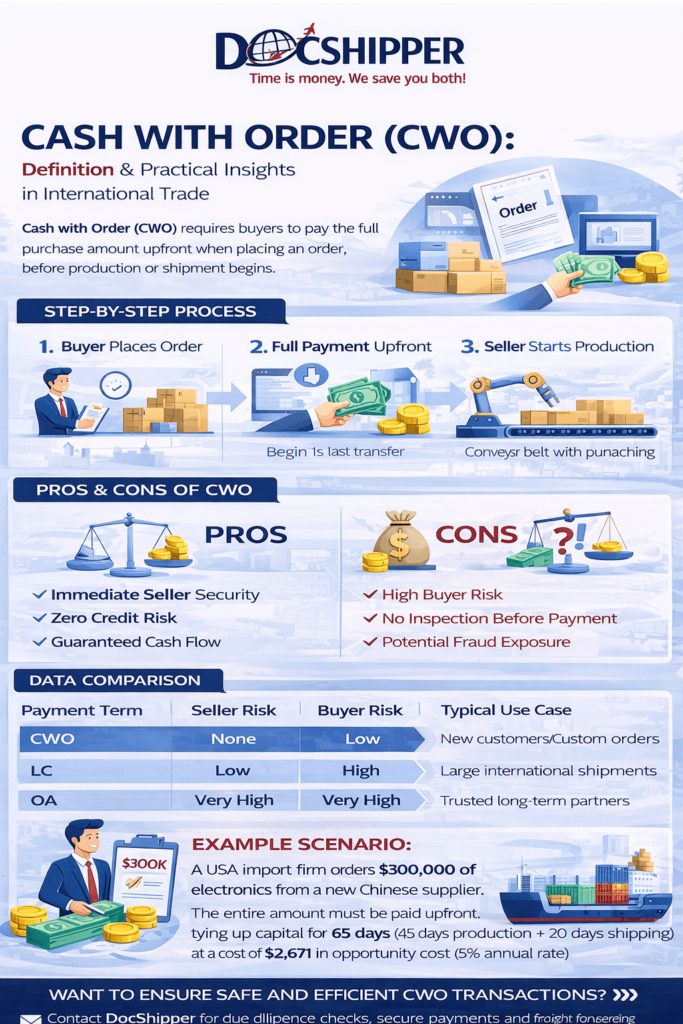
Cash with Order (CWO) is a payment term requiring the buyer to pay the full purchase amount at the time of placing an order, before production or shipment begins. This method eliminates seller risk by ensuring funds are secured upfront, commonly used in international trade with new or unverified customers.Introduction
International trade thrives on trust, yet many transactions fail due to payment disputes or buyer defaults. Cash with Order (CWO) addresses this challenge by requiring immediate payment before any goods are produced or shipped. This payment term shifts all financial risk from the seller to the buyer, making it particularly relevant for exporters dealing with unknown partners or high-value shipments.
In global logistics, CWO serves as the most conservative payment method for sellers. Unlike credit-based terms such as Net 30 or Net 60, CWO guarantees cash flow and eliminates accounts receivable concerns. However, this advantage for sellers creates challenges for buyers who must commit capital without seeing products.
Key characteristics of Cash with Order include:
- Immediate payment requirement at order placement
- Zero credit risk for the seller
- Production initiation only after payment confirmation
- Common in custom manufacturing or high-risk markets
- Negotiation leverage heavily favors the seller
Payment Mechanisms & Risk Implications
Cash with Order operates through a straightforward mechanism: the buyer transfers funds via wire transfer, credit card, or digital payment platforms before the seller commits resources. This contrasts sharply with Cash on Delivery (COD), where payment occurs upon receipt, or Letters of Credit (LC), which involve bank guarantees.
The legal framework for CWO transactions is governed by the Incoterms® 2020 rules published by the International Chamber of Commerce, though CWO itself is a payment term rather than a delivery term. Sellers must clearly specify CWO in proforma invoices and sales contracts to avoid misunderstandings. According to ICC guidelines, payment terms should be explicitly stated alongside delivery terms like FOB or CIF.
From a risk perspective, CWO creates several dynamics:
- Seller protection: Eliminates non-payment risk entirely, ensuring cash flow before production costs are incurred.
- Buyer vulnerability: Exposes buyers to fraud risk if dealing with unverified suppliers, particularly in cross-border transactions.
- Quality assurance concerns: Buyers cannot inspect goods before payment, increasing reliance on supplier reputation.
- Working capital impact: Ties up buyer funds for extended periods, especially if production or shipping delays occur.
- Currency exchange exposure: Buyers bear exchange rate fluctuations between payment and delivery dates.
At DocShipper, we advise clients to request third-party verification or escrow services when using CWO with new suppliers. This mitigates fraud risk while maintaining the seller’s cash flow advantages. Our due diligence services include supplier audits and payment security protocols tailored to CWO transactions.
The operational workflow for CWO typically follows this sequence: buyer places order → seller issues proforma invoice → buyer remits full payment → seller confirms receipt → production begins → goods shipped → delivery completed. Each stage requires documentation, including payment receipts, production schedules, and shipping notifications.
Practical Examples & Data Comparisons
Understanding CWO’s practical application requires examining real-world scenarios and comparing it against alternative payment terms. The following table illustrates how CWO stacks up against common payment methods in international trade:
| Payment Term | Seller Risk | Buyer Risk | Cash Flow Impact | Typical Use Case |
|---|---|---|---|---|
| CWO | None | High | Immediate (Seller) | New customers, custom orders |
| Letter of Credit | Low | Low | Delayed (Both) | Large international shipments |
| Net 30/60 | High | None | Delayed (Seller) | Established relationships |
| Cash on Delivery | Medium | Low | Upon delivery | Domestic shipments |
| Open Account | Very High | None | Extended delay | Trusted long-term partners |
Use Case Scenario: A U.S. electronics retailer orders 10,000 custom-branded smartphones from a Chinese manufacturer for the first time. The order value is $250,000. The manufacturer requests CWO due to lack of trading history.
Calculation breakdown:
- Order value: $250,000
- Payment due: 100% upfront ($250,000)
- Production time: 45 days
- Shipping time: 21 days (sea freight)
- Total capital lockup period: 66 days
- Opportunity cost (at 5% annual): $2,247
In this scenario, the buyer must evaluate whether the $2,247 opportunity cost plus fraud risk justifies the CWO requirement. Alternative approaches include requesting a 30% deposit with CWO and 70% against bill of lading, or engaging DocShipper’s supplier verification services to reduce counterparty risk.
Industry data shows that approximately 15-20% of first-time international transactions use CWO, according to trade finance surveys. This percentage drops to under 5% for established partnerships, where credit terms become standard. However, in sectors like custom manufacturing, prototyping, or high-risk markets (certain African or South American countries), CWO usage can exceed 40%.
DocShipper frequently structures hybrid payment arrangements for clients uncomfortable with full CWO terms. For example, combining a 50% CWO deposit with a 50% Letter of Credit balances risk while maintaining seller confidence. This approach reduces buyer exposure while still providing the seller with immediate working capital.
Conclusion
Cash with Order remains a critical payment tool in international logistics, offering sellers unmatched security while requiring buyers to carefully assess supplier credibility. Understanding its mechanisms, risks, and alternatives enables importers and exporters to negotiate terms that balance protection with operational efficiency.
Need guidance on structuring secure payment terms for your international shipments? Contact DocShipper for customized logistics and payment advisory services.
📚 Quiz
Test Your Knowledge: Cash with Order (CWO)
Q1. What does Cash with Order (CWO) require from the buyer?
Q2. A buyer is considering a CWO transaction with a new overseas supplier. Which of the following risks does the buyer face that the seller does NOT?
Q3. A U.S. retailer places a $250,000 custom order with a Chinese manufacturer under CWO terms. Production takes 45 days and sea freight takes 21 days. Which statement best describes this transaction?
🎯 Your Result
📞 Free Quote in 24hFAQ | Cash with Order (CWO): Definition, Calculation & Practical Examples
CWO requires payment before production or shipment, while COD (Cash on Delivery) requires payment upon receipt of goods. CWO eliminates seller risk entirely, whereas COD still exposes sellers to delivery refusal risks.
CWO carries higher risk for buyers, especially with unverified suppliers. Mitigate this by using escrow services, requesting supplier audits, or working with intermediaries like freight forwarders who verify seller legitimacy.
Yes. Buyers can propose partial CWO (e.g., 30% upfront, 70% against documents), combine it with Letters of Credit, or request third-party inspections before final payment release.
Common methods include wire transfers (most secure), credit cards (for smaller amounts), PayPal or Stripe (with buyer protection), and digital payment platforms like TransferWise for international transactions.
CWO itself doesn't impact customs procedures, but payment documentation (invoices, receipts) must match customs declarations. Ensure your commercial invoice reflects the CWO payment to avoid valuation disputes.
Sellers should require CWO for first-time buyers, custom/non-resalable products, high-risk markets, or when buyer creditworthiness cannot be verified through credit agencies or trade references.
CWO payments are recorded as revenue upon receipt for sellers and as prepaid expenses for buyers. Consult tax advisors regarding VAT/GST treatment, especially in cross-border transactions where reverse charge mechanisms may apply.
CWO and advance payment are functionally identical—both require full payment before shipment. The terminology varies by region, with "CWO" more common in North America and "advance payment" in European trade documentation.
Absolutely. CWO is a payment term that works independently of Incoterms, which define delivery obligations. A transaction can be "FOB Shanghai, CWO" meaning the seller delivers goods on board vessel, but payment must be made upfront.
Buyers can pursue legal action, file fraud complaints with trade authorities, or claim through payment platform protections (if used). Prevention is key: use verified suppliers, escrow services, or engage freight forwarders like DocShipper for transaction oversight.
Buyers bear exchange rate risk since payment occurs before delivery. If the buyer's currency weakens between payment and delivery dates, the effective cost increases. Hedge this risk through forward contracts or currency options.
Yes, most B2C e-commerce operates on CWO principles—customers pay online before order fulfillment. In B2B e-commerce, CWO is less common but used for marketplace transactions or when dealing with unfamiliar business buyers.
Need Help with
Logistics or Sourcing ?
First, we secure the right products from the right suppliers at the right price by managing the sourcing process from start to finish. Then, we simplify your shipping experience - from pickup to final delivery - ensuring any product, anywhere, is delivered at highly competitive prices.


Fill the Form
Prefer email? Send us your inquiry, and we’ll get back to you as soon as possible.
Contact us




:%20Definition%20&%20Guide%20for%202026)