



In short ⚡
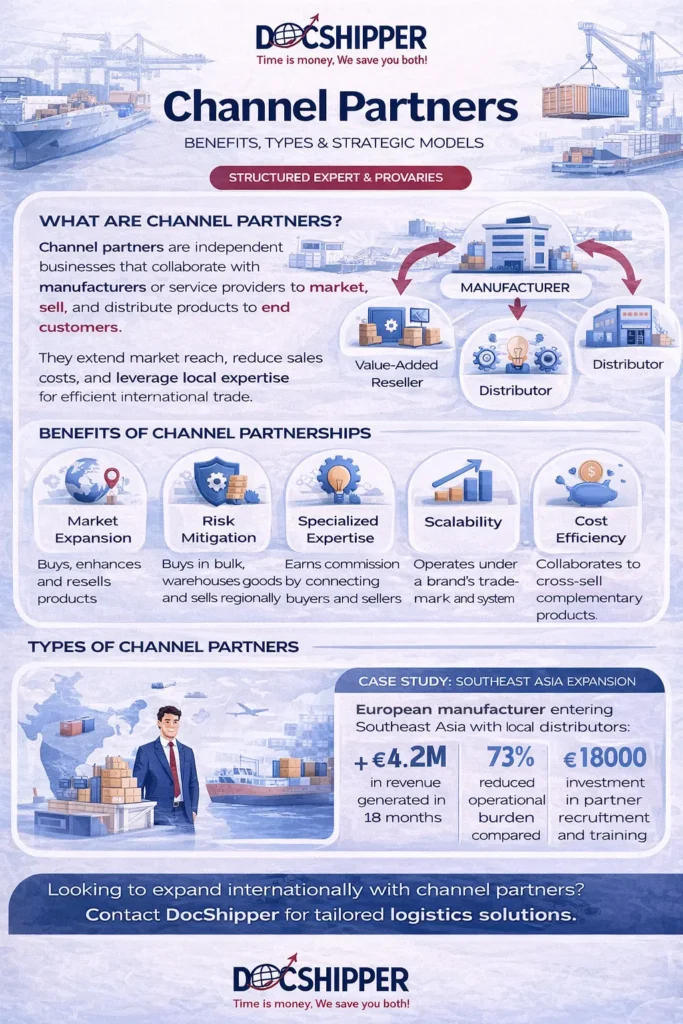
Channel partners are independent businesses or individuals that collaborate with manufacturers or service providers to market, sell, and distribute products to end customers. These intermediaries extend market reach, reduce direct sales costs, and leverage local expertise to penetrate new territories efficiently in international trade.
Introduction
Many businesses struggle to expand internationally without incurring prohibitive costs. Direct sales networks require significant capital investment, local regulatory knowledge, and cultural adaptation. This is where channel partners become critical.
In global logistics and trade, channel partners act as the bridge between manufacturers and distant markets. They handle localization, compliance, customer relationships, and after-sales service while sharing revenue with the principal company.
- Market penetration: Access new geographies without establishing physical presence
- Risk mitigation: Share financial and operational risks with local entities
- Specialized expertise: Leverage partners’ knowledge of regulatory frameworks and cultural nuances
- Scalability: Expand or contract operations flexibly based on market conditions
- Cost efficiency: Reduce overhead compared to direct sales infrastructure
Strategic Framework & Partnership Models
Channel partner relationships operate on clearly defined commercial agreements. The principal company grants specific rights to the partner in exchange for performance commitments. Understanding these models is essential for structuring profitable partnerships.
Value-Added Resellers (VARs) purchase products at wholesale prices, then enhance them with additional services, integration, or customization before reselling. They assume inventory risk but enjoy higher margins through service differentiation.
Distributors buy in bulk and warehouse inventory for regional markets. They manage logistics, break bulk orders into smaller quantities, and serve multiple retailers or end users. Their value lies in supply chain efficiency and local market knowledge.
Agents and brokers do not take ownership of goods. They facilitate transactions between buyers and sellers, earning commissions on completed sales. This model minimizes capital requirements while providing market access. According to World Trade Organization data, agent-based models account for approximately 18% of global B2B transactions.
Franchise partners operate under strict brand guidelines, paying royalties for the right to use trademarks and business systems. This model ensures brand consistency while enabling rapid geographic expansion through local capital investment.
Strategic alliances involve non-competing companies collaborating to cross-sell complementary products. These partnerships create synergies without formal equity arrangements, allowing both parties to access each other’s customer bases.
At DocShipper, we regularly coordinate with channel partners to ensure seamless customs clearance and delivery across multiple jurisdictions, maintaining compliance while optimizing transit times.
Performance Metrics & Real-World Cases
Effective channel partnerships require measurable performance indicators. Companies must balance partner autonomy with accountability to ensure mutual profitability and brand integrity.
| Partner Type | Typical Margin | Inventory Risk | Market Coverage | Best Use Case |
|---|---|---|---|---|
| VAR | 35-50% | High | Niche/Specialized | Complex technical products |
| Distributor | 15-30% | Very High | Regional/Broad | High-volume standardized goods |
| Agent | 5-15% | None | Local/Targeted | Market entry testing |
| Franchise | Variable + Royalty (4-8%) | Partner-Owned | Local/Exclusive Territory | Brand-sensitive services |
| Strategic Alliance | Negotiated Revenue Share | Shared | Cross-Market | Complementary product ecosystems |
Case Study: A European industrial equipment manufacturer sought to enter Southeast Asian markets. Instead of establishing subsidiaries, they engaged three regional distributors across Thailand, Vietnam, and Indonesia. Within 18 months, the channel generated €4.2M in revenue with only €180K in direct investment (partner recruitment and training costs). The distributors handled import documentation, local warehousing, and technical support, reducing the manufacturer’s operational burden by 73%.
Key performance indicators for channel partnerships include: sales volume growth rate, market share within territory, customer acquisition cost, average deal size, and partner satisfaction scores. Leading companies conduct quarterly business reviews with partners to align strategies and address performance gaps.
Revenue attribution models vary significantly. Some companies use last-touch attribution, crediting the final partner before purchase. Others employ multi-touch models that distribute credit across all partners involved in the customer journey. The choice impacts partner motivation and compensation fairness.
Conflict management becomes critical when territories overlap or partners compete for the same accounts. Clear contractual definitions of exclusive versus non-exclusive territories, along with deal registration systems, help prevent disputes and maintain partner trust.
Training investment correlates strongly with partner performance. Companies that provide comprehensive product training, sales enablement tools, and marketing support see 40-60% higher sales per partner compared to those offering minimal support, according to industry benchmarks.
Conclusion
Channel partners represent a strategic lever for international expansion, offering market access, risk distribution, and operational flexibility. Selecting the right partnership model and managing relationships through clear metrics ensures sustainable growth in global markets.
Need expert guidance on structuring your international distribution network or managing cross-border logistics for channel operations? Contact DocShipper for tailored solutions.
📚 Quiz
Test Your Knowledge: Channel Partners
Q1 — What best defines a channel partner in international trade?
Q2 — A company wants to test a new market with minimal capital exposure. Which channel partner model is most appropriate?
Q3 — A European manufacturer enters Southeast Asia through regional distributors instead of opening subsidiaries. After 18 months, they generate €4.2M in revenue with only €180K in direct investment. What does this scenario primarily illustrate about channel partners?
🎯 Your Result
📞 Free Quote in 24hFAQ | Channel Partners: Definition, Strategy & Concrete Examples
Channel partners are independent entities that sell on behalf of a company, while direct sales teams are employed by the company. Partners assume more risk but require less capital investment from the principal.
Selection criteria include market coverage, financial stability, existing customer base, technical capabilities, and alignment with brand values. Due diligence typically involves reference checks, credit assessments, and pilot programs.
Common agreements include reseller agreements, distribution contracts, agency agreements, and franchise licenses. These define territory rights, pricing structures, performance obligations, and termination conditions.
Compensation models vary: wholesale discounts (20-50% off retail), commission percentages (5-15%), royalty fees (4-8% for franchises), or performance bonuses tied to volume or market share targets.
Common challenges include maintaining brand consistency, preventing channel conflict, ensuring adequate training, managing inventory levels, and balancing partner autonomy with corporate oversight.
Yes, multi-tiered channel strategies often combine distributors for broad coverage, VARs for specialized segments, and agents for exploratory markets. Clear territory and account definitions prevent conflicts.
Partners directly influence customer satisfaction through sales interactions, technical support, and after-sales service. Companies must provide training and support tools to ensure consistent quality.
Partner Relationship Management (PRM) platforms facilitate communication, track performance, distribute marketing materials, manage leads, and automate commission calculations, improving efficiency and transparency.
ROI metrics include revenue per partner, customer acquisition cost, market penetration rate, inventory turnover, and incremental sales compared to direct channels. Tracking these requires integrated CRM systems.
Termination clauses in agreements define transition processes, including inventory buyback, customer transfer protocols, and confidentiality obligations. Proper exit planning minimizes market disruption.
Responsibility depends on contractual terms. Distributors typically handle import formalities, while agents may leave compliance to the principal. Clear agreements prevent legal and financial risks.
B2B channels emphasize technical expertise, long sales cycles, and relationship management. B2C channels prioritize volume, brand visibility, and consumer-facing support. Partner selection reflects these differences.
Need Help with
Logistics or Sourcing ?
First, we secure the right products from the right suppliers at the right price by managing the sourcing process from start to finish. Then, we simplify your shipping experience - from pickup to final delivery - ensuring any product, anywhere, is delivered at highly competitive prices.


Fill the Form
Prefer email? Send us your inquiry, and we’ll get back to you as soon as possible.
Contact us




