



In short ⚡
The Civil Aeronautics Board (CAB) was a U.S. federal agency established in 1938 to regulate commercial aviation, controlling routes, fares, and carrier entry until its dissolution in 1985. The CAB's deregulation marked a pivotal shift toward competitive air freight and passenger markets, fundamentally reshaping international logistics and supply chain economics.
Introduction
Why did air cargo costs drop dramatically after 1985? The answer lies in the dissolution of the Civil Aeronautics Board, an entity that controlled every aspect of commercial aviation for nearly five decades.
For international freight forwarders and importers, understanding the CAB’s legacy is essential. Its regulatory model influenced global aviation policy, and its removal catalyzed the competitive pricing structures we rely on today.
- Route authority: CAB determined which carriers could serve specific city pairs, limiting competition.
- Fare regulation: Airlines could not adjust prices without CAB approval, preventing market-driven pricing.
- Entry barriers: New carriers faced extensive approval processes, restricting industry innovation.
- International coordination: CAB negotiated bilateral air service agreements on behalf of U.S. carriers.
- Safety oversight: Initially handled by CAB before transfer to the FAA in 1958.
Regulatory Framework & Authority
The CAB operated under the Civil Aeronautics Act of 1938, consolidating aviation regulation under one federal body. Its mandate extended beyond safety to economic control, a model later adopted by numerous countries.
The Board’s certificate of public convenience and necessity determined carrier viability. Airlines submitted detailed route applications, often waiting years for approval. This bureaucratic process protected incumbent carriers but stifled innovation.
Fare setting involved complex formulas based on cost-plus pricing. The CAB calculated allowable profit margins, ensuring carriers remained financially viable but preventing competitive discounting. This system inflated air freight costs, impacting import/export economics.
International operations required bilateral agreements negotiated between governments. The CAB represented U.S. interests, often securing favorable terms for domestic carriers. These agreements still influence modern air cargo rights, particularly for transpacific and transatlantic routes.
At DocShipper, we navigate the legacy systems established during the CAB era, particularly when dealing with older bilateral agreements that still govern certain international freight corridors.
The Airline Deregulation Act of 1978 began the CAB’s phased elimination. Congress recognized that regulation suppressed efficiency, and the Board formally ceased operations on December 31, 1984. Residual functions transferred to the Department of Transportation.
Deregulation Impact & Modern Logistics
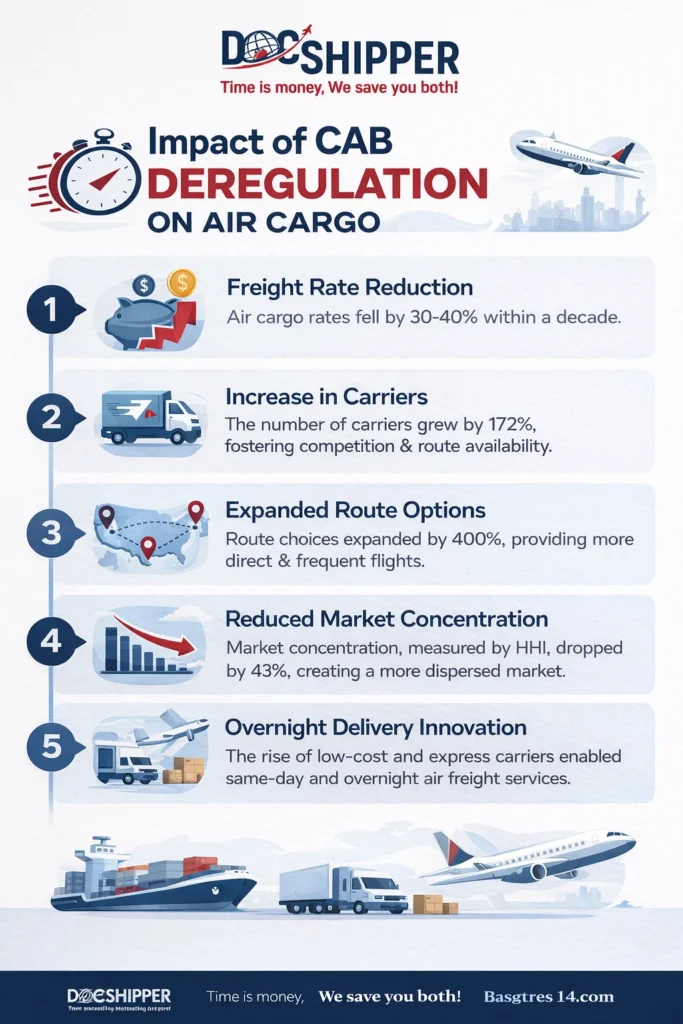
Post-CAB deregulation transformed air freight economics. Average cargo rates decreased by 30-40% within a decade as carriers competed aggressively. Hub-and-spoke networks emerged, optimizing route efficiency.
The removal of entry barriers spawned low-cost carriers and specialized freight operators. Companies like Federal Express (now FedEx) expanded rapidly, introducing overnight delivery models impossible under CAB constraints.
| Metric | Pre-Deregulation (1978) | Post-Deregulation (1990) | Change |
|---|---|---|---|
| Average Freight Rate (per ton-mile) | $0.58 | $0.38 | -34% |
| Number of Carriers | 36 | 98 | +172% |
| Route Options (Major Pairs) | Limited | Multiple Daily | +400% |
| Market Concentration (HHI) | High (2,800+) | Moderate (1,600) | -43% |
Use Case: A manufacturer shipping electronics from Los Angeles to New York in 1975 faced fixed CAB rates of approximately $2.40/kg with limited carrier choices. By 1990, competitive bidding reduced costs to $1.50/kg with same-day options from multiple carriers, cutting logistics expenses by 37%.
International markets adopted similar reforms. The European Union’s aviation liberalization (1987-1997) mirrored U.S. deregulation, creating the Single Aviation Market. Asian nations gradually opened skies, though some bilateral restrictions persist.
Modern freight forwarders benefit from dynamic pricing algorithms and real-time capacity management—innovations impossible under CAB-style regulation. At DocShipper, we leverage these competitive markets to secure optimal rates for clients across global trade lanes.
The CAB’s legacy remains visible in slot allocation systems at congested airports and in bilateral agreements governing fifth-freedom rights. Understanding these historical constraints helps navigate current regulatory complexities in air freight.
Conclusion
The Civil Aeronautics Board shaped aviation economics for nearly five decades, and its dissolution fundamentally altered international logistics. Today’s competitive air freight markets, with dynamic pricing and expanded carrier options, directly result from 1978 deregulation.
Need expert guidance navigating international air freight regulations and optimizing your supply chain costs? Contact DocShipper for tailored logistics solutions.
📚 Quiz
Test Your Knowledge: Civil Aeronautics Board (CAB)
1. What was the primary mandate of the Civil Aeronautics Board (CAB)?
2. A common misconception is that the CAB's dissolution hurt the air freight industry. What actually happened to average cargo rates within a decade after deregulation?
3. A freight forwarder in 1975 wants to ship electronics from Los Angeles to New York at a discounted rate by negotiating directly with a competing airline. Under CAB regulation, is this possible?
🎯 Your Result
📞 Free Quote in 24hFAQ | Civil Aeronautics Board (CAB): Definition, Role & Historical Impact
The CAB regulated commercial aviation economics, controlling routes, fares, and carrier entry from 1938 to 1985. It ensured service stability but limited competition and pricing flexibility.
Congress recognized that regulation suppressed market efficiency and innovation. The Airline Deregulation Act of 1978 initiated phased elimination, with full dissolution occurring December 31, 1984.
Freight rates decreased 30-40% within a decade as carriers competed freely. Hub-and-spoke networks and specialized cargo operators emerged, significantly reducing logistics costs.
Yes, the CAB negotiated bilateral air service agreements on behalf of U.S. carriers, controlling international route access and capacity. Many legacy agreements still influence modern air rights.
The Department of Transportation absorbed remaining CAB functions, including international aviation policy. The FAA continued handling safety regulation, which transferred from CAB in 1958.
The Board used cost-plus formulas, calculating allowable profit margins based on operational expenses. Airlines could not discount fares without CAB approval, preventing competitive pricing.
This CAB-issued document authorized airlines to operate specific routes. Obtaining certification required extensive applications and often took years, creating significant entry barriers for new carriers.
Yes, many nations implemented similar economic regulation models. However, most followed U.S. deregulation trends between 1980-2000, liberalizing their aviation markets to varying degrees.
Deregulation expanded carrier options and enabled competitive rate negotiations. Freight forwarders gained leverage to optimize routing and pricing, significantly reducing client costs and transit times.
Some bilateral agreements negotiated during the CAB era remain active, particularly governing fifth-freedom rights and capacity limits. Slot allocation systems at congested airports also reflect historical regulatory frameworks.
Initially, the CAB handled safety regulation until 1958, when these responsibilities transferred to the newly created Federal Aviation Agency (now FAA). The CAB then focused solely on economic regulation.
Deregulation allowed carriers to optimize networks freely. Airlines concentrated operations at strategic hubs, routing passengers and cargo through central points rather than maintaining point-to-point services mandated under CAB rules.
Need Help with
Logistics or Sourcing ?
First, we secure the right products from the right suppliers at the right price by managing the sourcing process from start to finish. Then, we simplify your shipping experience - from pickup to final delivery - ensuring any product, anywhere, is delivered at highly competitive prices.


Fill the Form
Prefer email? Send us your inquiry, and we’ll get back to you as soon as possible.
Contact us




