


In short ⚡
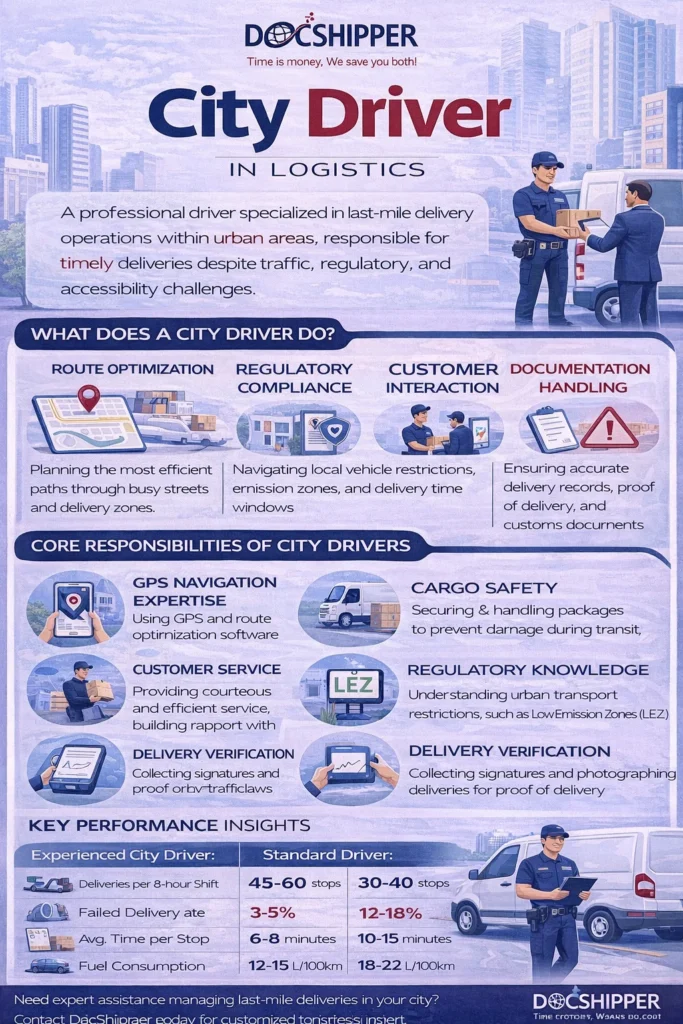
A city driver is a professional driver specialized in urban last-mile delivery operations, responsible for transporting goods within city limits while navigating traffic regulations, time constraints, and accessibility challenges. This role is critical in modern supply chains, ensuring timely delivery to businesses and consumers in densely populated areas.
Introduction
Urban logistics faces unprecedented challenges: traffic congestion, strict delivery windows, parking restrictions, and environmental regulations. The city driver stands at the intersection of these pressures, executing the most complex segment of the supply chain—the final mile.
In international trade and import/export operations, goods may travel thousands of miles smoothly, only to face delays in the last few kilometers. City drivers bridge this gap, transforming warehouse inventory into customer satisfaction.
- Route optimization expertise: Navigating one-way streets, delivery zones, and time-restricted areas
- Customer interaction: Direct contact with recipients, handling documentation and proof of delivery
- Regulatory compliance: Adhering to urban vehicle restrictions, emission standards, and parking regulations
- Time management: Meeting tight delivery schedules across multiple stops
- Technology proficiency: Using GPS systems, mobile apps, and electronic signature devices
Expertise & Key Responsibilities
The city driver’s role extends far beyond simply driving a vehicle. This position requires a unique combination of technical skills, local knowledge, and customer service capabilities that directly impact supply chain efficiency.
Urban navigation mastery is the foundation of effective city driving. Unlike highway transport, urban delivery demands constant adaptation to changing traffic patterns, construction zones, and pedestrian areas. Professional city drivers develop mental maps of their territories, identifying optimal routes that balance speed with fuel efficiency.
Regulatory compliance knowledge is non-negotiable in modern cities. Many urban centers impose Low Emission Zones (LEZ), weight restrictions, and specific delivery time windows. For instance, Paris restricts diesel vehicles in certain districts, while London’s Ultra Low Emission Zone (ULEZ) charges non-compliant vehicles daily fees. City drivers must navigate these regulations seamlessly.
Documentation handling represents a critical administrative function. Each delivery requires proper paperwork: delivery notes, customs clearance documents for international shipments, and proof of delivery signatures. At DocShipper, our city drivers are trained to verify documentation accuracy before departure, preventing costly delays or returns due to paperwork errors.
Safety and damage prevention protocols protect both cargo and public safety. City drivers must secure loads properly for frequent stops, handle fragile items with care, and maintain vehicle safety standards. Insurance claims often hinge on proper loading procedures and delivery protocols.
Customer relationship management transforms drivers into brand ambassadors. The city driver is often the only human contact customers have with a logistics company. Professional demeanor, communication skills, and problem-solving abilities directly influence customer retention and satisfaction scores.
For more information on urban logistics regulations, consult the European Commission’s Urban Mobility Guidelines.
Practical Examples & Operational Data
Understanding the city driver’s impact requires examining real-world scenarios and performance metrics that define success in urban logistics operations.
Comparative Performance Analysis
| Metric | Experienced City Driver | Standard Driver | Impact |
|---|---|---|---|
| Deliveries per shift (8 hours) | 45-60 stops | 30-40 stops | +40% productivity |
| Failed delivery rate | 3-5% | 12-18% | -70% redelivery costs |
| Average time per stop | 6-8 minutes | 10-15 minutes | +35% efficiency |
| Fuel consumption (urban cycle) | 12-15 L/100km | 18-22 L/100km | -30% fuel costs |
| Customer satisfaction score | 4.6/5.0 | 3.8/5.0 | +21% rating improvement |
Use Case: Import Shipment Final Mile
Scenario: A container of electronics arrives at Rotterdam port, destined for 12 retail locations across Amsterdam city center.
Challenge: Delivery windows between 6:00-10:00 AM (before store opening), strict parking enforcement, and signature requirements from store managers.
City Driver Solution:
- Pre-route planning: Sequenced stops to minimize backtracking, identified loading zones near each location
- Early departure: Started at 5:30 AM to avoid peak traffic and secure optimal parking
- Communication: Sent SMS notifications 15 minutes before each arrival
- Documentation: Collected all signatures digitally, uploaded to system in real-time
- Result: 12/12 deliveries completed by 9:45 AM, zero parking violations, 100% customer satisfaction
Key Operational Insights
Peak efficiency hours: City drivers achieve 40% higher delivery rates between 6:00-9:00 AM and 2:00-4:00 PM, avoiding lunch rush and school traffic.
Technology integration: Route optimization software reduces daily mileage by 18-25% compared to manual planning, while electronic proof-of-delivery systems cut administrative time by 60%.
Vehicle selection impact: Electric cargo vans reduce operational costs by €0.12 per kilometer while providing access to restricted zones in cities like Madrid and Milan.
Training ROI: Companies investing in city driver training programs report 32% reduction in accidents and 28% improvement in on-time delivery rates within six months.
Seasonal variations: December delivery volumes increase 200-300%, requiring temporary city drivers. Experienced drivers maintain 85% of normal productivity during peak seasons, while temporary staff achieve only 55%.
Conclusion
The city driver represents the critical human element in last-mile logistics, combining technical expertise with customer service excellence. As urban areas grow denser and regulations tighten, this role becomes increasingly specialized and valuable.
Need expert assistance with your urban delivery operations or import logistics? Contact DocShipper for tailored solutions that optimize your final-mile efficiency.
📚 Quiz
Test Your Knowledge: City Driver
Q1 — What best defines the primary role of a city driver in logistics?
Q2 — A common misconception about city drivers is that their job is mainly about driving. What is actually a critical part of their daily responsibilities?
Q3 — A container of electronics arrives at Rotterdam port and must be delivered to 12 retail stores in Amsterdam before opening time. Which approach best reflects a professional city driver's strategy?
🎯 Your Result
📞 Free Quote in 24hFAQ | City Driver: Definition, Role & Practical Examples in Logistics
City drivers need a valid commercial driver's license (CDL or equivalent), clean driving record, knowledge of local traffic regulations, and often specific certifications for handling hazardous materials or refrigerated goods. Many employers also require 1-2 years of delivery experience.
City drivers focus on multiple short-distance deliveries within urban areas, requiring frequent stops, customer interaction, and navigation of congested streets. Long-haul drivers transport goods between cities over extended distances with fewer stops and less customer contact.
Most city drivers work 8-10 hour shifts, often starting early morning (5:00-7:00 AM) to complete deliveries before business hours or avoid peak traffic. Some positions require evening or weekend work depending on customer delivery requirements.
When recipients are unavailable, city drivers follow company protocols: leaving delivery notices, attempting neighbor delivery with authorization, securing packages in designated safe locations, or returning items to the depot for redelivery scheduling.
Contemporary city drivers utilize GPS navigation systems, route optimization software, mobile delivery apps, electronic signature capture devices, barcode scanners, and real-time communication platforms to coordinate with dispatchers and customers.
Responsibilities vary by company. Many city drivers load their own vehicles following specific sequences that optimize delivery routes, while larger operations employ warehouse staff for loading. Drivers always verify load accuracy and security regardless of who loads.
City drivers must comply with Low Emission Zones, congestion charges, and vehicle emission standards. Many cities now require electric or hybrid vehicles for commercial deliveries, and drivers must plan routes to avoid restricted areas or pay applicable fees.
Commercial auto insurance is mandatory, covering liability, cargo damage, and vehicle collision. Employers typically provide this coverage, though independent contractor city drivers must secure their own commercial policies with appropriate cargo value limits.
Key performance indicators include on-time delivery rate, deliveries per hour, fuel efficiency, customer satisfaction scores, failed delivery percentage, safety record, and vehicle maintenance compliance. Many companies use GPS tracking to monitor these metrics continuously.
Yes, many logistics companies engage city drivers as independent contractors, particularly during peak seasons. Contractors provide their own vehicles and insurance but gain scheduling flexibility. However, employment classification varies by jurisdiction and specific work arrangements.
Major challenges include traffic congestion, limited parking availability, strict delivery time windows, navigating construction zones, handling difficult customer situations, maintaining delivery speed while ensuring safety, and adapting to constantly changing urban regulations.
City drivers execute the final and most expensive segment of the supply chain, directly impacting customer satisfaction and retention. Their efficiency in route execution, documentation accuracy, and problem-solving reduces overall logistics costs and ensures timely product availability.
Need Help with
Logistics or Sourcing ?
First, we secure the right products from the right suppliers at the right price by managing the sourcing process from start to finish. Then, we simplify your shipping experience - from pickup to final delivery - ensuring any product, anywhere, is delivered at highly competitive prices.


Fill the Form
Prefer email? Send us your inquiry, and we’ll get back to you as soon as possible.
Contact us




