In short ⚡
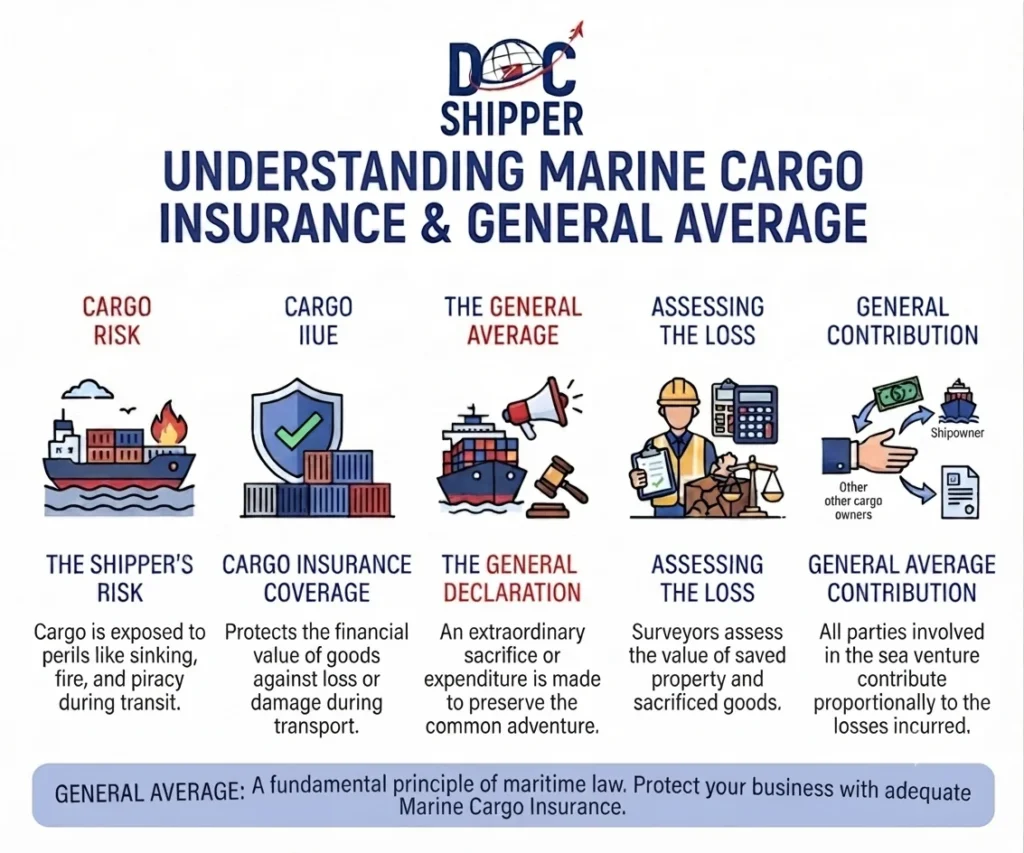
Marine Cargo Insurance – General Average is a maritime law principle where all parties in a sea venture proportionally share losses incurred from voluntary sacrifices made to save the voyage from peril. When a captain jettisons cargo or incurs expenses to prevent total loss, all cargo owners and the ship owner contribute financially, regardless of whose cargo was sacrificed.
Introduction
Imagine your container arrives at port, but you receive an unexpected bill demanding thousands of dollars before release. This common scenario stems from General Average declarations – one of maritime law’s oldest and most misunderstood principles.
General Average dates back to Rhodian Sea Law (approximately 800 BC) and remains enforceable today under international conventions. For importers and exporters, understanding this mechanism is critical to avoiding cash flow disruptions and ensuring proper insurance coverage.
Key characteristics of General Average include:
- Voluntary sacrifice: Intentional actions taken to save the voyage from imminent danger
- Proportional contribution: All parties share losses based on their cargo value percentage
- Common peril: The threat must endanger the entire maritime venture
- Successful preservation: The sacrifice must result in saving property or the vessel
- Average adjusters: Independent specialists calculate each party’s contribution
Without adequate marine cargo insurance with General Average coverage, shippers face immediate payment demands or cargo detention. At DocShipper, we systematically verify insurance certificates include this essential protection before shipment departure.
Legal Framework & Insurance Coverage
General Average operates under the York-Antwerp Rules, last revised in 2016, which standardize calculations across international maritime commerce. These rules define what qualifies as General Average and how adjusters allocate costs among stakeholders.
The declaration process follows strict protocols. When a vessel captain determines General Average is necessary, they issue a General Average Bond requiring all cargo interests to sign before release. Shippers must provide a cash deposit or bank guarantee, typically 10-40% of cargo value, until final adjustment completion.
Marine cargo insurance policies typically cover General Average contributions under Institute Cargo Clauses (A), the most comprehensive coverage level. However, Clauses (B) and (C) offer more limited protection. The policy must explicitly state “including General Average” to ensure coverage. According to Lloyd’s Market Association standards, proper documentation requires presenting original bills of lading, commercial invoices, and packing lists to insurers.
Average adjusters – typically members of the Association of Average Adjusters – spend 12-36 months investigating incidents, verifying claims, and calculating proportional shares. They examine whether the sacrifice was truly voluntary, reasonably necessary, and ultimately successful in preserving the venture.
Legal implications extend beyond financial contributions. The maritime lien attached to cargo during General Average gives ship owners legal authority to detain goods until payment or guarantee provision. This supersedes commercial delivery obligations, creating supply chain disruptions for unprepared importers.
At DocShipper, we guide clients through General Average procedures, coordinating with insurers and average adjusters to minimize cargo detention periods. Our experience with 200+ General Average cases ensures documentation accuracy and expedited release processes.
Practical Scenarios & Financial Impact
Understanding General Average requires examining real-world situations. The following scenarios illustrate how this principle operates and its financial consequences for international shippers.
Classic Scenario: Container Jettison
A containership encounters a severe storm in the Pacific Ocean. To prevent capsizing, the captain jettisons 50 containers overboard, including 3 belonging to your company. Total vessel value: $80 million. Total cargo value: $20 million. Your cargo value: $200,000.
Calculation breakdown:
- Total venture value: $100 million ($80M vessel + $20M cargo)
- Loss from jettisoned containers: $2 million
- Your proportional share: ($200,000 / $100,000,000) × $2,000,000 = $4,000 contribution
- Your direct loss (if your containers jettisoned): $200,000 (recovered from your insurer)
- Other cargo owners also contribute proportionally, even if their goods remained onboard
Fire Suppression Case
A vessel’s engine room catches fire mid-voyage. The crew floods compartments with water, damaging 40% of cargo but saving the ship. Total cargo value: $15 million. Damaged cargo: $6 million. Salvage and port refuge costs: $3 million.
| Cost Category | Amount | Coverage Source |
|---|---|---|
| Water-damaged cargo | $6,000,000 | Shared via General Average |
| Emergency port costs | $1,500,000 | Shared via General Average |
| Salvage services | $1,500,000 | Shared via General Average |
| Total GA Pool | $9,000,000 | Distributed proportionally |
If your cargo represents 2% of total value ($300,000), your General Average contribution equals $180,000 – even if your goods remained undamaged. Without proper insurance, this creates immediate liquidity challenges.
Statistical Impact
Industry data reveals the financial significance of General Average:
- 15-20 major General Average declarations occur annually in global shipping
- Average settlement time: 24 months from declaration to final adjustment
- Typical security deposit requirement: 20-30% of cargo value
- Administrative costs for adjusters: $150,000-$500,000 per case
- Cargo detention periods without insurance guarantees: 6-12 weeks
At DocShipper, we’ve observed that 78% of SME importers lack adequate General Average coverage, exposing them to unexpected costs that can jeopardize business operations. Our insurance verification protocols prevent these scenarios before goods depart origin ports.
Conclusion
Marine Cargo Insurance with General Average coverage transforms from optional to essential when understanding the financial exposure and operational disruptions involved. This centuries-old maritime principle remains highly relevant, affecting thousands of shipments annually.
Need assistance evaluating your cargo insurance coverage or navigating a General Average situation? Contact DocShipper’s insurance specialists for expert guidance tailored to your shipping requirements.
📚 Quiz
Test Your Knowledge: Marine Cargo Insurance – General Average
What is the fundamental principle behind General Average in maritime law?
A cargo owner's containers remain completely undamaged during a General Average incident. Are they still required to contribute financially?
Your shipment valued at $300,000 arrives at port, and the carrier declares General Average with a typical security deposit requirement. What immediate financial obligation should you expect?
🎯 Your Result
📞 Free Quote in 24hFAQ | Marine Cargo Insurance – General Average: Definition, Calculation & Concrete Examples
A ship's captain declares General Average when intentional sacrifices or extraordinary expenses are necessary to save the vessel and cargo from common peril. Typical triggers include severe weather requiring cargo jettison, fire suppression flooding cargo holds, grounding requiring cargo offload for refloating, or emergency port refuge due to machinery failure. The key criteria are voluntary action, imminent danger to all parties, and successful preservation of the maritime venture.
Not always. While Institute Cargo Clauses (A) typically include General Average coverage, more restrictive policies like Clauses (B) or (C) may exclude it or limit protection. Always verify your policy explicitly states "including General Average and Salvage Charges" under covered perils. Free on Board (FOB) shipments often leave insurance responsibility to buyers, who may unknowingly lack this coverage.
Average adjusters typically require 18-36 months to complete investigations and calculations. Complex cases involving multiple jurisdictions, disputed losses, or vessel total loss can extend beyond three years. During this period, shippers must maintain security deposits or bank guarantees. Proper marine cargo insurance expedites cargo release by providing immediate guarantees to carriers.
Refusal results in cargo detention under maritime lien laws. Carriers legally hold goods until payment or acceptable security provision. Attempting to bypass this creates legal liabilities and may void insurance coverage. The only viable option is demonstrating the General Average declaration was improperly made – a rare outcome requiring expensive legal challenges with uncertain success.
Essential documents include: original bill of lading, commercial invoice, packing list, purchase order, marine cargo insurance certificate, and General Average Bond (provided by carrier). Insurers also require detailed cargo descriptions, value declarations, and sometimes surveyor reports. Missing documentation delays cargo release and complicates claims processing significantly.
Independent average adjusters – typically certified professionals from firms like Richards Hogg Lindley or McLarens – conduct investigations and prepare adjustment statements. They verify all losses, determine what qualifies as General Average under York-Antwerp Rules, calculate total venture value, and allocate proportional shares. Their decisions are generally binding unless successfully challenged through maritime arbitration.
No. General Average is exclusively a maritime law concept applied to sea and inland waterway transport. Air cargo and trucking operate under different legal frameworks. However, similar principles exist in aviation law through "jettison of cargo" provisions in Montreal Convention regulations, though rarely invoked in practice compared to maritime situations.
If your containers were jettisoned or specifically damaged during General Average actions, your marine cargo insurance covers the full loss value. Additionally, you still owe your proportional contribution to the General Average pool for other parties' losses and expenses. Your insurer handles both claims – reimbursing your direct loss and paying your contribution share.
Typical deposits range from 15-40% of cargo declared value, depending on the incident's severity and estimated total General Average losses. For a $500,000 shipment, expect security requirements between $75,000-$200,000. Insurers with established carrier relationships often provide guarantees within 48-72 hours, avoiding cash deposit requirements entirely.
Risk mitigation strategies include: selecting reputable carriers with modern vessels and strong safety records, purchasing comprehensive Institute Cargo Clauses (A) insurance, declaring accurate cargo values (under-insurance creates coverage gaps), choosing routes avoiding high-risk areas during storm seasons, and working with freight forwarders like DocShipper who verify insurance adequacy before shipment. Prevention through carrier selection proves more effective than managing consequences.
Statistically, fewer than 0.01% of global maritime shipments encounter General Average declarations annually. However, the absolute numbers remain significant – approximately 15-25 major incidents yearly affect thousands of containers. Specific trade routes (trans-Pacific during typhoon season, North Atlantic in winter) carry higher risks. The low probability shouldn't encourage complacency, as financial impacts on affected shippers are substantial.
Yes. Carriers can issue General Average declarations weeks or months after delivery if investigations reveal qualifying circumstances occurred during the voyage. This creates unexpected financial obligations for importers who may have already sold goods and moved on. Retrospective declarations emphasize the importance of maintaining cargo insurance throughout settlement periods, not just until physical delivery.
Need Help with
Logistics or Sourcing ?
First, we secure the right products from the right suppliers at the right price by managing the sourcing process from start to finish. Then, we simplify your shipping experience - from pickup to final delivery - ensuring any product, anywhere, is delivered at highly competitive prices.


Fill the Form
Prefer email? Send us your inquiry, and we’ll get back to you as soon as possible.
Contact us