


In short ⚡
A shipping container is a standardized steel box designed for intermodal freight transport, enabling seamless movement of goods across ships, trucks, and trains without unpacking. Regulated by ISO standards, containers revolutionized global trade by reducing handling costs, transit times, and cargo damage while ensuring universal compatibility across transport modes and infrastructure worldwide.
Introduction
Many importers struggle with selecting the right container type, leading to wasted space, damaged goods, or unexpected costs. Understanding container specifications is fundamental to optimizing logistics operations and maintaining competitive shipping rates.
Containers form the backbone of international trade, handling approximately 90% of global non-bulk cargo. Their standardization transformed supply chains by enabling door-to-door transport without intermediate handling, drastically reducing theft, damage, and labor costs.
- Standardization: ISO 668 defines dimensions ensuring global infrastructure compatibility
- Durability: Corten steel construction withstands saltwater, stacking, and extreme temperatures
- Versatility: Specialized variants accommodate refrigerated, oversized, or hazardous cargo
- Efficiency: Reduces port dwell time by 70% compared to break-bulk methods
- Security: Lockable steel doors with customs seals prevent tampering during transit
Container Types & Technical Specifications
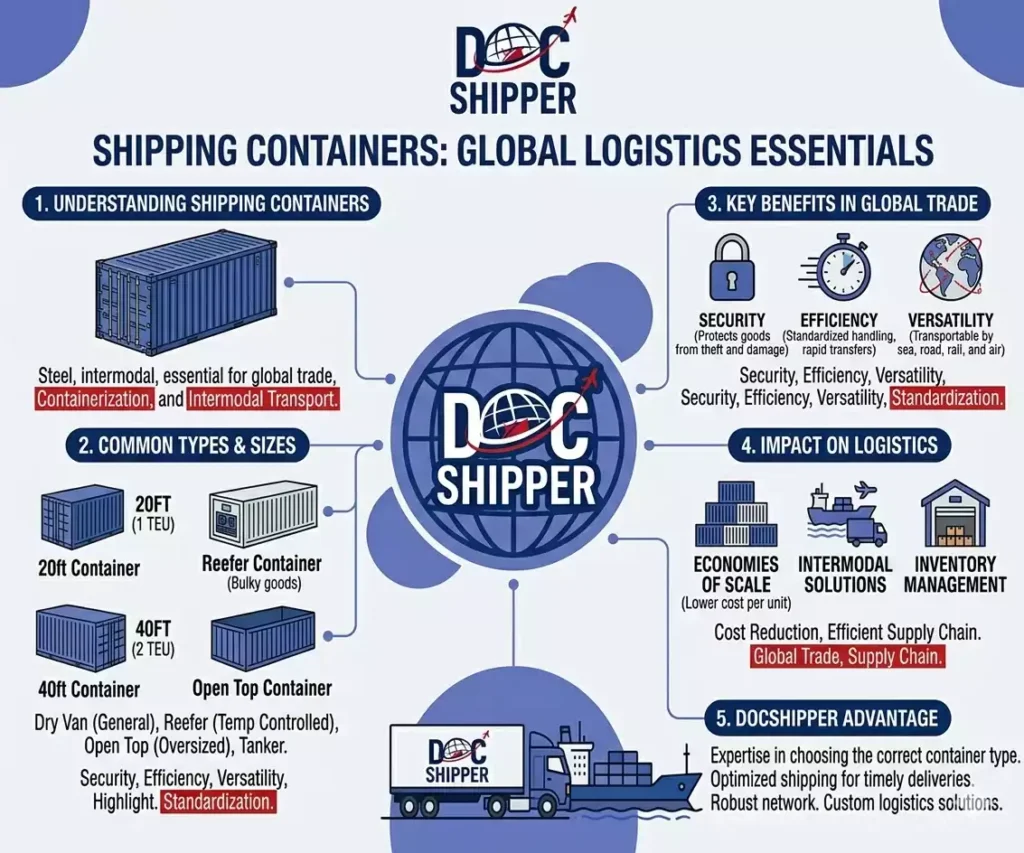
The dry van container represents 85% of global fleet volume, measuring 20 or 40 feet in length with internal dimensions of 5.90m (20′) or 12.03m (40′) length, 2.35m width, and 2.39m height. These general-purpose units handle palletized goods, cartons, and non-perishable products with payload capacities reaching 28,000 kg for 20′ and 26,500 kg for 40′ units due to structural weight differences.
Reefer containers maintain temperature-controlled environments from -30°C to +30°C using integrated refrigeration units, consuming 3-5 kW of power. The insulated walls reduce internal volume by approximately 10% compared to dry vans, making them essential for pharmaceuticals, perishables, and temperature-sensitive chemicals. According to IICL standards, reefers require pre-trip inspections (PTI) to verify refrigeration functionality before loading.
The high cube container adds 30cm of vertical space (2.69m internal height), increasing cubic capacity by 13% to accommodate lightweight, voluminous cargo like furniture or textiles. This variant has become standard for many trade lanes, representing 60% of new container production since 2015.
Open-top and flat-rack containers solve oversized cargo challenges through removable roofs or collapsible sides, enabling crane loading for machinery, vehicles, or construction materials exceeding standard door dimensions. Flat racks handle cargo up to 45 tons when properly secured with chains and lashing equipment.
At DocShipper, we systematically verify container condition reports (CCR) before booking, ensuring structural integrity, door functionality, and cleanliness standards that prevent cargo damage and customs delays. Our pre-shipment inspections identify issues like rust, holes, or contamination that could compromise your goods during ocean transit.
Practical Applications & Industry Data
Container selection directly impacts freight costs and cargo safety. A practical example illustrates this: shipping 500 cartons of electronics (each 60×40×40 cm, 15 kg) from Shanghai to Rotterdam.
| Container Type | Internal Volume | Cartons Capacity | Cost (USD) | Best Use Case |
|---|---|---|---|---|
| 20′ Dry Van | 33.2 m³ | ~520 cartons | 2,800 | Full container load (FCL) |
| 40′ High Cube | 76.3 m³ | ~1,200 cartons | 3,500 | Cost-efficient for volume |
| LCL (Shared) | 12 m³ space | 500 cartons | 1,850 | Small shipments |
This comparison reveals that while LCL appears cheaper, the per-cubic-meter rate ($154/m³) exceeds FCL rates ($84/m³ for 20′, $46/m³ for 40’HC). The break-even point typically occurs at 15 m³, beyond which FCL becomes economically advantageous despite paying for unused space.
Industry data from 2023 shows global container fleet reached 49.5 million TEU (twenty-foot equivalent units), with China manufacturing 95% of new units. Average container lifespan extends 12-15 years before retirement to secondary markets like construction site offices or storage solutions.
Detention and demurrage charges represent hidden costs many shippers overlook. Carriers typically allow 5-7 free days after port arrival; exceeding this incurs $75-150 daily fees per container. Proper planning and warehouse coordination prevent these penalties, which can exceed the ocean freight cost on delayed shipments.
Container weight verification became mandatory under SOLAS VGM regulations (2016), requiring shippers to provide verified gross mass before loading. Non-compliance results in port rejection, causing costly delays and rebooking fees averaging $500-800 per container.
Real-world scenario: A furniture importer shipping from Vietnam to Germany initially selected 3×20′ containers based on volume calculations. DocShipper’s optimization analysis revealed that 2×40’HC containers reduced total costs by 18% ($1,200 savings) while improving delivery speed by consolidating customs clearance procedures.
Conclusion
Mastering container selection transforms logistics from a cost center into a competitive advantage. Proper container choice balances cargo protection, space optimization, and cost efficiency while ensuring regulatory compliance across international borders.
Need expert guidance on container booking, customs clearance, or end-to-end logistics management? Contact DocShipper for tailored solutions that streamline your supply chain operations.
📚 Quiz
Test Your Knowledge: Shipping Container
Q1 — What is the primary purpose of a shipping container?
Q2 — A shipper believes that LCL (Less than Container Load) is always cheaper than FCL (Full Container Load). Is this correct?
Q3 — A furniture importer needs to ship lightweight, voluminous goods from Vietnam to Europe. Which container type is most appropriate?
🎯 Your Result
📞 Free Quote in 24hFAQ | Container (Shipping Container): Definition, Types & Practical Examples
TEU (Twenty-foot Equivalent Unit) measures container capacity using 20' containers as the baseline. FEU (Forty-foot Equivalent Unit) equals two TEUs. Port capacities and vessel sizes are quoted in TEU for standardized comparison across global terminals.
Yes, consolidating multiple product types in one container (known as mixed cargo) is common practice. Ensure proper segregation, labeling, and documentation for each commodity to facilitate customs clearance and prevent cross-contamination between incompatible goods.
Calculate total cubic meters (length × width × height of all packages) and compare against container internal volumes: 33 m³ for 20', 67 m³ for 40' standard, and 76 m³ for 40' high cube. Account for 10-15% void space for practical loading constraints.
Fumigation treats wooden packaging materials to eliminate pests per ISPM 15 standards. Required for shipments to countries like Australia, New Zealand, and the EU when using non-heat-treated wood pallets or crates. The process takes 24-48 hours and costs $150-300 per container.
Used containers meeting IICL standards (grades A-C) provide adequate protection for most cargo. Grade A units show minimal wear, while Grade C may have cosmetic damage but remain structurally sound. Always request a Container Condition Report before booking to verify watertightness and door functionality.
Overweight containers violate road safety regulations and incur penalties ranging from $500-5,000 depending on jurisdiction. Carriers reject loading, forcing re-palletization or splitting into multiple containers. Maximum gross weights are 24,000 kg (20') and 30,480 kg (40') including container tare weight.
Transit times average 25-35 days from East Asian ports to Northern European destinations via Suez Canal route. Factors affecting duration include vessel schedule, transshipment points, port congestion, and customs clearance efficiency. Express services reduce time to 18-22 days at premium rates.
Cargo insurance is highly recommended as carrier liability covers only $500 per package under Hague-Visby Rules. Comprehensive marine insurance costs 0.3-0.5% of cargo value and protects against total loss, damage, theft, and general average contributions during ocean transit.
Demurrage applies when containers remain at the port terminal beyond free time (typically 5-7 days), charged by the terminal operator. Detention occurs when containers leave the port but aren't returned empty within the agreed period, charged by the shipping line. Both incur daily fees of $75-150.
Yes, reefers can transport dry cargo when refrigeration units are switched off, though this practice is uncommon due to higher rental rates ($200-400 more than dry containers). Some carriers prohibit this to maintain reefer fleet availability for temperature-controlled shipments.
Essential documents include commercial invoice, packing list, bill of lading, certificate of origin, and import licenses where applicable. Additional requirements vary by country and commodity—pharmaceuticals need health certificates, electronics require conformity declarations, and food products demand phytosanitary certificates.
Rates depend on route, container type, season, fuel surcharges, and carrier. Base ocean freight is quoted per container (not weight), with additional charges for documentation ($50-100), seal fees ($15-30), VGM certification ($25-50), and destination handling. Peak season (August-October) rates increase 30-50% on major trade lanes.
Need Help with
Logistics or Sourcing ?
First, we secure the right products from the right suppliers at the right price by managing the sourcing process from start to finish. Then, we simplify your shipping experience - from pickup to final delivery - ensuring any product, anywhere, is delivered at highly competitive prices.


Fill the Form
Prefer email? Send us your inquiry, and we’ll get back to you as soon as possible.
Contact us




:%20Definition,%20Types%20&%20Practical%20Examples)