


In short ⚡
Commodity rate is a specialized freight pricing structure applied to specific goods or product categories, offering standardized rates based on the nature, volume, and handling requirements of the commodity being shipped. Unlike general cargo rates, commodity rates provide optimized pricing for homogeneous shipments.
Introduction
Many importers struggle with unpredictable shipping costs that vary wildly between shipments. The confusion often stems from not understanding how carriers price different types of cargo.
Commodity rates represent a critical pricing mechanism in international logistics. They enable businesses to secure consistent, predictable freight costs for regular shipments of specific goods.
- Product-specific pricing: Rates tailored to particular commodity classifications rather than generic cargo categories
- Volume-based advantages: Lower per-unit costs for shippers moving consistent quantities of the same commodity
- Standardized handling: Pricing reflects the specific loading, storage, and transport requirements of each commodity type
- Contract stability: Fixed rates over defined periods, protecting against market fluctuations
- Classification systems: Based on harmonized tariff codes and commodity groupings recognized across carriers
Understanding Commodity Rates in Freight Logistics
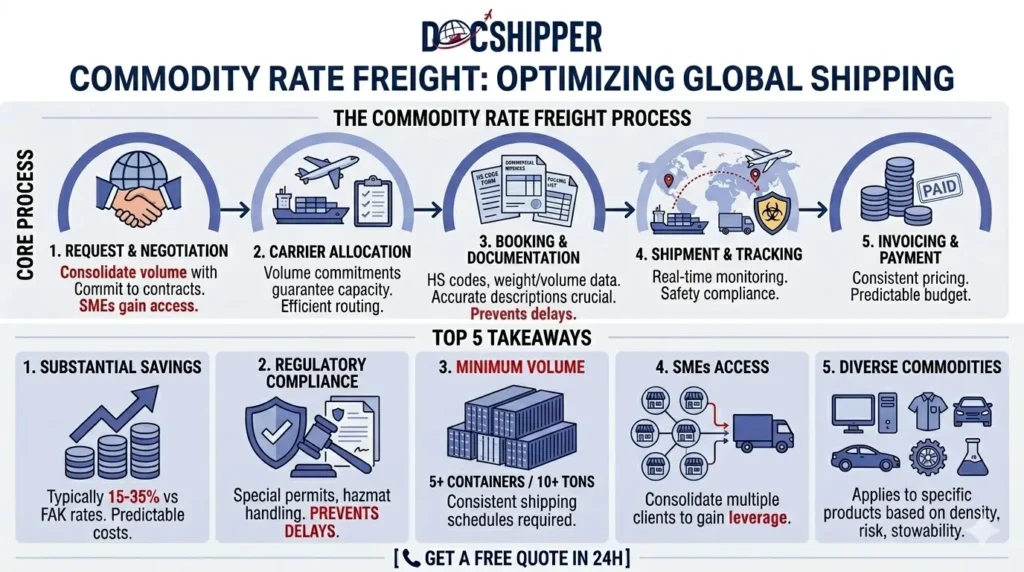
Commodity rates function as negotiated agreements between shippers and carriers for specific product categories. These rates differ fundamentally from general cargo rates (FAK – Freight All Kinds) which apply uniform pricing regardless of cargo type.
The classification basis typically follows the National Motor Freight Classification (NMFC) in North America or similar systems internationally. Each commodity receives a class number based on density, stowability, handling characteristics, and liability factors.
Carriers establish commodity rates through tariff publications or individual contracts. Published commodity rates appear in carrier tariffs accessible to all shippers, while contract rates remain confidential agreements between specific parties. According to the International Chamber of Commerce, contract commodity rates typically offer 15-40% savings compared to published rates for consistent shippers.
The calculation methodology incorporates multiple factors: base transportation cost, fuel surcharges, accessorial charges specific to the commodity (refrigeration, hazmat handling), and seasonal adjustments. Unlike weight-based pricing alone, commodity rates consider the entire cost structure associated with moving that specific product type.
Regulatory compliance plays a crucial role in commodity rate structures. Certain commodities require special documentation, permits, or handling procedures that influence pricing. At DocShipper, we systematically verify commodity classifications and applicable regulations to ensure accurate rate applications and prevent unexpected charges during customs clearance.
Practical Applications & Cost Comparisons
Understanding commodity rates through real-world scenarios demonstrates their financial impact on import/export operations.
| Pricing Type | Commodity Rate | General Cargo Rate | Savings |
|---|---|---|---|
| Electronics (10 pallets, Shanghai-LA) | $3,200 | $4,500 | 28.9% |
| Textiles (FCL 40′, Mumbai-Hamburg) | $2,100 | $2,800 | 25% |
| Automotive Parts (LCL 5 CBM, Tokyo-Rotterdam) | $850 | $1,150 | 26.1% |
| Chemicals (Hazmat, 8 pallets, Houston-Antwerp) | $4,200 | $5,900 | 28.8% |
Use Case Example: A furniture importer shipping 15 containers monthly from Vietnam to the US East Coast negotiated a commodity rate of $2,300 per FEU (Forty-foot Equivalent Unit) versus the general rate of $3,100. Annual savings: ($3,100 – $2,300) × 180 containers = $144,000.
Key qualification criteria for obtaining favorable commodity rates include:
- Minimum monthly volume commitments (typically 5+ containers or 10+ tons)
- Consistent shipping schedules allowing carrier capacity planning
- Single commodity classification reducing handling complexity
- Established credit history and payment reliability
- Long-term contract commitments (6-12 months minimum)
DocShipper leverages consolidated volume across multiple clients to negotiate preferential commodity rates that individual shippers cannot access independently, particularly beneficial for SMEs entering international markets.
Conclusion
Commodity rates provide substantial cost optimization opportunities for businesses shipping consistent product types internationally. Understanding classification systems and negotiation leverage transforms freight costs from variable expenses into predictable budget items.
Need assistance optimizing your freight rates or navigating commodity classifications? Contact DocShipper for expert guidance tailored to your specific shipping requirements.
📚 Quiz
Test Your Knowledge: Commodity Rate
Q1 — What best defines a commodity rate in freight logistics?
Q2 — A shipper assumes that commodity rates include customs duties and taxes in the total price. Is this correct?
Q3 — A small furniture importer ships 15 containers per month from Vietnam to the US East Coast. Which approach would most likely give them access to favorable commodity rates?
🎯 Your Result
📞 Free Quote in 24hFAQ | Commodity Rate: Definition, Calculation & Practical Examples
Commodity rates apply to specific products with negotiated pricing, while class rates use standardized freight classifications (NMFC classes 50-500) with published tariffs. Commodity rates typically offer better pricing for regular shippers of particular goods.
Carriers analyze density, handling requirements, liability risk, stowability, market demand, lane competitiveness, and shipper volume commitments. Rates reflect the total cost-to-serve for that specific commodity type including specialized equipment or procedures.
Yes, though minimum volume thresholds apply. Freight forwarders like DocShipper consolidate shipments from multiple clients to achieve volume requirements, enabling SMEs to benefit from commodity rate pricing otherwise available only to large shippers.
Commodity rates include fixed base components plus variable elements like fuel surcharges (BAF/CAF), currency adjustment factors, and seasonal peak charges. Contract terms specify which components remain stable and which fluctuate with market conditions.
Typically requires commercial invoice showing commodity description, HS codes, packing list, volume/weight data, and shipping history demonstrating consistency. Hazardous commodities need MSDS, certifications, and compliance documentation affecting rate structures.
Standard contracts run 6-12 months with quarterly review clauses. Spot commodity rates exist for single shipments but lack the stability of contracted rates. Longer commitments (24+ months) may secure additional discounts but reduce flexibility.
Yes, airlines publish commodity-specific rates for categories like perishables, pharmaceuticals, electronics, and general cargo. Air commodity rates often show greater variance than ocean rates due to capacity constraints and faster market response times.
Most contracts include commodity substitution clauses allowing limited flexibility within similar classifications. Significant changes typically require rate renegotiation. Freight forwarders can manage mixed commodity shipments under blended rate structures.
For consistent shippers of specific products, commodity rates typically provide 15-35% savings versus FAK. However, FAK rates offer simplicity and flexibility for diverse cargo mixes. The optimal choice depends on shipping patterns and product consistency.
Consolidate volumes, commit to longer contracts, provide accurate forecasts, maintain payment reliability, and leverage multi-lane opportunities. Working with experienced freight forwarders provides access to pre-negotiated carrier contracts and market intelligence.
No, commodity rates cover transportation costs only. Customs duties, taxes, and clearance fees are separate charges based on HS classification, origin, and destination country regulations. Always calculate total landed costs including all duty and tax components.
Yes, tiered pricing structures often apply additional discounts as volume thresholds increase. For example, a base commodity rate might reduce 5% at 20 containers monthly, 10% at 50 containers, creating compounding savings for high-volume shippers.
Need Help with
Logistics or Sourcing ?
First, we secure the right products from the right suppliers at the right price by managing the sourcing process from start to finish. Then, we simplify your shipping experience - from pickup to final delivery - ensuring any product, anywhere, is delivered at highly competitive prices.


Fill the Form
Prefer email? Send us your inquiry, and we’ll get back to you as soon as possible.
Contact us




