


In short ⚡
A draft is a negotiable financial instrument used in international trade where one party instructs another to pay a specified sum to a third party on demand or at a predetermined date. It serves as a payment order that facilitates secure transactions between buyers and sellers across borders, particularly when trust is limited or credit terms are required.
Introduction
In international trade, payment security remains one of the most critical concerns for both exporters and importers. The draft system addresses this challenge by creating a formal payment obligation that protects both parties’ interests.
Unlike simple purchase orders or invoices, drafts create legally binding payment commitments. They’re particularly vital when shipments cross multiple jurisdictions, currencies fluctuate, or parties lack established business relationships.
Key characteristics of drafts include:
- Transferability: Can be endorsed and transferred to third parties
- Legal enforceability: Creates formal payment obligations under commercial law
- Flexibility: Available in sight (immediate) or time (deferred) payment formats
- Risk mitigation: Reduces non-payment risks in cross-border transactions
- Financing capability: Can be discounted or used as collateral for trade finance
Draft Mechanisms & Trade Finance Expertise
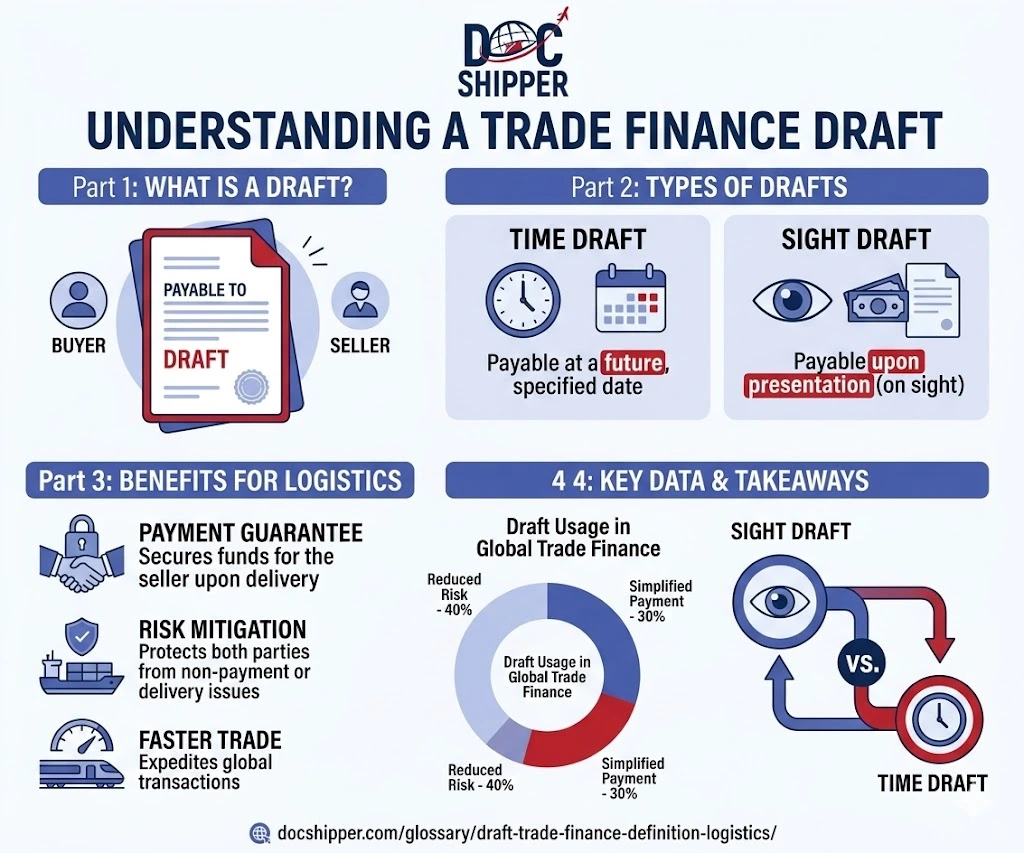
The draft system operates through a structured process involving three primary parties: the drawer (typically the seller), the drawee (usually the buyer or their bank), and the payee (the party receiving payment).
Two fundamental types dominate international commerce. A sight draft requires immediate payment upon presentation, typically used when goods are ready for delivery and the seller demands instant settlement. Conversely, a time draft specifies a future payment date, often 30, 60, or 90 days after presentation, allowing buyers working capital flexibility.
The acceptance process transforms a draft’s legal status. When a drawee formally accepts a time draft by signing it, the instrument becomes a banker’s acceptance (if accepted by a bank) or trade acceptance (if accepted by the buyer). This acceptance converts the draft into an unconditional payment obligation.
Documentary collections under URC 522 rules govern most draft transactions. The International Chamber of Commerce established these uniform rules to standardize procedures globally. Banks act as intermediaries, handling document exchange without assuming payment risk (unlike letters of credit).
Drafts integrate with other trade instruments. When combined with letters of credit, they provide maximum security. The LC guarantees payment if documents comply with terms, while the draft specifies exact payment mechanics. According to ICC banking commission data, approximately 35% of documentary credits involve time drafts for deferred payment.
At DocShipper, we systematically verify draft documentation against shipping documents to prevent discrepancies that could delay payment or create disputes. Our logistics coordinators ensure that bill of lading dates, invoice amounts, and draft terms align perfectly before document presentation.
Practical Examples & Trade Data
Understanding drafts through concrete scenarios clarifies their practical application in global supply chains. Consider these representative cases:
Use Case: Electronics Importer from China
A French retailer orders €180,000 worth of consumer electronics from a Shenzhen manufacturer. Without established credit history, the parties agree on a documentary collection with a 60-day time draft.
Transaction flow: The Chinese exporter ships goods and presents documents (commercial invoice, packing list, bill of lading) to their bank along with a time draft drawn on the French buyer. The Chinese bank forwards documents to the French buyer’s bank. Upon receiving documents, the French buyer accepts the draft, acknowledging the obligation to pay in 60 days. The Chinese exporter can immediately discount the accepted draft with their bank at approximately 4-6% discount rate, receiving €173,000-€175,000 immediately while the buyer maintains cash flow for two months.
Comparative Analysis: Payment Methods
| Payment Method | Seller Risk | Buyer Risk | Typical Cost | Processing Time |
|---|---|---|---|---|
| Advance Payment | Very Low | Very High | Wire fees only (~$25-50) | 1-3 days |
| Documentary Collection (Draft) | Medium | Medium | 0.5-1.5% of value | 5-10 days |
| Letter of Credit | Very Low | Low | 2-5% of value | 7-15 days |
| Open Account | Very High | Very Low | No banking fees | 30-90 days |
Industry Statistics & Trends
Global trade finance data reveals shifting draft utilization patterns. According to the Asian Development Bank, documentary collections represented 9% of trade finance methods in 2023, down from 14% in 2015. This decline reflects increased trust in digital payment platforms and established trading relationships.
However, drafts remain dominant in specific sectors. Agricultural commodities trading continues using time drafts in over 40% of transactions, particularly for grains and oilseeds where seasonal payment cycles align with harvest periods. Similarly, machinery and capital equipment exports frequently employ 90-180 day time drafts, allowing buyers to generate revenue before payment becomes due.
Key Practical Considerations
- Currency designation: Always specify the draft currency explicitly to avoid conversion disputes
- Acceptance location: Clearly identify where the draft should be presented for acceptance or payment
- Protest provisions: Include instructions for protesting non-payment if required by local law
- Document requirements: List all accompanying documents precisely (commercial invoice, certificate of origin, inspection certificate)
- Delivery instructions: Specify whether documents should be released against acceptance (D/A) or payment (D/P)
Conclusion
Drafts remain a cornerstone instrument in international trade, balancing payment security with financing flexibility. Their structured approach reduces transaction risks while accommodating diverse commercial needs across industries and geographies.
Need guidance on implementing drafts in your import/export operations? Contact DocShipper for expert support on payment terms and documentary requirements.
📚 Quiz
Test Your Knowledge: Draft in International Trade
1. What is the primary function of a draft in international trade?
2. What's the key difference between D/P (Documents against Payment) and D/A (Documents against Acceptance) terms?
3. A French importer receives a 60-day time draft for €100,000 from a Chinese supplier. The importer accepts the draft but needs the goods immediately. What is the best course of action?
🎯 Your Result
📞 Free Quote in 24hFAQ | Draft: Definition, Types & Practical Examples in International Trade
These terms are essentially synonymous. "Draft" is more commonly used in American English, while "bill of exchange" predominates in British Commonwealth countries and international banking conventions. Both refer to the same negotiable instrument—a written order directing one party to pay another. The Uniform Commercial Code (UCC) in the US and the Bills of Exchange Act in the UK govern these instruments under slightly different legal frameworks, but their commercial function remains identical.
Absolutely. Documentary collections using drafts operate independently of letters of credit. In a collection, banks handle document transmission and payment collection but don't guarantee payment. This makes collections significantly cheaper (0.5-1.5% vs 2-5% for LCs) but transfers non-payment risk to the seller. Many established trading partners prefer this method for its cost efficiency and simplified documentation. Collections suit transactions where some trust exists but parties still want banking intermediation for document handling.
Discounting converts a time draft into immediate funds at a reduced amount. After the buyer accepts your time draft, approach your bank or a specialized trade finance institution. They'll purchase the draft at a discount rate (typically 4-8% annually, prorated to the remaining days). For a 60-day draft worth $100,000, you might receive $98,500-$99,000 immediately. The discount rate depends on the accepting party's creditworthiness, prevailing interest rates, and your banking relationship. Major exporters often establish discounting facilities with their banks for routine access to this working capital tool.
Refusal triggers specific legal procedures. For sight drafts, non-payment means the presenting bank returns documents to the seller, who retains title to goods. For time drafts, non-acceptance means no payment obligation exists—documents return and the seller can redirect goods or negotiate new terms. If a draft was accepted but remains unpaid at maturity, the holder can legally "protest" the draft (a formal notarized declaration of non-payment) establishing grounds for legal action. Most jurisdictions allow the holder to pursue the drawer, all endorsers, and the drawee for payment. Insurance products like export credit insurance can mitigate these risks.
Yes, electronic drafts (e-drafts) are legally recognized in most jurisdictions under electronic commerce laws. The UNCITRAL Model Law on Electronic Transferable Records provides a framework adopted by numerous countries. However, practical adoption remains limited—only about 15-20% of international drafts are fully electronic as of 2024. The ICC's eUCP supplement addresses electronic presentations under documentary credits. Banks require specific software compatibility and digital signature protocols. While paper drafts still dominate, the industry is gradually transitioning as blockchain-based trade finance platforms gain regulatory approval and interbank acceptance.
While no absolute legal maximum exists, commercial practice and banking regulations impose practical limits. Most banks won't accept time drafts exceeding 180 days (six months) without special approval. Usance periods of 30, 60, 90, or 120 days are standard. Longer tenors face several challenges: higher discount rates, increased credit risk, potential currency volatility, and regulatory capital requirements for banks. For capital equipment or project-based transactions requiring extended payment terms, buyers typically use structured finance facilities or installment letters of credit rather than single long-tenor drafts.
Currency risk impacts time drafts significantly. If you issue a 90-day draft in a foreign currency, exchange rate movements during those three months directly affect the final amount received in your home currency. For example, a €100,000 draft might equal $108,000 when drawn but only $103,000 at maturity if the euro weakens. Exporters commonly hedge this risk through forward contracts, locking in exchange rates when drawing the draft. Some sophisticated traders include currency adjustment clauses in sales contracts, though this shifts risk to the buyer. Banker's acceptances in major currencies (USD, EUR, GBP) generally offer more stable discounting rates.
Yes, transferability is a defining characteristic of drafts as negotiable instruments. The original payee can endorse the draft (sign on the back) and transfer it to another party, who becomes the new holder. This endorsement chain creates sequential liability—each endorser guarantees payment if subsequent parties default. Banks frequently purchase endorsed drafts through discounting. Supply chain finance programs leverage this feature, with factors or forfaiters buying receivables represented by accepted drafts. However, some drafts are marked "non-negotiable" or "not to order," restricting transferability to the named payee only. Always check draft wording before attempting transfer.
Standard document sets include: commercial invoice (describing goods and price), transport document (bill of lading, air waybill, or truck receipt proving shipment), packing list (detailing cargo contents), and insurance certificate (if terms require seller-arranged insurance). Additional documents depend on product and destination: certificate of origin (proving manufacturing location for customs/tariffs), inspection certificates (third-party quality verification), phytosanitary certificates (for agricultural products), and conformity certificates (proving regulatory compliance). The collection order specifies exact documents required. Missing or discrepant documents give buyers grounds to refuse acceptance, so meticulous document preparation is critical.
These abbreviations define when importers receive shipping documents. D/P (Documents against Payment) means the bank releases documents only after the importer pays a sight draft or provides confirmed payment arrangements. This protects exporters but requires importers to pay before inspecting goods. D/A (Documents against Acceptance) means the bank releases documents immediately after the importer accepts a time draft, acknowledging the obligation to pay later (typically 30-180 days). D/A gives importers possession and use of goods before payment but increases exporter risk. D/A is essentially a short-term credit extension, while D/P maintains stricter payment control.
Incoterms define delivery obligations and cost/risk transfer points but don't specify payment methods—that's where drafts enter. However, Incoterms influence draft documentation requirements. Under FOB terms, the exporter's obligations end when goods cross the ship's rail, so the draft typically accompanies a "clean on board" bill of lading. CIF terms require the exporter to arrange insurance and freight, so drafts include insurance certificates and prepaid freight receipts. EXW terms with drafts create complexity—buyers typically arrange transport, so coordinating document flow through banking channels requires careful structuring. Modern practice often combines DDP/DAP terms with sight drafts for maximum buyer convenience.
While legally permissible, drafts are uncommon in domestic trade where alternative payment methods (checks, ACH transfers, credit terms) are simpler and cheaper. Domestic drafts occasionally appear in three scenarios: high-value machinery sales requiring structured payment schedules, agricultural commodity transactions following traditional seasonal patterns, and situations where parties want bank intermediation without full LC expense. However, domestic documentary collections lack the cost justification of international transactions. Most businesses find purchase orders, invoices, and standard payment terms adequate for domestic deals. Drafts domestically signal either industry tradition (grain trading) or unusual credit concerns.
Need Help with
Logistics or Sourcing ?
First, we secure the right products from the right suppliers at the right price by managing the sourcing process from start to finish. Then, we simplify your shipping experience - from pickup to final delivery - ensuring any product, anywhere, is delivered at highly competitive prices.


Fill the Form
Prefer email? Send us your inquiry, and we’ll get back to you as soon as possible.
Contact us




