


In short ⚡
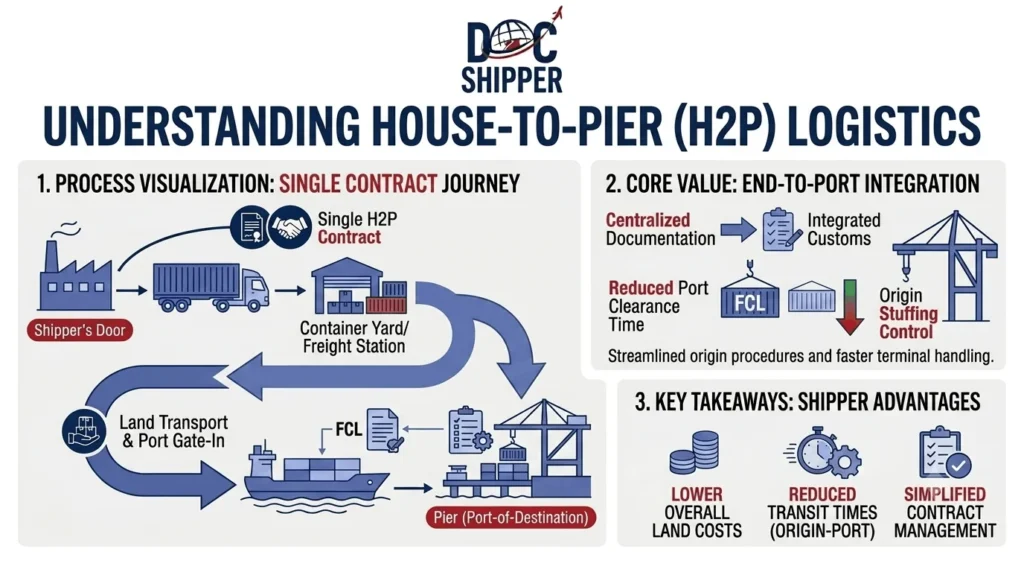
House to Pier refers to a shipping service where cargo is collected directly from the shipper's premises (house) and transported to the designated port terminal (pier) for export. This door-to-port logistics solution eliminates the need for shippers to arrange separate inland transportation, streamlining the export process through consolidated pickup, documentation handling, and customs clearance coordination.
Introduction
Many exporters struggle with coordinating multiple service providers for inland transport, port delivery, and customs formalities. The fragmentation of logistics responsibilities often leads to delays, miscommunication, and unexpected costs.
House to Pier service addresses this complexity by offering integrated logistics from origin to port. This approach is particularly valuable for businesses lacking dedicated logistics departments or those shipping to international markets regularly.
Key characteristics of House to Pier services include:
- Direct pickup from manufacturer, warehouse, or commercial address
- Consolidated documentation including commercial invoice, packing list, and export declarations
- Customs clearance coordination at the export port
- Container loading supervision (for FCL shipments) or cargo consolidation (for LCL)
- Delivery to CY/CFS (Container Yard or Container Freight Station) at the specified pier
House to Pier Process & Logistics Framework
The House to Pier operation involves multiple coordinated steps. Understanding this framework helps exporters optimize timing and avoid common pitfalls.
The process begins with cargo pickup scheduling. The freight forwarder coordinates with the shipper to determine optimal collection times, considering production schedules and vessel cutoff dates. For temperature-sensitive or fragile goods, specialized vehicles may be required.
Next comes pre-carriage transportation. This inland leg uses trucks, rail, or barge depending on distance and cargo type. The forwarder selects routes that balance cost-efficiency with transit time requirements. Cargo remains under the forwarder’s responsibility throughout this phase.
Export customs clearance represents a critical juncture. The forwarder submits required documentation to customs authorities, including commercial invoices, certificates of origin, and any special permits. For goods subject to export controls, additional licenses must be obtained. At DocShipper, we systematically verify all export documentation to prevent clearance delays that could result in missed vessel departures.
The container stuffing or consolidation stage differs based on shipment size. Full Container Load (FCL) shipments undergo stuffing at the shipper’s premises or a nearby facility, with forwarders ensuring proper weight distribution and cargo securing. Less than Container Load (LCL) shipments move to a consolidation warehouse where they’re combined with other exporters’ cargo.
Finally, pier delivery and handover completes the service. The container or cargo arrives at the Container Yard within the port’s required timeframe, typically 24-48 hours before vessel departure. The forwarder provides the terminal with delivery orders and receives gate-in receipts confirming acceptance. According to World Customs Organization standards, proper documentation at this stage is essential for seamless vessel loading.
Real-World Applications & Cost Comparisons
House to Pier services demonstrate significant value across different shipping scenarios. Examining concrete examples reveals how this model reduces complexity and total landed costs.
Case Study: Electronics Manufacturer in Shenzhen to Hamburg Port
A mid-sized electronics company ships 15 CBM of products monthly from their Shenzhen factory to Hamburg. Previously, they hired local trucking separately and managed customs clearance independently.
| Service Component | Self-Arranged | House to Pier Service |
|---|---|---|
| Factory to Port Trucking | $180 | Included |
| Customs Broker Fee | $120 | Included |
| Documentation Handling | $85 | Included |
| Container Drayage | $150 | Included |
| Total Cost | $535 | $420 |
| Time to Port | 3-4 days | 1-2 days |
The consolidated service saved $115 per shipment (21.5% reduction) while halving transit time. Over 12 months, this represented $1,380 in direct savings plus reduced inventory carrying costs.
Sector-Specific Applications:
Automotive parts exporters benefit from House to Pier services when shipping to multiple international assembly plants. Coordinated pickup ensures just-in-time delivery alignment with production schedules.
Fashion and apparel companies use these services during seasonal peaks. Direct factory pickup allows manufacturers to ship immediately after quality inspections, reducing warehouse storage requirements.
Perishable goods suppliers rely on temperature-controlled House to Pier services. Integrated cold chain management from farm or processing facility to refrigerated containers minimizes quality degradation. DocShipper’s cold chain specialists monitor temperature logs throughout the entire pre-carriage phase to ensure compliance with international food safety standards.
Small and medium enterprises (SMEs) particularly value this model. Without dedicated logistics staff, SMEs gain access to professional freight management without maintaining in-house expertise. A typical SME exporter reduces administrative burden by approximately 60% when switching to House to Pier arrangements.
Conclusion
House to Pier services transform export logistics from a multi-vendor coordination challenge into a streamlined single-point-of-contact solution. By consolidating pickup, transportation, documentation, and customs clearance, exporters reduce costs while improving reliability and speed.
Need expert guidance on optimizing your export logistics? Contact DocShipper for a customized House to Pier solution tailored to your shipping requirements.
📚 Quiz
Test Your Knowledge: House to Pier
What is the primary scope of House to Pier shipping service?
A textile exporter believes House to Pier service includes ocean freight costs. Is this interpretation correct?
An electronics manufacturer ships 15 CBM monthly and currently manages trucking, customs clearance, and documentation separately. Which scenario best applies House to Pier service benefits?
🎯 Your Result
📞 Free Quote in 24hFAQ | House to Pier: Definition, Process & Practical Examples
House to Pier covers transport from the shipper's location to the export port only. Door to Door extends through ocean freight, import customs clearance, and final delivery to the consignee's address. House to Pier responsibility ends when cargo enters the port terminal, while Door to Door includes the complete international journey.
The shipper typically arranges cargo insurance unless the freight forwarder offers integrated insurance services. Standard carrier liability covers only limited loss or damage amounts. Comprehensive marine cargo insurance should cover the entire journey from factory to final destination, not just the House to Pier segment.
Yes, forwarders can coordinate multi-stop pickups when cargo originates from different suppliers or warehouses. This requires advance planning to optimize routing and ensure all cargo arrives at the consolidation point or port within required timeframes. Additional fees may apply for multiple pickup addresses.
For standard shipments, booking 5-7 business days before desired pickup allows sufficient time for vehicle allocation and documentation preparation. Peak season or specialized cargo (hazardous materials, oversized items) requires 10-14 days advance notice. Last-minute bookings are possible but may incur premium charges.
Essential documents include commercial invoice, packing list, and any product-specific certificates (origin certificates, phytosanitary certificates, etc.). The freight forwarder uses these to prepare export declarations and customs documentation. Incomplete documentation is the primary cause of House to Pier service delays.
For FCL shipments, most forwarders include loading supervision to ensure proper weight distribution and cargo securing. LCL shipments undergo professional consolidation at the forwarder's warehouse. Loading reports with photos are standard practice for high-value goods or when requested by the shipper.
Missing cutoff typically requires rebooking on the next available sailing, incurring additional port storage fees and potential detention charges for the container. Reputable House to Pier providers build buffer time into schedules. At DocShipper, we monitor real-time traffic conditions and adjust pickup times proactively to avoid missed sailings.
Restrictions depend on local road regulations and port equipment capabilities. Standard trucks handle up to 24-28 tons and containers up to 40 feet. Oversized or overweight cargo requires special permits and equipment, which the forwarder arranges. Always disclose exact dimensions and weights during booking.
If customs selects cargo for physical inspection, the forwarder coordinates with authorities and notifies the shipper immediately. Additional fees may apply for storage during examination. Experienced forwarders maintain customs compliance records that reduce examination frequency compared to shippers with irregular export histories.
Most modern forwarders offer GPS tracking for inland transport and milestone updates (pickup confirmed, customs cleared, gate-in at port). Real-time visibility varies by provider. Premium services include photo documentation at each stage and immediate notification of any exceptions or delays.
Key pricing variables include distance from pickup to port, cargo volume and weight, special handling requirements (temperature control, hazardous materials), customs complexity, and market demand. Fuel surcharges and peak season premiums may also apply. Consolidating multiple shipments or establishing regular shipping patterns typically secures better rates.
Yes, the same principle applies to air exports, where cargo moves from the shipper's facility to the airport cargo terminal. Air freight House to Pier services often include additional security screening coordination and IATA dangerous goods compliance when applicable. Transit times are shorter but handling fees at airports are typically higher than seaports.
Need Help with
Logistics or Sourcing ?
First, we secure the right products from the right suppliers at the right price by managing the sourcing process from start to finish. Then, we simplify your shipping experience - from pickup to final delivery - ensuring any product, anywhere, is delivered at highly competitive prices.


Fill the Form
Prefer email? Send us your inquiry, and we’ll get back to you as soon as possible.
Contact us




