


In short ⚡
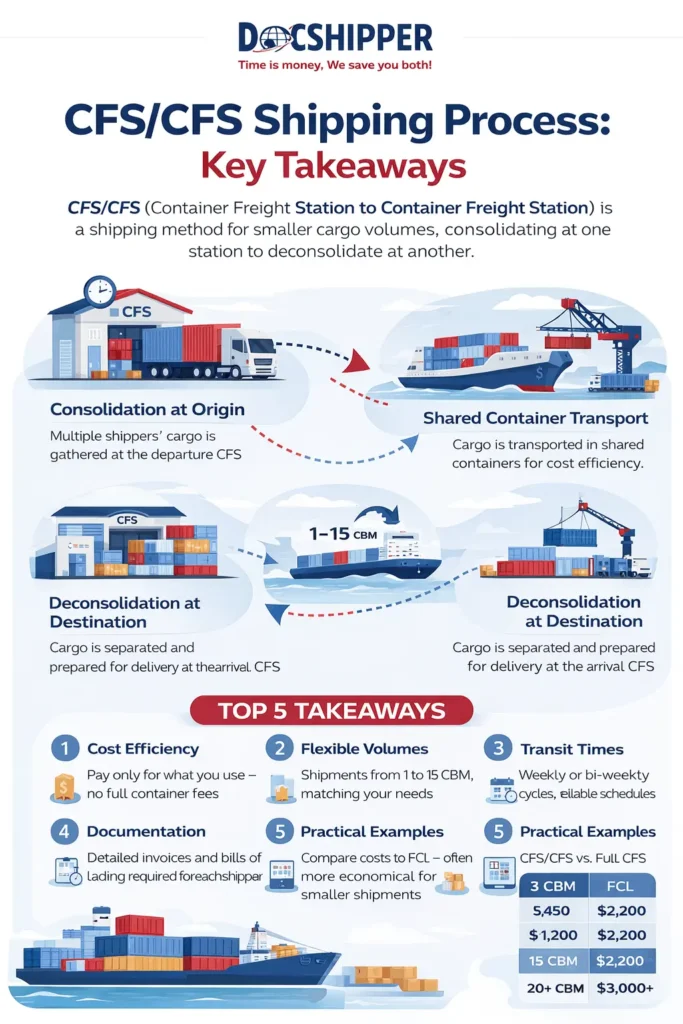
CFS/CFS (Container Freight Station to Container Freight Station) is a shipping method where cargo is consolidated at the origin CFS, transported in shared containers, and deconsolidated at the destination CFS. This Less than Container Load (LCL) solution enables shippers to transport smaller volumes without booking full containers, optimizing costs while maintaining reliable transit times.Introduction
Many importers and exporters face a common dilemma: their cargo volume doesn’t justify booking an entire 20ft or 40ft container, yet they need reliable international shipping. Paying for unused container space inflates costs unnecessarily. This is where CFS/CFS shipping becomes essential.
In global trade, CFS/CFS represents the backbone of Less than Container Load (LCL) logistics. It allows multiple shippers to share container space, making international freight accessible and economical for small to medium-sized businesses. Understanding this process is crucial for optimizing supply chain costs and transit efficiency.
Key characteristics of CFS/CFS shipping include:
- Consolidation at origin: Cargo from multiple shippers is grouped at the departure CFS facility
- Shared container transport: Mixed cargo travels together in standardized containers
- Deconsolidation at destination: Cargo is separated and prepared for individual delivery at the arrival CFS
- Cost efficiency: Shippers pay only for the cubic meters or weight they use
- Flexible volumes: Ideal for shipments ranging from 1 to 15 cubic meters
CFS/CFS Process & Operational Expertise
The CFS/CFS workflow involves precise coordination between freight forwarders, warehouse operators, and carriers. At the origin CFS, cargo undergoes inspection, measurement, and documentation verification. Each shipment receives a unique identifier before being loaded into shared containers according to compatibility, destination, and weight distribution requirements.
Consolidation timing directly impacts transit schedules. Most CFS facilities operate on weekly or bi-weekly consolidation cycles, meaning cargo must arrive at the facility 3-5 days before the scheduled vessel departure. Missing these cutoffs can delay shipments by an entire cycle, extending delivery times significantly.
At the destination CFS, deconsolidation begins immediately after customs clearance. Cargo is sorted, inspected for damage, and prepared for final delivery. This stage typically adds 2-4 days to the overall transit time compared to door-to-door FCL shipments. However, the cost savings often justify this additional handling time for smaller volumes.
Documentation requirements for CFS/CFS shipments are more complex than FCL. Each shipper needs individual commercial invoices, packing lists, and bills of lading. The master bill of lading covers the entire container, while house bills of lading identify individual shipments within. Errors in documentation can cause significant delays at both origin and destination CFS facilities.
According to the International Chamber of Commerce, proper cargo classification and Harmonized System (HS) codes are critical in LCL shipments to avoid customs complications. At DocShipper, we systematically verify all documentation and HS codes before consolidation to prevent clearance delays and ensure smooth CFS/CFS operations.
Risk management in CFS/CFS shipping requires understanding cargo compatibility. Hazardous materials, temperature-sensitive goods, and high-value items may face restrictions when sharing container space. Freight forwarders must assess compatibility to prevent contamination, damage, or regulatory violations during the consolidation process.
Practical Examples & Cost Comparisons
Understanding when CFS/CFS makes financial sense requires comparing it against Full Container Load (FCL) alternatives. The break-even point typically occurs between 12-15 cubic meters, though this varies by trade lane and carrier pricing.
| Shipment Volume | CFS/CFS Cost (USD) | FCL 20ft Cost (USD) | Recommended Option |
|---|---|---|---|
| 3 CBM | $450 | $2,200 | CFS/CFS |
| 8 CBM | $1,200 | $2,200 | CFS/CFS |
| 15 CBM | $2,250 | $2,200 | FCL |
| 20+ CBM | $3,000+ | $2,200 | FCL |
Use Case: Electronics Importer from China to USA
A small electronics retailer needs to ship 6 cubic meters of smartphones and accessories from Shenzhen to Los Angeles. Booking a full 20ft container (28 CBM capacity) would cost approximately $2,400, leaving 22 CBM of wasted space. Using CFS/CFS, the actual cost breakdown becomes:
- Ocean freight (6 CBM): $900
- Origin CFS handling: $120
- Destination CFS handling: $180
- Documentation fees: $75
- Total CFS/CFS cost: $1,275 (47% savings vs. FCL)
Transit time for this CFS/CFS shipment: 22-25 days port-to-port, plus 3-4 days for CFS handling at both ends. Total door-to-door: approximately 28-32 days. An FCL shipment would save 5-7 days but cost nearly double.
Key operational considerations:
- Frequency: Major trade lanes (Asia-Europe, Asia-North America) offer weekly CFS consolidations
- Minimum charges: Most carriers apply minimum charges of 1 CBM or 100 kg, whichever is greater
- Peak season surcharges: CFS/CFS rates can increase 20-35% during Q4 retail peak periods
- Cargo insurance: Recommended at 0.3-0.5% of cargo value due to multiple handling points
- Demurrage risks: Delays in picking up cargo from destination CFS can incur storage fees of $50-100 per day
Conclusion
CFS/CFS shipping remains the most cost-effective solution for small to medium cargo volumes, offering significant savings compared to booking underutilized full containers. Understanding consolidation cycles, documentation requirements, and cost structures enables businesses to optimize their international logistics strategies.
Need expert guidance on CFS/CFS shipping for your business? Contact DocShipper for tailored logistics solutions and competitive LCL rates on all major trade lanes.
📚 Quiz
Test Your Knowledge: CFS/CFS Shipping
1. What does CFS/CFS shipping fundamentally describe?
2. A shipper believes that CFS/CFS and FCL take the same total door-to-door transit time since they share the same ocean route. Is this correct?
3. A small retailer needs to ship 6 CBM of goods from China to the USA. Which option is the most cost-effective?
🎯 Your Result
📞 Free Quote in 24hFAQ | CFS/CFS (Container Freight Station to Container Freight Station): Definition, Process & Practical Examples
CFS stands for Container Freight Station, a warehouse facility where LCL cargo is consolidated into containers (origin) or deconsolidated from containers (destination). It serves as the consolidation point for multiple shippers' cargo.
CFS/CFS covers only port-to-port service with cargo handling at freight stations. Door-to-door includes pickup from shipper's location and delivery to consignee's address, adding inland transportation and additional handling charges to the total cost.
Most carriers accept shipments starting from 1 cubic meter or 100 kilograms. However, minimum charges typically apply, making very small shipments (under 0.5 CBM) less economical compared to air freight or courier services.
CFS/CFS typically adds 5-10 days to total transit time due to consolidation at origin (2-4 days) and deconsolidation at destination (3-6 days). Ocean transit time remains the same as FCL on identical routes.
Yes, but tracking is less precise than FCL. You can monitor the container's movement, but individual cargo visibility inside the container requires updates from your freight forwarder at consolidation and deconsolidation points.
Liability depends on where damage occurred. CFS operators are responsible for damage during handling at their facilities. Carrier liability covers ocean transit. Cargo insurance is strongly recommended to cover all potential damage scenarios.
Yes. Hazardous materials, perishables, and high-value goods often face restrictions or require special handling. Cargo must be compatible with other shipments in the container. Consult your freight forwarder for specific commodity restrictions.
Charges are based on volume (cubic meters) or weight (tons), whichever yields higher revenue for the carrier. Additional fees include origin CFS handling, destination CFS handling, documentation, and potential storage or demurrage charges.
Essential documents include commercial invoice, packing list, house bill of lading, and any required certificates (origin, quality, phytosanitary). Customs documentation must be accurate to avoid clearance delays at destination CFS.
Yes, this is a common practice. Multiple suppliers can deliver cargo to the same origin CFS for consolidation under one master bill of lading, simplifying logistics and reducing costs for importers working with multiple vendors.
Free time is the period (typically 3-7 days) after cargo arrival when you can pick up goods without storage charges. Exceeding free time results in demurrage fees, which can accumulate quickly at $50-150 per day.
CFS/CFS works best for cost-sensitive rather than time-sensitive cargo. The consolidation process adds transit time. For urgent shipments under 100 kg, air freight is more appropriate. For 100-500 kg urgent cargo, consider air freight or express LCL services.
Need Help with
Logistics or Sourcing ?
First, we secure the right products from the right suppliers at the right price by managing the sourcing process from start to finish. Then, we simplify your shipping experience - from pickup to final delivery - ensuring any product, anywhere, is delivered at highly competitive prices.


Fill the Form
Prefer email? Send us your inquiry, and we’ll get back to you as soon as possible.
Contact us




