


In short ⚡
A hub airport is a strategically positioned airport serving as a central connection point in air transportation networks, where airlines consolidate passenger and cargo traffic from multiple origins to redistribute them toward final destinations. This hub-and-spoke model optimizes flight frequencies, reduces operational costs, and enables efficient global connectivity for international trade.
Introduction
Many importers struggle to understand why certain airports handle their shipments faster than others. The answer often lies in the hub airport infrastructure.
In international logistics, hub airports represent critical nodes where airlines concentrate operations. Rather than operating direct flights between every possible city pair, carriers route traffic through these central points. This strategy revolutionized global air freight and passenger transport efficiency.
Key characteristics of hub airports include:
- Geographic positioning at continental crossroads or major economic zones
- Extensive network connectivity with dozens to hundreds of destinations
- Advanced cargo handling facilities including customs clearance infrastructure
- Airline base operations with maintenance, crew scheduling, and fleet management
- Intermodal connections linking air, rail, and road transport networks
Strategic Function & Operational Mechanisms
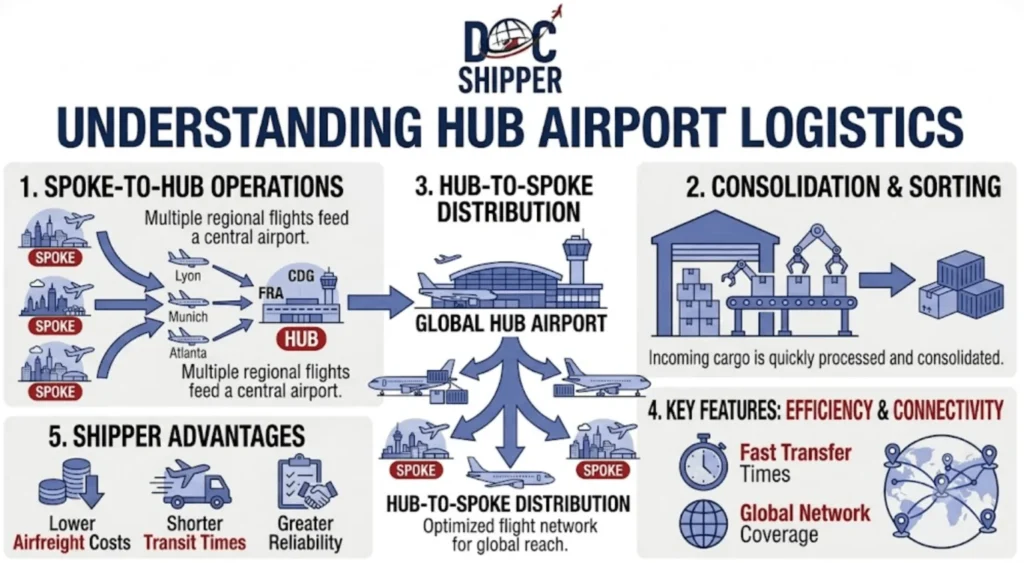
The hub-and-spoke model operates through wave systems or “banks” of synchronized arrivals and departures. Airlines schedule incoming flights from spoke cities to arrive within narrow time windows. After passengers and cargo transfer, outbound flights depart toward final destinations. This creates temporal concentration that maximizes connection possibilities.
From a cargo perspective, hub airports provide consolidation advantages. Freight from multiple origins merges at the hub, then redistributes based on final destinations. This enables airlines to operate larger aircraft on high-volume trunk routes while maintaining service to smaller markets through spoke connections.
Regulatory frameworks significantly impact hub operations. According to ICAO standards, hub airports must maintain advanced customs facilities supporting rapid clearance processes. The authorized economic operator (AEO) programs at major hubs expedite inspection procedures for certified shippers.
Infrastructure requirements distinguish true hubs from regional airports. Multimodal cargo terminals integrate air freight with surface transport. Temperature-controlled facilities handle pharmaceuticals and perishables. Dedicated security screening areas process express shipments. At DocShipper, we systematically evaluate hub capabilities when designing supply chain solutions to ensure your cargo benefits from optimal handling infrastructure.
The slot allocation system at congested hubs creates competitive dynamics. Airlines holding historical slots at premium hubs maintain strategic advantages. New entrants face barriers accessing peak operational windows. This regulatory structure concentrates market power among established hub operators, influencing pricing and service availability for international shippers.
Concrete Examples & Data Analysis
Analysis of global cargo throughput data reveals distinct hub performance patterns. The following comparison illustrates operational characteristics across major logistics hubs:
| Hub Airport | Annual Cargo (Million Tonnes) | Destinations Served | Average Transit Time |
|---|---|---|---|
| Hong Kong (HKG) | 4.2 | 220+ | 6-8 hours |
| Memphis (MEM) | 4.6 | 180+ | 4-6 hours |
| Dubai (DXB) | 2.9 | 260+ | 8-12 hours |
| Frankfurt (FRA) | 2.1 | 310+ | 10-14 hours |
Use Case: Consider a European electronics manufacturer shipping 500kg of smartphone components from Munich to Jakarta. Routing through Frankfurt hub enables next-day delivery via Singapore connection, whereas direct freight would require 3-4 days. The hub model provides 40% faster transit despite the additional stop.
Economic analysis reveals hub concentration patterns. The top 25 cargo hubs handle approximately 52% of global air freight volume. This concentration creates economies of scale but also systemic vulnerabilities. When Shanghai Pudong experienced COVID-19 restrictions in 2022, regional supply chains faced cascading delays affecting pharmaceuticals, electronics, and automotive sectors.
Alliance partnerships amplify hub advantages. SkyTeam, Star Alliance, and Oneworld coordinate operations at primary hubs, offering seamless interline transfers. Shippers benefit from expanded destination reach without negotiating multiple carrier contracts. DocShipper leverages these alliance networks to optimize routing options and negotiate competitive rates for your international shipments.
Emerging trends indicate hub decentralization in certain corridors. Secondary hubs like Zhengzhou (CGO) and Leipzig (LEJ) capture overflow traffic from congested primary hubs. These facilities offer competitive pricing and faster processing with less congestion. For cost-sensitive cargo tolerating slightly longer transit, secondary hubs provide strategic alternatives.
Conclusion
Hub airports form the operational backbone of global air logistics, enabling efficient cargo distribution through strategic network design. Understanding hub dynamics helps importers and exporters optimize routing decisions, balance cost against speed, and anticipate potential disruptions.
Need guidance selecting optimal routing through global hub networks? Contact DocShipper for expert consultation on air freight strategy.
📚 Quiz
Test Your Knowledge: Hub Airport
What is the primary operational function of a hub airport in the global logistics network?
A shipper believes routing cargo through a hub airport always increases delivery time compared to direct flights. Is this assumption correct?
Your electronics shipment from Munich to Jakarta can route through Frankfurt hub (next-day via Singapore) or wait 3-4 days for direct freight. Which strategy optimizes delivery speed?
🎯 Your Result
📞 Free Quote in 24hFAQ | Hub Airport: Definition, Role & Concrete Examples in Global Logistics
Hub airports serve as central transfer points where airlines concentrate operations, offering extensive connecting flights. Regular international airports may handle intercontinental traffic but lack the systematic wave scheduling, alliance coordination, and cargo consolidation infrastructure defining true hubs. Hubs typically feature dedicated transit facilities, customs pre-clearance programs, and intermodal transport links absent at standard airports.
This model enables airlines to operate larger, more fuel-efficient aircraft on high-density trunk routes between hubs while serving smaller markets with appropriately sized spoke connections. Consolidating cargo at hubs increases load factors, reducing per-kilogram transport costs. Additionally, centralized operations lower maintenance, crew scheduling, and handling expenses compared to point-to-point networks requiring dispersed resources.
Direct routing bypasses hubs but requires sufficient volume to justify dedicated flights. Express carriers operate direct services between major commercial centers for time-sensitive shipments. However, most cargo lacks the volume or urgency warranting dedicated flights. Hub connections provide daily frequency to hundreds of destinations uneconomical to serve with point-to-point operations, though transit adds 6-24 hours depending on connection scheduling.
Singapore Changi, Hong Kong, and Dubai consistently rank highest for expedited customs processing, averaging 4-6 hours for standard cargo. These hubs implement advanced electronic documentation systems, risk-based inspection protocols, and 24/7 customs operations. European hubs like Amsterdam and Frankfurt follow closely with AEO programs enabling pre-clearance for certified shippers. U.S. hubs vary significantly, with Memphis and Anchorage offering specialized express clearance infrastructure.
Alliances coordinate schedules and share facilities at common hubs, enabling seamless transfers between member carriers. Shippers using alliance networks access broader destination coverage with single booking procedures. For example, Star Alliance consolidates operations at Frankfurt and Chicago O'Hare, while SkyTeam focuses on Amsterdam and Paris CDG. Selecting carriers within your preferred alliance simplifies documentation and often reduces handling costs through shared ground services.
Over-reliance on single hubs exposes supply chains to operational disruptions from weather events, labor actions, infrastructure failures, or regulatory changes. The 2010 Eyjafjallajökull eruption demonstrated European hub vulnerability when volcanic ash grounded flights continent-wide. Prudent logistics strategies incorporate alternative routing through secondary hubs or different geographic regions to maintain continuity during primary hub disruptions.
Major hubs maintain temperature-controlled facilities specifically designed for pharmaceuticals, fresh produce, and other perishables. However, connection times add exposure to temperature fluctuations and handling. Direct flights better serve highly sensitive products like vaccines or tropical fruit. For less critical perishables, hub routing remains viable provided airlines guarantee climate-controlled storage during transfers and minimize connection windows to under 8 hours.
Asian hubs like Incheon, Changi, and Hong Kong offer modern infrastructure, competitive handling rates, and strategic positioning for trans-Pacific and intra-Asian trade. They typically process cargo faster with less congestion than legacy European hubs. However, European hubs maintain advantages in transatlantic connectivity and established customs relationships. For Asia-Europe shipments, routing through Middle Eastern hubs like Dubai or Doha often provides optimal balance between speed and cost.
Specialized cargo hubs like Memphis (FedEx), Louisville (UPS), and Liège prioritize freight operations without passenger traffic constraints. These facilities operate 24/7 with streamlined handling processes, dedicated customs staff, and sortation systems optimized for express parcels and e-commerce. Cargo-only hubs enable integrated carriers to maintain guaranteed delivery schedules independent of passenger flight timing, though destination coverage remains narrower than combination hubs.
Slot limitations at airports like London Heathrow, Tokyo Narita, and New York JFK restrict carrier access to peak operational periods. Airlines holding historical slots charge premium rates reflecting scarcity value. New entrants or expanding services face barriers obtaining desirable departure windows. Shippers may experience limited frequency or inconvenient connection times on routes through slot-constrained hubs, making less congested alternatives like Amsterdam or Dubai strategically attractive despite potentially longer routings.
Secondary hubs offer growing destination networks, competitive pricing, and often faster processing due to lower congestion. Airports like Leipzig, Zhengzhou, and Cologne-Bonn handle substantial cargo volumes with modern facilities rivaling established hubs. However, they typically offer fewer daily frequencies and narrower intercontinental connectivity. For regional distribution within Europe or Asia, secondary hubs frequently outperform primary hubs on cost and efficiency. Global shipments still benefit from primary hub networks.
Automation technologies including robotic cargo handling, AI-driven scheduling optimization, and blockchain documentation systems will enhance hub efficiency. Environmental regulations may favor hubs with sustainable aviation fuel infrastructure and carbon offset programs. E-commerce growth drives demand for express sorting capabilities at hubs near major consumption centers. Geopolitical shifts could elevate Middle Eastern and African hubs as alternatives to traditional European and Asian routes, diversifying global network architecture and reducing concentration risks.
Need Help with
Logistics or Sourcing ?
First, we secure the right products from the right suppliers at the right price by managing the sourcing process from start to finish. Then, we simplify your shipping experience - from pickup to final delivery - ensuring any product, anywhere, is delivered at highly competitive prices.


Fill the Form
Prefer email? Send us your inquiry, and we’ll get back to you as soon as possible.
Contact us




