


In short ⚡
Freight refers to goods transported in bulk by sea, air, rail, or road, as well as the transportation service itself. In international logistics, freight encompasses both the physical cargo being shipped and the charges associated with its movement from origin to destination.Introduction
Many businesses confuse freight with shipping, courier services, or parcel delivery. This misunderstanding costs companies thousands in unnecessary expenses annually. Freight transportation represents the backbone of global trade, accounting for over 90% of world commerce by volume.
Understanding freight is critical for importers and exporters. It determines delivery timelines, cost structures, and regulatory compliance. Every international transaction involves freight considerations that directly impact profitability.
Key characteristics of freight include:
- Volume-based pricing: Costs calculated by weight, volume, or container units rather than individual items
- Multiple transport modes: Sea, air, road, and rail options with distinct advantages
- Documentation requirements: Bills of lading, commercial invoices, and customs declarations
- Regulatory frameworks: International conventions governing liability, insurance, and transit
- Consolidation opportunities: Multiple shipments combined to reduce per-unit costs
Freight Mechanisms & Classification
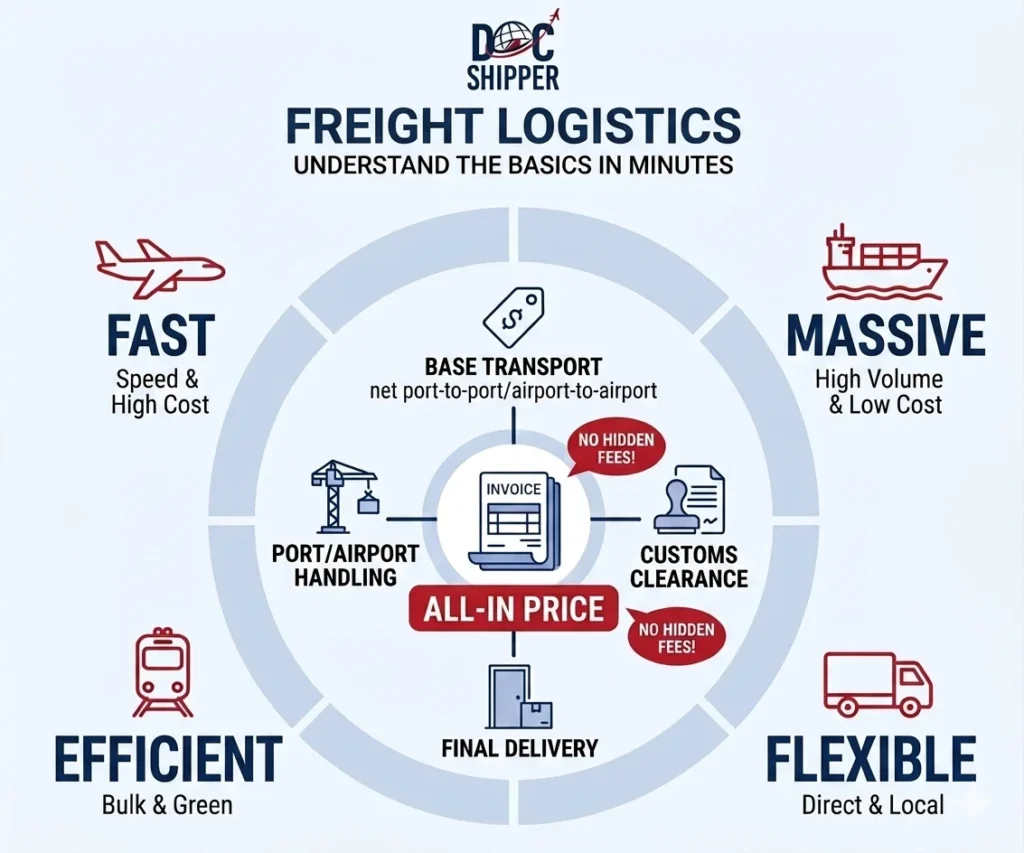
Freight operates through distinct transportation modes, each governed by specific regulations and pricing structures. Ocean freight dominates international trade for bulk goods, while air freight serves time-sensitive shipments.
The freight rate calculation depends on multiple factors: actual weight, volumetric weight (length × width × height ÷ dimensional factor), cargo class, route, and seasonal demand. Carriers apply the greater of actual or volumetric weight to determine charges.
Incoterms define freight responsibility between buyers and sellers. Under FOB (Free On Board), buyers arrange freight from the departure port. Under CIF (Cost, Insurance, Freight), sellers prepay transportation to the destination port. According to ICC Incoterms 2020, these terms standardize global trade obligations.
Freight classification distinguishes between general cargo (manufactured goods, consumer products) and bulk cargo (raw materials like grain, oil, minerals). General cargo typically ships in containers, while bulk cargo moves in specialized vessels or railcars.
The freight forwarder role bridges shippers and carriers. These intermediaries negotiate rates, consolidate shipments, handle documentation, and coordinate multimodal transport. At DocShipper, we manage freight arrangements across all transport modes, optimizing routes and costs while ensuring customs compliance.
Practical Examples & Data
Freight costs vary dramatically by mode and route. A 20-foot container from Shanghai to Los Angeles averages $1,500-$3,000 for ocean freight, while the same cargo by air costs $8,000-$15,000 but arrives in 3-5 days versus 18-25 days.
Consider a practical scenario: An electronics importer ships 5,000 kg of smartphones from Shenzhen to Hamburg.
| Transport Mode | Transit Time | Freight Cost | Cost per kg |
|---|---|---|---|
| Ocean Freight (FCL) | 28-35 days | $2,400 | $0.48 |
| Air Freight (Standard) | 5-7 days | $12,500 | $2.50 |
| Rail Freight (China-Europe) | 18-22 days | $5,800 | $1.16 |
| Express Air Freight | 2-3 days | $18,000 | $3.60 |
Additional freight considerations include:
- Peak season surcharges: Ocean freight rates increase 30-50% during Q4 holiday shipping periods
- Fuel adjustments: Bunker Adjustment Factor (BAF) for sea, Fuel Surcharge for air fluctuate with oil prices
- Dimensional weight impact: Low-density cargo (furniture, textiles) often pays volumetric rates exceeding actual weight
- Consolidation savings: LCL (Less than Container Load) shipments sharing containers reduce costs for smaller volumes
- Insurance costs: Typically 0.3-0.5% of cargo value for standard coverage, higher for fragile or high-value goods
According to World Bank data, freight costs represent 6-12% of import value for developing economies, compared to 3-5% for advanced economies with efficient logistics infrastructure. Route optimization and mode selection directly impact bottom-line profitability.
Conclusion
Freight represents the physical movement and associated costs of goods in international trade. Selecting the optimal transport mode, understanding rate structures, and managing documentation determine supply chain efficiency. Strategic freight management reduces costs while maintaining delivery reliability.
Need expert guidance on freight optimization for your business? Contact DocShipper for customized logistics solutions.
📚 Quiz
Test Your Knowledge: Freight
What does "freight" encompass in international logistics?
Which statement about volumetric weight in freight shipping is correct?
A company ships 3,000 kg of furniture from Vietnam to Germany. The cargo is lightweight but occupies significant space. Which freight consideration is most critical?
🎯 Your Result
📞 Free Quote in 24hFAQ | Freight: Definition, Types & Concrete Examples in International Trade
Freight specifically refers to bulk cargo transport and commercial shipments, typically involving palletized or containerized goods. Shipping is a broader term encompassing all forms of goods movement, including small parcels and courier services. Freight involves specialized carriers, documentation like bills of lading, and volume-based pricing structures not applicable to individual parcel shipping.
Freight costs are determined by the greater of actual weight or volumetric weight, multiplied by the rate per kilogram or per cubic meter. Additional factors include origin and destination, transport mode, cargo class, seasonal demand, fuel surcharges, and accessorial charges like liftgate service or inside delivery. Carriers use dimensional weight formulas (typically length × width × height ÷ 5000 for air, ÷ 6000 for ocean) to prevent revenue loss on lightweight, bulky shipments.
FCL (Full Container Load) means a shipper uses an entire container exclusively, typically 20ft or 40ft. LCL (Less than Container Load) involves sharing container space with other shippers' cargo. FCL offers faster transit since containers aren't opened until destination, reduced handling risk, and cost efficiency for volumes exceeding 15 cubic meters. LCL suits smaller shipments but involves consolidation and deconsolidation delays at freight stations.
Essential freight documentation includes: commercial invoice (goods description, value, buyer/seller details), packing list (cargo dimensions, weight), bill of lading or air waybill (transport contract and receipt), certificate of origin (proving manufacturing country), and customs declarations. Additional documents may include inspection certificates, insurance certificates, import licenses, and phytosanitary certificates for regulated goods. Missing or incorrect documentation causes costly customs delays.
Ocean freight transit times vary significantly by route: Asia to US West Coast typically takes 12-18 days, Asia to US East Coast 25-35 days, Asia to Europe 28-40 days, and Europe to US East Coast 8-12 days. These are port-to-port times excluding inland transportation, customs clearance, and potential delays from weather, port congestion, or transshipment. Express ocean services reduce transit by 5-7 days at premium rates.
A freight forwarder is a logistics intermediary organizing cargo movement on behalf of shippers. They don't own transport vehicles but arrange shipping through carrier networks, negotiating competitive rates and optimizing routes. Services include customs brokerage, documentation preparation, cargo insurance, warehousing, and consolidation. Freight forwarders handle complex multimodal shipments combining ocean, air, rail, and truck transport, managing the entire supply chain from factory to final destination.
Incoterms (International Commercial Terms) are standardized trade terms defining buyer and seller responsibilities for freight, insurance, and risk transfer. Common terms include FOB (seller delivers to port, buyer pays freight), CIF (seller pays freight and insurance to destination port), EXW (buyer handles all transportation from seller's premises), and DDP (seller delivers to buyer's location with all costs paid). Incoterms 2020 provides 11 rules governing international and domestic trade obligations.
Air freight costs approximately 5-10 times more than ocean freight per kilogram. A 1,000 kg shipment from China to Europe might cost $500-800 by sea versus $3,500-5,000 by air. However, air freight delivers in 3-7 days compared to 30-40 days for ocean, reducing inventory carrying costs, warehouse fees, and opportunity costs. For high-value, time-sensitive, or perishable goods, total landed cost calculations often favor air despite higher base freight charges.
Freight insurance (cargo insurance) protects against loss or damage during transit. While carriers have limited liability (typically $500 per package or less), comprehensive insurance covers full cargo value. Premiums typically cost 0.3-0.5% of insured value for standard cargo, higher for fragile, valuable, or hazardous goods. Insurance is essential for high-value shipments, as carrier liability rarely covers replacement costs. Many Incoterms require the seller to provide insurance (CIF, CIP terms).
Volumetric weight (dimensional weight) is a pricing calculation for lightweight, bulky cargo. Carriers calculate it by multiplying length × width × height (in cm), then dividing by a dimensional factor (5,000 for air freight, 6,000 for ocean LCL, 4,000 for express air). If volumetric weight exceeds actual weight, shipping charges are based on volumetric weight. This prevents revenue loss when transporting low-density goods like furniture, pillows, or packaging materials that occupy significant space.
Four primary freight modes serve different needs: ocean freight (cost-effective for bulk, non-urgent cargo, 90% of global trade volume), air freight (fast delivery for high-value, perishable, or urgent goods), rail freight (economical for overland long-distance transport, especially in Asia-Europe corridors), and road freight (flexible door-to-door service, essential for inland distribution). Intermodal freight combines multiple modes, such as ocean-rail or rail-truck, optimizing cost and speed. Selection depends on cargo type, urgency, budget, and destination infrastructure.
Freight cost reduction strategies include: consolidating shipments to achieve full container loads, negotiating volume-based contracts with carriers, optimizing packaging to reduce dimensional weight, planning shipments during off-peak seasons, using slower transit modes when urgency permits, comparing multiple freight forwarders for competitive quotes, and leveraging free trade agreements to reduce duties. Strategic warehouse placement near ports minimizes inland freight costs. At DocShipper, we analyze your shipping patterns to identify specific cost-saving opportunities tailored to your trade lanes and cargo profiles.
Need Help with
Logistics or Sourcing ?
First, we secure the right products from the right suppliers at the right price by managing the sourcing process from start to finish. Then, we simplify your shipping experience - from pickup to final delivery - ensuring any product, anywhere, is delivered at highly competitive prices.


Fill the Form
Prefer email? Send us your inquiry, and we’ll get back to you as soon as possible.
Contact us




