In short ⚡
The best supply chain management software is the one that fits your operational complexity, not the biggest or most famous suite, and should combine real-time visibility, strong planning, and deep logistics and trade compliance execution.
Match tools like SAP IBP, Oracle SCM Cloud, Kinaxis, Blue Yonder, NetSuite, or Odoo to your company size, industry, and integration needs.
We hope you’ll find this article genuinely useful, but remember, if you ever feel lost at any step, whether it’s finding a supplier, validating quality, managing international shipping or customs, DocShipper can handle it all for you!
What is supply chain management software and how does it transform your operations?
Supply chain management software is the system you use to plan, execute, and control everything from procurement to production, warehousing, transportation, and last mile delivery, with the goal of turning messy real life workflows into predictable outcomes.
If you’re searching for the best supply chain management software, here’s the thing, you’re not really buying “software”, you’re buying fewer surprises across import export, shipping, inventory management, and trade compliance.
From experience at DocShipper, you’ll notice fast that your biggest wins come when your SCM platform talks cleanly to freight forwarding and logistics operations, not when it just looks good in a demo.
Quick micro-story to make it concrete.
You approve a supplier PO, the factory ships early, the forwarder books space late, and suddenly you’re paying premium freight rates, plus storage because your warehouse slot wasn’t reserved.
A solid SCM platform prevents that chain reaction by forcing shared dates, documents, and accountability before your cargo ever reaches the port for cargo handling.
Workflow you can map inside your SCM platform (and actually run weekly):
Demand signal, PO release, supplier confirmation, production milestones, pre-shipment inspection, export docs (packing list, commercial invoice), booking, pickup, containerization or palletization, customs clearance, delivery order, inbound appointment, cross docking or put-away, proof of delivery, reconciliation.
SCM checklist to confirm you’re not missing the basics:
- You can tie each shipment to the right Incoterms, with who pays what clearly assigned.
- You can store and validate documents, bill of lading, airway bill, packing list, commercial invoice.
- You can manage inventory management across sites, including bonded warehouse flows if you use them.
- You can track shipment tracking events and exceptions, not just “in transit”.
- You can control trade compliance, tariff classification, duties and taxes, and customs brokerage handoffs.
- You can connect suppliers, carriers, and third party logistics partners without endless spreadsheets.
DocShipper Info
Talk to our logistics experts to connect procurement, shipping, and customs into one controlled workflow.
Core capabilities you should expect from modern SCM platforms
The best supply chain management software doesn’t just “manage” a supply chain, it orchestrates decisions across sourcing, logistics, and fulfillment, with real constraints like lead times, MOQs, and carrier cutoffs.
If you run import export lanes, you’ll feel the difference when your SCM platform treats shipping documents and milestones as first-class data, not email attachments.
Here are the core capabilities you should expect, no matter your industry:
- Planning and forecasting: demand planning, supply planning, safety stock, and scenario simulation when lead times shift.
- Procurement and supplier management: RFQs, contract terms, supplier scorecards, and escalation workflows when quality slips.
- Inventory management and warehouse control: multi-location availability, batch/lot tracking, and rules for cross docking vs storage.
- Transportation management: carrier selection, route optimization, load planning, freight quotation, and freight consolidation.
- International trade execution: Incoterms handling, export documentation, customs clearance, tariff classification, duties and taxes.
- Visibility: shipment tracking, exception management, and alerts tied to service-level targets and customer promises.
- Financial control: landed cost, freight insurance, charge validation, and support for trade finance data needs.
- Integrations: ERP, WMS, TMS, customs brokerage tools, and forwarder feeds for multimodal transport.
Another real scenario we see.
You negotiate FOB with a supplier, but the factory still books local trucking “for you”, and you get billed twice because nobody reconciles the freight forwarding contract against the PO terms.
Modern SCM platforms reduce that leak by binding procurement, Incoterms, freight quotation approvals, and invoice matching into one trail you can audit.
Quick comparison table, what “modern” really means for SCM:
| Capability | Basic tools (typical) | Modern SCM platform (what you want) |
| Visibility | Status updates by email | Milestone-based shipment tracking with exception alerts |
| Logistics execution | Manual booking and ad hoc carrier selection | Carrier selection, load planning, route optimization, freight rates comparison |
| Trade compliance | Docs stored in folders | Central docs with tariff classification fields, duties and taxes estimates, audit trail |
| Warehouse operations | One-site stock view | Multi-site inventory management, cross docking rules, inbound scheduling |
Key benefits for manufacturers, retailers, and logistics-intensive businesses
The best supply chain management software pays you back in three ways, you see issues earlier, you decide faster, and you stop paying for avoidable mistakes across transportation and warehousing.
And yes, it matters whether you’re a manufacturer chasing components, a retailer fighting stockouts, or a brand living and dying by last mile delivery.
Benefits you’ll actually feel in day-to-day operations:
- Lower landed cost: tighter freight rates control, fewer accessorial surprises, better freight consolidation decisions.
- Fewer delays: proactive alerts for booking cutoffs, port congestion, customs clearance holds.
- Cleaner import processes: consistent packing list and commercial invoice data, fewer customs brokerage back-and-forths.
- Better inventory turns: fewer “ghost stock” problems and fewer panic air shipments.
- Stronger supplier performance: scorecards and corrective actions when inspection results trend down.
- Customer promise accuracy: proof of delivery and service-level tracking for retail and B2B shipments.
One quick insider anecdote.
A fast-growing retailer we supported had “inventory” on paper, but half of it sat in a bonded warehouse awaiting duties and taxes payment, so the webstore kept selling units that couldn’t ship.
Once the SCM workflow treated bonded stock as its own state and synced it with shipping and customs clearance milestones, stockouts stopped being a weekly firefight.
Also, if you align your operations with frameworks promoted by APICS (ASCM), you’ll recognize these benefits as the practical output of better planning discipline, not magic software.
 How to choose the best supply chain management software for your business
Choosing the best supply chain management software comes down to fit, not fame.
You don’t need the “biggest suite” if your real pain is multimodal transport visibility, freight quotation control, or trade compliance gaps at customs clearance.
At DocShipper, we see a familiar trap.
You select a platform that shines in dashboards, then realize it can’t handle a messy reality like split shipments, freight consolidation, partial deliveries, or a supplier who changes carton counts after you’ve issued the packing list.
Step-by-step workflow to pick the right platform without getting sold a fantasy:
Map your current flow, tag bottlenecks, define must-have outcomes, shortlist tools by use case, run a data-backed pilot, validate integrations, confirm total cost, negotiate contract and SLAs.
Selection checklist you can use before you sign anything:
- You’ve mapped your shipping lanes, Incoterms, and who owns each leg of transportation.
- You’ve listed required documents, bill of lading, airway bill, delivery order, proof of delivery.
- You’ve confirmed how the tool handles tariff classification, duties and taxes, and customs brokerage handoffs.
- You’ve tested exception handling, delays, damages, holds, and split shipments.
- You’ve validated integrations with ERP, WMS, TMS, and 3PL or logistics outsourcing partners.
- You’ve defined the one metric you’ll use to prove ROI, not ten vanity KPIs.
7 evaluation criteria that matter more than feature checklists
The best supply chain management software for you is the one that matches your constraint, lead time volatility, supplier reliability, warehouse capacity, or freight forwarding complexity.
So instead of counting features, you’ll get better results by grading these seven criteria.
- 1) Time-to-value: how fast you can go live on one lane, one warehouse, one product family.
- 2) Data model realism: can it represent partials, backorders, containerization, palletization, and multimodal transport correctly.
- 3) Execution depth: can you run carrier selection, route optimization, and load planning, or does it stop at reporting.
- 4) Trade compliance maturity: Incoterms fields, tariff classification support, and audit trails for customs clearance events.
- 5) Supplier collaboration: confirmations, ASN-like updates, inspection gates, and dispute resolution workflows.
- 6) Integration strength: ERP, warehouse systems, marketplaces, customs tools, and forwarders, with clean APIs.
- 7) Cost transparency: total cost of ownership, implementation fees, user licensing, transaction costs, and support.
A scenario you’ll recognize if you’ve lived through peak season.
Your forwarder offers two routing options, one cheaper but risky, one stable but pricier, and your team picks based on gut because the software can’t simulate ETA impact on stock.
When an SCM platform can connect freight rates, route options, inventory coverage, and customer promise dates, you stop gambling.
Mini comparison table, evaluation criteria vs real outcome:
| Criterion | What you validate | What it prevents |
| Trade compliance maturity | Tariff classification fields, docs, customs statuses | Border delays and surprise duties and taxes |
| Execution depth | Carrier selection, load planning, freight quotation approvals | Overpaying freight rates and missed cutoffs |
| Data model realism | Split shipments, backorders, partial receipts | Phantom inventory and late customer deliveries |
Looking for a Reliable Shipping & Sourcing Partner?


Questions to ask vendors about pricing, implementation, and security
When you’re comparing the best supply chain management software vendors, the demo is the easy part.
The hard part is getting clear answers on pricing, implementation reality, and security, especially if you’ll connect logistics providers, customs brokerage partners, and third party logistics networks.
Here are the questions that separate a smooth rollout from a six-month headache:
- Pricing: Do you charge per user, per shipment, per facility, or per transaction, and what triggers overage fees?
- Hidden costs: Are integrations billed separately, and do you pay extra for EDI, carrier connections, or shipment tracking events?
- Implementation: What does a realistic timeline look like for one trade lane, including customs clearance milestones and document flows?
- Data migration: Who cleans supplier master data, HS codes for tariff classification, and historical inventory management records?
- Support model: Do you get a named solution architect, and what’s the SLA during peak shipping season?
- Security: How do you handle access controls for suppliers, forwarders, and logistics outsourcing partners, and do you support SSO?
- Resilience: What’s your uptime commitment, incident response time, and backup policy?
A quick story we’ve seen more than once.
A vendor quotes low, then charges extra for “advanced” features like bill of lading storage, carrier selection connectors, and even proof of delivery ingestion.
If you ask the right questions early, you’ll negotiate from facts, not frustration.
And one practical note, if your platform will touch financial data, supplier banking details, or trade finance workflows, you should ask for a security posture aligned with ISO/IEC 27001 practices, because “trust us” doesn’t survive an audit.
If you want, we can help you translate your real operations, freight forwarding contract terms, cargo handling steps, and customs brokerage process into a software requirement list, then pressure-test vendors against it.
DocShipper Advice
We help you translate operations into clear software requirements that vendors must prove, not promise.
Top supply chain management software compared by use case and company size
You do not choose the best supply chain management software the same way if you are a fast-growing SME or a multinational manufacturer. Your operational complexity, geographic footprint, and integration needs will define the right platform.
Below you will find a practical comparison based on real-world use cases, not marketing promises. Focus on what matches your current maturity level and your 3-year growth plan.
| Software | Best for | Company size | Key strengths | Pricing level |
| SAP Integrated Business Planning | Complex global supply chains | Large enterprises | Advanced planning, S&OP, deep ERP integration | High |
| Oracle SCM Cloud | End-to-end digital transformation | Mid to large enterprises | Strong AI, automation, global compliance tools | High |
| Kinaxis RapidResponse | Real-time scenario planning | Mid to large enterprises | Concurrent planning, fast simulations | High |
| Blue Yonder | Retail and demand forecasting | Mid to large enterprises | AI-driven forecasting, inventory optimization | High |
| NetSuite SCM | Scaling SMEs | Small to mid-sized companies | Cloud-native, ERP + SCM in one | Medium |
| Odoo | Budget-conscious businesses | Small businesses | Modular, flexible, affordable | Low to medium |
If you are managing international sourcing from China or Southeast Asia, scenario planning and supplier collaboration tools should be non-negotiable. We often see companies underestimate this and struggle during peak season or geopolitical disruption.
- Manufacturers, prioritize production planning, MRP, and supplier risk tools.
- Retailers, focus on demand forecasting accuracy and omnichannel inventory visibility.
- Importers and traders, ensure strong purchase order tracking and freight integration.
- 3PL-driven businesses, check API capabilities and real-time shipment tracking.
At DocShipper, we help you align your software choice with your sourcing strategy. A powerful platform without operational discipline will not deliver ROI.
DocShipper Info
Get a tailored shortlist based on your trade lanes, suppliers, and growth targets.
Essential SCM features you cannot skip in 2024 (visibility, AI, and integrations)
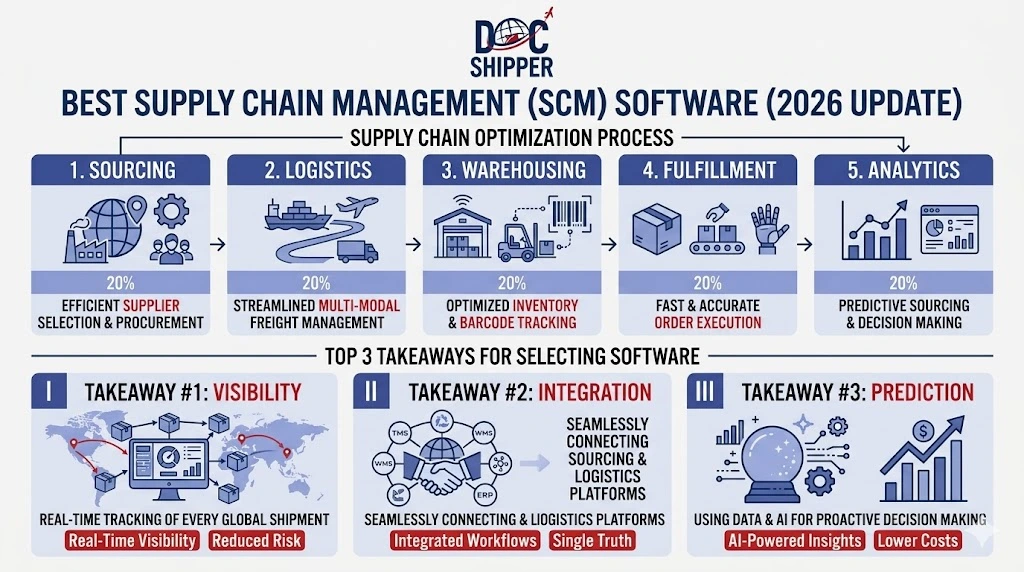
In 2024, the best supply chain management software is not just about planning. It is about real-time visibility, predictive intelligence, and seamless connectivity across your ecosystem.
If your system cannot provide end-to-end transparency from supplier to final customer, you are flying blind. And blind supply chains are expensive.
- End-to-end visibility, real-time tracking of orders, inventory, and shipments.
- AI-driven demand forecasting, machine learning models that adapt to seasonality and disruption.
- Supplier collaboration portals, shared forecasts, quality reports, and performance KPIs.
- Advanced inventory optimization, safety stock calculation based on variability and lead time.
- Scenario planning tools, simulate delays, tariff changes, or demand spikes.
- ERP and freight integrations, API connectivity with accounting, WMS, TMS, and customs brokers.
| Feature | Why it matters | Risk if missing |
| Real-time dashboards | Instant decision-making | Delayed reaction to disruptions |
| AI forecasting | Reduced stockouts and overstocks | Excess inventory or lost sales |
| Integration APIs | Data consistency across systems | Manual errors and silos |
| Supplier scorecards | Performance monitoring | Uncontrolled quality issues |
You should also evaluate cybersecurity standards and data hosting locations. Global sourcing exposes you to compliance risks that basic tools cannot manage.
We regularly advise importers sourcing from China to prioritize milestone tracking and quality inspection reporting inside their SCM environment. This directly reduces disputes and payment risks.
DocShipper Alert
Audit your current SCM setup before peak season exposes the gaps.
Conclusion
Choosing the best supply chain management software is a strategic decision, not a technical one. Your platform must support your sourcing model, growth objectives, and risk exposure.
- Define your operational complexity before comparing vendors.
- Match the software to your company size and industry use case.
- Prioritize visibility, AI forecasting, and strong integrations.
- Evaluate total cost of ownership, not just license fees.
- Ensure the platform supports international sourcing and supplier collaboration.
- Align software implementation with clear supply chain KPIs.
At DocShipper, we combine sourcing expertise with operational optimization. You do not just implement software, you build a resilient and cost-efficient supply chain.
FAQ | Best supply chain management software to cut costs and boost visibility in 2024
No, you can get real value from SCM software even with a small or mid-sized business, as long as you match the tool to your complexity.
The key is not size, but whether you’re losing money/time today because of manual tracking, blind spots, or poor coordination with suppliers and logistics partners.
- For small businesses: look for cloud tools with basic PO tracking, simple inventory, and shipment visibility.
- For growing SMEs: add features like multi-warehouse stock, freight integration, and basic demand planning.
- For large/global players: you’ll likely need advanced planning (S&OP), multimodal transport management, and deep ERP integration.
The visible license is often the smallest piece. You should budget for:
To avoid surprises, ask vendors specifically about: per-shipment or per-transaction fees, extra charges for carrier connections, customs or EDI links, and premium support during peak season.
- Implementation services: configuration, process mapping, and user training.
- Integrations: ERP, WMS/TMS, carrier APIs, customs brokers, marketplaces.
- Data work: cleaning supplier master data, SKUs, HS codes, and historical inventory.
- Change management: internal project lead, super-users, and temporary productivity dip.
In 2024, there are a few capabilities you should not compromise on:
If a tool can’t handle split shipments, partial receipts, and freight consolidation, it will struggle with real-world operations.
- End-to-end visibility: milestone-based shipment tracking with exception alerts, not just “in transit”.
- Multi-site inventory: clear view of stock by location, including bonded or in-transit inventory.
- Trade compliance basics: Incoterms fields, export docs, tariff/HS code management, duties and taxes estimation.
- Supplier collaboration: POs, confirmations, inspections, and delivery dates shared in one workspace.
- Strong integrations: clean APIs for ERP, warehouse systems, freight forwarders, and customs partners.
Define one or two hard metrics before you implement, then track them ruthlessly. Examples:
Use your SCM platform to generate these metrics from real transactions; if they’re not improving after 3–6 months on a pilot lane or product family, you either misconfigured the tool or picked the wrong one.
- Logistics cost: freight + accessorials as a percentage of sales or landed cost per unit.
- Service level: on-time in-full delivery rates, by lane or customer.
- Inventory performance: days of inventory on hand, emergency airfreight incidents, or stockout frequency.
- Process efficiency: time to confirm a PO, time to book freight, time to clear customs.
Push for specifics around “who does what, by when” instead of generic project plans:
This keeps you out of the trap where the demo was great, but six months later you’re still running Excel for critical flows.
- Scope: which trade lanes, warehouses, suppliers, and carriers are in phase 1.
- Timeline: realistic go-live dates for a pilot, including customs and freight milestones.
- Responsibilities: who owns mapping Incoterms, HS codes, carrier rates, and document templates.
- Testing: how you’ll validate split shipments, delays, damages, and customs holds before go-live.
- Support: whether you get a named solution architect and their SLA during peak season.
When done right, integrations remove email chains and duplicate data entry:
You should confirm with vendors which forwarders, carriers, and customs brokers they connect to natively, and which will require custom work or additional fees.
- Bookings: POs and shipping instructions flow from your SCM to the forwarder automatically.
- Milestones: pickup, port departure, customs clearance, and delivery status sync back into your SCM as events.
- Documents: bill of lading, commercial invoice, packing list, and delivery order are stored and linked to each shipment.
- Costs: quoted vs invoiced freight charges can be matched and flagged for discrepancies.
DocShipper combines operational logistics work with tooling advice, so you don’t design a “theoretical” process:
The result is not just a new platform, but a supply chain that is measurably cheaper, faster, and more predictable.
- We map your real flows: sourcing, PO approval, factory lead times, freight routing, customs steps.
- We identify bottlenecks: recurrent demurrage, detention, stockouts, or double-billed freight.
- We translate that into software requirements: must-have features, data fields, and integrations.
- We then align execution: sourcing support, freight forwarding, and customs handling that actually use the SCM workflows you put in place.
Need Help with
Logistics or Sourcing ?
First, we secure the right products from the right suppliers at the right price by managing the sourcing process from start to finish. Then, we simplify your shipping experience - from pickup to final delivery - ensuring any product, anywhere, is delivered at highly competitive prices.


Fill the Form
Prefer email? Send us your inquiry, and we’ll get back to you as soon as possible.
Contact us