


In short ⚡
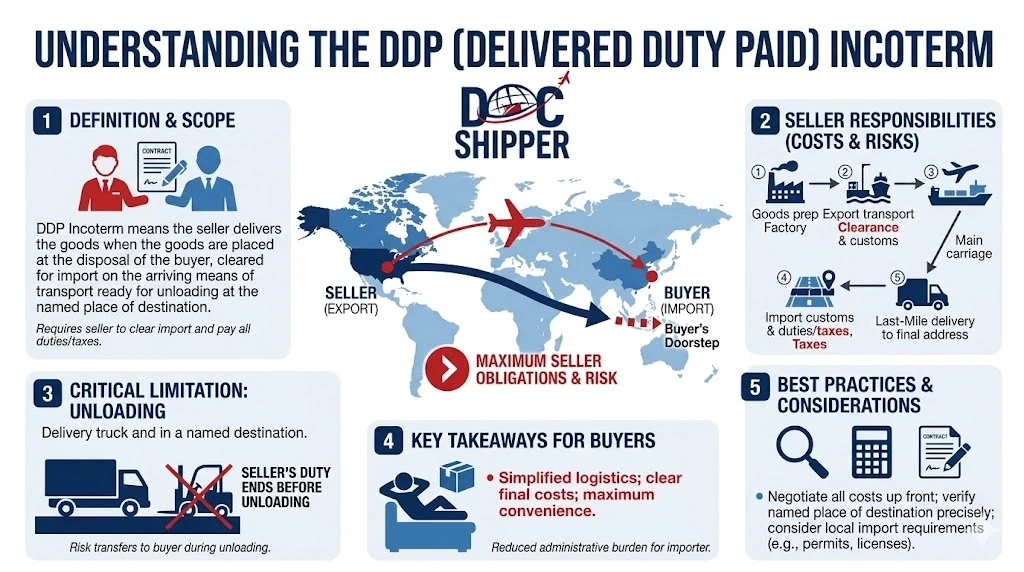
Delivery Duty Paid (DDP) is an Incoterm where the seller assumes all responsibility, risk, and costs—including customs duties, taxes, and delivery—until goods reach the buyer's specified destination. It represents maximum seller obligation in international trade.
Introduction
Many importers struggle with unexpected customs charges, clearance delays, and hidden logistics costs. The confusion often stems from unclear responsibility allocation between buyer and seller.
Delivery Duty Paid (DDP) eliminates this ambiguity by placing complete delivery responsibility on the seller. This Incoterm is particularly relevant for e-commerce, B2B transactions, and situations where buyers lack customs expertise.
Key characteristics of DDP include:
- Seller handles export and import customs clearance
- All duties, taxes, and tariffs paid by seller
- Risk transfers only upon delivery at named destination
- Buyer receives goods ready for unloading
- Maximum seller obligation among all Incoterms
Understanding DDP is critical for pricing accuracy, contract negotiation, and avoiding costly disputes in cross-border logistics.
DDP Mechanics & Legal Obligations
Under DDP terms, the seller’s responsibilities extend far beyond simple shipment. The seller must navigate both export and import regulations, often in unfamiliar jurisdictions.
Export obligations require the seller to obtain all necessary licenses, complete export customs formalities, and pay export duties in the origin country. This includes proper documentation like commercial invoices, packing lists, and certificates of origin.
Import clearance represents the most complex aspect. The seller must register as importer of record in the destination country, calculate and pay all customs duties, value-added taxes (VAT), and excise taxes. At DocShipper, we manage this entire process through our local customs brokerage network, ensuring compliance across 150+ countries.
Transportation and insurance remain entirely the seller’s responsibility until delivery. This includes international freight, terminal handling charges, and cargo insurance covering the full journey.
Risk transfer timing is crucial: unlike FOB or CIF terms, risk only transfers when goods are placed at the buyer’s disposal at the named destination, ready for unloading. The buyer’s sole obligation is unloading at the final location.
Legal frameworks governing DDP are defined by the ICC Incoterms® 2020 rules, which provide standardized interpretations recognized in international commercial law. Sellers must also comply with destination country customs regulations, which vary significantly by jurisdiction.
Cost Breakdown & Practical Examples
DDP pricing requires comprehensive cost calculation to avoid underestimating total delivery expenses. Understanding the complete cost structure is essential for competitive quoting.
Typical DDP Cost Components
| Cost Element | Responsibility | Typical % of FOB Value |
|---|---|---|
| Product Cost (FOB) | Seller | 100% |
| International Freight | Seller | 8-15% |
| Marine Insurance | Seller | 0.3-0.5% |
| Customs Duties | Seller | 0-25% |
| Import VAT/GST | Seller | 5-20% |
| Customs Brokerage | Seller | 1-3% |
| Local Delivery | Seller | 2-5% |
Real-World Calculation Example
Scenario: German machinery manufacturer ships CNC equipment to a buyer in Los Angeles, USA.
- FOB Hamburg value: €50,000
- Ocean freight (Hamburg-LA): €4,500 (9%)
- Marine insurance: €200 (0.4%)
- US customs duty (machinery HS code 8458): 2.4% = €1,200
- US import processing fees: €150
- Customs brokerage: €800
- Trucking (LA port to buyer facility): €1,200
Total DDP price: €58,050 (16.1% above FOB value)
This example demonstrates how landed cost calculation requires detailed knowledge of destination country tariff schedules, tax regulations, and logistics infrastructure. At DocShipper, we provide automated DDP quotations using real-time duty rates and carrier pricing across global trade lanes.
Critical considerations: VAT is not included in this example as the US doesn’t impose VAT. For EU or Asian destinations, add 7-25% VAT on CIF value plus duties. Currency fluctuations can impact final costs by 3-8% between quotation and payment.
Conclusion
Delivery Duty Paid offers maximum convenience for buyers but requires sellers to master complex international compliance. Accurate cost calculation and robust customs partnerships are essential for profitable DDP operations.
Need expert assistance with DDP shipments or customs compliance? Contact DocShipper for comprehensive international logistics support.
📚 Quiz
Test Your Knowledge: Delivery Duty Paid (DDP)
Q1 — Under DDP terms, who is responsible for paying import customs duties and taxes?
Q2 — A common misconception about DDP is that risk transfers to the buyer once the goods are loaded onto the international vessel. What is the correct interpretation?
Q3 — A German manufacturer quotes DDP Los Angeles for CNC machinery with a FOB value of €50,000. After adding freight, insurance, US customs duty, brokerage, and local trucking, the total DDP price reaches €58,050. What does this scenario best illustrate?
🎯 Your Result
📞 Free Quote in 24hFAQ | Delivery Duty Paid (DDP): Definition, Calculation & Real-World Examples
Under DAP, the buyer pays import duties and taxes. With DDP, the seller covers all costs including customs duties, making it the only Incoterm where the seller handles import clearance.
Yes, Incoterms are contractual agreements. Buyers may prefer DAP or other terms to maintain control over customs clearance and potentially reduce costs through their own import licenses.
No. Some countries restrict foreign entities from acting as importer of record. DDP is complex in nations with strict import licensing requirements like India, Brazil, or Russia.
The buyer is responsible for unloading at the named destination. All costs up to that point, including delivery to the location, are the seller's responsibility.
Use the destination country's Harmonized System (HS) code for your product, then apply the corresponding tariff rate to the CIF value. Rates vary from 0% to over 100% depending on product and origin.
Unless the contract includes tariff escalation clauses, the seller absorbs the additional cost. This is why DDP quotes should include contingency buffers for regulatory changes.
Absolutely. DDP applies to all transport modes—air, ocean, road, and rail. The principle remains the same: seller delivers duty-paid to the named destination.
Yes, in most countries. The seller must register as an importer, which often requires obtaining a local tax identification number or using a fiscal representative.
Commercial invoice, packing list, bill of lading or air waybill, certificate of origin, import customs clearance documents, proof of duty payment, and delivery confirmation.
Not mandatory by Incoterms rules, but highly recommended. Since the seller bears risk until delivery, comprehensive cargo insurance protects against loss or damage throughout the journey.
Standard DDP ends at delivery ready for unloading. Installation requires separate contractual terms beyond Incoterms scope, though sellers often bundle these services commercially.
DDP simplifies buyer budgeting but typically results in higher quoted prices. Transparency in landed costs can improve competitiveness versus opaque FOB pricing with hidden import fees.
Need Help with
Logistics or Sourcing ?
First, we secure the right products from the right suppliers at the right price by managing the sourcing process from start to finish. Then, we simplify your shipping experience - from pickup to final delivery - ensuring any product, anywhere, is delivered at highly competitive prices.


Fill the Form
Prefer email? Send us your inquiry, and we’ll get back to you as soon as possible.
Contact us




:%20Definition,%20Calculation%20&%20Real-World%20Examples)